Showing posts with label piano. Show all posts

Monday, February 9, 2015

Gifts of Grandeur: Edward Burne-Jones' Marriage Piano, 1860


"[I] lived inside the pictures and from the inside of them looked out upon a world less real than they."

--Pre-Raphaelite artist Edward Burne-Jones, in a letter to May Gaskell


Piano
Frederick Priestly, 1860
Painted panels by Edward Burne-Jones
This and all related images courtesy of the Victoria and Albert Museum
The name Edward Burne-Jones immediately puts one in mind of the Pre-Raphaelite Brotherhood and theatrical images of languid, titian-haired beauties, rich turquoise and emerald hues and deceptively sparkling waters.  Burne-Jones was one of the most influential of the Brotherhood, the conductor of a beautiful orchestra, if you will.

Georgiana Burne-Jones
And, so, such an artist should have a lovely instrument.  This piano, made in 1860, is the work of Frederick Priestley, an otherwise, as the V&A puts it, unknown piano maker.  The piano was presented as a wedding gift to Edward Burne-Jones and Georgiana "Georgie" MacDonald in 1860. 

Burne-Jones decorated the otherwise modest and plain instrument's case of American oak with a scene from the Medieval Romance,  the Chant d’Amour as an allegory of death--you know, standard wedding stuff. 

In her biography, The Memorials of Edward Burne-Jones, Georgie referenced a portrait of Death on the panel below the keyboard of their piano.  She described Death as  "standing outside the gate of a garden where a number of girls, unconscious of his approach, are resting and listening to music."


Tuesday, July 8, 2014

Gifts of Grandeur: A Miniature Fabergé Piano, c. 1896


Piano by Michael Perchin
Created before 1896
Collected by Queen Mary
Crown Copyright
The Royal Collection
Image Courtesy of Her Majesty Queen Elizabeth II


Mikhail Evlampievich Perkhin (1860-1903, frequently listed under the anglicized version of his name, Michael Perchin) was one of Fabergé’s chief workmasters, and, undoubtedly, alongside Viktor Aarne, one of the most brilliant and prolific artists under the employ of Carl Fabergé.

Here’s a nifty example of his work—a lovely miniature piano of nephrite, two-color gold and enamel. We’re not sure the exact year that Perchin made this, but it appears to match his pre-1896 work.

The piece didn’t join the other Fabergé in the Royal Collection until it was somehow acquired by Queen Mary, Consort of George V (1867-1953), sometime between 1922-1931
Queen Mary, like her mother-in-law, Queen Alexandra, before her, had a special fondness for Fabergé’s miniature “objets de fantasie.” These include several examples of miniature furniture in the form of bonbonnières (candy dishes).

This miniature piano of Siberian nephrite is carved and polished to resemble ebonized wood. It is a nearly exact replica of the real thing. The lid opens for use as a bonbonnière and the front drops down to reveal a miniature keyboard in gold and enamel, inscribed C. Fabergé.

The piano belonged originally to Tsarina Alexandra Feodorovna—niece of Queen Alexandra and King Edward VII. The piece can be clearly seen in one of the display cases in photographs of the exhibition which Fabergé held in St Petersburg in 1902. We’ll never know how Queen Mary managed to get it, but I’m not surprised that she did. The former Mary of Teck was passionate about retrieving items which once belonged to the British Royal Family or other related Royal Families so that they might be preserved. 


Regular readers of this blog know how much of a fan I am of Her Majesty Queen Mary. If you, too, are a fan of Mary of Teck, you might enjoy our “Teck Support” products—available only in our online store.


Saturday, June 7, 2014

Object of the Day: Another Trade Card for Pianos


This is one of several Victorian trade cards that I have from this same thuggish supplier of pianos and organs. We’ve already 
looked at one other. These are all in the very 1880s fashion of monochromatic images on metallic ink which often depict chubby tots engaged in sporting activities, and, very often, in the process of being gravely injured.

Let’s take a look at this work of blue on a gold background. Called “Bucked,” it is dated to 1881. What’s happening here? Well, it’s a typical, bright, sunny, gilt-sky day. You know…just the sort of thing you’d see anywhere in the world in 1881. Everything seems normal. A child with a large posterior is riding a bicycle. He (or possibly she) is, for some reason, dressed like a page with a wee, stylish pillbox hat. Princess Diana would have worn it in 1981. He’s hit a rock with is front tire and is being propelled over the handle bars. No doubt, he wall fall into the thorny shrubbery which lines the fence. His injuries will be too severe for 1881 medicine. His physician will prescribe him sarsaparilla—taken orally as well as rubbed on his wounds. Death is unavoidable. Buy some pianos.

The reverse bears the same heavy-handed, slightly ominous copy with which this card’s brother has been printed. “Maybe you buy some pianos. Maybe this whole thing goes away. Maybe you add an organ. Maybe the kid doesn’t need to die. You get me?”


We are selling PIANOS and ORGANS 
At just Ten Dollars advance on the Whole- 
sale Prices. 
-<<<<<---- span="">>---->.-.<---- span=""><---->>>>>-

WE WISH IT POSITIVELY UNDER- 
STOOD THAT WE KEEP NO AGENTS. 

-------------------------

We sell an ORGAN for 50 Dollars as good 
as any other Dealer that employs Agents 
can Sell at 75 Dollars. 

-------------------------------

WE SELL A BETTER PIANO FOR $250 THAN 
AGENTS AND DEALERS WHO EMPLOY THEM, 
CAN SELL FOR $350. 

WE HAVE CONTRACTED TO SELL 3,000 PIANOS 
AND ORGANS IN ONE YEAR. AND WILL SELL 
To ALL at Wholesale Prices. 

-------------------------- 

Look to your interest and send for our 
WHOLESALE PRICE LIST before pur- 
chasing. 

NEW YORK MUSIC COMPANY 
524 GENESEE AVENUE 
          EAST SAGINAW , MICH. 
                                DEPEWManager.


Thursday, April 24, 2014

Object of the Day: A Trade Card for Pianos and Organs


Click Image to Enlarge


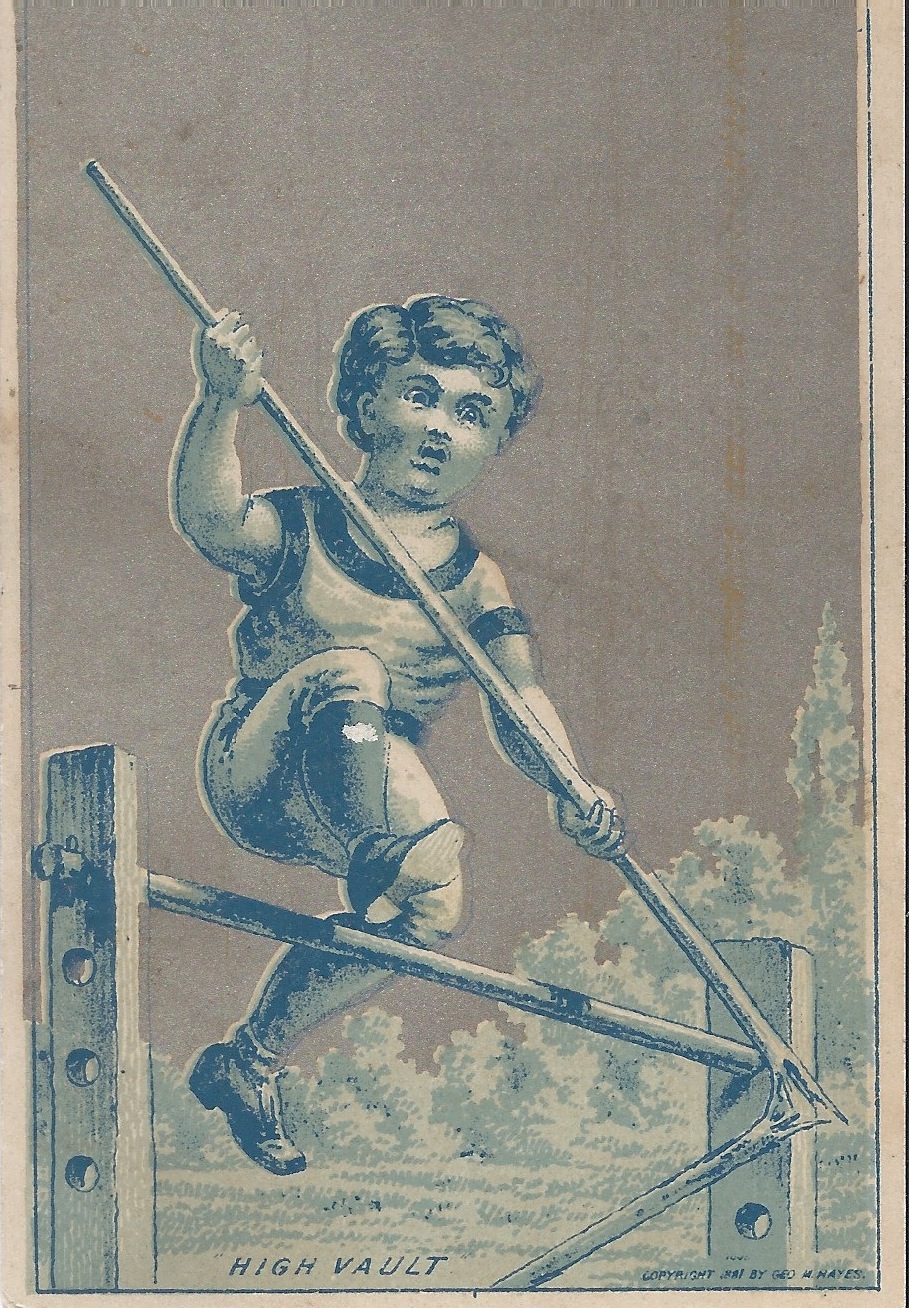
In my growing collection of antique ephemera, I have several trade cards which are printed in monochromatic ink on a metallic ink background. The metallic backgrounds create a sense of motion in these scenes which usually involve children involved in sporting pursuits. For example, this American card printed in blue and silver shows a young man attempting the high vault. Sadly, his pole has snapped in half. I’m sure death is nigh.

So, this must be an advertisement for medicine or some sort of invigorating sarsaparilla. Yes? No. It’s an advertisement for pianos. Once again, this was a stock card which was selected by the business owner because he or she knew it would be the sort of thing which would be collectible and would end up bringing news of their concern into people’s homes.

Let’s take a look at the reverse.

It’s printed upside down. I don’t think that was intentional. It’s also oddly aggressive for a piano ad.

It reads: 


We are selling PIANOS and ORGANS 
At just Ten Dollars advance on the Whole- 
sale Prices. 
-<<<<<---- span="">>---->.-.<---- span=""><---->>>>>-

WE WISH IT POSITIVELY UNDER- 
STOOD THAT WE KEEP NO AGENTS. 

-------------------------

We sell an ORGAN for 50 Dollars as good 
as any other Dealer that employs Agents 
can Sell at 75 Dollars. 

-------------------------------

WE SELL A BETTER PIANO FOR $250 THAN 
AGENTS AND DEALERS WHO EMPLOY THEM, 
CAN SELL FOR $350. 

WE HAVE CONTRACTED TO SELL 3,000 PIANOS 
AND ORGANS IN ONE YEAR. AND WILL SELL 
To ALL at Wholesale Prices. 

-------------------------- 

Look to your interest and send for our 
WHOLESALE PRICE LIST before pur- 
chasing. 

NEW YORK MUSIC COMPANY 
524 GENESEE AVENUE 
          EAST SAGINAW , MICH. 
                                DEPEWManager.


Friday, March 21, 2014

The Home Beautiful: Edward Burne-Jones' Marriage Piano, 1860


"[I] lived inside the pictures and from the inside of them looked out upon a world less real than they."

--Pre-Raphaelite artist Edward Burne-Jones, in a letter to May Gaskell


Piano
Frederick Priestly, 1860
Painted panels by Edward Burne-Jones
This and all related images courtesy of the Victoria and Albert Museum


The name Edward Burne-Jones immediately puts one in mind of the Pre-Raphaelite Brotherhood and theatrical images of languid, titian-haired beauties, rich turquoise and emerald hues and deceptively sparkling waters.  Burne-Jones was one of the most influential of the Brotherhood, the conductor of a beautiful orchestra, if you will.

Georgiana Burne-Jones
And, so, such an artist should have a lovely instrument.  This piano, made in 1860, is the work of Frederick Priestley, an otherwise, as the V&A puts it, unknown piano maker.  The piano was presented as a wedding gift to Edward Burne-Jones and Georgiana "Georgie" MacDonald in 1860. 

Burne-Jones decorated the otherwise modest and plain instrument's case of American oak with a scene from the Medieval Romance,  the Chant d’Amour as an allegory of death--you know, standard wedding stuff. 

In her biography, The Memorials of Edward Burne-Jones, Georgie referenced a portrait of Death on the panel below the keyboard of their piano.  She described Death as  "standing outside the gate of a garden where a number of girls, unconscious of his approach, are resting and listening to music."


Sunday, September 8, 2013

Her Majesty's Furniture: A Piano Stool. 19th C.


Piano Stool
Mid-Nineteenth Century
Crown Copyright
The Royal Collection 
Image Courtesy of Her Majesty Queen Elizabeth II


Made in England in the mid-Nineteenth Century specifically for use in Buckingham Palace, this piano stool was constructed of costly rosewood. Adjustable in height, the stool is upholstered in a hand-made floral needlework.

The stool stands on three turned supports which are joined by a triangular stretcher. The supports stand around a central column which was designed to conceal the threading mechanism which allows the height to be adjusted. The whole of it rests on outward splaying legs with block feet.


Monday, July 8, 2013

Object of the Day: Edward Burne-Jones' Marriage Piano, 1860


"[I] lived inside the pictures and from the inside of them looked out upon a world less real than they."

--Pre-Raphaelite artist Edward Burne-Jones, in a letter to May Gaskell


Piano
Frederick Priestly, 1860
Painted panels by Edward Burne-Jones
This and all related images courtesy of the Victoria and Albert Museum
The name Edward Burne-Jones immediately puts one in mind of the Pre-Raphaelite Brotherhood and theatrical images of languid, titian-haired beauties, rich turquoise and emerald hues and deceptively sparkling waters.  Burne-Jones was one of the most influential of the Brotherhood, the conductor of a beautiful orchestra, if you will.

Georgiana Burne-Jones
And, so, such an artist should have a lovely instrument.  This piano, made in 1860, is the work of Frederick Priestley, an otherwise, as the V&A puts it, unknown piano maker.  The piano was presented as a wedding gift to Edward Burne-Jones and Georgiana "Georgie" MacDonald in 1860. 

Burne-Jones decorated the otherwise modest and plain instrument's case of American oak with a scene from the Medieval Romance,  the Chant d’Amour as an allegory of death--you know, standard wedding stuff. 

In her biography, The Memorials of Edward Burne-Jones, Georgie referenced a portrait of Death on the panel below the keyboard of their piano.  She described Death as  "standing outside the gate of a garden where a number of girls, unconscious of his approach, are resting and listening to music."


Sunday, May 19, 2013

Mr. Punch in the Arts: The Puppet Suite, 1927


The Billy Mayerl Society


Written by the famed pianist 
Billy Mayerl, “The Puppets Suite” was published in 1927 and consists of three movements which encapsulate the joyful spirit of a “Punch and Judy” show.

The first movement is called “Golliwog.” The term is out-of-favor today and is generally thought to be a derisive term, however, for decades it simply referred to an African man. Such a character appears in the Punch and Judy tradition in the form of “Jim Crow” who acted as a footman to Mr. Punch.

The second movement is entitled “Judy.” This bluesy section reflect Judy’s position as Punch’s put-upon wide.

And, finally, there’s “Punch.” This section is considered a “masterpiece of brio.” A complicated piece, it is only successfully played when approached with the right speed and attack. This recording allows us to hear the Suite as it should be played—by Billy Mayerl himself.


Saturday, October 20, 2012

Object of the Day: The Sterling Piano

Click image to make your face crooked.


THE 
STERLING 
PIANO 

Makes your lips go off center. 

Makes you wear odd hats. 

Shortens your car. 

Gives you a doppelganger dressed as the opposite gender. 


These are just a few of the things which this trade card for “The Sterling Piano” seems to suggest to me.

However, I don’t think that’s the point. When I saw this one for the first time, I chuckled because in the lithography, somehow, the red ink became misaligned. Pure red is only used in two little spots and the fact that it’s askew gives both figures a slightly goofy expression which I’m sure wasn’t intended.

Let’s see what the reverse says: 


-----THE----- 
STERLING 


T H E 
IDEAL 
HOME 
PIANO 


THE STERLING CO. 
DERBY – CONN. 


And, if you look closely, there’s still the very, very faint remains of a retailer’s stamp:

HANCOCK’S (unreadable) 
OSWEGO, N.Y.


Friday, July 27, 2012

Mr. Punch in the Arts: The Puppet Suite, 1927

The Billy Mayerl Society


Written by the famed pianist Billy Mayerl, “The Puppets Suite” was published in 1927 and consists of three movements which encapsulate the joyful spirit of a “Punch and Judy” show.

The first movement is called “Golliwog.” The term is out-of-favor today and is generally thought to be a derisive term, however, for decades it simply referred to an African man. Such a character appears in the Punch and Judy tradition in the form of “Jim Crow” who acted as a footman to Mr. Punch.

The second movement is entitled “Judy.” This bluesy section reflect Judy’s position as Punch’s put-upon wide.

And, finally, there’s “Punch.” This section is considered a “masterpiece of brio.” A complicated piece, it is only successfully played when approached with the right speed and attack. This recording allows us to hear the Suite as it should be played—by Billy Mayerl himself.


Wednesday, July 11, 2012

Object of the Day: Another Trade Card for Pianos


This is one of several Victorian trade cards that I have from this same thuggish supplier of pianos and organs. We’ve already looked at one other. These are all in the very 1880s fashion of monochromatic images on metallic ink which often depict chubby tots engaged in sporting activities, and, very often, in the process of being gravely injured.

Let’s take a look at this work of blue on a gold background. Called “Bucked,” it is dated to 1881. What’s happening here? Well, it’s a typical, bright, sunny, gilt-sky day. You know…just the sort of thing you’d see anywhere in the world in 1881. Everything seems normal. A child with a large posterior is riding a bicycle. He (or possibly she) is, for some reason, dressed like a page with a wee, stylish pillbox hat. Princess Diana would have worn it in 1981. He’s hit a rock with is front tire and is being propelled over the handle bars. No doubt, he wall fall into the thorny shrubbery which lines the fence. His injuries will be too severe for 1881 medicine. His physician will prescribe him sarsaparilla—taken orally as well as rubbed on his wounds. Death is unavoidable. Buy some pianos.

The reverse bears the same heavy-handed, slightly ominous copy with which this card’s brother has been printed. “Maybe you buy some pianos. Maybe this whole thing goes away. Maybe you add an organ. Maybe the kid doesn’t need to die. You get me?”


We are selling PIANOS and ORGANS 
At just Ten Dollars advance on the Whole- 
sale Prices. 
-<<<<<---->---->.-.<----<---->>>>>-

WE WISH IT POSITIVELY UNDER- 
STOOD THAT WE KEEP NO AGENTS. 

-------------------------

We sell an ORGAN for 50 Dollars as good 
as any other Dealer that employs Agents 
can Sell at 75 Dollars. 

-------------------------------

WE SELL A BETTER PIANO FOR $250 THAN 
AGENTS AND DEALERS WHO EMPLOY THEM, 
CAN SELL FOR $350. 

WE HAVE CONTRACTED TO SELL 3,000 PIANOS 
AND ORGANS IN ONE YEAR. AND WILL SELL 
To ALL at Wholesale Prices. 

-------------------------- 

Look to your interest and send for our 
WHOLESALE PRICE LIST before pur- 
chasing. 

NEW YORK MUSIC COMPANY 
524 GENESEE AVENUE 
          EAST SAGINAW , MICH. 
                                DEPEWManager.


Thursday, June 28, 2012

Her Majesty's Furniture: A Piano Stool. 19th C.

Piano Stool
Mid-Nineteenth Century
Crown Copyright
The Royal Collection
Image Courtesy of Her Majesty Queen Elizabeth II


Made in England in the mid-Nineteenth Century specifically for use in Buckingham Palace, this piano stool was constructed of costly rosewood. Adjustable in height, the stool is upholstered in a hand-made floral needlework.

The stool stands on three turned supports which are joined by a triangular stretcher. The supports stand around a central column which was designed to conceal the threading mechanism which allows the height to be adjusted. The whole of it rests on outward splaying legs with block feet.