Showing posts with label handkerchief. Show all posts

Thursday, February 26, 2015

After a Fashion: The Lion, the Monkey and the Two Asses Handkerchief, 1710-20

This and all related images from:
The Victoria & Albert Museum


In Eighteenth Century France, personal items were often adorned with images which brought joy to their users. Among the most popular of these were handkerchiefs like this one with small scenes (vignettes). This handkerchief shows a scene from la Fontaine's fable “The Lion, the Monkey and the Two Asses.” Here, the lion sits on a high-backed chair at the left of the scene, with the monkey seated on the ground before him and the two mules to the right. The ornamental corner elements and the decorative border are rendered in the popular French style of the time.

The handkerchief is painted on dyed cotton chintz and was made between 1710 and 1720 on the Coromandel coast of India for export to France. 


Monday, April 30, 2012

Object of the Day, Museum Edition: An Italian Linen Handkerchief, 1600


Italian Linen Handkerchief
1600
The Victoria and Albert Museum


Plain linen handkerchiefs have been around almost literally forever and have long served the same purpose that they do to this day.  However, in the Sixteenth Century, a fashion arose wherein decorative handkerchiefs carried purely as fashionable accessories.  These delicate articles were popularly given as fashionable gifts, especially on New Year’s Day.  This was a habit which was especially enjoyed by Queen Elizabeth I.  However, the gift of a handkerchief usually carried romantic significance.  During courtship, the couple exchanged symbolic gifts such as gloves, ribbons, rings and handkerchiefs. The acceptance of such a gift indicated a binding commitment and, as the V&A reminds us, “could be used as proof of betrothal in the case of any disputes.

This Italian example dating to the early Seventeenth Century (about 1600, actually) has whitework embroidery which has been worked in detached buttonhole and satin stitches, needle lace and cutwork decoration.

Cutwork adornment is the earliest form of needle lace and was originally based on a woven ground, from which areas have been cut away. Elaborate cutwork was an important decoration on fashionable dress for both men and women from about 1570 to 1620.  As was the style of this era, the cutwork decoration is located at the handkerchief’s four corners .

The handkerchief has survived all of these centuries because it was intended as an accessory and was never used for less-elegant purposes.  Somehow, it ended up in the collection of  the English lace dealer Samuel Chick from whom it was purchased by the V&A in 1906.


Sunday, January 22, 2012

Object of the Day: The Lion, the Monkey and the Two Asses Handkerchief, 1710-20

This and all related images from:
The Victoria & Albert Museum


In Eighteenth Century France, personal items were often adorned with images which brought joy to their users. Among the most popular of these were handkerchiefs like this one with small scenes (vignettes). This handkerchief shows a scene from la Fontaine's fable “The Lion, the Monkey and the Two Asses.” Here, the lion sits on a high-backed chair at the left of the scene, with the monkey seated on the ground before him and the two mules to the right. The ornamental corner elements and the decorative border are rendered in the popular French style of the time.

The handkerchief is painted on dyed cotton chintz and was made between 1710 and 1720 on the Coromandel coast of India for export to France.


Sunday, November 20, 2011

Object of the Day: A Souvenir of Queen Victoria's Golden Jubilee, 1887

Well, over the last week, you’ve seen a lot of Royal handkerchiefs from coronations and jubilees ranging from George V and Queen Mary to Queen Elizabeth II. They’ve varied in sizes and textiles. But, here’s the mother of them all! This is, by far, the largest in the collection and, certainly, the largest I’ve ever seen.


This handkerchief was produced in 1887 for the Golden Jubilee of Queen Victoria (1837-1887) and it’s huge! It features, of course, a large portrait of Victoria as she looked in 1887, but also images of her throughout her life. Included also are portraits of her many children, and her many Prime Ministers.

I also like that it has been embroidered at some point in its life with a large red “B.” My Bertie tells me that it was in his honor—113 years before his birth.


Thursday, November 17, 2011

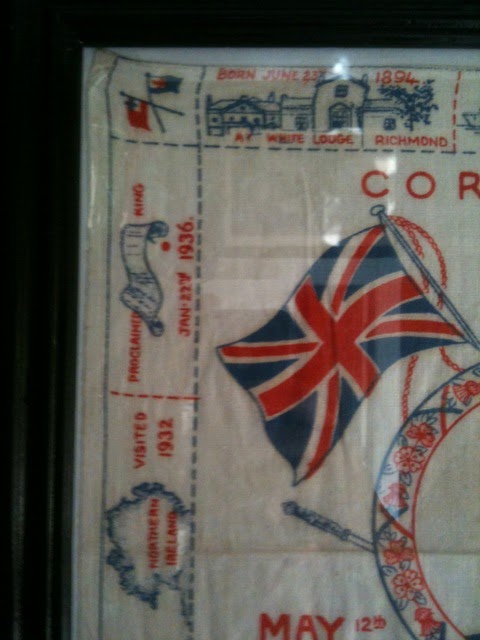
Object of the Day: A Handkerchief Commemorating the Coronation that Never Happened


Oh, Edward VIII---even though he broke his mama’s heart with the abdication kerfuffle, can you imagine what the world would have been like if he’d actually remained King? I’m thinking that the Second World War would have been a lot different…and not in a good way. So, it’s best that he stepped down and let his brother become King George VI, allowing his niece to eventually become Queen Elizabeth II.


Still, as I’ve said before, the Coronation was already planned. It was easy enough to swap out George’s name for Edwards on the programs. So, why not keep the same date?

Here’s one of the rare souvenirs from the coronation that never happened. Most of the Edward VIII items were scrapped when he abdicated and the Coronation was changed for George VI. The ones which remain, most likely, had already been purchased. This handkerchief is emblazoned with a portrait of the temporary King in a circle flanked by Union Jacks and punctuated with his name and the planned dates for the coronation. The border of the textile spells out milestones in Edward’s life. Obviously, the abdication isn’t listed.


Wednesday, November 16, 2011

Object of the Day: A Handkerchief Commemorating the Coronation of Queen Elizabeth II


This beautiful silk-blend handkerchief was made in 1953 in honor of the coronation of Queen Elizabeth II. The design of the textile is quite indicative of the stylistic sensibilities of the early 1950s. A medium-blue circle contains drawings of prominent figures in the coronation ceremony surrounded by the date of the coronation and the Queen’s name. The corners are adorned with crossed flags and the edges show images of important British landmarks: Buckingham Palace, Westminster Abbey, The Tower of London and the Houses of Parliament.


A recent addition to my collection, this handkerchief is now forever preserved in a frame that my father custom-built.


Tuesday, November 15, 2011

Object of the Day: A Handkerchief Commemorating the Coronation of King George VI


Another addition to my collection is this beautiful commemorative handkerchief marking the coronation of King George VI and Queen Elizabeth (the Queen Mother) in 1937. You’ll see, n coming days another handkerchief made in 1937 for a coronation. The other, of course, shows King Edward VIII, but we know how that worked out.


Despite the fact that souvenirs for King George VI and Queen Elizabeth were made in a hurry, they certainly don’t show it or lack in quality. This cotton handkerchief shows portraits of the King and Queen surmounted by St. Edward’s Crown and surrounded by draped Union Jacks. Crests at each corner are adorned with roses and thistles—symbols of England and Scotland as well as clover for Ireland.

Monday, November 14, 2011

Object of the Day: A Souvenir Handkerchief Commemorating the Coronation of Queen Elizabeth II, 1952-53


I’ve recently gone wild and added a lot of vintage and antique handkerchiefs to my collection of Royal memorabilia. My father has very kindly framed them all for me.


This one dates to 1952 to 1953 and was made to commemorate the coronation of Queen Elizabeth II. We see, in the center of the textile, a portrait of Her Majesty in an oval inset over Buckingham Palace and beneath her crowned cipher. The whole of the handkerchief is lined with the labeled crests of those nations and countries who made up the Commonwealth.


Made of a silky synthetic material, the handkerchief is in remarkably good condition and still retains its brilliant colors. The original "Made in England" tag remains.

Wednesday, September 7, 2011

Object of the Day: A Souvenir Handkerchief from the Silver Jubilee of King George V

Regular readers of Stalking the Belle Époque already know of my immense fondness for Royal Souvenirs. And, there are many of them around here. You all also know of my tremendous respect for Mary of Teck and King George V. So, of course, I just love this new addition to my collection.

This beautiful and colorful handkerchief commemorates the 1935 Silver Jubilee of King George V and his consort, Queen Mary. It is gorgeously decorated with scenes of the Royal Residences, Westminster Abbey and the Palace of Westminster as well as the corners of the British Empire (at the time). George V and Mary are center stage in handsome oval portraits.

This handkerchief is now preserved in a lovely frame made by my father. And, now, here are a lot of pictures…


Wednesday, August 31, 2011

Object of the Day, Museum Edition: A Handkerchief Commemorating the Coronation of Queen Victoria, 1838

Handkerchief
English, 1838
The Victoria & Albert Museum
As part of my recent collecting of objects related to Royal coronations and jubilees, I’ve become interested in handkerchiefs commemorating these events. These textiles are difficult to come by. Though the really weren’t designed to be used on a daily basis, many were, and therefore haven’t survived in good condition. Others simply have been ruined by time.

Here’s one from the Victoria & Albert Museum which commemorates the coronation of Queen Victoria in 1838. Made in England by an unknown manufacturer, this block-printed silk square reads—amidst a border of crowns "LONG LIVE VICTORIA QUEEN OF ENGLAND.” The central image shows the interior of Westminster Abbey and the scene of the Coronation in vivid colors.

The central image is captioned, “CORONATION OF HER MOST GRACIOUS MAJESTY/QUEEN VICTORIA/JUNE 1838.”