Showing posts with label Costume. Show all posts

Monday, February 23, 2015

Mastery of Design: "The Queen of Transylvania" Tiara, 1958


Costume Tiara
Cecil Beaton, 1958
The Victoria & Albert Museum


This costume tiara was made for the character of the  “Queen of Transylvania” (as played by Margaret Halstan) in the London production of the musical “My Fair Lady,” at the Theatre Royal, Drury Lane.  The show opened on April 30, 1958.

Based on George Bernard Shaw's play “Pygmalion,” the music for the famous musical was composed by Frederick Lowe, and the book and lyrics were by Alan Jay Lerner. The production was directed by Moss Hart (husband of my dear Kitty Carlisle Hart), the sets were designed by Oliver Smith, and the costumes were designed by the celebrated photographer Cecil Beaton.

The production starred Julie Andrews as Eliza Dolittle and Rex Harrison as Henry Higgins.

This bears a label for Margaret Halstan, who played the Queen throughout most of the London run for My Fair Lady. This is one of several tiaras designed for Halstan for the production.  Photographs from the show indicate different sixed crowns of different weights, allowing the actress flexibility in what she wore each night.  A silversmith made the tiaras, set with fine pastes, based on Beaton’s detailed designs.  

Monday, February 9, 2015

After A Fashion: A Costume Design for Wendy Hiller, 1935


Dress Design for Wendy Hiller, c. 1935
The Victoria & Albert Museum


Wendy Hiller (1912-2003) was trained at the Manchester Repertory Theatre in 1930 and made her West End debut, to exceptional acclaim. In 1935, at the apex of her illustrious carrer, Miss Hiller appeared as Sally Hardcastle in “Love on the Dole.”  Later, she went on to star in countless roles on the stage and, then, in film and television.  Her grand career led to being awarded a DBE (Dame of the British Empire) in 1975.

Here, we see a pencil and watercolor costume design for Dame Wendy Hiller. The drawing shows a side view of an elegant lady with her auburn hair swept back into a low bun. She is depicted wearing a pink dress with cap sleeves trimmed with pearls, a row of pearls, and elbow-length white opera gloves.

The costume sketch is unsigned, but it is inscribed “Miss Wendy Hiller. Heavy Silk Dress Flamingo Pink. Organza Pleated Insets. Large Chiffon Scarves in Three (underlined) Pinks.”

The drawing dates to about 1935.  It’s not certain which of her shows the costume was for.  Perhaps it was a drawing for a gown for her to wear personally.


Thursday, June 5, 2014

Unusual Artifacts: A Victorian Clown Costume, c.1878


Click image to enlarge.
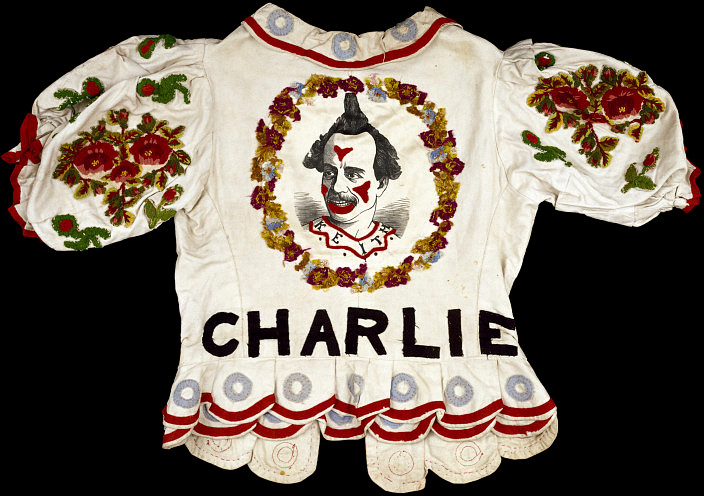
Charlie Keith's Costume
c. 1870
This and all related images from:
The Victoria & Albert Museum


By the very nature of the job, a clown’s costumes are quickly consumed. So, finding an example of a Nineteenth Century clown’s costume, especially one in good condition, is quite a rare event indeed. The one pictured above is a remarkable example, and, one of only a few such costumes which survive.

Both printed and embroidered, this fine costume belonged to Charlie Keith (1836-1895)—a popular and celebrated clown who was also responsible for managing his own touring circus. The curators of the V&A found an advertisement for Charlie Keith's Circus in The Southport Critic. Dated June 15, 1878, the ad features an engraving of Keith wearing a costume very much like this one. And, here’s a photo from around the same time of Charlie wearing this very costume. 


The costume consists of a back-fastening, waist-length jerkin of heavy white cotton. A scalloped frill adorns the neck. The jerkin features short, puffed sleeves which are also edged with a similar frill. Upon the front is appliquéd a large satin circle printed with an image of Charlie Keith in his clown makeup and costume with his surname “Keith” printed on his neck frill. On his cheeks, red wool hearts have been appliquéd with similar patterns on his cheeks and forehead. The back is similarly adorned with the wearer’s first name. 


Wednesday, May 28, 2014

Drawing of the Day: Costume Design for 'Babes in the Wood,' 1907


Costume Design
Attilio Comelli
1907
The Victoria & Albert Museum


Here we see a costume design by Attilio Comelli for the character of the Jester in the 1907-1908 play 
Babes in the Wood which ran at the Theatre Royal, Drury Lane.  This production featured characters from the legend of Robin Hood.

In this production, the Jester was played by a woman, so, the drawing for the costume design depicts a female figure wearing a red, orange and purple jester's outfit.

The drawing was finished in 1907 prior to the debut of the production.


Sunday, April 13, 2014

Antique Image of the Day: Clementina, Lady Hawarden, 1864


Clementina, Lady Hawarden and Companion
South Kensington Gardens, 1864
The Victoria & Albert Museum


Isn’t this an odd photo? It dates to 1864 and was taken at the Horticultural Gardens at South Kensington. In left profile, we have Clementina, Lady Hawarden she’s donned fancy dress as a jester or harlequin. Next to her is an unidentified young female companion. Who is this woman? Some believe her to be Marion Lloyd, a close friend and cousin, and the daughter of Lady Hawarden's sister Mary Keith (Keithy) Lloyd. The young lady is dressed in a peasant costume. 

The photo was taken in a photography booth at the gardens.  That's a lot of leg for 1864.


Saturday, March 8, 2014

Drawing of the Day: The Fairy of the Woodland Glades Costume Design, 1945


The Fairy of the Woodland Glades
Costume Design
Oliver Messel, 1946
The Victoria & Albert Museum


The 1946 production of “The Sleeping Beauty” at The Sadler's Wells (now Royal) Ballet is considered the greatest triumph of Britain’s leading theatre designer of the mid-Twentieth Century, Oiliver Messel (1904-1978).

Messel created a feeling of a “real” world for the fantastical production. Instead of focusing on the fairytale elements, Messel depended on visual themes based on the architecture and fashions of Seventeenth to Eighteenth Century English, Spanish and French styles. The clever overall look was one of stepping back in time, but not so otherworldly that the character and action seemed false.

In the production, the good fairies arrive to visit Princess Aurora on the day of her christening. They present her with a variety of gifts. Notable, the character of “The Fairy of the Woodland Glades” offers the little princess the gift of “generosity.”

Here is Messel’s proposed costume for “The Fairy of the Woodland Glades.” This design features a train. We know from photographs of the performance that this is not the costume which was created for the show. Obviously, the design was later rejected. It is noted that Messel decided against this design since he had initially wished for all seven fairies to wear costumes with long trains. The extra fabric proved cumbersome and filled the stage so that the dancers’ movements were hindered.

Still, it’s interesting to see how the production design developed over time.


Saturday, February 8, 2014

Unusual Artifacts: Queen Victoria’s Costume for the Stuart Ball, 1851


Queen Victoria's Costume for
the Stuart Ball, 1851
Designed by Lemi
Pearls, Silk, Gold Braid, Silver Fringe,
Irish Lace
Crown Copyright
The Royal Collection
Image Courtesy of Her Majesty
Queen Elizabeth II
For the Stuart Ball of 1851, Queen Victoria commissioned the Royal Dressmakers to create a truly breathtaking gown for her—drawing inspiration from her court of King Charles II. Though we often tend to remember Victoria as the Dowager Queen, we must remind ourselves that during her marriage, she was a vibrant and vivacious woman with a taste for fine clothes and gems.


Beaded with seed pearls, the silk gown is also adorned with gold braid, silver fringe and lace. The underskirt was a luxurious brocade created in Benares. The lace is of the finest quality—created in Ireland—in a Venetian raised-point needle style. The lace was most likely purchased at The Great Exhibition of 1850.

While the exact makers of the gown are unknown, it is known to have been designed (with much instruction from the Queen) by Eugéne Lemi—a favorite of the Queen. In this magnificent costume, she’s sure to have made the grand entrance that she’d hoped for.

Crown Copyright
The Royal Collection
Images Via The Royal Collection Trust
All Images Courtesy of Her Majesty Queen Elizabeth II

Crown Copyright
The Royal Collection
Images Via The Royal Collection Trust
All Images Courtesy of Her Majesty Queen Elizabeth II

Crown Copyright
The Royal Collection
Images Via The Royal Collection Trust
All Images Courtesy of Her Majesty Queen Elizabeth II

Crown Copyright
The Royal Collection
Images Via The Royal Collection Trust
All Images Courtesy of Her Majesty Queen Elizabeth II

Crown Copyright
The Royal Collection
Images Via The Royal Collection Trust
All Images Courtesy of Her Majesty Queen Elizabeth II


Saturday, January 11, 2014

Drawing of the Day: The Cornelli Countryman, 1905


The Victoria & Albert Museum


This costume design by Attilio Comelli was intended for the role of a countryman or peasant in a production of : The Prodigal Son” in London, 1905. The design depicts a man dressed from head to toe in pink with a “gnome style” hat and a mask that covers his forehead and nose—Pulcinella-style. He dons a knee-length coat with a waistcoat and a large bow tie, striped trousers and horizontal striped hosiery and shoes.

Comelli’s design in pencil and watercolor on board is clearly rooted in the tradition of the Italian Commedia dell’Arte. The production opened in September of 1905 at the Theatre Royal Drury Lane.


Wednesday, September 25, 2013

Drawing of the Day: Comelli's 'Blacksmith, Grocer, Boatman and Yokel,' 1907


Blacksmith, Grover, Boatman and Yokel
from "Babes in the Wood."
Attilio Comelli, 1907
The Victoria & Albert Museum


The famed costume designer Attilio Comelli, (1858 -1925) was the designer in residence at the Royal Opera House in London from the 1880s until his death. He was also called upon to create costumes for the Theatre Royal, Drury Lane, from time to time during this period. This original drawing by Comelli dates to 1907 and was created during one of his visits to the Theatre Royal.

The design, titled “Blacksmith, Grocer, Boatman and Yokel,” was created for the 1907 production of “Babes in the Wood.” Four watercolor sketches show designs for costumes for different characters. Comelli’s attention to detail is apparent as he indicates not only the details of each costume but also the footwear and accessories for each. He even makes suggestions for the wigs and makeup.

Monday, August 12, 2013

Drawing of the Day: Wilhelm Pantomime Designs, 1890


Sunshine
William Charles Pitcher, RI
The  Victoria & Albert Museum


Known professionally as "Wilhelm," William Charles Pitcher RI, (1858-1925) is remembered in theatrical circles as one of Britain's most ingenious and influential costume designers. Wilhelm's love of the theatre started at an early age, and, with dreams of being part of the spectacles he so admired, as a young man, he started his career designing pantomime costumes for Drury Lane Theatre. There, he made such an impression on theatre managers, producers and the public that he became a much sought-after commodity for the remainder of his career. Known for his attention to detail and fine understanding of color as well as character, Wilhelm is credited as producing some of the most stunning costumes in British theatre history.

Wilhelm designed this costume for the actress Miss Vera Dudleigh for her role as "Sunshine" (The Spirit of Light) in the pantomime "Dick Whittington" which opened at The Crystal Palace on Christmas Eve, 1890. 

The gold gown of semi-transparent fabric is fixed with three, small electrical lights which served to illuminate the gown, the matching cape and dramatic golden wings. Her headpiece and wand were also set with a single light each.


Saturday, April 6, 2013

History's Runway: A Costume Design for Wendy Hiller, 1935


Dress Design for Wendy Hiller, c. 1935
The Victoria & Albert Museum


Wendy Hiller (1912-2003) was trained at the Manchester Repertory Theatre in 1930 and made her West End debut, to exceptional acclaim. In 1935, at the apex of her illustrious carrer, Miss Hiller appeared as Sally Hardcastle in “Love on the Dole.”  Later, she went on to star in countless roles on the stage and, then, in film and television.  Her grand career led to being awarded a DBE (Dame of the British Empire) in 1975.

Here, we see a pencil and watercolor costume design for Dame Wendy Hiller. The drawing shows a side view of an elegant lady with her auburn hair swept back into a low bun. She is depicted wearing a pink dress with cap sleeves trimmed with pearls, a row of pearls, and elbow-length white opera gloves.

The costume sketch is unsigned, but it is inscribed “Miss Wendy Hiller. Heavy Silk Dress Flamingo Pink. Organza Pleated Insets. Large Chiffon Scarves in Three (underlined) Pinks.”

The drawing dates to about 1935.
  It’s not certain which of her shows the costume was for.  Perhaps it was a drawing for a gown for her to wear personally.


Tuesday, March 19, 2013

Drawing of the Day: A Costume Design by Victor Stiebel, 1928


Costume Design
1928
The Victoria & Albert Museum

Victor Stiebel was one of Britain’s best-known fashion designers of the mid-Twentieth century. While attending Cambridge, he designed costumes for many university productions and continued to produce stage dresses for several theatrical leading ladies after opening his own couturier house in 1932.

Here, we see one of Stiebel’s most engaging costume designs. The face, with the heavily emphasized, khol-encircled eyes, follows the tradition established by silent-screen star Theda Bara, who popularized the word “vamp” (a contraction of the word “vampire,” which she played in one of her films) to mean a predatory female.

This drawing shows a full-length female figure with black slicked-back hair which ends in kiss curl on the left cheek and with a deep black band around neck. The rather ghoulish figure wears a black fitted dress, the left shoulder bare, with a short bell sleeve. The left side of the skirt ends in a short tail while the right is split on the right hip. The dramatic slit is covered with layers of narrow fabric strips.

A rather theatrical adornment, on the shoulder is a bold corsage of orange, carmine and purple flowers. While, at the hip are one purple and one orange flower.

The costume seems designed entirely to emphasis onto the eyes and blood red lips. Not for one moment, does anyone doubt that this is, indeed, a vamp.


Saturday, February 9, 2013

Unusual Artifacts: Queen Victoria’s Costume for the Stuart Ball, 1851


Queen Victoria's Costume for
the Stuart Ball, 1851
Designed by Lemi
Pearls, Silk, Gold Braid, Silver Fringe,
Irish Lace
Crown Copyright
The Royal Collection
Image Courtesy of Her Majesty
Queen Elizabeth II
For the Stuart Ball of 1851, Queen Victoria commissioned the Royal Dressmakers to create a truly breathtaking gown for her—drawing inspiration from her court of King Charles II. Though we often tend to remember Victoria as the Dowager Queen, we must remind ourselves that during her marriage, she was a vibrant and vivacious woman with a taste for fine clothes and gems.


Beaded with seed pearls, the silk gown is also adorned with gold braid, silver fringe and lace. The underskirt was a luxurious brocade created in Benares. The lace is of the finest quality—created in Ireland—in a Venetian raised-point needle style. The lace was most likely purchased at The Great Exhibition of 1850.

While the exact makers of the gown are unknown, it is known to have been designed (with much instruction from the Queen) by Eugéne Lemi—a favorite of the Queen. In this magnificent costume, she’s sure to have made the grand entrance that she’d hoped for.


Thursday, January 24, 2013

History's Runway: A Costume from "A Midsummer Night's Dream," 1914


Theatre Costume
1914
The Victoria & Albert Museum


Naturally, some of the most unusual and interesting historical clothing that still remains are pieces which were designed for theatrical use. Here we see a theatre costume of a dress of white crêpe-de-chine. The skirt is stenciled with sprays of pink flowers and weighted with a fringe of tiny silver balls. Cap sleeves, a deep V-neck with a silver lamé infill at the base and gold ball buttons create an ethereal look. The tunic is gathered at the bust with a thin gold cord belt ending in golf briolettes and red beads. A deep macramé fringe, decorated at the top with small red beads completes the outfit.


This costume was commissioned by Harley Granville Barker (1877-1946) who was an established director and promoter of contemporary drama, directing three of Shakespeare's plays at the Savoy Theatre--The Winter's Tale, Twelfth Night (both 1912) and A Midsummer Night's Dream (1914). Barker did away with historical costume, inviting his designer, Norman Wilkinson (1882-1934), to create simple stylized period dress without attempting to imitate it.

This gown comes from Barker's production of A Midsummer Night's Dream. The play's mortal characters wore costumes loosely based on Grecian dress while the fairies and ethereal characters wore sparkling costumes to match their gilded faces. Barker's then wife, Lillah McCarthy, played Helena, and for her first scene, she appeared in this dress of white crêpe-de-chine with mauve shoes and red beads. Helena's long blonde wig was adorned with a wreath of flowers.

Monday, December 17, 2012

Drawing of the Day: A Costume from “The Bell Flower Ballet,” 1890

Costume Design from "Dick Whittington"
Wilhelm, 1890
The Victoria & Albert Museum


Charles William Pitcher (1858-1925), under the name “Wilhelm,” was one of the most prolific English costume designers of the late Nineteenth to early Twentieth Centuries. “Wilhelm” began his career at an early age, designing costumes for pantomimes at the Drury Lane Theatre. His innovative designs quickly caught the eye of Britain’s most notable producers, and “Wilhelm” was soon highly in demand. 

This design by Wilhelm shows his idea for the costumes for the twelve “Lilies of the Valley” featured in the “Bell Flower Ballet,” from the pantomime “Dick Whittington.” The panto was performed at the Crystal Palace on Christmas Eve of 1890.


Monday, November 19, 2012

Antique Image of the Day: Clementina, Lady Hawarden, 1864

Clementina, Lady Hawarden and Companion
South Kensington Gardens, 1864
The Victoria & Albert Museum


Isn’t this an odd photo? It dates to 1864 and was taken at the Horticultural Gardens at South Kensington. In left profile, we have Clementina, Lady Hawarden she’s donned fancy dress as a jester or harlequin. Next to her is an unidentified young female companion. Who is this woman? Some believe her to be Marion Lloyd, a close friend and cousin, and the daughter of Lady Hawarden's sister Mary Keith (Keithy) Lloyd. The young lady is dressed in a peasant costume. 

The photo was taken in a photography booth at the gardens.  That's a lot of leg for 1864.

Tuesday, October 9, 2012

Drawing of the Day: Comelli's 'Blacksmith, Grocer, Boatman and Yokel,' 1907

Blacksmith, Grover, Boatman and Yokel
from "Babes in the Wood."
Attilio Comelli, 1907
The Victoria & Albert Museum


The famed costume designer Attilio Comelli, (1858 -1925) was the designer in residence at the Royal Opera House in London from the 1880s until his death. He was also called upon to create costumes for the Theatre Royal, Drury Lane, from time to time during this period. This original drawing by Comelli dates to 1907 and was created during one of his visits to the Theatre Royal.

The design, titled “Blacksmith, Grocer, Boatman and Yokel,” was created for the 1907 production of “Babes in the Wood.” Four watercolor sketches show designs for costumes for different characters. Comelli’s attention to detail is apparent as he indicates not only the details of each costume but also the footwear and accessories for each. He even makes suggestions for the wigs and makeup.


Sunday, October 7, 2012

Drawing of the Day: Wilhelm Pantomime Designs, 1890


Sunshine
William Charles Pitcher, RI
The  Victoria & Albert Museum


Known professionally as "Wilhelm," William Charles Pitcher RI, (1858-1925) is remembered in theatrical circles as one of Britain's most ingenious and influential costume designers. Wilhelm's love of the theatre started at an early age, and, with dreams of being part of the spectacles he so admired, as a young man, he started his career designing pantomime costumes for Drury Lane Theatre. There, he made such an impression on theatre managers, producers and the public that he became a much sought-after commodity for the remainder of his career. Known for his attention to detail and fine understanding of color as well as character, Wilhelm is credited as producing some of the most stunning costumes in British theatre history.

Wilhelm designed this costume for the actress Miss Vera Dudleigh for her role as "Sunshine" (The Spirit of Light) in the pantomime "Dick Whittington" which opened at The Crystal Palace on Christmas Eve, 1890. The gold gown of semi-transparent fabric is fixed with three, small electrical lights which served to illuminate the gown, the matching cape and dramatic golden wings. Her headpiece and wand were also set with a single light each.


Tuesday, September 18, 2012

Mastery of Design: The Snow Queen's Crown, 1950

Wig and Diadem of "The Snow Queen"
Stanley Hall, 1950
The Victoria & Albert Museum


If you’re a ballerina and you’re in “The Nutcracker,” you’re likely going to want to play the Sugar Plum Fairy. Even though the character doesn’t appear until the second act, the young lady cast in the part knows she got the plum role. I know…I’m sorry.

But, sometimes it’s just not enough. Famed ballerina Alicia Markova, when she played the Sugar Plum Fairy in the 1950 production at London’s Stoll Theatre, decided her part wasn’t big enough, so she insisted that she also play “The Snow Queen” at the end of the first act. Fair enough.

Here’s part of Markova’s Snow Queen costume—a diamanté crown set on a wig of opalescent cellophane. The wig was the clever work of Stanley Hall of “Wig Creations,” and is notable as being the first wig ever made of cellophane. The effect was one of frosty hair when viewed beneath the bright stage lights. 


Unusual Artifacts: A Victorian Clown Costume, c.1878

Click image to enlarge.
Charlie Keith's Costume
c. 1870
This and all related images from:
The Victoria & Albert Museum


By the very nature of the job, a clown’s costumes are quickly consumed. So, finding an example of a Nineteenth Century clown’s costume, especially one in good condition, is quite a rare event indeed. The one pictured above is a remarkable example, and, one of only a few such costumes which survive.

Both printed and embroidered, this fine costume belonged to Charlie Keith (1836-1895)—a popular and celebrated clown who was also responsible for managing his own touring circus. The curators of the V&A found an advertisement for Charlie Keith's Circus in The Southport Critic. Dated June 15, 1878, the ad features an engraving of Keith wearing a costume very much like this one. And, here’s a photo from around the same time of Charlie wearing this very costume. 


The costume consists of a back-fastening, waist-length jerkin of heavy white cotton. A scalloped frill adorns the neck. The jerkin features short, puffed sleeves which are also edged with a similar frill. Upon the front is appliquéd a large satin circle printed with an image of Charlie Keith in his clown makeup and costume with his surname “Keith” printed on his neck frill. On his cheeks, red wool hearts have been appliquéd with similar patterns on his cheeks and forehead. The back is similarly adorned with the wearer’s first name.