Showing posts with label British Museum. Show all posts

Friday, June 6, 2014

Mr. Punch in the Arts: An Antique Drawing by George Scharf


Punch & Judy Show
George Scharf
The British Museum
Drawn from life, this pencil and watercolor sketch shows a Punch & Judy show being performed on the street much to the delight of those watching.  In the highly decorative tent, we can see Mr. Punch with his famous slapstick, aiming for a rather frantic Judy.  Scharf’s depiction of the tent is quite authentic.  We can see the evolution of such a Punch & Judy booth from when this was drawn in the 1800’s to a version from 1912 (below).   Since this was drawn from life, we’re led to believe that the booth’s signage, “Our Endavour is to Please” is an accurate transcription of a misspelling on the part of the “Professor.” 


Punch & Judy Booth
1912-1962
The Museum of Childhood at
The Victoria & Albert Museum


Friday, May 23, 2014

Print of the Day: A Ticket to Wynnstay, 1786


Click on image for admission.

Ticket to the Private Theatre at Wynnstay
Wales, 1786
The British Museum


Printed in 1786, this work of rusty red ink on very thick card was produced as a novelty admission ticket for the theatre at Wynnstay. Wynnstay was a grand Seventeenth Century estate in Wales which became the home of Eighteenth Century politician and statesman, Sir Watkin Williams-Wynn, 4th Baronet. Wynnstay boasted an elegant private theatre for which Williams-Wynn would have attractive tickets printed to issue to his guests as mementos of their evening’s entertainment.

This ticket features Mr. Punch, Judy, the Baby and the Devil standing around a barrel which has been adorned with theatrical masks. “Wynnstay” is printed prominently in the center.

In the Nineteenth Century, Wynnstay was a favorite visitation spot for Queen Victoria and her mother, the Duchess of Kent. A hundred years later, the estate had fallen into disrepair and the house was sold off and converted into a school. Later, it was cut up into flats and several private homes. The gardens are now in a continued state of revival.


Thursday, April 10, 2014

Print of the Day: A Terrier After Frederick William Keyl, c. 1845


Terrier After Frederick William Keyl
1845-1871
The British Museum


This print from a wood engraving by an unknown engraver was published sometime between 1845 and 1871. The subject is a very handsome terrier based on a painting by Frederick William Keyl. 


Wednesday, February 12, 2014

Gifts of Grandeur: The Hull Grundy Bodice Ornament, c. 1650


Click image to see larger picture.
Hull Grundy Bodice Ornament
Spain, Seventeenth Century
The British Museum


This bodice ornament of gold is set with table-cut emeralds and diamonds. The upper section of the piece features an openwork design in a bow form incorporating foliate tendrils and volutes. This is hinged to a section which works the initial “S” in pierced openwork.

The reverse of the jewel is enameled in pink and black on a ground of white in a floral pattern.

At one point, this piece was in the collection of Dame Joan Evans, but ended up in the catalogue of the Hull Grundys who presented this as part of a large gift to the British Museum. It’s believed that the ornament has significance to a Spanish religious confraternity.


Sunday, January 19, 2014

Object of the Day, Museum Edition: The Comet, 1789


A Return of the Comet is expected this Year and to be within our horizon from the month of Octr 1788 to Augt 1789 but is expected to be most -visible (if it forces itself upon our Notice).


"The Comet"
Aquatint by James Sayers, 1789
Version housed in the Victoria & Albert Museum
This aquatint (a printmaking technique like engraving wherein an acid is applied to a metal plate) is entitled “The Comet” and is the work of engraver James Sayers. A satirical piece, Sayers has placed in the composition the Prince of Wales at the time (later the Prince Regent, later still King George IV) at the head of the comet, notable contemporary characters make up its tail.

This piece was published in London by Thomas Cornell. Those pictured behind the future King George IV are: Edmund Burke, Sir Grey Cooper, Edward Stanley Smith the Twelfth Earl of Derby, Charles James Fox, Frederick North the Second Earl of Guilford, Thomas Powys the First Baron of Lilford, William John Kerr the Fifth Marquess of Lothian, David Murray the Second Earl of Mansfield, Charles Howard the Eleventh Duke of Norfolk, William Henry Cavendish Bentinck the Third Duke of Portland, William Douglas the Fourth Duke of Queensberry, Alexander Wedderburn the First Earl of Rosslyn (Lord Loughborough), John Montagu the Fourth Earl of Sandwich, John Sawbridge, Richard Brinsley Sheridan, John Warren, Richard Watson and Christopher Wilson.

To quote Homer Simpson, “Mmmmm…Fourth Earl of Sandwich.” As for the rest, well, they’re less delicious.

Another version of this piece, located at the V&A, is in the collection of The British Museum. So, what makes this so important that two major museums display it? What’s going on here?

The piece was produced during one of George III’s famous bouts of illness—leading to his famed madness. The King was not expected, at first, to recover and supporters of the randy Prince of Wales expected him to ascend the throne.  However, George III rallied and his eldest boy's followers found that they were no closer to the throne than ever.  Still, the Prince of Wales looked forward to surpassing his rickety father.  This is summed up visual in the drawing we see above.

A comet is cutting through the design diagonally and downwards from the right to the left. The comet’s head is that of the future King George IV surrounded by a star, while the tail contains the heads of his disappointed followers. Immediately after the Prince is the head of Richard Sheridan, with a gloomy expression. Behind him are James Fox, with a melancholy countenance, and an angry Duke of Portland.

After them comes the wig in back view of Lord Loughborough and a host of other disgruntled hangers-on. On the background is etched “A Return of the Comet” which appeared in 1761. The text reads:


A Return of the Comet is expected this Year and to be within our horizon from the month of Octr 1788 to Augt 1789 but is expected to be most -visible {if it forces itself upon our Notice) in the Winter months Febry & March ------ vide Dr Trusslers Almanack


By some of the ancient Astronomers Comets were deemed Meteors kindled in the Air and designed as Presages or unlucky Omens of some disastrous Catastrophe------


The Peripateticks deemed them not permanent Bodies but bodies newly produced and in a short Time to perish again, and affirmed that they were made up of Exhalations in the terrestrial Regions------


Sr Isaac Newton asserts That the Tail of a Comet is nothing else than a fine Vapour which the Head of the Comet emits by its heat that Heat the Comet receives from the Sun and the magnitude of the Tail is always proportional to the degree of heat which the Comet receives, and Comets which are nearest to the Sun have the longest Tails------' 18 February 1789


The version exhibited at The British Museum.


Tuesday, January 14, 2014

Mastery of Design: Over 100 carats of Fun, Diamond Earrings from the British Museum


Diamond Earrings
1940-1950
This and all related images from
The British Museum


Created between 1940 and 1950, this pair of platinum and diamond earrings contains two large pear-shaped unmatched Indian diamonds.  One is 50 carats, while the other weighs in a 55 carats.  They are hung from platinum mounts set with smaller baguette (baton-cut) diamonds. The pair still resides in the original red leather, fitted case.

The pear-shaped diamonds, while spectacular, do not match, obviously, in size, nor exactly in shape.  This owes to the fact that the diamonds were not cut to match, but rather to highlight their best clarity.  The difference would have been much less obvious when worn.  But, really, if you're wearing over 100 carats, who cares if they are exactly the same?

Strangely, the jeweler is unknown.  They're made in the Western style popular during the period in America and Europe, and they could have been produced on either continent.

Now housed in the British Museum, the earrings were given by an anonymous donor.  Click on the images to enlarge them.


Tuesday, December 3, 2013

Mastery of Design: A Bohemian Garnet Hair Ornament, c. 1830

Garnet Hair Ornament
The British Museum


Imagine an elegant ballroom, flickering in the light of candles held in chandeliers and girandoles dripping in crystals.  A lady nods a greeting to you.  Nestled in the cascades of curls which form her upswept coiffure is this ornament, a fiery shower of crimson sparks from a foliate spray.


This gold hair ornament is set with briolette-cut garnet drops and pearls hung from eight gold volutes set behind a rose gold ribbon which is also mounted with garnets.  It was made in Bohemia (or possibly Austria) circa 1830 and was collected by Professor John and Anne Hull Grundy who donated their important collection of jewels to the British Museum in 1978.


So...do you like garnets?  Do you like mysteries?  Drama?  Reading?  Me?  Do you like me?

Have you read my first novel, The Garnet Red?  I wrote it many years ago.  It even ties into the Mr. Punch stories.

Christmas is coming up.  Do you know what makes a great gift?  Books.  Books make great gifts.  Or, if you're one of those e-reader types, you can do that.  You can download it at the iTunes store by going here.  If you've got a Nook, you can buy an e-Book here through Barnes and Noble.  Or you can buy an actual book book on Amazon.

As you know, I don't hawk a lot of things here.  I keep the self-promotion to the bare minimum.  But...go on...buy a book, so I can keep doing this, and keep feeding the dog and the puppets and the cats...  


Thursday, August 15, 2013

Mastery of Design: The Hull-Grundy Forget-Me-Not Tiara

Tiara
From the Hull Grundy Gift at The British Museum

Click image for detail.


Another brilliant piece from the Hull-Grundy Gift to The British Museum, we see this French-made tiara which was constructed of three-color gold.  The gold has been worked into elaborate swags of leaves and flowers.  These are surrounded by a large crest of forget-me-nots mounted in turquoises with diamond-set centers.


Originally, this piece was worn as a frontlet ornament.  In 1805, the French jewel was altered, probably in Italy, into its present form as a tiara.


Friday, July 12, 2013

Mastery of Design: A Hungarian Headband, mid to late Thirteenth Century

Fragment of a Headband
Thirteenth Century
Images Courtesy of The British Museum


While just a fragment now, once this headband would have adorned the brow of a wealthy Hungarian lady of the mid to late Thirteenth Century.  What remains is the frontmost piece of the band.  Two smaller sections would have flanked this and, from these, a ribbon would have been attached to tie at the back of the wearer's head.

Set in gold, cabochon rubies, sapphires and emeralds are joined by seed pearls, making a regal statement against the elegant filigree-work.

The fragment is now housed in The British Museum.


Wednesday, July 10, 2013

Mastery of Design: Over 100 carats of Fun, Diamond Earrings from the British Museum

Diamond Earrings
1940-1950
This and all related images from
The British Museum


Created between 1940 and 1950, this pair of platinum and diamond earrings contains two large pear-shaped unmatched Indian diamonds.  One is 50 carats, while the other weighs in a 55 carats.  They are hung from platinum mounts set with smaller baguette (baton-cut) diamonds. The pair still resides in the original red leather, fitted case.

The pear-shaped diamonds, while spectacular, do not match, obviously, in size, nor exactly in shape.  This owes to the fact that the diamonds were not cut to match, but rather to highlight their best clarity.  The difference would have been much less obvious when worn.  But, really, if you're wearing over 100 carats, who cares if they are exactly the same?

Strangely, the jeweler is unknown.  They're made in the Western style popular during the period in America and Europe, and they could have been produced on either continent.

Now housed in the British Museum, the earrings were given by an anonymous donor.  Click on the images to enlarge them.


Friday, May 3, 2013

Drawing of the Day: The George Scharf Punch and Judy Show


Drawing by George Scharf
The British Museum


This sketch was drawn from life in the early Nineteenth Century. 
 It depicts a Punch and Judy puppet show being watched in the street.  The drawing is the work of George Scharf and does an excellent job of capturing the spirit of these street-side performances which are still performed to this day.

Punch and Judy "professors" still use the same kind of fit-ups (booths).  In fact, I've seen some which were modeled on this drawing with its decorative figures of Mr. Punch and his wife and "Joey the Clown" who acts as something of a Master of Ceremonies and interpreter for the show.  Even the misspelled sign is indicative of the joy of these wonderful shows.  I think it's marvelous that three and a half centuries (to the day, today) after Punch and Judy was first recorded as being performed in Britain, that he's being kept alive.  We need to do all that we can to ensure that this tradition remains strong and thriving for another three centuries and beyond.  


Wednesday, May 1, 2013

Antique Image of the Day: The Royal Opening of the King Edward VII Gallery at the British Museum, May 7, 1914


King George V and Queen Mary
Attending the Opening of the King Edward VII Galleries
at the British Museum
May 7, 1914
The British Museum


In 1907, three years before his death, King Edward VII laid the foundation stone to a monumental addition to the British Museum, which was to be named in his honor. 
 The King Edward VII's Galleries were designed by the celebrated architect  J.J. Burnet and were built between 1906 and 1914.

Burnet, in preparing the design, visited newly built museums across Europe and the U.S. to ensure that the extension in honor of the King would use the most stylish and up-to-date materials and would offer the latest amenities including heating, ventilation, modern lighting and exhibition cases.

The new extension was opened after Edward VII’s death by the King's son, King George V, and Queen Mary, on May 7 1914—one day and four years after the king’s death.
  That would be ninety-eight years ago today!  The event was captured in a series of photographs.  The image above shows King George V and Queen Mary on their way to the opening and, then, the image below shows them leaving.

King George V and Queen Mary were shown around the new building and the King inspected the Guard, formed by the Brigade of the Artists' Rifles.

This building marked the first stage of a grand scheme to replace the houses surrounding the existing British Museum building with new galleries, more library space, students' rooms and lecture theatres.

The First World War, a lack of funds and later conservation regulations regarding the existing structures halted these plans. 


Saturday, March 16, 2013

Sculpture of the Day: The Stevens Lion, 1852


Bronze lion after Stevens, 1852
The Victoria & Albert Museum


This bronze figure of a seated lion is copied from a model made by British sculptor Alfred George Stevens (1817-1875) around 1852 for the seated lions he cast for the tops of the newel posts outside of London's British Museum.

According to one critic of the day, “the number of imitations of this lion by other artists is their sincerest tribute; and technically it is equally a triumph for Stevens in the small number (20) of pieces which are necessary in the mould for casting it.”

The lions are no longer in position outside the British Museum. Some were removed in 1896 to railings outside the Charles Holden wing of the Law Society building in Chancery Lane. Others were placed on the railings which surround the Wellington monument in St Paul's Cathedral, London. This transfer took place between 1892 and 1912, when the tomb was removed from the Consistory Chapel in St Paul's.


Thursday, February 28, 2013

Object of the Day, Museum Edition: The Soldier's Return, 1791


The grand old Duke of York, 

He had ten thousand men. 
He marched them up to the top of the hill 
And he marched them down again. 
And when they were up, they were up. 
And when they were down, they were down. 
And when they were only halfway up, 
They were neither up nor down. 

--Popular Rhyme of 1793, pillorying the Duke of York following the Flanders* Campaign
(*"Stupid Flanders"--H. Simpson)


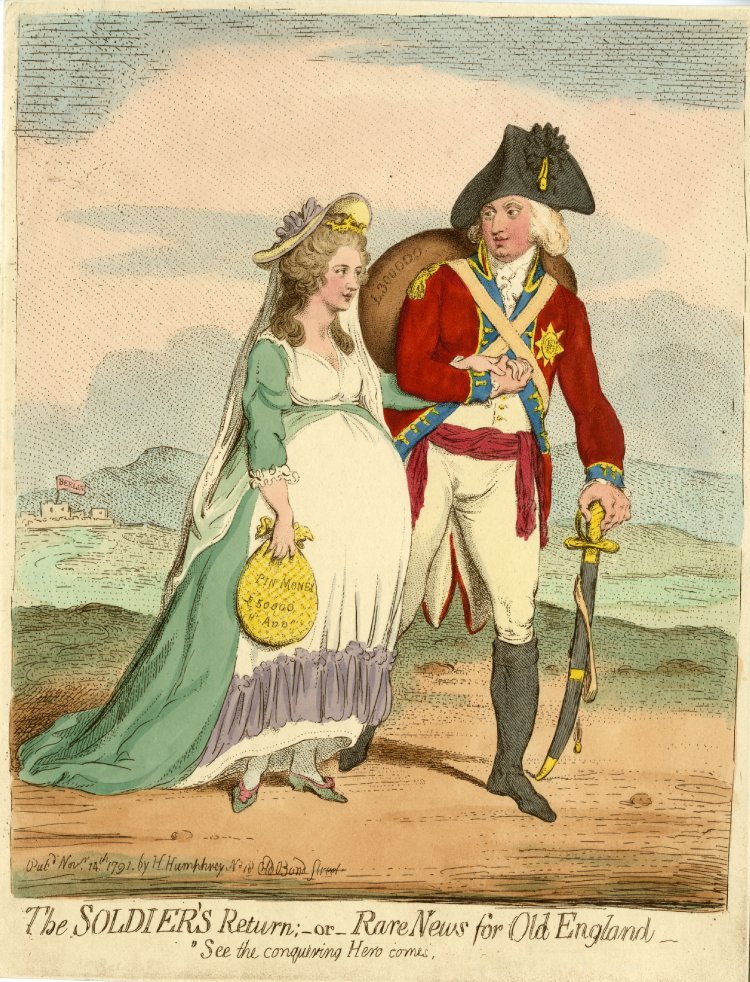
"The Soldier's Return"
James Gillray and H. Humphrey, 1791
The Victoria & Albert Museum

Entitled “The Soldier's Return;” or “Rare News for Old England,” this hand-colored etching depicts Frederick, Duke of York. Prince Frederick, Duke of York and Albany, Earl of Ulster was the second son of King George III and Queen Charlotte. He was, curiously, at 196 days old named Prince-Bishopric of Osnabrück, making him, to this date, the youngest bishop in history.

Like his brother, the future King George IV, Frederick enjoyed a rather debauched life. And, like his brother (who married the future Queen Caroline with whom he had a strained and bizarre relationship) suffered through a less-than-successful marriage. Prince Frederick remained a relatively popular figure, making a strong impression on the population of Britain with his military work. His reputation, however, suffered two years after his marriage upon the unsuccessful Flanders Campaign. The subtitle reads: “See the Conquering Hero Comes.”

This scene might show Prince Frederick returning from Hanover to meet his cousin/bride Frederica Charlotte of Prussia whom he married in 1791. The print was published in London by H. Humphrey on “14th November 1791.” We should note that the Duke of York married his cousin twice—once on 29 September 1791 at Charlottenburg, Berlin, and again on 23 November 1791 at Buckingham Palace. This scene probably shows the Duke meeting his bride before their second marriage. Something curious about this, however, is that the new princess is clearly pregnant in this picture. The Duke and Duchess had no children together, however, he did sire many illegitimate children (keeping the family tradition of the time alive) with a slew of women all over Britain and Hanover. The depicted pregnancy was more wishful-thinking than anything else since all expected them to procreate. Furthermore, the image is intended to show not only the prince’s virility, but also the longevity of the Royal Family.

This, however, is not as much of a loving tribute as it is a satire. We see here, the Duke of York and his bride walking arm in arm, in the manner of a tramping soldier and his wife. But, there’s more to it than just that. Let’s look more closely. A large bundle on the prince’s back is inscribed “L. 300000.” This refers to the dowry that the Duke received upon his marriage. The dowry from the girl’s father, Crown Prince Frederick William of Prussia, which amounted to only £13,000, was absolutely nothing in comparison with the Duke's debts. Meanwhile, the falsely pregnant princess carries a large money-bag reading: “Pin Money £50000 Pr Annm,” a reference to their controversial yearly allowance. Behind them, at the left, in the distance is a castle with a flag inscribed “Berlin”—a reference to Charlottenburg Palace, the place of their first, German, wedding. The Duke wears regimentals with his star; the Duchess wears a simple straw hat—denoting the idea that she was of humbler, if not still Royal, birth. However, this hat is tilted back to show a tiara, an obvious reference to her past and future great expectations.

Within the pattern of the ground, we can make out: “Pubd Novr 14th 1791. by H Humphrey No 18 Old Bond Street.”

Here’s another image that I know I’ve seen before, but not at the V&A. And, so, I’ve gone on a hunt to figure out where I’ve seen it. The listing for this piece in the V&A tells us nothing except it depicts the Duke of York in 1791—no more. So, I’ve been doing quite a bit of research on this one.

Another version of the same etching by James Gillray lives at the British Museum. I’m fairly certain that’s where I saw it. The British Museum’s example differs slightly since these were hand-colored. See below.

Whew! That’s enough digging into that for now.

The version from the British Museum

Friday, February 1, 2013

Object of the Day, Museum Edition: A Tail Piece from “Points of Humour”

Tail Piece from "Points of Humour"
George Cruikshank, 1824
The British Museum


Good morning, all! I’m a bit under-the-weather again today, so, I’m all the happier that it’s a “Punch” Friday. I thought we would begin our puppet-fest with a look at piece that I’ve not seen before. It’s been tucked away in the British Museum for quite some time, and I find it quite charming.

Another of Cruikshank’s drawings for the 1824 publication of “Points of Humour,” we see here a very simple, but dynamic image of Londoners watching a Punch & Judy show. Gathered around the fit-up, we see a guardsman, a butcher boy and several children.


Sunday, November 11, 2012

Mastery of Design: The Grundy Bodice Ornament, c. 1650

Click image to see larger picture.
Hull Grundy Bodice Ornament
Spain, Seventeenth Century
The British Museum


This bodice ornament of gold is set with table-cut emeralds and diamonds. The upper section of the piece features an openwork design in a bow form incorporating foliate tendrils and volutes. This is hinged to a section which works the initial “S” in pierced openwork.

The reverse of the jewel is enameled in pink and black on a ground of white in a floral pattern.

At one point, this piece was in the collection of Dame Joan Evans, but ended up in the catalogue of Hull Grundy who presented this as part of a large gift to the British Museum. It’s believed that the ornament has significance to a Spanish religious confraternity.


Saturday, November 10, 2012

Mastery of Design: A Middle Eastern Garnet Necklace, 1st C.


Necklace
The British Museum


A necklace of turquoise, gold and garnets, this piece was excavated in the Middle East and dates to the First Century. The piece was restrung in the Nineteenth Century at which time gold glass beads were added. The positioning of the pendants, as noted in a 1968 inventory of the British Museum, may have been changed at the time of the re-stringing. 


Tuesday, November 6, 2012

Gifts of Grandeur: A Carnelian Intaglio

Hardstone Intaglio
The British Museum


Of unknown origin and date, this handsome intaglio of jasper comes to us from The British Museum. Common sense tells us that the piece is of ancient origins, possibly Roman. Ancient Roman gem carvers set the standard for intaglio and hardstone work for centuries to come. This piece is especially interesting. The red jasper has been carved with a double mask. One shows a youthful visage while the other shows an aged and bald countenance—no doubt, a reminder of the passage of time and its effect on all of us.


Friday, October 5, 2012

Object of the Day, Museum Edition: A Ticket to Wynnstay, 1786

Click on image for admission.

Ticket to the Private Theatre at Wynnstay
Wales, 1786
The British Museum


Printed in 1786, this work of rusty red ink on very thick card was produced as a novelty admission ticket for the theatre at Wynnstay. Wynnstay was a grand Seventeenth Century estate in Wales which became the home of Eighteenth Century politician and statesman, Sir Watkin Williams-Wynn, 4th Baronet. Wynnstay boasted an elegant private theatre for which Williams-Wynn would have attractive tickets printed to issue to his guests as mementos of their evening’s entertainment.

This ticket features Mr. Punch, Judy, the Baby and the Devil standing around a barrel which has been adorned with theatrical masks. “Wynnstay” is printed prominently in the center.

In the Nineteenth Century, Wynnstay was a favorite visitation spot for Queen Victoria and her mother, the Duchess of Kent. A hundred years later, the estate had fallen into disrepair and the house was sold off and converted into a school. Later, it was cut up into flats and several private homes. The gardens are now in a continued state of revival.

Monday, June 11, 2012

Print of the Day: A Terrier After Frederick William Keyl, c. 1845

Terrier After Frederick William Keyl
1845-1871
The British Museum


This print from a wood engraving by an unknown engraver was published sometime between 1845 and 1871. The subject is a very handsome terrier based on a painting by Frederick William Keyl.

The reason I selected this print for Bertie’s birthday is quite obvious, I think.