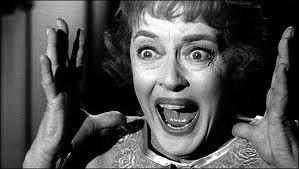
Now let me see... what is it you call your job? Oh, yes. Public relations. Sounds like something pretty dirty to me.
--Charlotte Hollis
In 1964, following the wildly successful pairing of stars Bette Davis and Joan Crawford inWhatever Happened to Baby Jane, Producer/Director Robert Aldrich planned to team the duo in another film based on a another book by Henry Farrell, Whatever Happened to Cousin Charlotte. Davis insisted that the title of the film be changed. She didn’t want audiences to think that the film was a sequel to Whatever Happened to Baby Jane. She suggested, “Hush… Hush, Sweet Charlotte” which was the name of the song which had been composed as the main musical theme of the picture. Aldrich agreed.
A rare publicity shot of Crawford and Davis
Davis would play Charlotte Hollis—an eccentric Southern recluse who hides in her family’s crumbling Louisiana mansion after being accused of murdering her lover many years earlier. Crawford would play Miriam Deering, Charlotte’s strong-willed cousin who’s come to help Charlotte vacate her home when it is ordered to be torn down.
Joseph Cotten was cast as Dr. Drew Bayliss—a long-time friend of the family. The cast was further completed with Cecil Kellaway as an insurance investigator, Anges Moorehead as Charlotte’s cranky but loyal maid, a young Bruce Dern as Charlotte’s girl-hood lover, Victor Buono as Charlotte’s father, and Mary Astor as Charlotte’s former rival. Davis had specifically asked for Astor to play the role of Jewel Mayhew. Astor was one of the few female stars that Bette Davis actually liked. They had been friends and had worked well together on The Great Lie. When Bette Davis liked you, she really liked you. When she didn’t, she really didn’t.
Shooting began with both Davis and Crawford on location at Houmas House in Darrow Louisiana which would serve as the exteriors for Charlotte’s family home. However, soon, Miss Crawford developed one of her famous “Joan Crawford Colds” and was consistently absent—only appearing for four days of filming. Rumor had it that she couldn’t face working with Bette Davis again. While relations between them had been frosty on “Baby Jane,” they did manage to maintain a somewhat professional attitude. This time, however, Crawford wasn’t cooperating and she withdrew from the picture.
Olivia de Havilland as "Miriam"
Aldrich scrambled to find a suitable star for the second leading part in the film. At one point Vivien Leigh was approached to replace Crawford. Leigh responded, “"No, thank you. I can just about stand looking at Joan Crawford's face at six o'clock in the morning, but not Bette Davis'." Katherine Hepburn didn’t return Aldrich’s calls. Barbara Stanwyck and Loretta Young were also considered for the part of Miriam, but either declined or were deemed unsuitable for the role. The only other actress of that caliber that Bette Davis wanted was her old friend and co-star Olivia de Havilland.
Davis and Moorhead
Aldrich flew to Switzerland and, after much cajoling, convinced de Havilland to accept the part. Later, de Havilland would confess that she really did it as a favor to Bette Davis. She said, “I always thought it would be fun if [Bette and I] could work together. Then, I was offered the chance to work with her on the film that became Hush...Hush, Sweet Charlotte when Joan Crawford withdrew. I knew Bette wanted badly to work, and Jane had been such a success that Bette was quite anxious. They had to find the replacement, and Bette wanted me. The problem was I wasn't as anxious to work as she was. I didn't need to. I wasn't thrilled with the script, and I definitely didn't like my part. I was reverse-typecast, being asked to be an unsympathetic villain. It wasn't what people expected of me. It wasn't really what I wanted to do. Bette wanted it so much, so I did it. I can't say I regretted it, because working with her was special, but I can't say it was a picture I am proud to put on my résumé. Given the choice, I wouldn't have deprived Joan Crawford of the honor."
Mary Astor in her final film role.
On the first day of shooting together, Bette Davis and Olivia de Havilland toasted one another with bottles of Coca Cola—a sly slap-in-the-face to Joan Crawford’s memory. Crawford’s husband, Al Steele was an executive at Pepsi Cola.
The result of their collaboration was an excellent Southern Gothic thriller with plenty of chilling moments despite the obviously fake severed body parts. The three leads deliver excellent performances which are relatively restrained given the material. And, it’s interesting to see Olivia de Havilland in a “bad girl” part. With Halloween around the corner, Hush…Hush, Sweet Charlotte should certainly be on your play-list.
Now let me see... what is it you call your job? Oh, yes. Public relations. Sounds like something pretty dirty to me.
--Charlotte Hollis
In 1964, following the wildly successful pairing of stars Bette Davis and Joan Crawford inWhatever Happened to Baby Jane, Producer/Director Robert Aldrich planned to team the duo in another film based on a another book by Henry Farrell, Whatever Happened to Cousin Charlotte. Davis insisted that the title of the film be changed. She didn’t want audiences to think that the film was a sequel to Whatever Happened to Baby Jane. She suggested, “Hush… Hush, Sweet Charlotte” which was the name of the song which had been composed as the main musical theme of the picture. Aldrich agreed.
A rare publicity shot of
Crawford and Davis
Davis would play Charlotte Hollis—an eccentric Southern recluse who hides in her family’s crumbling Louisiana mansion after being accused of murdering her lover many years earlier. Crawford would play Miriam Deering, Charlotte’s strong-willed cousin who’s come to help Charlotte vacate her home when it is ordered to be torn down.
Joseph Cotten was cast as Dr. Drew Bayliss—a long-time friend of the family. The cast was further completed with Cecil Kellaway as an insurance investigator, Anges Moorehead as Charlotte’s cranky but loyal maid, a young Bruce Dern as Charlotte’s girl-hood lover, Victor Buono as Charlotte’s father, and Mary Astor as Charlotte’s former rival. Davis had specifically asked for Astor to play the role of Jewel Mayhew. Astor was one of the few female stars that Bette Davis actually liked. They had been friends and had worked well together on The Great Lie. When Bette Davis liked you, she really liked you. When she didn’t, she really didn’t.
Shooting began with both Davis and Crawford on location at Houmas House in Darrow Louisiana which would serve as the exteriors for Charlotte’s family home. However, soon, Miss Crawford developed one of her famous “Joan Crawford Colds” and was consistently absent—only appearing for four days of filming. Rumor had it that she couldn’t face working with Bette Davis again. While relations between them had been frosty on “Baby Jane,” they did manage to maintain a somewhat professional attitude. This time, however, Crawford wasn’t cooperating and she withdrew from the picture.
Olivia de Havilland as "Miriam"
Aldrich scrambled to find a suitable star for the second leading part in the film. At one point Vivien Leigh was approached to replace Crawford. Leigh responded, “"No, thank you. I can just about stand looking at Joan Crawford's face at six o'clock in the morning, but not Bette Davis'." Katherine Hepburn didn’t return Aldrich’s calls. Barbara Stanwyck and Loretta Young were also considered for the part of Miriam, but either declined or were deemed unsuitable for the role. The only other actress of that caliber that Bette Davis wanted was her old friend and co-star Olivia de Havilland.
Davis and Moorhead
Aldrich flew to Switzerland and, after much cajoling, convinced de Havilland to accept the part. Later, de Havilland would confess that she really did it as a favor to Bette Davis. She said, “I always thought it would be fun if [Bette and I] could work together. Then, I was offered the chance to work with her on the film that became Hush...Hush, Sweet Charlotte when Joan Crawford withdrew. I knew Bette wanted badly to work, and Jane had been such a success that Bette was quite anxious. They had to find the replacement, and Bette wanted me. The problem was I wasn't as anxious to work as she was. I didn't need to. I wasn't thrilled with the script, and I definitely didn't like my part. I was reverse-typecast, being asked to be an unsympathetic villain. It wasn't what people expected of me. It wasn't really what I wanted to do. Bette wanted it so much, so I did it. I can't say I regretted it, because working with her was special, but I can't say it was a picture I am proud to put on my résumé. Given the choice, I wouldn't have deprived Joan Crawford of the honor."
Mary Astor in her final film role.
On the first day of shooting together, Bette Davis and Olivia de Havilland toasted one another with bottles of Coca Cola—a sly slap-in-the-face to Joan Crawford’s memory. Crawford’s husband, Al Steele was an executive at Pepsi Cola.
The result of their collaboration was an excellent Southern Gothic thriller with plenty of chilling moments despite the obviously fake severed body parts. The three leads deliver excellent performances which are relatively restrained given the material. And, it’s interesting to see Olivia de Havilland in a “bad girl” part. With Halloween around the corner, Hush…Hush, Sweet Charlotte should certainly be on your play-list.
In a seedy boarding house in Newark, New Jersey, a world-weary man stretches out on his narrow bed. His landlady interrupts his rest and scolds him for leaving his money out in the open. She informs him that two men came looking for him. The man is angered and ventures out into the glare of the city, walking past his followers in defiance.
Meanwhile, In Santa Rosa, California—the picture of suburban America—Charlotte “Charlie” Newton is also stretched out on her bed. She’s bored—bored with everything in her young life. She wishes they could have some excitement, some culture. Young Charlie is thrilled when they receive a telegram from her Uncle Charlie Oakley—her mother’s younger brother. He’s coming to town. Charlie thinks that’s just what they need.
Universal Pictures
Like her mother, Young Charlie is enchanted by the man for whom she was named. He brings extravagant gifts and throws around his money. Most importantly, his presence has not only brought some excitement to Santa Rosa, but has brought so much joy to Young Charlie’s mother. So what if Uncle Charlie acts a little peculiar sometimes? Great men are often peculiar. Yet, why doesn’t Uncle Charlie want his photograph taken? And, what’s behind his strange rant in which he declares that wealthy women should be slaughtered like animals?
When two detectives come looking for one of two men they suspect to be “The Merry Widow Murderer” who seduces and kills wealthy widows, Charlie refuses to believe that her uncle could have anything to do with it. But, then, there are the “accidents.” And, Charlie realizes that her uncle is more than just an exciting relation.
Universal Pictures
Alfred Hitchock considered Shadow of a Doubt his favorite film. Many call it his first masterpiece. It is, certainly, Hitchcock’s first truly “American” film. Others he directed in the U.S. were still set abroad. Hitchcock was fascinated with the idea of the quintessential American town. He contracted famed American playwright, Thornton Wilder—known for his dramas set in small town America—to write the script. Hitchcock and his wife also contributed ot the screenplay. The town of Santa Rosa was selected as the setting of the film because, to Hitchcock, it could have been anywhere in the Unites States. Hitchcock made the uncharacteristic decision to shoot the film on location—something he rarely did. While some sequences were later reshot in a studio on a recreated set, the majority of the finished film was shot in Santa Rosa.
Universal Pictures
The cast of Shadow of a Doubt was exceptional. Teresa Wright and Joseph Cotton starred as Young Charlie and Uncle Charlie respectively. Wright was reuninted with her The Little Foxes co-star, Patricia Collinge, who played Young Charlie’s mother. Rounding out the cast were a young Hume Cronyn as a curious neighbor and Macdonald Carrey as the detective/Young Charlie’s love interest.
Universal Pictures
This film is full of classic Hitchcock-ian touches from the black smoke which issues from the train as it arrives with Uncle Charlie to the smooth and steady camera work as we focus on Uncle Charlie standing menacingly atop the front steps. With a score by Dimitri Tiomkin the result is a chilling and suspenseful 108 minutes. If you’ve not seen Shadow of a Doubt, I would highly recommend it.
Enjoy the full picture below...
Now let me see... what is it you call your job? Oh, yes. Public relations. Sounds like something pretty dirty to me.
--Charlotte Hollis
In 1964, following the wildly successful pairing of stars Bette Davis and Joan Crawford in Whatever Happened to Baby Jane, Producer/Director Robert Aldrich planned to team the duo in another film based on a another book by Henry Farrell, Whatever Happened to Cousin Charlotte. Davis insisted that the title of the film be changed. She didn’t want audiences to think that the film was a sequel to Whatever Happened to Baby Jane. She suggested, “Hush… Hush, Sweet Charlotte” which was the name of the song which had been composed as the main musical theme of the picture. Aldrich agreed.
A rare publicity shot of
Crawford and Davis
Davis would play Charlotte Hollis—an eccentric Southern recluse who hides in her family’s crumbling Louisiana mansion after being accused of murdering her lover many years earlier. Crawford would play Miriam Deering, Charlotte’s strong-willed cousin who’s come to help Charlotte vacate her home when it is ordered to be torn down.
Joseph Cotten was cast as Dr. Drew Bayliss—a long-time friend of the family. The cast was further completed with Cecil Kellaway as an insurance investigator, Anges Moorehead as Charlotte’s cranky but loyal maid, a young Bruce Dern as Charlotte’s girl-hood lover, Victor Buono as Charlotte’s father, and Mary Astor as Charlotte’s former rival. Davis had specifically asked for Astor to play the role of Jewel Mayhew. Astor was one of the few female stars that Bette Davis actually liked. They had been friends and had worked well together on The Great Lie. When Bette Davis liked you, she really liked you. When she didn’t, she really didn’t.
Shooting began with both Davis and Crawford on location at Houmas House in Darrow Louisiana which would serve as the exteriors for Charlotte’s family home. However, soon, Miss Crawford developed one of her famous “Joan Crawford Colds” and was consistently absent—only appearing for four days of filming. Rumor had it that she couldn’t face working with Bette Davis again. While relations between them had been frosty on “Baby Jane,” they did manage to maintain a somewhat professional attitude. This time, however, Crawford wasn’t cooperating and she withdrew from the picture.
Olivia de Havilland as "Miriam"
Aldrich scrambled to find a suitable star for the second leading part in the film. At one point Vivien Leigh was approached to replace Crawford. Leigh responded, “"No, thank you. I can just about stand looking at Joan Crawford's face at six o'clock in the morning, but not Bette Davis'." Katherine Hepburn didn’t return Aldrich’s calls. Barbara Stanwyck and Loretta Young were also considered for the part of Miriam, but either declined or were deemed unsuitable for the role. The only other actress of that caliber that Bette Davis wanted was her old friend and co-star Olivia de Havilland.
Davis and Moorhead
Aldrich flew to Switzerland and, after much cajoling, convinced de Havilland to accept the part. Later, de Havilland would confess that she really did it as a favor to Bette Davis. She said, “I always thought it would be fun if [Bette and I] could work together. Then, I was offered the chance to work with her on the film that became Hush...Hush, Sweet Charlotte when Joan Crawford withdrew. I knew Bette wanted badly to work, and Jane had been such a success that Bette was quite anxious. They had to find the replacement, and Bette wanted me. The problem was I wasn't as anxious to work as she was. I didn't need to. I wasn't thrilled with the script, and I definitely didn't like my part. I was reverse-typecast, being asked to be an unsympathetic villain. It wasn't what people expected of me. It wasn't really what I wanted to do. Bette wanted it so much, so I did it. I can't say I regretted it, because working with her was special, but I can't say it was a picture I am proud to put on my résumé. Given the choice, I wouldn't have deprived Joan Crawford of the honor."
Mary Astor in her final film role.
On the first day of shooting together, Bette Davis and Olivia de Havilland toasted one another with bottles of Coca Cola—a sly slap-in-the-face to Joan Crawford’s memory. Crawford’s husband, Al Steele was an executive at Pepsi Cola.
The result of their collaboration was an excellent Southern Gothic thriller with plenty of chilling moments despite the obviously fake severed body parts. The three leads deliver excellent performances which are relatively restrained given the material. And, it’s interesting to see Olivia de Havilland in a “bad girl” part. With Halloween around the corner, Hush…Hush, Sweet Charlotte should certainly be on your play-list.