Showing posts with label Marble. Show all posts

Tuesday, July 15, 2014

Her Majesty's Furniture: The Birley-Randell Marble Table, 1862


The Victoria & Albert Museum


The International Exhibition of 1862 in London revisited some of the artistic triumphs of the Great Exhibition of 1851. Manufacturers and artists from across the world sought to show their skills. S. Birley of Derbyshire made this table for the Exhibition. The magnificent work of pietra dura won prizes in the furniture and the mining classes.

Samuel Birley was known for gorgeous inlaid marble objects which imitated the Italian mosaic inlaying technique that had been prized for centuries since being developed for Italy’s powerful Medici family. This is one of Birley’s most exceptional pieces--thin polished slices of hardstone and semi-precious stone have been used to create a brilliantly colored, naturalistic pattern of flowers and foliage. The design, much admired by Queen Victoria, was created by Birley’s associate, J. Randell.

Matthew Digby Wyatt, in judging the group, compared Birley's table with the pietra dura exhibited by the Italian firms in attendance. He said, “Many very good samples of the usual imitations of flowers, &c., inlaid in black marble for table tops and cabinets, are contributed by various Florentine manufacturers, amongst whom the jury specially noted the houses of Barzanti, Betti, and Rinaldini. In the same class of goods the table top exhibited by our solitary producer in the same line, Mr. Samuel Birley, of Ashford, Derbyshire, was much admired. Observations were, however, made upon the inequality of scale in which the centre group of flowers and the surrounding wreath had been worked out.”


Monday, June 23, 2014

Her Majesty's Furniture: The Putti Cabinet, 1855


Cabinet
Jackson and Graham, 1855
This and all related images from:
The Victoria & Albert Museum


This handsome cabinet was not made for domestic use, but rather as a sample of the ingenuity and talents of the craftsmen and designers of the London furnishing firm of Jackson and Graham. Made in the Eighteenth Century style, the cabinet was presented at the Paris International Exhibition of 1855 where it was heralded for its fineness.

The 1855 catalog notes of the cabinet that “the interior is finished with as much care as the exterior, being of satin-wood inlaid with tulip-wood and the fronts of the drawers inlaid with ivory and panelled, the panels being fitted with finely-chased and gilded metal-work.”  


The stars of the show are the three porcelain mounts depicting putti representing the arts.  These panels are mounted in gilt moldings which echo the shape of the central mirror.

The piece was designed by Alexandre Prignot (born 1822) who had been the chief designer for Jackson and Graham from 1849 to 1855. This piece was one of his final triumphs. The ceramics were supplied by Minton & Co. while Elkington & Co, offered the electroplated mounts. Cope and Collinson provided the casters.

The marquetry, giltwood, and inlays of marble and porcelain drew much positive attention and praise at the 1855 exhibition as did the mirror which surmounted the cabinet. 


Monday, February 17, 2014

Object of the Day, Museum Edition: A Bust of Thomas Jefferson, 1789


Thomas Jefferson
Jean-Antoine Houdon
1789

In the U.S., it's been a celebratory weekend beginning with Valentine's Day and concluding with Presidents' Day which is something of a Bank Holiday.  

Since it is Presidents' Day, let's look at objects related to some U.S. presidents, beginning with this exceptional marble bust of Thomas Jefferson by French sculptor Jean-Antoine Houdon.

Houdon was considered the “Sculptor of the Enlightenment” and espoused Neoclassical ideals in his crisp, attractive work. This bust of Jefferson was created in 1789 while Jefferson was still Minister to France. Today, the bust is housed in the Museum of Fine Arts in Boston.  

The terra-cotta prototype for the bust lives at Monticello. 

While we're doing Presidents' Day things today, tomorrow, we'll revisit Valentine's Day and, especially, take a look at this year's annual Valentine's Tea as this week's Treat of the Week.  You won't want to miss that!  I think Mr. Jefferson would have enjoyed it, too.


This and all related images from
The Boston Museum of Fine Arts


Wednesday, December 4, 2013

The Home Beautiful: The Hildburgh Inkwell, 1600-25


This and all related images from:
The Victoria & Albert Museum


For centuries, curators have debated about this object. What exactly is it? Most believe that it’s probably an inkwell. The top of the object has been lost, and so, its original function is uncertain. It was given to the Victoria & Albert Museum by Walter Leo Hildburgh, one of the most dedicated and generous patrons in the history of the V&A whose passion for the art of Spain and Portugal, allowed the museum to acquire the finest collection of Hispanic silver in the world. Hildburgh developed a delightful habit of giving the Museum presents at Christmas and on his own birthday. This was one of them.

The object features a round body of yellow marble with black streaks, a gilt brass lip band, and a silver cartouche with an oval center decorated with strapwork on a ground of dark blue.  A unicorn perches at the apex. It is thought to have been made between 1600-1625 in Spain. Clearly, it is damaged and missing pieces at the top. Some suggest that it might have once surmounted a clock or another more monumental base. Nevertheless, it’s a beautiful object even in its current mysterious form.


Tuesday, October 15, 2013

Sculpture of the Day: A Bust of Young Queen Victoria


Queen Victoria
Marble Bust 1843
The Victoria & Albert Museum
We tend to always think of Queen Victoria as the Dowager Queen in her mourning dress, looking quite grim. Though she was never heralded for her enormous beauty, the Queen, as a young woman, was quite handsome, and images of her such as this one remind us of that.

This marble bust of Queen Victoria shows her in the simple, feminine attire she favored. Her royal status is indicated by the royal coat of arms on the front of the plinth.

The bust is the work of Johann Jacob Flatters (1786-1845), a German sculptor known to Victoria’s husband, Prince Albert, who trained at the Ecole des Beaux-Arts (School of Fine Arts) in Paris, under the French artists Jean-Antoine Houdon (1741-1828) and Jacques-Louis David (1748-1825). It is believed that Albert commissioned the bust of his beloved young wife. 

Object of the Day, Museum Edition: Princess Gouramma of Coorg, 1855

Crown Copyright
The Royal Collection
Image Courtesy of Her Majesty Queen Elizabeth II


Princess Gouramma of Coorg
Marocheti, 1852-55
Marble painted with watercolor
The Royal Collection

In 1852, as a display of goodwill and affection for the empire in India, Queen Victoria welcomed the daughter of the deposed Rajah of Coorg. Coorg was considered the ‘Scotland of India,’ and Victoria wanted to ensure good relations there. Princess Gouramma was presented to the Queen and Prince Albert at Buckingham Palace on June 30, 1852 where she was promptly baptized with Victoria and Albert as her godparents. 

As one does.

Following that bit of fun, Victoria commissioned Carlo, Baron Marocheti, to create a marble bust of the girl as she looked when presented with her crucifix.  

Doesn't she look thrilled?  

To heighten the sense of realism, the Queen had the bust painted in watercolor over the marble. The painting was completed by W.H. Millais.


Here's the Princess looking equally as excited in a photo by Fenton.
Crown Copyright
The Royal Collection
Image via the Royal Collection Trust
Courtesy of Her Majesty Queen Elizabeth II


Tuesday, August 6, 2013

Sculpture of the Day: A Bust in Classical Style by Joseph Gott, 1830-1840

Bust of an Unknown Man
Joseph Gott, 1830-1840
The Victoria & Albert Museum


Well-regarded sculptor Joseph Gott (1786-1860) served his apprenticeship under John Flaxman between 1798 and 1802. By 1819, he had won a gold medal at the Royal Academy for a marble group of "Jacob Wrestling with an Angel."  According to the V&A, "He exhibited at the British Institution in 1821 and 1822, and at the Royal Academy between 1820 and 1848. In 1822 he moved to Rome, where he stayed for the rest of his life, though he returned to Britain regularly to meet his patrons and gain commissions."


Gott preferred the Roman style over the austere neo-Greek style which seemed too scientific to him.  Gott's work was idealized, but unheroic, relying on the pastoral and romantic.  This bust of an unknown man, for example, shows Gott's appreciation for creating soft, sensual portraits.  While others during this era were striving to create heroic monuments, Gott preferred to let a the natural beauty of both subject and material endure for all time.  


Wednesday, July 10, 2013

Object of the Day, Museum Edition: 'Puck', Harriet Goodhue Hosmer (1856)


Puck
Harriet Hosmer, 1855
The Walker Art Gallery, Liverpool


The mischievous sprite of Shakespeare's A Midsummer Night’s Dream, Puck, has inspired many an artist for centuries. This sculpture of “Puck” was sculptor Harriet Hosmer's most popular work. She created the first version of the subject between 1855 and 1856. This version was followed by about thirty marble replicas that were said to have brought the sculptor a profit of over 30,000 dollars.


One of these Pucks was purchased in 1859 by the Prince of Wales (the future King Edward VII). Here, we see that version. It was purchased from the family to whom King Edward VII had gifted the piece by the Walker Art Gallery in Liverpool in 1976.

Hosmer was the pupil of John Gibson is remembered as the leading figure among an important group of American women sculptors working in Rome in the second half of the 19th century. The figure of Puck is an excellent example of the two facets of her talent—the playful and the classical.


Tuesday, May 7, 2013

Her Majesty's Furniture: The Tatham Stool, 1800


This majestic footstool from the Victoria & Albert Museum has a design similar to that of a marble seat that been discovered in Rome. Though it appears to be made of marble, the stool is made from beech wood, painted in white and grey to simulate the appearance of stone. The use of beech wood allowed for easier carving and much less costly (and less weighty) medium to marble. 

The stoolmwas designed by Charles Heathcote Tatham (1772-1842) who studied ancient architecture in Rome in July 1794 under the patronage of his employer and mentor, Henry Holland (1745-1806)--architect to the Prince of Wales.

This stool is one of a pair from the Neave Collection.  Its twin is at Temple Newsam House, Leeds. 


Thursday, April 25, 2013

Her Majesty's Furniture: The Birley-Randell Marble Table, 1862


The Victoria & Albert Museum


The International Exhibition of 1862 in London revisited some of the artistic triumphs of the Great Exhibition of 1851. Manufacturers and artists from across the world sought to show their skills. S. Birley of Derbyshire made this table for the Exhibition. The magnificent work of pietra dura won prizes in the furniture and the mining classes.

Samuel Birley was known for gorgeous inlaid marble objects which imitated the Italian mosaic inlaying technique that had been prized for centuries since being developed for Italy’s powerful Medici family. This is one of Birley’s most exceptional pieces--thin polished slices of hardstone and semi-precious stone have been used to create a brilliantly colored, naturalistic pattern of flowers and foliage. The design, much admired by Queen Victoria, was created by Birley’s associate, J. Randell.

Matthew Digby Wyatt, in judging the group, compared Birley's table with the pietra dura exhibited by the Italian firms in attendance. He said, “Many very good samples of the usual imitations of flowers, &c., inlaid in black marble for table tops and cabinets, are contributed by various Florentine manufacturers, amongst whom the jury specially noted the houses of Barzanti, Betti, and Rinaldini. In the same class of goods the table top exhibited by our solitary producer in the same line, Mr. Samuel Birley, of Ashford, Derbyshire, was much admired. Observations were, however, made upon the inequality of scale in which the centre group of flowers and the surrounding wreath had been worked out.”


Monday, February 18, 2013

Sculpture of the Day: A Bust of the Duchess of Teck, c. 1857


Bust of Princess Mary Adelaide of Cambridge, Duchess of Teck
Baron Carlo Marochetti, 1857
Crown Copyright
The Royal Collection 
Image Courtesy of Her Majesty Queen Elizabeth II


Sculpted in 1857 by the Baron Carlo Marochetti (1805-1868), this marble bust depicts Princess Mary Adelaide of Cambridge, the Duchess of Teck (1833-97).

The bust was commissioned as a gift from the Duchess of Teck to her friend Lady Marian Alford. As was often the case with objects related to the Royal Family, many decades later, Queen Mary managed to get the Alford family to return the bust to the Royal Collection. Her Majesty wrote of the bust thusly when entering it into her catalog: 


Marble bust of the Duchess of Teck, as a young woman with roses in her hair and double string of pearls around her neck.  She looks to her right.


The catalog also contains a notation copied from the memoirs of the Duchess of Teck wherein Princess Mary Adelaide describes her delight at her visits to Marochetti’s studio in June of 1857 to sit for the bust. Queen Mary, after being introduced to the sculptor by her mother, had long been an admirer of Marochetti who had been one of Queen Victoria and Prince Albert’s favorite sculptors and from whom they commissioned fifteen works.

Years after this bust was created and, then, returned to the Royal Family, when Marochetti’s grandson visited Buckingham Palace, Queen Mary took delight in showing off this bust—her favorite—to the young man, making sure that he knew how much his grandfather’s work was appreciated and that the bust was one of the highlights of her monumental collection.


Saturday, February 16, 2013

Object of the Day, Museum Edition: A Bust of Young Queen Victoria


Queen Victoria
Marble Bust 1843
The Victoria & Albert Museum
We tend to always think of Queen Victoria as the Dowager Queen in her mourning dress, looking quite grim. Though she was never heralded for her enormous beauty, the Queen, as a young woman, was quite handsome, and images of her such as this one remind us of that.

This marble bust of Queen Victoria shows her in the simple, feminine attire she favored. Her royal status is indicated by the royal coat of arms on the front of the plinth.

The bust is the work of Johann Jacob Flatters (1786-1845), a German sculptor known to Victoria’s husband, Prince Albert, who trained at the Ecole des Beaux-Arts (School of Fine Arts) in Paris, under the French artists Jean-Antoine Houdon (1741-1828) and Jacques-Louis David (1748-1825). It is believed that Albert commissioned the bust of his beloved young wife.

Wednesday, January 16, 2013

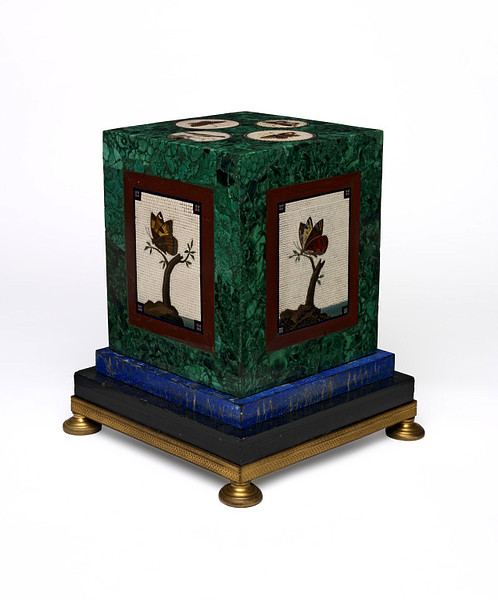
Unusual Artifacts: A Roman Micromosaic Specimen Block, 1800

Click Images for Larger Size

Specimen Block
Raffaeli, 1800
This and all related images from
The Victoria & Albert Museum


Created as a means of displaying a handsome group of early Italian micromosaics, this specimen block was assembled around 1800. And, it shows them off beautifully, but the block itself must not be dismissed as a mere display item. It’s quite impressive in its own right. The block is a rare Nineteenth Century example of an Italian use of malachite, a stone then found only rarely, and then, typically just outside of Russia. The malachite block stands on a plinth of lapis lazuli, and, this, on a base of black marble within a frame of gilt bronze.

The use of the butterfly form in the micromosaics is wholly Roman, owing to the ancient belief that the butterfly represented the soul leaving the body at the moment of death. The top of the malachite block is set with four lovely micromosaic roundels, each with a white background and three of them featuring the butterfly theme. The fourth depicts a bird resting on a branch.

The other four sides (not counting the side attached to the base), are each set with rectangular micromosaics featuring a depiction of a butterfly perched on a branch within a border of red marble.

While it’s difficult to date the micromosaics, it’s safe to assume that they’re Roman in origin. The valuable collection of panels was assembled by Giacomo Raffaelli (1753-1836). A similarly-set block of lapis lazuli is housed in a private Roman collection. This one was acquired by Sir Arthur and Rosalinde Gilbert and now is part of the V&A’s Gilbert Collection.


Tuesday, January 15, 2013

Sculpture of the Day: Mrs Freeman as Isis, 1789


Mrs. Freeman as Isis
England, 1789
The Victoria & Albert Museum

Just smaller than life-size, this bust is both a portrait of one Mrs Freeman, a good friend of the artist who lived in nearby Fawley Court, Buckinghamshire, and an allegorical depiction of a priestess of the Egyptian god Isis.

The sculptor, Anne Seymour Damer, curiously signed the bust in Greek lettering, which can be translated as “ANNA S. DAMER THE LONDONER MADE IT.” Anne Seymour Damer was the wife of the Hon. John Damer from 1767 until his suicide. After this shock, she trained as a sculptor.

Damer was a cousin of Horace Walpole (1717-1797), who encouraged his cousin’s artistic inclinations/. Walpole bequeathed his country house, Strawberry Hill at Twickenham, to Damer and her sister.

Damer practiced as an amateur--being an aristocratic woman, unable to pursue a real career in the arts. Because of this, she was not given the recognition she deserved. However, she did exhibit at the Royal Academy from 1784 to 1818 and also entertained “careers” as a novelist and stage performer.

The model here--Damer's good friend Mrs. Freeman was mentioned in the diary of a contemporary - the artist Joseph Farington (1747-1821) - as the mistress of the author and engraver Samuel Ireland.

Tuesday, November 27, 2012

Precious Time: Napoleon Bonaparte’s Pietre Dura Clock, 1804


Triumphal Arch Clock
Raffaelli and Breguet, 1804
The Victoria & Albert Museum
This magnificent clock wants to be studied. An impressive combination of various stones and gilt bronze, the clock takes the form of a Triumphal Arch of red and white antique marble with shimmering columns of amethyst topped by gilt bronze Corinthian capitals.


The two panels which flank the arch show micromosaic, pietre dure panels depicting military trophies. These pietre dure ornaments as well as other decorative inlays consist of amethyst, lapis lazuli, malachite, labradorite, jasper, agate, marble, and glass.

The whole of the clock case—designed by Giacomo Raffaelli—is surmounted by gilt bronze figures of Victory and Fame while the niche in the archway protects a statuette of Mars. Raffaelli and clockmaker Abraham-Louis Breguet worked together to create this gorgeous timepiece, hoping it would find its way into a prominent home. And, it certainly did.

Pope Pius VII had entrusted Venetian Sculptor Antonio Canova with the task of finding suitable gifts to present to Napoleon Bonaparte on the event of his coronation. The “Triumphal Arch Clock” (as it is known) was among the items selected by Canova for the occasion.

The Empress Josephine was said to have favored the clock and kept it as the centerpiece of her collection. Later, the clock was sold to pay off mounting debts. Purchased by Sir Arthur Gilbert and his wife Rosalinde in 1976, the clock was added to their impressive collection of decorative arts—considered one of the world’s greatest such collections. Gilbert loaned the clock to the Victoria & Albert Museum in 1996 where it remains on loan to this day.


The Home Beautiful: The John Jones Table, 1870


Center Table
c. 1870
The Victoria & Albert Museum
Celebrated for its beautiful hardstone work, this narrow, rectangular center table is supported by four tapering legs and is veneered in Mozambique rosewood and ebony on a structure of oak. The sides are set with plaques of hardstone and with one plaque of porcelain. The whole is adorned with mounts of gilt bronze


John Jones, an avid British collector of French 18th-century furniture and porcelain, bought this table between about 1870 and 1880, thinking that the table was already an antique. But, inspection of the table has proven otherwise. This table is narrower than most Eighteenth-Century tables. Furthermore, the combination of hardstones (pietre dure) with owed more to the tastes of the 1870s than the 1770s.

The table was most likely made shortly before John Jones purchased it. However, the hardstone panels of Marble, Alabaster, Chalcedony, Agate, Carnelian, Lapis-lazuli, Amethyst, Jasper, Carrara marble, Sainte Ann marble, and Belgium marble were probably made in Florence between about 1660 and 1690. So, at least a portion of it was antique. Nevertheless, Jones was quite proud of the table, and, if you wait long enough, anything can be an antique.


Tuesday, November 6, 2012

Sculpture of the Day: Admiral Sir Henry Keppel, c. 1900

Admiral Sir Henry Keppel
Crown Copyright
The Royal Collection
Image Courtesy of Her Majesty Queen Elizabeth II


If the name Keppel seems familiar, it might be because Alice Keppel was a favorite mistress of King Edward VII, and an ancestor of the present Duchess of Cornwall. One of Alice’s more famous relations was Admiral Sir Henry Keppel who also served King Edward VII, just in a different way. The Admiral also served under Queen Victoria.

This marble bust depicts Admiral Sir Henry Keppel (1809-1904) in his full dress uniform. It’s the work of Prince Victor of Hohenlohe-Langenburg, Count Gleichen, 3rd son of Ernest of Hohenlohe-Langenburg (1833-1891) and was made for Queen Victoria. It remains in the Royal Collection.


Wednesday, October 24, 2012

Sculpture of the Day: Victoria, Princess Royal as Summer, 1846

Victoria, Princess Royal as Summer
Mary Thornycroft
Britain, 1848
Crown Copyright
The Royal Collection
Image Courtesy of Her Majesty Queen Elizabeth II


One of a series by Mary Thornycroft (1814-1895) (wonderful name), this sculpture was given to Queen Victoria by Prince Albert on August 26, 1848. The series depicts the Royal offspring as the seasons. Exhibited at the Great Exhibition of 1851, the life-size marble statue depicts Princess Victoria, still a child, as Summer. She’s caught in a moment, just about to sit on a tree stump, wearing flowing robes in the classical style. The princess holds, in her left hand, a floral wreath and a sheaf of corn.


Saturday, September 1, 2012

Sculpture of the Day: The Sleep of Sorrow and the Dream of Joy, 1861


The Sleep of Sorrow and the Dream of Joy
Raffaelle Monti
London, 1861
This and all related images from:
The Victoria & Albert Museum


Since today’s trade card was so glum and sluggish, I thought we’d look at other historically grim and lethargic artwork today. Hooray! It’s a holiday weekend in the U.S.. Let’s look at depressed children. Well, at least this marble sculpture gives us some hope for better times.

The work of Italian-born sculptor Raffaelle Monti (1818-1881), this allegorical figural group was carved in 1861 to be shown in the International Exhibition in London in 1862. The group depicts a veiled figure of the “Dream of Joy” who hovers above the slumbering figure of “Sorrow.” So, Sorrow dreams of Joy? That seems about right. While the allegory is quite clear, the group was also meant to be a metaphor for the political climate at the time in Italy—a hopeful sign of growing cultural unity with the proclamation of a kingdom there on March 17, 1861.

Monti, born in Milan, worked predominantly in London where he enjoyed the patronage of the wealthy English. He’s best known, perhaps, for the enchanting sculptures which he created for the grounds of the Crystal Palace. Later in his life, Monty was employed at the famed Elkington & Co. where he was involved with the production of electrotypes. For Elkington, Monti created the largest known electrotype monument--an equestrian statue of Charles William Stewart, 3rd Marquess of Londonderry (1778-1854).

The sculptor’s work was quite beloved by the English. In fact, this sculpture was praised during the International Exhibition of 1862. Afterwards, it’s believed that the figure group was purchased by the chairman of the London Stereoscopic Company. Over the next century, it passed through the collections of many families. Eventually, it came into the hands of Mrs. Sarah Hoda of Essex who lent it to the V&A for an large display of items from the 1862 Exhibition, in celebration of its hundredth anniversary. Hoda sold the group to the V&A in 1964.