Showing posts with label parure. Show all posts

Wednesday, February 4, 2015

Mastery of Design: Queen Victoria's Anniversary Brooch, 1839

Brooch of Gold and Porcelain
Part of the Orange Blossom Parure
Commissioned by Prince Albert, 1845
Crown Copyright
The Royal Collection 
Image Courtesy of Her Majesty Queen Elizabeth II


This dear brooch of gold and white porcelain was a gift from Albert, the Prince Consort in 1845 for their wedding anniversary. Albert had appreciated the combination of white porcelain and gold, and had commissioned similar pieces for the Queen in this style.


This brooch takes the form of a sprig of orange blossoms—a flower usually associated with weddings. On the day of their wedding, Queen Victoria wore real sprays of orange blossoms on her bodice as well as in her hair. In commemoration of that, for their anniversaries, the Prince presented the Queen with jewels in the shape of orange blossoms—matching a pin he had made as an engagement gift. Eventually, Her Majesty amassed a beautiful orange blossom parure of which this piece became a part.

Upon the 1861 death of Prince Albert, Queen Victoria made a list of special jewels which were to be placed in “The Albert Room” at Windso Castle. This room was left untouched and none of its contents were allowed to be moved. Among the jewels displayed there were the pieces of the Orange Blossom Parure, including this brooch and its original presentation box.


Crown Copyright
The Royal Collection
Image Courtesy of Queen Elizabeth II

Crown Copyright
The Royal Collection
Image Courtesy of Her Majesty Queen Elizabeth II

Tuesday, May 27, 2014

Mastery of Design: Mary of Teck’s Silver Jubilee Necklace and Earrings


Necklace and Earrings
Sixteenth to Nineteenth Century
English
Gold, Enamel, Pearls, Rubies, Emeralds
The Royal Collection
This necklace and earrings (part of a parure which also includes a brooch) is actually a culmination of over three hundred years of workmanship. A masterpiece of gold, delicately-colored enamel, pearls, rubies and emeralds in a pattern of scrolls and snakes, the original links of the necklace date to the Sixteenth Century.


The necklace’s original owner was Mary, Queen of Scots who passed it to her attendant, Mary Seton. Over the centuries, the necklace was passed from family to family and altered considerably, though always with careful consideration in keeping the style of the necklace cohesive. The necklace was extended and the brooch was added in the Eighteenth Century. In the Nineteenth Century, the matching earrings were created.

Bu the 1930’s the parure was in possession of the Countess Bathurst where it was noticed by Queen Mary who admired it greatly. In 1935 for the Silver Jubilee of George V and Mary of Teck, the parure was presented as a gift to the Queen.

Crown Copyright
The Royal Collection
Image courtesy of Her Majesty Queen Elizabeth II

Click image to enlarge.


Thursday, April 3, 2014

Gifts of Grandeur: The Forget-Me-Not Demi-Parure, c. 1840


Parure
The British Museum


From The British Museum, we have this circa 1840 gold demi-parure set with turquoises and small diamonds in the from of sprays of Forget-Me-Knots.  The suite consists of a brooch and earrings.  These are the set at the top of the photo above.


Over time, owners of the suite added similar earrings and brooches which were made around the same time.  The entire suite was donated to The British Museum by Prof. John and Anne Hull Grundy in 1978.

Saturday, March 15, 2014

Gifts of Grandeur: The Pugin Headband, 1848


Headband
A.W.N. Pugin, 1848
The Victoria & Albert Museum

We have previously looked at a brooch which comprises partof this suite by famed architect (of Palace of Westminster fame) A.W.N. Pugin. Let’s, now, take a look at another piece from this same parure dating to 1848.

Designed by Pugin and made in Birmingham, this headband of enameled gold is set with a ruby, brilliant-cut diamonds, turquoises and pearls, and is one of the few, rare pieces of jewelry designed by the architect. Like the other pieces in the larger parure (suite) of jewels, the headband is created in the Gothic style that Pugin favored. Pugin was inspired by medieval ecclesiastical decoration in almost everything he set his mind to.

The headband bears the inscription “CHRISTI CRUX EST MEA LUX” (Christ's cross is my [guiding] light). Pugin designed this suite of jewels for the lady he proposed to make his third wife, but that marriage was not to be. A few months later, he met and married Jane Knill and offered the parure to her. The new Mrs. Pugin allowed for the suite to be shown at the 1851 Great Exhibition in London as part of the Medieval Court.


Sunday, January 26, 2014

Mastery of Design: The Countess Portman Oak Parure


Diamond Oak Leaf Parure
From the Hull Grundy Gift
This and all related images from:
The British Museum

All images can be enlarged by clicking on them.


Something about the description for this magnificent jewel in the collection of The British Museum put me in mind of "The Phantom of the Opera."  However, instead of a "chandelier in pieces," here, we have a tiara in three pieces.  


The diamonds are set, open-back, with silver prongs on a structure of gold which takes the form of branches of oak leaves and acorns.  


The three diamond sections can be worn mounted to two tortoise-shell combs, hooked together on a special mount as a brooch or on the golden crown frame as a tiara.  The various parts are still housed in their original case from the jeweler:  Hunt & Roskell, 156 New Bond Street.  The jewelled elements are interchangeable between the combs, the brooch-frame and the tiara. The lid of the case is stamped with a Viscount's coronet and the initials MP."


This suite is part of the Hull-Grundy gift to The British Museum which we've been examining these past few days.  


Text from catalogue of the Hull Grundy Gift tells us:

This set was sold at Sotheby's in 1970 (19 March, lot 140) with its original case. The gold initials and coronet on the lid suggest that the tiara may once have been owned by Mary Selina Charlotte Portman, daughter of Viscount Milton and wife of William Henry Berkeley, 2nd Viscount Portman; she was married on 1 June, 1855, and died in 1899.


Friday, January 17, 2014

Mastery of Design: A Cartier Ruby and Diamond Parure, 1954


Necklace, Clip and Earrings of Diamonds, Rubies and Platinum
Cartier, 1954
This and all related images from
The British Museum

Click image to enlarge


Made around 1954, this parure consists of a earrings and a necklace which boasts a detachable clip brooch as the dramatic central element. The group is made of fine Burmese rubies and diamonds set in platinum. They’re the work of Cartier’s London location. The parure is still fitted into its original red leather case. The Cartier name is emblazoned in gold on the lid.


Monday, November 25, 2013

Mastery of Design: An Impressive Reversible Mosaic Necklace, 1850


Necklace
Uppermost Face
Micromosaic Glass, Gold, Silver, Copper
Italian, 1850
The Victoria & Albert Museum

This impressive parure, consisting of a necklace, bracelet and earrings, truly is the definition of “mastery of design.” It has the unusual property of being reversible, per each individual section. Each of the micromosaic panels is double-sided. The wearer had the option of displaying scenes of monuments of Rome or images of figures in regional costume, or a combination of the two.


Each panel is comprised of the smallest glass pieces--containing more than 5000 pieces per square inch. The panels are set in silver held together by gold links and backed in a copper alloy. The work of an unknown jeweler, this magnificent suite is surely from Rome.


Reverse

The Suite

Sunday, November 3, 2013

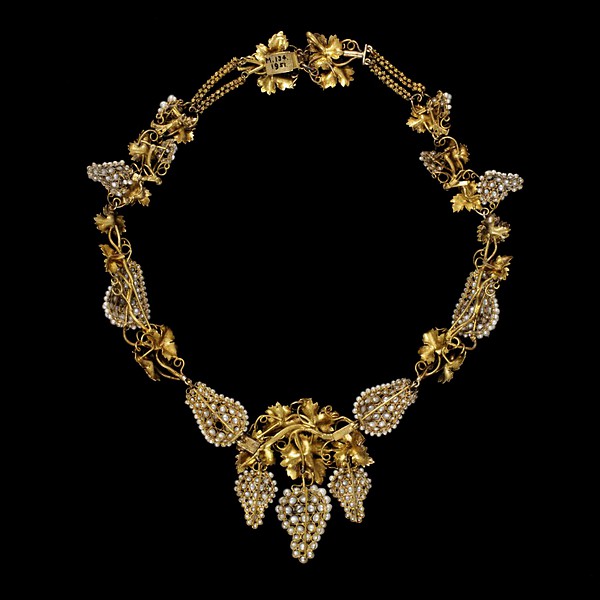
Mastery of Design: The Grapes and Vines Necklace, c. 1850


Necklace
Gold, Seed Pearls
English, c. 1850
The Victoria & Albert Museum


The visual motif of grapes and vines has been utilized in jewelry-making since antiquity. However, the idea saw a revival during the Victorian era when the fashion for sets of seed pearl jewelry gave jewelers the perfect “canvas” for grape-like forms. 

This English example, made around 1850, is the necklace from one of the most complex, elaborate and intricately-made grape parures that I’ve ever seen. The construction of the piece is exceptional. The pearls are attached with horsehair and silk to an elaborate framework made of gold wires. The varicolored gold gives an unusual depth and sense of naturalism to the suite. 


Saturday, October 5, 2013

Mastery of Design: The Schlichtegroll Necklace, 1855


Necklace from a parure
Vienna, c. 1855
The Victoria & Albert Museum


Austrian jeweler Schlichtegroll showed an impressive parure at Paris Universal Exhibition of 1855. The suite was purchased by the V&A after the exhibition as an example of a handsome and important-looking parure which was made inexpensively. The set includes a bracelet, brooch and earrings which were inspired by Seventeenth Century jewels. Schlichtegroll specifically designed the suite to be massed produced cheaply from parts which were interchangeable and standardized. 


It does look quite expensive, doesn’t it? It’s not junk, after all. Take a look at the necklace. It’s made of silver gilt, painted in imitation of enamel. The piece is set with almandine garnets, emeralds and green pastes, pearls and imitation pearls. So, there are some real gems, and some fakes, not unlike some of the less expensive jewels available today. It was meant for the merchant class who wanted to give the impression of being more prosperous than they really were—not quite aristocrats and not laborers. I think it serves its purpose quite handsomely and elegantly. 


Saturday, September 7, 2013

Masterpiece of the Week: The Joicey Garnet Parure, c. 1835


Parure of Gold and Garnets
English, c. 1835
The Victoria & Albert Museum


This posh parure looks affords the look of enormous wealth, however, it’s a bit of clever jewelry trickery. With mounts stamped from a thin sheet of gold, the pieces appear to be heavier than they are. The lushness of the stones is real enough, the warm red glow of carbuncles (almandine garnets, cut en cabochon), and, when combined with the swirling mounts, the overall impression is one of immense richness. 


Wednesday, August 7, 2013

Mastery of Design: The Countess Portman Oak Parure

Diamond Oak Leaf Parure
From the Hull Grundy Gift
This and all related images from:
The British Museum

All images can be enlarged by clicking on them.


Something about the description for this magnificent jewel in the collection of The British Museum put me in mind of "The Phantom of the Opera."  However, instead of a "chandelier in pieces," here, we have a tiara in three pieces.  


The diamonds are set, open-back, with silver prongs on a structure of gold which takes the form of branches of oak leaves and acorns.  


The three diamond sections can be worn mounted to two tortoise-shell combs, hooked together on a special mount as a brooch or on the golden crown frame as a tiara.  The various parts are still housed in their original case from the jeweler:  Hunt & Roskell, 156 New Bond Street.  The jewelled elements are interchangeable between the combs, the brooch-frame and the tiara. The lid of the case is stamped with a Viscount's coronet and the initials MP."


This suite is part of the Hull-Grundy gift to The British Museum which we've been examining these past few days.  


Text from catalogue of the Hull Grundy Gift tells us:

This set was sold at Sotheby's in 1970 (19 March, lot 140) with its original case. The gold initials and coronet on the lid suggest that the tiara may once have been owned by Mary Selina Charlotte Portman, daughter of Viscount Milton and wife of William Henry Berkeley, 2nd Viscount Portman; she was married on 1 June, 1855, and died in 1899.


Monday, August 5, 2013

Mastery of Design: The Forget-Me-Not Demi-Parure, c. 1840

Parure
The British Museum


From The British Museum, we have this circa 1840 gold demi-parure set with turquoises and small diamonds in the from of sprays of Forget-Me-Knots.  The suite consists of a brooch and earrings.  These are the set at the top of the photo above.


Over time, owners of the suite added similar earrings and brooches which were made around the same time.  The entire suite was donated to The British Museum by Prof. John and Anne Hull Grundy in 1978.


Sunday, May 19, 2013

Sunday Sparkle: The Pugin Brooch, 1848


Brooch
Part of a Parure (see below)
A.W.N. Pugin
Gold, Enamel, Garnet, Rubies, Turquoise, Pearls
This, and all related images:
The Victoria & Albert Museum
If the V&A ever has a garage sale or “jumble,” I have dibs on this brooch of enameled gold, set with a ruby, cabochon garnets, turquoises and pearls
Not only is it extremely beautiful, but, it’s got an interesting provenance. It’s one of the few pieces of jewlery designed by the English architect A.W.N. Pugin (partially responsible for the Palace of Westminster). Part of a large parure of jewels by Puding, designed in the Gothic style that he favored, this delicious brooch is inspired by medieval ecclesiastical adornment.

Pugin had a motive for designing this brooch. He designed it for the lady whom he proposed to make his third wife. That marriage was not to be, however, and, in 1848, he offered the parure to one Jane Knill who not only accepted the big box of sparklies, but also agreed to be his third wife. Considered excpetionally spectacular—the jewels, not Jane--in 1851, the complete parure was displayed at the Great Exhibition in London as part of the Medieval Court.