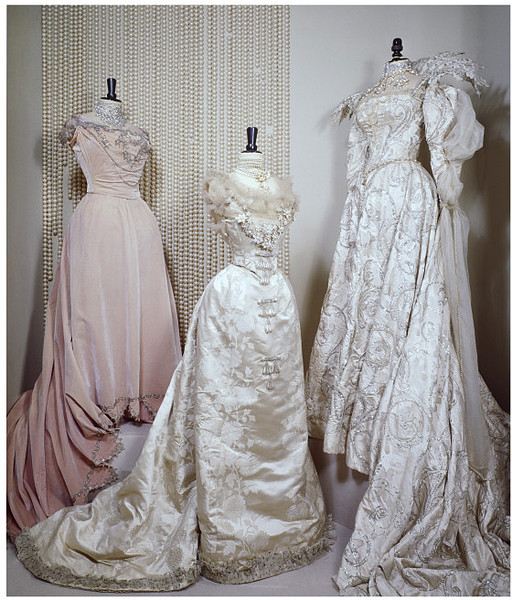
Showing posts with label Paris. Show all posts

Monday, June 23, 2014

Her Majesty's Furniture: The Putti Cabinet, 1855


Cabinet
Jackson and Graham, 1855
This and all related images from:
The Victoria & Albert Museum


This handsome cabinet was not made for domestic use, but rather as a sample of the ingenuity and talents of the craftsmen and designers of the London furnishing firm of Jackson and Graham. Made in the Eighteenth Century style, the cabinet was presented at the Paris International Exhibition of 1855 where it was heralded for its fineness.

The 1855 catalog notes of the cabinet that “the interior is finished with as much care as the exterior, being of satin-wood inlaid with tulip-wood and the fronts of the drawers inlaid with ivory and panelled, the panels being fitted with finely-chased and gilded metal-work.”  


The stars of the show are the three porcelain mounts depicting putti representing the arts.  These panels are mounted in gilt moldings which echo the shape of the central mirror.

The piece was designed by Alexandre Prignot (born 1822) who had been the chief designer for Jackson and Graham from 1849 to 1855. This piece was one of his final triumphs. The ceramics were supplied by Minton & Co. while Elkington & Co, offered the electroplated mounts. Cope and Collinson provided the casters.

The marquetry, giltwood, and inlays of marble and porcelain drew much positive attention and praise at the 1855 exhibition as did the mirror which surmounted the cabinet. 


Sunday, April 27, 2014

Royal Fashion: Princess Alexandra’s Evening Dress, 1900


Evening Dress
Made for Princess Alexandra of Denmark, 1900
The Victoria & Albert Museum
As both Princess of Wales and Queen Consort, Alexandra of Denmark was known for her impeccable fashion sense and her enduring beauty. Her style was the benchmark for upper class fashion and ladies of the court looked to Queen Alexandra to see what was in vogue.

Here’s one of her gowns. This elegant evening dress of figured satin, decorated with imitation pearls, diamantes and spangles was designed by the famous Paris fashion house Maison Laferrière which was was frequented by only the wealthiest in London society. Maison Laferrière was celebrated for their exquisite designs and fine workmanship. The chief mind behind the fabulous fashion house was Madame Laferrière's whose designs were among those shown by the Collectivité de la Couture at the Universal Exhibition of 1900 held in Paris.

This gown was made for Princess Alexandra of Denmark (later Queen Alexandra). It was given to theVictoria & Albert Museum by one Lady Lloyd as part of the Cecil Beaton Collection—an exhibition of style collected by the society photographer Sir Cecil Beaton (1904-1980). 


Thursday, March 13, 2014

Object of the Day, Museum Edition: A Potpourri Case and Pastille Burner, 1730s


Click image to enlarge.
Potpourri Case and Pastille Burner
St. Cloud Porcelain Factory
Paris, 1730s
The Victoria & Albert Museum


Made in Paris in the 1730s, this potpourri case and cover is made of porcelain. It takes the from of a gourd with an oval opening at the top. The cover fits into this aperture which is surrounded by perforations which allow the scent to escape. 


The piece of soft-paste porcelain is molded in relief. The work of the Saint-Cloud Porcelain Factory, the vase also doubles as a pastille burner. Pastilles were a tablet of a fragrant medium bound in gum which, when heated by a candle flame in the base, emitted a pleasing aroma. 

Tuesday, February 18, 2014

Serious Style: A Balenciaga “Balloon” Evening Dress, 1950


Balloon Gown
Balenciaga, 1953-1954
This and all related images from:
The Victoria & Albert Museum


In the 1950s, high society ladies were intrigued with the designs of Cristóbal Balenciaga (1895-1972) who offered up a collection of sumptuous and theatrical evening gowns of silk taffeta which were inspired by dramatic drapery and flounces.

Here’s one of them. Designed by Balenciaga in Paris between 1953 and 1954, this gown of cerise silk taffeta features a bouffant back which offers an extravagant contrast to the simple lines of the v-neck front of the sleeveless sheath. A slit at the center of the tapered, narrow skirt allows the wearer a greater range of motion.

The back of the dress is composed of swathed flounces over doubled tiers of triangularly-cut taffeta. These layers are wired to help them retain their shape even after the wearer has been sitting.

Lined with chiffon, the dress fastens with a metal zip and a row of covered buttons at the reverse of the boned and padded bodice.

Balenciaga nicknamed this gown the “Balloon Dress.” It’s one of two which were made that season. The other is crafted of pale blue silk taffeta. This style nodded at the scale and extravagance of historical dress while keeping a modern silhouette and demonstrated a penchant for Nineteenth-Century designs which Balenciaga shared with Dior. By the 1960s, however, Balenciaga had transitioned to simpler designs.


Fans of FX's "American Horror Story," may be put in mind of the "Coven" character "Myrtle Snow" and her famous last word.  As Myrtle is bravely burned at the stake for a second time (this time voluntarily), the fashionista-spell-caster shouts, "Balenciaga" whilst wearing a red gown which is certainly an intentional nod to the designer's brilliant cherry works of this era.

Pardon the loop of "Balenciaga" on this video before Myrtle is...uh... enflamed, but it was the only clip available.


Monday, January 27, 2014

Print of the Day: Royal visit to Napoleon III: Queen Victoria's Entry into Paris, 18 August 1855.


Click image for larger size.
Queen Victoria's Royal Visit to Napoleon III
Goorgen, 1855
Crown Copyright
The Royal Collection
Image Courtesy of Her Majesty Queen Elizabeth II


Signed simply, “Goorgen,” this print from 1855 depicts the arrival of Queen Victoria in Paris on August 18. The Royal party drives through the triumphal arch which had been raised by the “artistes” of the Paris Opéra on the Rue Le Peletier. This image serves to demonstrate the grand fuss which had been made in conjunction with the arrival of the Queen and Prince Albert.


Tuesday, November 5, 2013

Gifts of Grandeur: The Gérard Sandoz Cigarette Case, 1929


Click Image to Enlarge.
Cigarette Case
Sandoz of Paris, c. 1932
The Victoria & Albert Museum


As cigarette smoking became the stuff of the elegant and fashionable, suitably posh accessories were created by jewelers to cash-in on the deadly habit. Lighters, cigarette holders and cigarette cases were made of the finest metals and gems, and, give a pretty face to a nasty practice. 

Take this handsome cigarette case from Paris. Made in 1929 by Gérard Sandoz, the flat, rectangular case is characteristic of the geometry of Art Deco design. Sandoz was a top Parisian jeweler whose angular style was one of the most influential of any jeweler of his period. You can see his favored style here with the geometric pattern of green, black and white enamel on silver. A stripe below the triangular pattern of the case is inlaid with eggshell—an odd medium for the day. However, Sandoz was a proponent of incorporating new materials into jewelry, and, obviously, he was quite good at it.  


Wednesday, September 25, 2013

Building of the Week: The Palais Garnier, Paris


The Palais Garnier as it is today

From its founding in 1669 by King Louis XIV, The Paris Opéra has called several different venues its home. Prior to 1821, three of the ten opera houses in which The Paris Opéra found a home had been destroyed by fire. In 1821, the Opéra opened a new opera house called Salle Le Peletier which remained in operation until 1873. The Salle Le Peletier had seen innumerable artistic triumphs as well as a host of important visitors including Queen Victoria in 1855. However, by 1858, Emperor Napoleon III—as part of his Second Empire reconstruction of Paris—had seen the need to build a larger home for the Opéra. Napoleon III envisioned a grander version of the Salle Le Peletier with soaring domes and magnificent architecture.

The Grand Foyer
The emperor enlisted the Baron Haussmann to oversee the construction. A contest was open to architects who wished to submit their designs for the new opera house. In 1861, the competition was won by architect Charles Garnier for whom the building is now named.

Construction was slated to begin in 1862. The Empress Eugénie is rumored to have asked Garnier if he considered his creation to be in Greek or Roman style. His response was, “It is in the Napoleon III style, Madame!” And, so it was. Napoleon selected the land upon which the Opéra was to be built—a section in the 9th arrondissement of Paris. The land, however, was not terribly cooperative owing to its swampiness and the presence of a subterranean lake. Water was pumped from the location for eight months, but the lake would not abate. Garnier was forced to amend the designs for the foundation to be built over the lake. And, so it remains today.
The Grand Staircase
The presence of the lake under the Opéra was one of the chief inspirations for the 1910 novel, The Phantom of the Opera, by Gaston Leroux. The other was the famous failing of a chandelier’s counterweight which caused the fixture to plummet to the floor, crushing one person to death. Of course, this figures prominently into Leroux’s story, and perhaps, more famously, into the musical version of the same name by Andrew Lloyd-Webber

But, before chandeliers could crush anyone, or, even, before a singer could belt out a note, the Opéra had to be finished. The construction was stalled by numerous setbacks—not the least of which was the Franco-Prussian War and the resulting collapse of The Second Empire. For awhile, the Opéra feared that the skeleton of their new home would have to be demolished due to lack of funds and a distinct political disinterest in finishing the building.

In 1873, circumstance forced the completion of the new opera house when a fire rampaged through the Salle Le Peletier—raging for twenty-seven hours and completely destroying the home of the Paris Opéra. The Palais Garnier was completed in 1874, giving the Opéra a permanent new home and the people of France a reason to celebrate.
The Theater
A rich confection in the Beaux Arts style, the Palais Garnier is a magnificent combination of multi-colored marble, bronze, gilding, glass, columns and statuary. With its majestic central staircase, magnificently frescoed vaults and color scheme of red and gold, it truly is a palace of the arts. The centerpiece of the monumental theater is an enormous crystal chandelier which weighs over six tons—this time, properly weighted and firmly held to the domed ceiling.

The dome of the theater itself was repainted in 1964 by Marc Chagall in a modern style and color palette which proved to be controversial. While some felt that Chagall’s fresco was a fitting addition to a building which was, in essence, a temple to the arts, others believed that Chagall’s work was out of place and inappropriate to the Beaux Arts style and velvety architecture of the Palais Garnier. Forty-seven years later, Chagall’s work remains, and while quite accepted, still raises some eyebrows.
Chagall's Dome
The façade of the Palais Garnier features a variety of sculptures including busts of famous composers, two gilded figural groups of Charles Gumery (of “Harmony” and “Poetry”) and a central sculptural group by Aimé Millet which is called, “Apollo, Poetry and Music.” The architectural rhythm of the façade is repeated in the interior grand foyer—substituting lavish colored marble for the cool exterior stone. Hung with mirrors and chandeliers, the foyer is quite operatic in and of itself.

Aside from Chagall’s painting and some technological changes, the Palais Garnier remains much as it was in 1874 and gives one a sense of the epic scheme that Napoleon III had for Paris. Though the Second Empire did not survive, Garnier’s creation of “Napoleon III style” has remained relatively untouched and has served as a source of inspiration for generations of artists of all media. 


Monday, April 15, 2013

History's Runway: Princess Alexandra’s Evening Dress, 1900


Evening Dress
Made for Princess Alexandra of Denmark, 1900
The Victoria & Albert Museum

As both Princess of Wales and Queen Consort, Alexandra of Denmark was known for her impeccable fashion sense and her enduring beauty. Her style was the benchmark for upper class fashion and ladies of the court looked to Queen Alexandra to see what was in vogue.

Here’s one of her gowns. This elegant evening dress of figured satin, decorated with imitation pearls, diamantes and spangles was designed by the famous Paris fashion house Maison Laferrière which was was frequented by only the wealthiest in London society. Maison Laferrière was celebrated for their exquisite designs and fine workmanship. The chief mind behind the fabulous fashion house was Madame Laferrière's whose designs were among those shown by the Collectivité de la Couture at the Universal Exhibition of 1900 held in Paris.

This gown was made for Princess Alexandra of Denmark (later Queen Alexandra). It was given to theVictoria & Albert Museum by one Lady Lloyd as part of the Cecil Beaton Collection—an exhibition of style collected by the society photographer Sir Cecil Beaton (1904-1980). 


Monday, March 11, 2013

Object of the Day, Museum Edition: The Barye Elephant, 1880

Elephant du Senegal
Antoine-Louis Barye, 1855
Cast by Barbedienne around 1880
The Victoria and Albert Museum


Antoine-Louis Barye, a prolific sculptor of the Nineteenth Century, was celebrated for his “animilier” sculptures. These highly-detailed, true-to-life figures offered a glimpse at exotic animals, the likes of which most Parisians at the time would never see in person.

Here, we have a bronze figure of an “Elephant du Sénégal” (Senegalise Elephant) which was modeled before 1855. This cast bears the mark of Ferdinand Barbédienne (1820-1892). Barbédienne, in 1838, established a foundry whose hundreds of worker produced thousands of models a year. The works of this foundry supplied bronzes of various sizes for the growing demand from middle-class households for important-looking figures. Upon the death of Barye in 1875, his designs were taken over Barbédienne who sold them exclusively.

A version of this elephant first appeared in the catalogue issued by Barye in 1855, but this model is likely a later casting from Barbédienne's foundry and probably dates to about 1880.


Saturday, February 23, 2013

At the Music Hall: “Parisian Pierrot,: 1923


Gertrude Lawrence
Parisian pierrot, society’s hero
The lord of the day, the Rue de la Paix
Is under your sway
The world may flatter but what does that matter?
They’ll never shatter your bloom profound
Parisian pierrot, your spirit’s at zero
Divinely forlorn, with exquisite scorn
From sunset to dawn
The limbo is calling, your star will be falling
As soon as the clock goes round

Parisian pierrot, your spirit’s at zero
Divinely forlorn, with exquisite scorn
From sunset to dawn
The limbo is calling, your star will be falling
As soon as the clock goes round 


This popular song with music and lyrics by Noël Coward is known to many of us from its appearance in the film “Star!” which starred Julie Andrews as Coward’s longtime friend, Gertrude Lawrence. However, the song was one of Coward’s most memorable long before Miss Andrews turn in the biopic. Coward debuted “Parisian Pierrot” as well as a host of others in the 1923 musical revue “London Calling!” which was produced by André Charlot.

“London Calling!” opened in London's Duke of York's Theatre on September 4, 1923. It was famous Noël Coward's first publicly produced musical. The revue caused quite a sensation, not only for its music, but also for incorporating a 3-D stereoscopic shadowgraph during the opening act.

"Parisian Pierrot", as sung by Gertrude Lawrence, was Coward's first huge hit and, consequently, it became one of his signature tunes—a song which her performed himself until his death. We have two versions here. One as performed by Coward and, the other, a clip from “Star!”


Wednesday, February 13, 2013

The Home Beautiful: The Boucheron Hand Mirror, 1860-65


Hand Mirror
Boucheron, 1860-1865
Enameled Gold, Diamonds, Rubies and Pearls
Presented to Queen Mary and King George V
Crown Copyright
The Royal Collection 
Image Courtesy of Her Majesty Queen Elizabeth II


Made by Boucheron between 1860 and 1865, this hand mirror glistens with a frame of gold, enamel, pearls, rubies and diamonds.  

The mirror was presented to George V and Queen Mary, while still Prince and Princess of Wales, by the Aga Khan. 
 Before that, the mirror was exhibited at the Paris Exhibition of 1867 where it was purchased  by the Earl of Dudley.

This oval hand mirror features a faceted beveled edge and gold enameled frame set with scalloped flat-cut ruby collets. The outer border is set with a red and green enameled honey suckle pattern with pearls set in rose diamond acanthus cups, with pearls between. The top of the mirror boasts a diamond fleur-de-lys.
 A pierced gold, scrollwork handle is set with rubies, diamonds and pearls, and showcases heart-shaped shields of painted enamel and enamel bars.

This mirror was enameled by Armand-Désir Riffault (1832-1872), a jeweler and enameller who worked for Boucheron.
  Riffault famously crafted elegant objects for the Paris exhibition of 1867.

According to the curators of the Royal Collection, “This mirror, enameled by Riffault for the 1867 exhibition in the Renaissance style, won praise from the officials and the press and Riffault, together with Boucheron, were awarded a 'Médaille de bronze' for it.”


Tuesday, October 23, 2012

Print of the Day: Royal visit to Napoleon III: Queen Victoria's Entry into Paris, 18 August 1855.


Click image for larger size.
Queen Victoria's Royal Visit to Napoleon III
Goorgen, 1855
Crown Copyright
The Royal Collection
Image Courtesy of Her Majesty Queen Elizabeth II


Signed simply, “Goorgen,” this print from 1855 depicts the arrival of Queen Victoria in Paris on August 18. The Royal party drives through the triumphal arch which had been raised by the “artistes” of the Paris Opéra on the Rue Le Peletier. This image serves to demonstrate the grand fuss which had been made in conjunction with the arrival of the Queen and Prince Albert.


Wednesday, October 17, 2012

History's Runway: A Balenciaga “Balloon” Evening Dress, 1950

Balloon Gown
Balenciaga, 1953-1954
This and all related images from:
The Victoria & Albert Museum


In the 1950s, high society ladies were intrigued with the designs of Cristóbal Balenciaga (1895-1972) who offered up a collection of sumptuous and theatrical evening gowns of silk taffeta which were inspired by dramatic drapery and flounces.

Here’s one of them. Designed by Balenciaga in Paris between 1953 and 1954, this gown of cerise silk taffeta features a bouffant back which offers an extravagant contrast to the simple lines of the v-neck front of the sleeveless sheath. A slit at the center of the tapered, narrow skirt allows the wearer a greater range of motion.

The back of the dress is composed of swathed flounces over doubled tiers of triangularly-cut taffeta. These layers are wired to help them retain their shape even after the wearer has been sitting.

Lined with chiffon, the dress fastens with a metal zip and a row of covered buttons at the reverse of the boned and padded bodice.

Balenciaga nicknamed this gown the “Balloon Dress.” It’s one of two which were made that season. The other is crafted of pale blue silk taffeta. This style nodded at the scale and extravagance of historical dress while keeping a modern silhouette and demonstrated a penchant for Nineteenth-Century designs which Balenciaga shared with Dior. By the 1960s, however, Balenciaga had transitioned to simpler designs.


Wednesday, October 10, 2012

Object of the Day: A Double-sided Stereograph

Click on image to be novel.


Made to be viewed in a stereoscope, a popular novelty of the Nineteenth Century, these cards feature side-by-side, off-set pictures which, when seen through the viewer, would appear as a 3-D image. A number of companies produced such cards and viewers. Every so often, as in this case, the stereographs were hand-colored.

I’m not sure who published this stereograph. There’s no mark whatsoever. What’s unusual about it is that it’s two sided. Prior to seeing these few which were recently added to my collection, I’d not come across other two-sided stereographs. Usually, this would have been prohibitive because of the intention curve given to most cards in order to produce the 3-D effect. Images on the back would have curved the wrong way and made a distorted image. However, this card is flat, allowing for a double-sided image. Since I don’t actually have a stereoscope, I can’t see how the flatness alters the dimension of the final image. 

The card boasts off-set images of Paris’ Notre Dame Cathedral on one side and Spain’s Court of the Fishes at The Alhambra on the other. Such architectural images were popular themes for stereographs as they provided opportunities for visual depth.


You can click on this one, too.

Tuesday, October 9, 2012

Mastery of Design: The Gaillard Parasol Handle, c. 1900

Parasol Fittings
Gaillard, 1900
The Victoria & Albert Museum


The work of Parisian maker Lucien Gaillard, we see here fittings from a parasol. Made around 1900, the parasol’s handle is made of carved and bleached horn which has been set with pearls and small rubies in gold settings. The other fittings, tips for the spokes, are made of carved tortoiseshell.


Thursday, August 23, 2012

Her Majesty's Furniture: The Putti Cabinet, 1855

Cabinet
Jackson and Graham, 1855
This and all related images from:
The Victoria & Albert Museum


This handsome cabinet was not made for domestic use, but rather as a sample of the ingenuity and talents of the craftsmen and designers of the London furnishing firm of Jackson and Graham. Made in the Eighteenth Century style, the cabinet was presented at the Paris International Exhibition of 1855 where it was heralded for its fineness.

The 1855 catalog notes of the cabinet that “the interior is finished with as much care as the exterior, being of satin-wood inlaid with tulip-wood and the fronts of the drawers inlaid with ivory and panelled, the panels being fitted with finely-chased and gilded metal-work.”  


The stars of the show are the three porcelain mounts depicting putti representing the arts.  These panels are mounted in gilt moldings which echo the shape of the central mirror.

The piece was designed by Alexandre Prignot (born 1822) who had been the chief designer for Jackson and Graham from 1849 to 1855. This piece was one of his final triumphs. The ceramics were supplied by Minton & Co. while Elkington & Co, offered the electroplated mounts. Cope and Collinson provided the casters.

The marquetry, giltwood, and inlays of marble and porcelain drew much positive attention and praise at the 1855 exhibition as did the mirror which surmounted the cabinet. 


Saturday, August 18, 2012

At the Music Hall: “Parisian Pierrot,: 1923

Gertrude Lawrence


Parisian pierrot, society’s hero
The lord of the day, the Rue de la Paix
Is under your sway
The world may flatter but what does that matter?
They’ll never shatter your bloom profound
Parisian pierrot, your spirit’s at zero
Divinely forlorn, with exquisite scorn
From sunset to dawn
The limbo is calling, your star will be falling
As soon as the clock goes round

Parisian pierrot, your spirit’s at zero
Divinely forlorn, with exquisite scorn
From sunset to dawn
The limbo is calling, your star will be falling
As soon as the clock goes round 


This popular song with music and lyrics by Noël Coward is known to many of us from its appearance in the film “Star!” which starred Julie Andrews as Coward’s longtime friend, Gertrude Lawrence. However, the song was one of Coward’s most memorable long before Miss Andrews turn in the biopic. Coward debuted “Parisian Pierrot” as well as a host of others in the 1923 musical revue “London Calling!” which was produced by André Charlot.

“London Calling!” opened in London's Duke of York's Theatre on September 4, 1923. It was famous Noël Coward's first publicly produced musical. The revue caused quite a sensation, not only for its music, but also for incorporating a 3-D stereoscopic shadowgraph during the opening act.

"Parisian Pierrot", as sung by Gertrude Lawrence, was Coward's first huge hit and, consequently, it became one of his signature tunes—a song which her performed himself until his death. We have two versions here. One as performed by Coward and, the other, a clip from “Star!”


Wednesday, August 15, 2012

Unusual Artifacts: A Potpourri Case and Pastille Burner, 1730s

Click image to enlarge.
Potpourri Case and Pastille Burner
St. Cloud Porcelain Factory
Paris, 1730s
The Victoria & Albert Museum


Made in Paris in the 1730s, this potpourri case and cover is made of porcelain. It takes the from of a gourd with an oval opening at the top. The cover fits into this aperture which is surrounded by perforations which allow the scent to escape. 


The piece of soft-paste porcelain is molded in relief. The work of the Saint-Cloud Porcelain Factory, the vase also doubles as a pastille burner. Pastilles were a tablet of a fragrant medium bound in gum which, when heated by a candle flame in the base, emitted a pleasing aroma. 


Sunday, August 5, 2012

Gifts of Grandeur: The Gérard Sandoz Cigarette Case, 1929


Click Image to Enlarge.
Cigarette Case
Sandoz of Paris, c. 1932
The Victoria & Albert Museum


As cigarette smoking became the stuff of the elegant and fashionable, suitably posh accessories were created by jewelers to cash-in on the deadly habit. Lighters, cigarette holders and cigarette cases were made of the finest metals and gems, and, give a pretty face to a nasty practice. 

Take this handsome cigarette case from Paris. Made in 1929 by Gérard Sandoz, the flat, rectangular case is characteristic of the geometry of Art Deco design. Sandoz was a top Parisian jeweler whose angular style was one of the most influential of any jeweler of his period. You can see his favored style here with the geometric pattern of green, black and white enamel on silver. A stripe below the triangular pattern of the case is inlaid with eggshell—an odd medium for the day. However, Sandoz was a proponent of incorporating new materials into jewelry, and, obviously, he was quite good at it.