Showing posts with label ancient. Show all posts

Tuesday, February 17, 2015

Unusual Artifacts: The Castellani Etruscan Scarab Necklace, 500 B.C. to 1925 A.D.


Necklace
Ancient Granulated Gold Beads and Etruscan
Carnelian Scarabs set in Gold.
Artifacts: 500 - 300 B.C.
Setting: 1920-1025
Castellani, Rome
This and all related images:
The Victoria & Albert Museum

This beautiful necklace is the result of over two thousand years of artistry. In the Nineteenth Century, jewelers began to experiment with resurrecting ancient jewelry styles which they based on then-recent archeological finds. The trend reached new heights of popularity in the early Twentieth Century.

The Italian jewelry firm, Castellani, was among the leaders in this movement. This necklace is an adaptation of archeological-style jewelry which is rooted both in Nineteenth Century ideals and ancient styles as well as incorporates actual Etruscan artifacts into the piece.

The jeweler based the design on earlier Nineteenth Century prototypes, chiefly, the Campana Collection necklace which is housed in the Louvre. This design features authentic Etruscan carnelian scarabs strung with truly ancient, granulated gold beads. Using these ancient elements to produce a necklace in a new, popular style was both a novelty and a way of rescuing broken and discarded artifacts. 


Tuesday, July 15, 2014

Mastery of Design: A Hellenistic Gold, Emerald and Garnet Necklace, 200 B.C.-100 B.C.


Necklace
Gold, Emeralds, Garnets, Glass
Greek, 200-100 B.C.
The Victoria & Albert Museum

In Greece, during the Hellenistic period (323-27 BC), all of the arts thrived and artists of every conceivable medium began to examine the relationships between different colors. Even Hellenistic jewelers had become fascinated with the concept of color and began to play with different combinations of gold and gemstones. 

During this period, garnets were the most popular gemstone—prized for their deep, wine color. Garnets were often combined with emeralds, carnelian, rock crystal, agates, onyxes or lapis-lazuli to great effect. While the gems were not faceted in the manner of more modern gem cuts, they were often elaborately carved, pierced, and polished. Jewelers even began to toy with the idea of using colored glass to simulate the look of costlier stones. In this necklace, for example, glass was used to imitate onyx and pearl.

Reverse
The fashion of the day dictated that necklaces should be worn tight around the neck like a modern-day choker. This magnificent necklace of gold, polished garnets and emeralds, originally featured a ribbon at the back to allow the wearer to fasten it snugly against her throat. Necklaces such as this were meant to be worn with others, rising high upon the neck. Usually, the central piece was ornate, as is the case of this one, augmented by tight strings of beads in matching colors.


Saturday, June 28, 2014

To Serve and Project: The John Addis Jun Ware Bottle, 12th C.


Jun Ware Bottle, Song Dynasty, 12th C.
The Victoria & Albert Museum


This celestite blue bottle is representative of a type of Chinese ceramics known as Jun ware. Overall, Chinese ceramics are typically categorized by the geographical area in which they were made since the kilns of a particular region usually only produced one or two types of ceramics at any given time in history. 

Jun ware was a product of the kilns of the Henan province, reaching its apex during the Song dynasty (960-1279). This pottery is identified visually by its coarse stoneware body and its shiny blue glaze. Another identifying characteristic is the presence of a red spot or spots on the vessels, a visual cue evident in this example. This is due to the copper-rich pigment on the ceramic body beneath the glaze.

While some types of Chinese ceramics were made exclusively for the imperial household, Jun ware, conversely, was produced for popular. By the Qing dynasty the status of these ceramics had elevated since the Qianlong emperor (reigned 1736-95) was an admirer of them and used them for decorating his home.


Wednesday, June 25, 2014

Figure of the Day: An Actor, 2nd C. BC


An Actor
Etruscan, Second Century B.C.
The British Museum


Made in Italy in the Second Century B.C., this terracotta figure depicts a comic actor. As was the theatrical style of the time, the actor has donned a mask. This mask is a broad representation of a bald slave. He carries something in his hand, but what? Is it a purse? We’re unsure. The figure was found in Carino, Italy and is an excellent representation of the figural work of our Etruscan forebears.


Saturday, May 17, 2014

Mastery of Design: The Shepherds and Goats Signet Ring, 200-100 BC


Intaglio Ring
Italy, 200-100 B.C.
The Victoria & Albert Museum


A vertically-positioned oval intaglio of brown-hued carnelian is the centerpiece of this ancient ring which nicely demonstrates the mastery of early Roman gem carving.

It’s thought that this ring was meant to represent a shepherd. The conclusion makes sense since it depicts a young man with a goat which, I’m guessing, represents his flock. It’s hard to carve a whole flock of goats onto a ring. Don’t let the fact that the young man is nude bother you.

Others suggest that since the fellow has no clothes on, he could be the god Mercury. I don’t know if I’d want to be a shepherd with no pants. So, Mercury is a good guess, too, especially since Mercury’s attribute is often a ram and he does tend to be shown wearing the sort of broad-brimmed hat favored by farmers and travelers.

Either way, the goat’s not too happy. Maybe he doesn’t like the pan flute. Goats probably don’t care for pipe music.

The ring was made in Italy circa 200-100 BC. Of course, it ended up in the collection of the Reverend Chauncy Hare Townshend (1798-1868), who preferred collecting jewelry to being a clergyman. I agree with him wholeheartedly.


Wednesday, March 12, 2014

Gifts of Grandeur: Pendant of the Dwarf God Bes, c. 600 BC


Pendant of the Dwarf God Bes
Egypt, c. 600 BC
The Victoria & Albert Museum


I confess, I picked this jewel for today because I was tickled by the title of “The Dwarf God Bes.” Bes, it seems, was an Egyptian deity of music, war and childbirth. I’m not sure how all of those things go together, but there you have it. Oh, and, yes, he was also a dwarf. And, he was thought to be good luck. Charms of Bes were placed around the home to protect the house and pendants such as this one were worn to protect the wearer during war, childbirth, or…um…music. Again, they don’t really go together. But, who am I to argue with a dwarf god? 


This pendant is constructed of gold and adorned with glazed steatite. It was made in Egypt between 600BC-100BC.


History's Runway: An Egyptian Tunic, 670-870


Tunic
Egypt, 670-870
The Victoria & Albert Museum


The history of fashion is as long as the history of humankind. As long as there’s been nudity, we’ve sought attractive ways to cover ourselves. To this end, textiles have been made for centuries. For example, in the late Roman Empire and in Byzantine Egypt, textiles were made commercially by weavers for sale to households, and, often by commission. These lush fabrics were used to create tunics—garments which were similar for both men and women.

While initially a garment constructed of one piece of fabric, by the Fifth Century, tunics were made in three pieces and adorned with a belt. One of the most popular patterns were stripes, both in Rome and Coptic Egypt.

This tunic of red wool, dating between 670 and 870, heralds from Egypt. It is adorned with white vertical strikes at the sides and, at the neck, features a woven tapestry of colored wools and linen thread.

Like later tunics, this one is made up of several pieces which have been seamed and cuffed. The sleeves are open under the arms. Though stained and slightly decayed, it’s an exceptional example of fashion of the Seventh to Eighth Century Egypt.

Sunday, November 17, 2013

Mastery of Design: The Shepherds and Goats Signet Ring, 200-100 BC


Intaglio Ring
Italy, 200-100 B.C.
The Victoria & Albert Museum


A vertically-positioned oval intaglio of brown-hued carnelian is the centerpiece of this ancient ring which nicely demonstrates the mastery of early Roman gem carving.

It’s thought that this ring was meant to represent a shepherd. The conclusion makes sense since it depicts a young man with a goat which, I’m guessing, represents his flock. It’s hard to carve a whole flock of goats onto a ring. Don’t let the fact that the young man is nude bother you.

Others suggest that since the fellow has no clothes on, he could be the god Mercury. I don’t know if I’d want to be a shepherd with no pants. So, Mercury is a good guess, too, especially since Mercury’s attribute is often a ram and he does tend to be shown wearing the sort of broad-brimmed hat favored by farmers and travelers.

Either way, the goat’s not too happy. Maybe he doesn’t like the pan flute. Goats probably don’t care for pipe music.

The ring was made in Italy circa 200-100 BC. Of course, it ended up in the collection of the Reverend Chauncy Hare Townshend (1798-1868), who preferred collecting jewelry to being a clergyman. I agree with him wholeheartedly.


Thursday, November 7, 2013

Object of the Day, Museum Edition: The Sicilian Lion Ring, 1100-1200


Gold Ring
Sicily, 1100-1200
The Victoria & Albert Museum


Large in size, this ancient ring was made for a man with a motif of a lion passant (a lion in profile facing to the right), a theme which was often used in heraldry. In this case, the lion symbol may possibly indicate a particular family's arms, but is most likely purely decorative.

This gold ring is cast and chased with shaped shoulders decorated with an interlace pattern. The flat rectangular bezel into which the lion is set is decorated with incising. It was made in Sicily between 1100 and 1200.

During this era (as now), rings were often exchanged as gifts, or bequeathed to friends and relatives. If a ring did not fit the new owner, the custom was to wear it on a ribbon around the neck, or secured to the finger by a ribbon tied around the wrist.

Sunday, October 6, 2013

Unusual Artifacts: The Ceres Signet Ring, 100-200 A.D.


Sardonyx Intaglio Signet Ring
Rome, 100-200 A.D.
The Victoria & Albert Museum


This gold and sardonyx signet ring is so finely made that you’d, at first, not believe that it dates between 100 and 200 A.D. Made in Rome, the bezel-set intaglio of this ring has been engraved with an ant—a traditional symbol of the Roman goddess Ceres who was considered the mother goddess of grain and fertility. Her name, in fact, was adapted into the word, “Cereal,” which is considered her gift to humankind. A ring such as this was intended to bring prosperity to the person who wore it. Other similar rings were engraved with bees and butterflies. 


Saturday, September 7, 2013

Gifts of Grandeur: An Italian Garnet Ring, 7th C.


Gold ring with a garnet bead and pearls, 7th C., Italy
The Victoria & Albert Museum

This magnificent ring was made in Italy in the Seventh Century and is comprised of a gold band with a projecting cone-shaped bezel set with a garnet and pearls. The hoop of the ring is pierced and chased with a pattern of foliage and an applied beaded border.

Given the age of the piece, it’s in remarkably good condition though it is missing a pearl. 


Tuesday, July 30, 2013

Mastery of Design: A Curious Sapphire Dress-Pin, 100-130

Dress Pin
Roman, 100-130
The British Museum


Here's a curious, but attractive bit of sparkle from The British Museum.  This Roman dress-pin dates to about 100-130.  A work of carved sapphire and wrought gold, the piece depicts the bust of a woman sporting an elaborate coiffure.  The odd part of the bust's hairdo is that, in the reverse, it reveals the face of a child.  Hmmmm...


A modern gold pedestal was added to the original wrought gold setting which included the small diamond that's still visible at the bodice of the bust.  

Tuesday, July 2, 2013

Mastery of Design: Ring with a Cameo of Demeter, 1799


Cameo Ring
Crown Copyright
The Royal Collection 
Image Courtesy of Her Majesty Queen Elizabeth II


In the Eighteenth and Nineteenth Centuries, the fashion for cameos prompted jewelers to take ancient carvings and set them in new gold mounts and bezels. This ring from the Royal Collection is a nifty example of that trend.

The cameo of white and brown striated sardonyx is an ancient Roman piece from the First Century B.C. It was mounted in this gold ring with an open bezel in 1799 and first recorded in the Royal Collection in 1872, likely a gift to Queen Victoria. The cameo depicts a half-figure of a woman in left profile. She’s holding two stalks of corn and almost certainly represents Demeter. 


Sunday, April 28, 2013

Unusual Artifacts: The Castellani Etruscan Scarab Necklace, 500 B.C. to 1925 A.D.


Necklace
Ancient Granulated Gold Beads and Etruscan
Carnelian Scarabs set in Gold.
Artifacts: 500 - 300 B.C.
Setting: 1920-1025
Castellani, Rome
This and all related images:
The Victoria & Albert Museum

This beautiful necklace is the result of over two thousand years of artistry. In the Nineteenth Century, jewelers began to experiment with resurrecting ancient jewelry styles which they based on then-recent archeological finds. The trend reached new heights of popularity in the early Twentieth Century.

The Italian jewelry firm, Castellani, was among the leaders in this movement. This necklace is an adaptation of archeological-style jewelry which is rooted both in Nineteenth Century ideals and ancient styles as well as incorporates actual Etruscan artifacts into the piece.

The jeweler based the design on earlier Nineteenth Century prototypes, chiefly, the Campana Collection necklace which is housed in the Louvre. This design features authentic Etruscan carnelian scarabs strung with truly ancient, granulated gold beads. Using these ancient elements to produce a necklace in a new, popular style was both a novelty and a way of rescuing broken and discarded artifacts. 


Sunday, April 21, 2013

Gifts of Grandeur: The Brogden Cameo Necklace, 1867


Cameo necklace
John Brogden, 1867
The Victoria & Albert Museum


This necklace, in the archaeological style features layered agate cameos inspired by the fashionable classical hardstone gems. The piece was made by the jeweler John Brogden and purchased by the V&A from the International Exhibition in Paris of 1867.

Brogden won a number of awards at the International Exhibitions in London and Paris from 1851-1878. Brogden is known for his pieces rendered in ancient styles.  He is recorded as having studied the archeological finds at Nineveh and Pompeian where he used the wall paintings for as inspiration for his jewels. He also famously worked in the Rennaissance style.  A collection of drawings by Brogden showing the original designs for many of his gems also lives at the V&A along with many of the finished pieces.

This particular example, a lovely enameled gold necklace is hung with cameos of classical masks in layered agate, chalcedony and onyx, which Brogden created based on ancient specimens.  He altered the source material by presenting the masks in the late 18th century Neoclassical manner. An applied plaque with the maker's mark of John Brogden, reads 'JB' in Roman capitals.  This came from Brogden's Covent Garden, on Henrietta Street, workshop and dates to 1867.


Wednesday, January 16, 2013

Unusual Artifacts: A Roman Micromosaic Specimen Block, 1800

Click Images for Larger Size

Specimen Block
Raffaeli, 1800
This and all related images from
The Victoria & Albert Museum


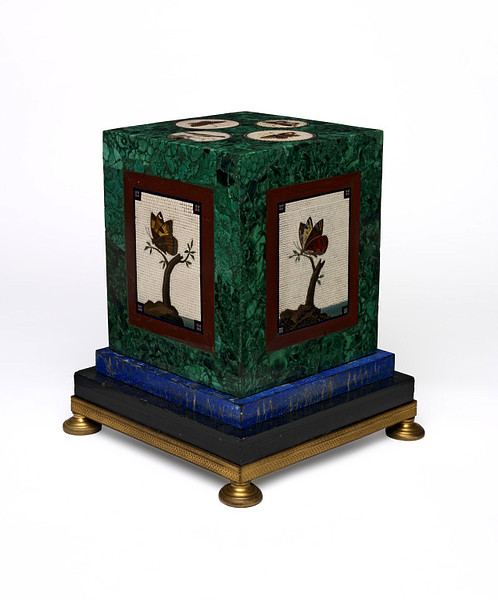
Created as a means of displaying a handsome group of early Italian micromosaics, this specimen block was assembled around 1800. And, it shows them off beautifully, but the block itself must not be dismissed as a mere display item. It’s quite impressive in its own right. The block is a rare Nineteenth Century example of an Italian use of malachite, a stone then found only rarely, and then, typically just outside of Russia. The malachite block stands on a plinth of lapis lazuli, and, this, on a base of black marble within a frame of gilt bronze.

The use of the butterfly form in the micromosaics is wholly Roman, owing to the ancient belief that the butterfly represented the soul leaving the body at the moment of death. The top of the malachite block is set with four lovely micromosaic roundels, each with a white background and three of them featuring the butterfly theme. The fourth depicts a bird resting on a branch.

The other four sides (not counting the side attached to the base), are each set with rectangular micromosaics featuring a depiction of a butterfly perched on a branch within a border of red marble.

While it’s difficult to date the micromosaics, it’s safe to assume that they’re Roman in origin. The valuable collection of panels was assembled by Giacomo Raffaelli (1753-1836). A similarly-set block of lapis lazuli is housed in a private Roman collection. This one was acquired by Sir Arthur and Rosalinde Gilbert and now is part of the V&A’s Gilbert Collection.


Monday, January 7, 2013

Mastery of Design: The Hands and Palm Trees Intaglio, 200 BCE

Intaglio
Rome, c. 200 BCE
The Victoria & Albert Museum


I always wonder who wore these pieces of jewelry, especially these ancient examples whose original owners are typically unknown. This was a jewel which was full of meaning and sentiment. To whom did it belong? How much did it mean to him or her?

Made around 200 BCE, this ring is set with an intaglio which was likely carved in Rome. The intaglio of clasped hands above a branch of palm is carved into translucent orange-red carnelian. The design is a heraldic device known as the “fede.” This image of two hands joined together was a popular symbol for wedding rings, however, such rings were exchanged between friends, and even between captains of armies and nations to show fidelity.

Above and below the hands, the words “Sesichoros” and “Eros” have been inscribed. The setting of the ring is silver which was later gilt, likely in the early Nineteenth Century. It was acquired by the South Kensington Museum (now the V&A) and first exhibited in 1871. 


Thursday, January 3, 2013

History's Runway: An Egyptian Tunic, 670-870

Tunic
Egypt, 670-870
The Victoria & Albert Museum


The history of fashion is as long as the history of humankind. As long as there’s been nudity, we’ve sought attractive ways to cover ourselves. To this end, textiles have been made for centuries. For example, in the late Roman Empire and in Byzantine Egypt, textiles were made commercially by weavers for sale to households, and, often by commission. These lush fabrics were used to create tunics—garments which were similar for both men and women.

While initially a garment constructed of one piece of fabric, by the Fifth Century, tunics were made in three pieces and adorned with a belt. One of the most popular patterns were stripes, both in Rome and Coptic Egypt.

This tunic of red wool, dating between 670 and 870, heralds from Egypt. It is adorned with white vertical strikes at the sides and, at the neck, features a woven tapestry of colored wools and linen thread.

Like later tunics, this one is made up of several pieces which have been seamed and cuffed. The sleeves are open under the arms. Though stained and slightly decayed, it’s an exceptional example of fashion of the Seventh to Eighth Century Egypt.


Wednesday, December 5, 2012

Gifts of Grandeur: The Milton Jewel, 600-700


The Milton Jewel
600-700
This and all related images from
The Victoria and Albert Museum


 This disc brooch, known as the Milton Jewel, is thought to be among the most exceptional examples of Angelo-Saxon jewels of the Seventh to Eighth Centuries. The jeweler employed bronze cloisons (cells) to hold the brooch’s garnets. The piece also boasts filigree knot work adornment on gold sheets and shell bosses. The center shell was once inlaid with garnet while the other shell bosses retain their garnet inlays. The whole piece is mounted on a silver back plate. 

The jewel was discovered in 1832 in a cemetery at Molton, Dorchester-on-Thames. A similar brooch was found nearby. Made between 600 and 700, the jewel was likely produced in Kent, England.

According to the V&A, “The materials used to make this brooch testify to the international trade during the Anglo-Saxons period: the garnets probably came from Sri Lanka, and scientific research on other similar brooches has shown that the white shell is from Mediterranean species.”

The piece is damaged, but considering it was found in a cemetery 1200 years after it was made, it's in great shape.  The V&A acquired the jewel in 1932 along with the other which was found nearby.


Saturday, November 10, 2012

Mastery of Design: A Middle Eastern Garnet Necklace, 1st C.


Necklace
The British Museum


A necklace of turquoise, gold and garnets, this piece was excavated in the Middle East and dates to the First Century. The piece was restrung in the Nineteenth Century at which time gold glass beads were added. The positioning of the pendants, as noted in a 1968 inventory of the British Museum, may have been changed at the time of the re-stringing.