Showing posts with label hair. Show all posts

Saturday, April 26, 2014

Saturday Sparkle: The Baynes Locket, c. 1775


Locket
The Victoria & Albert Museum


A plait of hair from some long-gone beloved has been preserved in this locket since about 1775. In the Eighteenth Century, locks of hair went from being mementos that were hidden away to being the centerpieces of important jewels. Some jewels used the hair or strands of hair as part of the pattern or in a miniature painting. Hair was even used to make sentimental objects. 


This locket with its openwork gold bow, bequeathed to the V&A by Mrs. Isobel Baynes in 1950, was made in England in the late Eighteenth Century. A work of gold, it is set with pearls, emeralds and green pastes (likely replacements). The plait is protected by glass. On the reverse, a painted coronet surmounts a monogram. 


Gifts of Grandeur: The FIDELLE ET SECRET Locket, 1780


Locket
England, 1780
The Victoria & Albert Museum


Though locks of hair had long been kept within compartments in sentimental jewelry, by the Eighteenth Century, the use of hair as a medium took on new distinction. Instead of just being housed in a jewel, hair became a part of the design and was used to make complicated patterns, ornate motifs and even delicate images. Such pieces were meant to not only honor the memory of the deceased, but also to show an attachment to someone living. 


This enameled English gold locket from 1780 features a design in hair on ivory with a watercolor inscription under glass. The painted monogram—M.C.G.—is traced with hair and a delicate (and barely visible now) pattern is set behind  the motto “Faithful and Secret” in French--FIDELLE ET SECRET. The back of the piece is set with more hair.


Unusual Artifacts: A Band of Hair Lace, 1625-1675


Band of Hair Lace
1625-1675
Human hair and horse hair
England
The Victoria & Albert Museum
Though it seems strange and almost savage to modern eyes, for centuries, human hair (often that of a deceased person) was used to make delicate objects which served as a memorial or remembrance of a loved one.


Few of these pieces have survived over time. The few that do remain are usually from the Victorian era when this practice was quite popular. Every so often, an older piece of hair art is found. This particular piece of hair art takes the form of a band of lace which would have been worn as a bracelet.

The hair was delicately worked with needles. Here, we see blonde and brown hair entwined into an intricate pattern which is supported in bands at the top and bottom by stronger horsehair.

Seventeenth Century poet, John Donne wrote of the practice in his work, “The Relique.”
When my grave is broke up againe 
Some second ghest to entertaine ... 
And he that digs it, spies 
A bracelet of bright haire about the bone, 
Will he not let us alone 
And thinke that there a loving couple lies ...


Saturday, March 1, 2014

Mastery of Design: A Ring Containing the Hair of King George III, 1816


Ring
Enamel, Gold, Diamond, Rubies
Containing the Hair of King George III
1816, English
The Victoria & Albert Museum
This ring of enameled gold contains bezel-set rubies and a brilliant-cut diamond in the shape of a crown. The band is dated, 1816. Behind the crown, a locket is cleverly hidden upon which has been inscribed, “Hair cut from the head of George III, 1 Apr., 1816.”


Items of jewelry, especially during the Nineteenth Century, frequently held lockets of hair—often behind rock crystal or glass as a memento of a loved one or in memory of a person who has passed away. To have a lock of a Regent’s hair was quite extraordinary. It’s unknown who made the ring and for whom it was made. However, the fact that it has remained intact with its original contents is nothing short of miraculous.


Saturday, November 16, 2013

Mastery of Design: The FIDELLE ET SECRET Locket, 1780


Locket
England, 1780
The Victoria & Albert Museum


Though locks of hair had long been kept within compartments in sentimental jewelry, by the Eighteenth Century, the use of hair as a medium took on new distinction. Instead of just being housed in a jewel, hair became a part of the design and was used to make complicated patterns, ornate motifs and even delicate images. Such pieces were meant to not only honor the memory of the deceased, but also to show an attachment to someone living. 


This enameled English gold locket from 1780 features a design in hair on ivory with a watercolor inscription under glass. The painted monogram—M.C.G.—is traced with hair and a delicate (and barely visible now) pattern is set behind  the motto “Faithful and Secret” in French--FIDELLE ET SECRET. The back of the piece is set with more hair.


Gifts of Grandeur: The Baynes Locket, c. 1775


Gifts of Grandeur: The Baynes Locket, c. 1775


Locket
The Victoria & Albert Museum


A plait of hair from some long-gone beloved has been preserved in this locket since about 1775. In the Eighteenth Century, locks of hair went from being mementos that were hidden away to being the centerpieces of important jewels. Some jewels used the hair or strands of hair as part of the pattern or in a miniature painting. Hair was even used to make sentimental objects. 


This locket with its openwork gold bow, bequeathed to the V&A by Mrs. Isobel Baynes in 1950, was made in England in the late Eighteenth Century. A work of gold, it is set with pearls, emeralds and green pastes (likely replacements). The plait is protected by glass. On the reverse, a painted coronet surmounts a monogram. 


Wednesday, November 13, 2013

Mastery of Design: The Dame Joan Evans Hair Brooch, 1754


Memorial Brooch, 1754
From the Collection of Dame Joan Evans
The Victoria & Albert Museum


We’ve looked at many jewels which incorporated hair into the design. Though considered somewhat icky when viewed through modern eyes, this was a very normal, sentimental practice which rose to a new prominence in the Eighteenth Century (but one which had been carried out for many centuries before) and served as a way of keeping a piece of a loved one (either alive or deceased) close at hand at a time before photography.

The fact that such pieces survive to this day prove how special and important they were.

Here we see a brooch from the collection of Dame Joan Evans. The brooch is composed of a silver openwork bow, set with rose and brilliant-cut diamonds and pink sapphires over foil, and am enameled gold ribbon which is also set with gems and inscribed ELIZ EYTON OBIT FEB 1754 AET 81, surrounding a hair locket. The face of the locket is set with rock crystal. Made in 1754, this piece serves as a memorial and would have been worn as a reminder of the deceased. 


Sunday, November 3, 2013

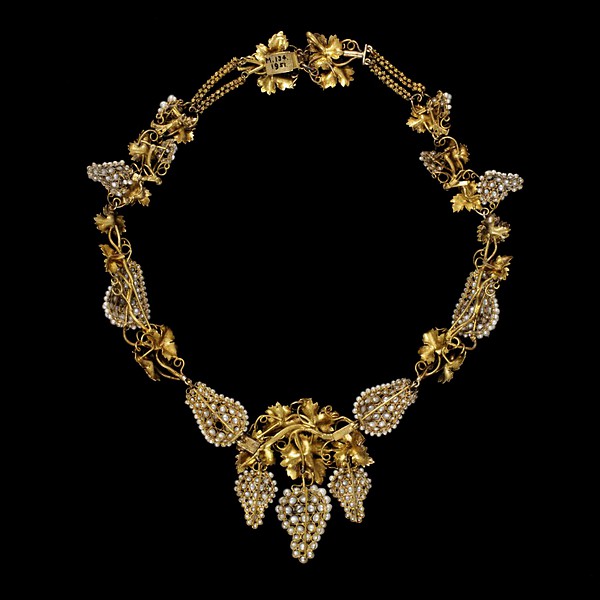
Mastery of Design: The Grapes and Vines Necklace, c. 1850


Necklace
Gold, Seed Pearls
English, c. 1850
The Victoria & Albert Museum


The visual motif of grapes and vines has been utilized in jewelry-making since antiquity. However, the idea saw a revival during the Victorian era when the fashion for sets of seed pearl jewelry gave jewelers the perfect “canvas” for grape-like forms. 

This English example, made around 1850, is the necklace from one of the most complex, elaborate and intricately-made grape parures that I’ve ever seen. The construction of the piece is exceptional. The pearls are attached with horsehair and silk to an elaborate framework made of gold wires. The varicolored gold gives an unusual depth and sense of naturalism to the suite. 


Sunday, February 17, 2013

Mastery of Design: A Ring Containing the Hair of King George III, 1816


Ring
Enamel, Gold, Diamond, Rubies
Containing the Hair of King George III
1816, English
The Victoria & Albert Museum
This ring of enameled gold contains bezel-set rubies and a brilliant-cut diamond in the shape of a crown. The band is dated, 1816. Behind the crown, a locket is cleverly hidden upon which has been inscribed, “Hair cut from the head of George III, 1 Apr., 1816.”


Items of jewelry, especially during the Nineteenth Century, frequently held lockets of hair—often behind rock crystal or glass as a memento of a loved one or in memory of a person who has passed away. To have a lock of a Regent’s hair was quite extraordinary. It’s unknown who made the ring and for whom it was made. However, the fact that it has remained intact with its original contents is nothing short of miraculous.


Wednesday, November 21, 2012

Gifts of Grandeur: The Baynes Locket, c. 1775


Locket
The Victoria & Albert Museum


A plait of hair from some long-gone beloved has been preserved in this locket since about 1775. In the Eighteenth Century, locks of hair went from being mementos that were hidden away to being the centerpieces of important jewels. Some jewels used the hair or strands of hair as part of the pattern or in a miniature painting. Hair was even used to make sentimental objects. 


This locket with its openwork gold bow, bequeathed to the V&A by Mrs. Isobel Baynes in 1950, was made in England in the late Eighteenth Century. A work of gold, it is set with pearls, emeralds and green pastes (likely replacements). The plait is protected by glass. On the reverse, a painted coronet surmounts a monogram. 


Wednesday, September 26, 2012

Mastery of Design: The Grapes and Vines Necklace, c. 1850

Necklace
Gold, Seed Pearls
English, c. 1850
The Victoria & Albert Museum


The visual motif of grapes and vines has been utilized in jewelry-making since antiquity. However, the idea saw a revival during the Victorian era when the fashion for sets of seed pearl jewelry gave jewelers the perfect “canvas” for grape-like forms. 

This English example, made around 1850, is the necklace from one of the most complex, elaborate and intricately-made grape parures that I’ve ever seen. The construction of the piece is exceptional. The pearls are attached with horsehair and silk to an elaborate framework made of gold wires. The varicolored gold gives an unusual depth and sense of naturalism to the suite. 


Tuesday, June 19, 2012

Mastery of Design: The FIDELLE ET SECRET Locket, 1780

Locket
England, 1780
The Victoria & Albert Museum


Though locks of hair had long been kept within compartments in sentimental jewelry, by the Eighteenth Century, the use of hair as a medium took on new distinction. Instead of just being housed in a jewel, hair became a part of the design and was used to make complicated patterns, ornate motifs and even delicate images. Such pieces were meant to not only honor the memory of the deceased, but also to show an attachment to someone living. 


This enameled English gold locket from 1780 features a design in hair on ivory with a watercolor inscription under glass. The painted monogram—M.C.G.—is traced with hair and a delicate (and barely visible now) pattern is set behind  the motto “Faithful and Secret” in French--FIDELLE ET SECRET. The back of the piece is set with more hair.


Wednesday, May 23, 2012

Gifts of Grandeur: The "I Cherish Even Her Shadow" Ring, 1780


I Cherish Even Her Shadow
French Love Ring
c. 1780, Imported to England 1864
The Victoria & Albert Museum


This Eighteenth-Century ring which somewhat resembles contemporary mourning rings, is inscribed in French around the bezel, “JE CHERIS JUSQU'A SON OMBRE “ meaning “I cherish even her shadow.”  Aw.  While it could well have been made as a mourning ring, chances are, this ring was made as a token of affection and to serve as a reminder of this gentleman’s lover. 

The blue enameled gold ring is surmounted by an oval bezel set with a silhouette of a woman with a locket of plaited hair beneath glass.  A French import mark from 1864 appears on the hoop, however, the piece was made in France around 1780.


Thursday, April 19, 2012

Mastery of Design: The Dame Joan Evans Hair Brooch, 1754


Memorial Brooch, 1754
From the Collection of Dame Joan Evans
The Victoria & Albert Museum


We’ve looked at many jewels which incorporated hair into the design.  Though considered somewhat icky when viewed through modern eyes, this was a very normal, sentimental practice which rose to a new prominence in the Eighteenth Century (but one which had been carried out for many centuries before) and served as a way of keeping a piece of a loved one (either alive or deceased) close at hand at a time before photography.

The fact that such pieces survive to this day prove how special and important they were.
Here we see a brooch from the collection of Dame Joan Evans.  The brooch is composed of a silver openwork bow, set with rose and brilliant-cut diamonds and pink sapphires over foil, and am enameled gold ribbon which is also set with gems and inscribed ELIZ EYTON OBIT FEB 1754 AET 81, surrounding a hair locket.  The face of the locket is set with rock crystal.  Made in 1754, this piece serves as a memorial and would have been worn as a reminder of the deceased. 


Tuesday, July 19, 2011

Object of the Day: A Silver Comb, 1809-1810

Comb
Silver
Henry Adcock, Birmingham, 1809-1810
The Victoria & Albert Museum
Several months ago, I shared with you some of the antique combs in my collection. Not for grooming, these combs were designed to be worn as hair ornaments which served to contain a lady’s complicated, upswept hairstyle.

This silver comb from the V&A dates between 1809 and 1810. Made in Birmingham by Henry Adcock, this comb is an exceptional example of the artistry with which these combs were made.

Cleverly crafted, the comb imitates faceted gemstones with its brightly polished cut silver. This style was extremely fashionable at the time. Such a comb would have been worn in a high upon the head, tucked into the hair of a tight bun. The design emulates the look of feather which were a popular adornment of the time, and nods to the symbol of the Prince of Wales—three silver feathers.


Thursday, June 9, 2011

Gifts of Grandeur: A Diamond Hair Ornament, 1820

Hair Ornament
Diamonds, Gold, Silver
English, 1820
The Victoria & Albert Museum
In the early Nineteenth Century, the cultures of England, France and Italy became especially interested in natural themes and the beauty of plants and flowers. In England, this coincided with a renewed interest in Botany and also with the swell of both the Romantic Movement and the Rococo Revival.


Jewels were often employed in complicated recreations of flowers and plants. In the earliest parts of the century, these were usually diamond works set in gold or silver. By 1830, jewelers were becoming more adventurous and also sought a new level of realism with their designs by incorporated colored stones and enamel into their works.

This hair ornament from 1820 by an unknown English maker is an early example of the trend toward Nature-themed jewels. Dozens of diamonds of various shapes and sizes are set in silver, backed with gold and mounted on a gold armature. Worn at the back of the head, this ornament would have glittered magnificently in the candlelight. The piece could also be worn as a brooch.


The Reverse
Showing the Gold Backing and Clip

Wednesday, June 1, 2011

Mastery of Design: A Ring Containing the Hair of King George III, 1816

Ring
Enamel, Gold, Diamond, Rubies
Containing the Hair of King George III
1816, English
The Victoria & Albert Museum
This ring of enameled gold contains bezel-set rubies and a brilliant-cut diamond in the shape of a crown. The band is dated, 1816. Behind the crown, a locket is cleverly hidden upon which has been inscribed, “Hair cut from the head of George III, 1 Apr., 1816.”


Items of jewelry, especially during the Nineteenth Century, frequently held lockets of hair—often behind rock crystal or glass as a memento of a loved one or in memory of a person who has passed away. To have a lock of a Regent’s hair was quite extraordinary. It’s unknown who made the ring and for whom it was made. However, the fact that it has remained intact with its original contents is nothing short of miraculous.

Unusual Artifacts: A Band of Hair Lace, 1625-1675

Band of Hair Lace
1625-1675
Human hair and horse hair
England
The Victoria & Albert Museum
Though it seems strange and almost savage to modern eyes, for centuries, human hair (often that of a deceased person) was used to make delicate objects which served as a memorial or remembrance of a loved one.


Few of these pieces have survived over time. The few that do remain are usually from the Victorian era when this practice was quite popular. Every so often, an older piece of hair art is found. This particular piece of hair art takes the form of a band of lace which would have been worn as a bracelet.

The hair was delicately worked with needles. Here, we see blonde and brown hair entwined into an intricate pattern which is supported in bands at the top and bottom by stronger horsehair.

Seventeenth Century poet, John Donne wrote of the practice in his work, “The Relique.”

When my grave is broke up againe
Some second ghest to entertaine ...
And he that digs it, spies
A bracelet of bright haire about the bone,
Will he not let us alone
And thinke that there a loving couple lies ...