Showing posts with label Roman. Show all posts

Thursday, February 5, 2015

Mastery of Design: The Castellani Helios Brooch, c. 1860


This and all related images from The British Museum.


This gold brooch, from The British Museum's Hull-Grundy collection, comes from the Italian Castellani workshop and dates to between 1860 and 1870.  Castellani looked to then-recent archeological discoveries for inspiration and this brooch is an ideal representation of that passion for the past.


The jewel depicts Helios, a Roman sun god, with a mask cast in relief and enameled eyes.  Fine granulation in rows represent the god's hair and rays of light emanate from his head in the form of twisted gold wires. 

Sunday, June 22, 2014

Precious Time: The Roman Charity Watch and Case, 1680-1700


Watch and Case
Switzerland, 1680-1700
This and all related images from:
The Victoria & Albert Museum


This watch is housed in a copper gilt case which, along with the timepiece, has been enameled with a variety of Italian scenes including “Roman Charity” and “Lucretia.” Made in Geneva, Switzerland, the movement is signed “Baccuet.” Created between 1680 and 1700, the enameling was done by the family team of Jean Pierre (1655-1723) and Ami Huaud (1657-1724). Their competent enamel work on the scene of “Roman Charity” was based on an engraving by Claude Mellan which itself was after a painting by Simon Vouet. 


Wednesday, June 11, 2014

Mastery of Design: The Castellani Peace Necklace, 1870


The V&A
Micromosaic and gold necklace
Castellani, 1870
The Victoria & Albert Museum


The Roman jewelry company of Castellani is considered as one of the first and finest makers of jewelry based on various ancient styles which had been uncovered through then-recent archaeological findings.

Alessandro Castellani remarked upon the firm’s introduction of micromosaic jewelry based on archaeological finds:  "At the time when we took up the subject the greater number of those who followed the occupation of working in mosaic at Rome were almost unemployed; […] We therefore applied mosaics to classical jewellery, imitating at first the antique scenic masks, and many Greek and Latin inscriptions, and our designs were very soon copied elsewhere."

This necklace of gold, made in 1870, shows Castellani’s fine micromosaic work with its woven chain of diverse-shaped pendants matching on each side. The medallions are arranged symmetrically on the chain and depict various symbols of peace, starting at hook clasp: a cherub, doves of peace, two crosses, another cherub and the Christian chi-rho motif; the central pendant with Cupid. The large pendants are hung with smaller pendants which show: roses, christian symbols, flowers, bunches of grapes and the moon and sun.


This necklace is part of an import parure which was once owned by Rosalinde Gilbert who, along with her husband, Sir Arthur, donated this suite along with their impressive collection of gems, gold, snuffboxes, enamels, portrait miniatures and other assorted treasures to the V&A.  


Saturday, May 17, 2014

Mastery of Design: The Shepherds and Goats Signet Ring, 200-100 BC


Intaglio Ring
Italy, 200-100 B.C.
The Victoria & Albert Museum


A vertically-positioned oval intaglio of brown-hued carnelian is the centerpiece of this ancient ring which nicely demonstrates the mastery of early Roman gem carving.

It’s thought that this ring was meant to represent a shepherd. The conclusion makes sense since it depicts a young man with a goat which, I’m guessing, represents his flock. It’s hard to carve a whole flock of goats onto a ring. Don’t let the fact that the young man is nude bother you.

Others suggest that since the fellow has no clothes on, he could be the god Mercury. I don’t know if I’d want to be a shepherd with no pants. So, Mercury is a good guess, too, especially since Mercury’s attribute is often a ram and he does tend to be shown wearing the sort of broad-brimmed hat favored by farmers and travelers.

Either way, the goat’s not too happy. Maybe he doesn’t like the pan flute. Goats probably don’t care for pipe music.

The ring was made in Italy circa 200-100 BC. Of course, it ended up in the collection of the Reverend Chauncy Hare Townshend (1798-1868), who preferred collecting jewelry to being a clergyman. I agree with him wholeheartedly.


Saturday, March 15, 2014

Mastery of Design: The Castellani Helios Brooch, c. 1860


This and all related images from The British Museum.


This gold brooch, from The British Museum's Hull-Grundy collection, comes from the Italian Castellani workshop and dates to between 1860 and 1870.  Castellani looked to then-recent archeological discoveries for inspiration and this brooch is an ideal representation of that passion for the past.


The jewel depicts Helios, a Roman sun god, with a mask cast in relief and enameled eyes.  Fine granulation in rows represent the god's hair and rays of light emanate from his head in the form of twisted gold wires. 

Friday, March 14, 2014

Mastery of Design: The Castellani Peace Necklace, 1870


The V&A
Micromosaic and gold necklace
Castellani, 1870
The Victoria & Albert Museum


The Roman jewelry company of Castellani is considered as one of the first and finest makers of jewelry based on various ancient styles which had been uncovered through then-recent archaeological findings.

Alessandro Castellani remarked upon the firm’s introduction of micromosaic jewelry based on archaeological finds:  "At the time when we took up the subject the greater number of those who followed the occupation of working in mosaic at Rome were almost unemployed; […] We therefore applied mosaics to classical jewellery, imitating at first the antique scenic masks, and many Greek and Latin inscriptions, and our designs were very soon copied elsewhere."

This necklace of gold, made in 1870, shows Castellani’s fine micromosaic work with its woven chain of diverse-shaped pendants matching on each side. The medallions are arranged symmetrically on the chain and depict various symbols of peace, starting at hook clasp: a cherub, doves of peace, two crosses, another cherub and the Christian chi-rho motif; the central pendant with Cupid. The large pendants are hung with smaller pendants which show: roses, christian symbols, flowers, bunches of grapes and the moon and sun.


This necklace is part of an import parure which was once owned by Rosalinde Gilbert who, along with her husband, Sir Arthur, donated this suite along with their impressive collection of gems, gold, snuffboxes, enamels, portrait miniatures and other assorted treasures to the V&A.  


Sunday, November 17, 2013

Mastery of Design: The Shepherds and Goats Signet Ring, 200-100 BC


Intaglio Ring
Italy, 200-100 B.C.
The Victoria & Albert Museum


A vertically-positioned oval intaglio of brown-hued carnelian is the centerpiece of this ancient ring which nicely demonstrates the mastery of early Roman gem carving.

It’s thought that this ring was meant to represent a shepherd. The conclusion makes sense since it depicts a young man with a goat which, I’m guessing, represents his flock. It’s hard to carve a whole flock of goats onto a ring. Don’t let the fact that the young man is nude bother you.

Others suggest that since the fellow has no clothes on, he could be the god Mercury. I don’t know if I’d want to be a shepherd with no pants. So, Mercury is a good guess, too, especially since Mercury’s attribute is often a ram and he does tend to be shown wearing the sort of broad-brimmed hat favored by farmers and travelers.

Either way, the goat’s not too happy. Maybe he doesn’t like the pan flute. Goats probably don’t care for pipe music.

The ring was made in Italy circa 200-100 BC. Of course, it ended up in the collection of the Reverend Chauncy Hare Townshend (1798-1868), who preferred collecting jewelry to being a clergyman. I agree with him wholeheartedly.


Sunday, October 6, 2013

Unusual Artifacts: The Ceres Signet Ring, 100-200 A.D.


Sardonyx Intaglio Signet Ring
Rome, 100-200 A.D.
The Victoria & Albert Museum


This gold and sardonyx signet ring is so finely made that you’d, at first, not believe that it dates between 100 and 200 A.D. Made in Rome, the bezel-set intaglio of this ring has been engraved with an ant—a traditional symbol of the Roman goddess Ceres who was considered the mother goddess of grain and fertility. Her name, in fact, was adapted into the word, “Cereal,” which is considered her gift to humankind. A ring such as this was intended to bring prosperity to the person who wore it. Other similar rings were engraved with bees and butterflies. 


Thursday, September 26, 2013

The Home Beautiful: The Capitoline Doves Micromosaic, 1800-1825


The V&A
Micromosaic Plaque
Rome, 1800-1825
The Victoria & Albert Museum


The subject of this stunning early Nineteenth Century micromosaic is a group of doves which is typically known as the Capitoline Doves or Doves of Pliny.
 These feathered little chaps appear frequently as the subject of micromosaics which replicate a famous Roman floor mosaic discovered in 1737 at Hadrian's Villa in Tivoli, which, in turn, is believed to be a copy of a lost ancient Greek mosaic at Pergamon. The original floor mosaic is recorded by Pliny the Elder in his Natural History, which he completed in 77AD.

Dating between 1800 and 1825, this rectangular Roman micromosaic plaque, from the V&A’s Gilbert Collection, recreates the well-known scene of four doves sitting on the edge of a circular, gold, two-handled basin which, itself, is resting on a square plinth. A border decorated in geometric motifs finishes the scene. Below the bordered picture is an inscription in Latin:
MIRABILIS IBI COLVMBA BIBENS, ET AQVAM VMBRA CAPITIS INFVSCANS. APRICANTVR ALIAE SCABENTES SESE IN CANTHARI LABRO. PLIN.LIB XXXV.CAP X.

 
A marvellous dove drinking and casting the shadow of its head on the water. Other doves are pluming their feathers in the sun on the lip of a goblet.

Reverse

Tuesday, August 20, 2013

Mastery of Design: The Castellani Helios Brooch, c. 1860


This and all related images from The British Museum.


This gold brooch, from The British Museum's Hull-Grundy collection, comes from the Italian Castellani workshop and dates to between 1860 and 1870.  Castellani looked to then-recent archeological discoveries for inspiration and this brooch is an ideal representation of that passion for the past.


The jewel depicts Helios, a Roman sun god, with a mask cast in relief and enameled eyes.  Fine granulation in rows represent the god's hair and rays of light emanate from his head in the form of twisted gold wires.


Object of the Day, Museum Edition: The Castellani Peace Necklace, 1870


The V&A
Micromosaic and gold necklace
Castellani, 1870
The Victoria & Albert Museum


The Roman jewelry company of Castellani is considered as one of the first and finest makers of jewelry based on various ancient styles which had been uncovered through then-recent archaeological findings.

Alessandro Castellani remarked upon the firm’s introduction of micromosaic jewelry based on archaeological finds:  "At the time when we took up the subject the greater number of those who followed the occupation of working in mosaic at Rome were almost unemployed; […] We therefore applied mosaics to classical jewellery, imitating at first the antique scenic masks, and many Greek and Latin inscriptions, and our designs were very soon copied elsewhere."

This necklace of gold, made in 1870, shows Castellani’s fine micromosaic work with its woven chain of diverse-shaped pendants matching on each side. The medallions are arranged symmetrically on the chain and depict various symbols of peace, starting at hook clasp: a cherub, doves of peace, two crosses, another cherub and the Christian chi-rho motif; the central pendant with Cupid. The large pendants are hung with smaller pendants which show: roses, christian symbols, flowers, bunches of grapes and the moon and sun.


This necklace is part of an import parure which was once owned by Rosalinde Gilbert who, along with her husband, Sir Arthur, donated this suite along with their impressive collection of gems, gold, snuffboxes, enamels, portrait miniatures and other assorted treasures to the V&A.  


Tuesday, July 30, 2013

Mastery of Design: A Curious Sapphire Dress-Pin, 100-130

Dress Pin
Roman, 100-130
The British Museum


Here's a curious, but attractive bit of sparkle from The British Museum.  This Roman dress-pin dates to about 100-130.  A work of carved sapphire and wrought gold, the piece depicts the bust of a woman sporting an elaborate coiffure.  The odd part of the bust's hairdo is that, in the reverse, it reveals the face of a child.  Hmmmm...


A modern gold pedestal was added to the original wrought gold setting which included the small diamond that's still visible at the bodice of the bust.  

Tuesday, July 2, 2013

Mastery of Design: Ring with a Cameo of Demeter, 1799


Cameo Ring
Crown Copyright
The Royal Collection 
Image Courtesy of Her Majesty Queen Elizabeth II


In the Eighteenth and Nineteenth Centuries, the fashion for cameos prompted jewelers to take ancient carvings and set them in new gold mounts and bezels. This ring from the Royal Collection is a nifty example of that trend.

The cameo of white and brown striated sardonyx is an ancient Roman piece from the First Century B.C. It was mounted in this gold ring with an open bezel in 1799 and first recorded in the Royal Collection in 1872, likely a gift to Queen Victoria. The cameo depicts a half-figure of a woman in left profile. She’s holding two stalks of corn and almost certainly represents Demeter. 


Wednesday, May 22, 2013

Mastery of Design: The Aurora Goddess of Dawn Bracelet, 1870


Bracelet
Rome, c. 1870
This and all related images from:
The Victoria & Albert Museum


With a shape inspired by then-recent finds of ancient jewelry, this bracelet is adorned, not with a scene from antiquity, but rather with a micromosaic scene based on a Renaissance painting by Guido Reni (1575-1642). Aurora, Goddess of the Dawn, is shown in much the same stance—with her chariot and assistants—that she takes in Reni’s fresco at the Pallavicini-Rospigliosi Palace in Rome.

Now part of the collection of Sir Arthur and Rosalinde Gilbert at the V&A, the oval mosaic and gold bracelet fastens with locking hinges. It was made in Rome, c. 1870.  Clearly, it was meant as a souvenir of Rome--as indicated by the giant ROMA on the reverse.  


Saturday, May 11, 2013

Mastery of Design: The Castellani Peace Necklace, 1870


The V&A
Micromosaic and gold necklace
Castellani, 1870
The Victoria & Albert Museum


The Roman jewelry company of Castellani is considered as one of the first and finest makers of jewelry based on various ancient styles which had been uncovered through then-recent archaeological findings.

Alessandro Castellani remarked upon the firm’s introduction of micromosaic jewelry based on archaeological finds:  "At the time when we took up the subject the greater number of those who followed the occupation of working in mosaic at Rome were almost unemployed; […] We therefore applied mosaics to classical jewellery, imitating at first the antique scenic masks, and many Greek and Latin inscriptions, and our designs were very soon copied elsewhere."

This necklace of gold, made in 1870, shows Castellani’s fine micromosaic work with its woven chain of diverse-shaped pendants matching on each side. The medallions are arranged symmetrically on the chain and depict various symbols of peace, starting at hook clasp: a cherub, doves of peace, two crosses, another cherub and the Christian chi-rho motif; the central pendant with Cupid. The large pendants are hung with smaller pendants which show: roses, christian symbols, flowers, bunches of grapes and the moon and sun.


This necklace is part of an import parure which was once owned by Rosalinde Gilbert who, along with her husband, Sir Arthur, donated this suite along with their impressive collection of gems, gold, snuffboxes, enamels, portrait miniatures and other assorted treasures to the V&A.  


Tuesday, May 7, 2013

Precious Time: King George IV’s “Apollo” Clock, 1805


Clock
Pierre-Philippe Thomire, 1805
Gilt Bronze, Enamel, Marble
Crown Copyright
The Royal Collection
Image Courtesy of Her Majesty Queen Elizabeth II
King George IV had many passions, but one of the few of them that we can discuss in polite company is his appreciation for clocks—particularly French timepieces.

Here, we see one of the many clocks collected by King George IV. This, like many others, is actually in use within one of the Royal residences and now belongs to Her Majesty, Queen Elizabeth II.

Made in 1805 by French horologist, Pierre-Philippe Thomire, this timepiece features gilt bronze figures and mounts upon a luxurious marble base. The figural group atop the predominate arch shows Apollo who was believed by the Romans to be the god of the sun. Here, Apollo reminds of the emergence of the sun each day as we see this representation of the god in his golden chariot rising from the sea. His chariot is drawn by four horses abreast.


Sunday, April 28, 2013

Masterpiece of the Week: The Neuber Bonbonnière, 1780


German Sweet Meat Box
With Roman insets
1780
The Victoria and Albert Museum


This bonbonnière of colored hardstone, including carnelian, turquoise, jasper, and lapis lazuli, has been attributed to the workshop of Christian Neuber who, in 1780, when the box was made, was working in Dresden.

The handsome lid and base of the box are set with micromosaic panels of a dog and a butterfly which appear to be based on the mosaics of Giacomo Raffaelli--one of the most talented Roman mosaicists.  In fact, some believe that Raffaelli or someone in his workshop may have made the micromosaic panels which were set into this German sweetmeat box--demonstrating the popularity of this medium in Europe in the 18th century.


Gifts of Grandeur: The Victory Intaglio Ring, 1810


Gold Ring of Rose-cut Diamonds and a Carnelian Intaglio Depicting Victory
Roman intaglio.  Mount: 1810.
The Victoria & Albert Museum


Dating to 1810, this gold ring is mounted with an intaglio of carnelian cut with a representation of Victory as a winged figure driving a chariot.  During the Nineteenth Century, the taste for intaglios cut with classical subjects was once again fashionable for gentlemen.   

The golden shoulders of the ring widen to an oval bezel of rose-cut diamonds set in silver around the intaglio.  The intaglio may, in fact, be an ancient carving, possibly of Roman origin.


Wednesday, January 16, 2013

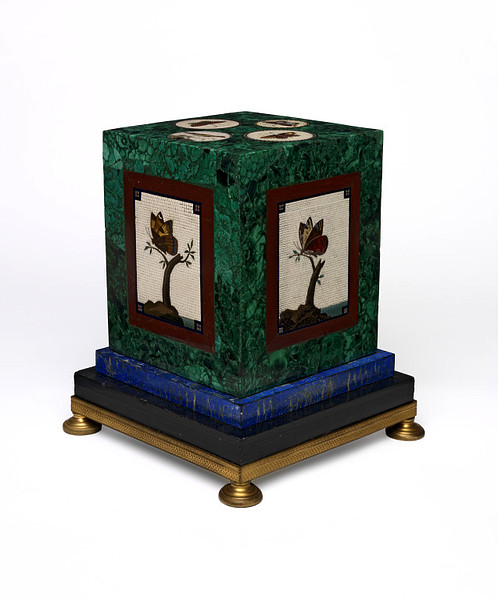
Unusual Artifacts: A Roman Micromosaic Specimen Block, 1800

Click Images for Larger Size

Specimen Block
Raffaeli, 1800
This and all related images from
The Victoria & Albert Museum


Created as a means of displaying a handsome group of early Italian micromosaics, this specimen block was assembled around 1800. And, it shows them off beautifully, but the block itself must not be dismissed as a mere display item. It’s quite impressive in its own right. The block is a rare Nineteenth Century example of an Italian use of malachite, a stone then found only rarely, and then, typically just outside of Russia. The malachite block stands on a plinth of lapis lazuli, and, this, on a base of black marble within a frame of gilt bronze.

The use of the butterfly form in the micromosaics is wholly Roman, owing to the ancient belief that the butterfly represented the soul leaving the body at the moment of death. The top of the malachite block is set with four lovely micromosaic roundels, each with a white background and three of them featuring the butterfly theme. The fourth depicts a bird resting on a branch.

The other four sides (not counting the side attached to the base), are each set with rectangular micromosaics featuring a depiction of a butterfly perched on a branch within a border of red marble.

While it’s difficult to date the micromosaics, it’s safe to assume that they’re Roman in origin. The valuable collection of panels was assembled by Giacomo Raffaelli (1753-1836). A similarly-set block of lapis lazuli is housed in a private Roman collection. This one was acquired by Sir Arthur and Rosalinde Gilbert and now is part of the V&A’s Gilbert Collection.


Monday, January 7, 2013

Mastery of Design: The Hands and Palm Trees Intaglio, 200 BCE

Intaglio
Rome, c. 200 BCE
The Victoria & Albert Museum


I always wonder who wore these pieces of jewelry, especially these ancient examples whose original owners are typically unknown. This was a jewel which was full of meaning and sentiment. To whom did it belong? How much did it mean to him or her?

Made around 200 BCE, this ring is set with an intaglio which was likely carved in Rome. The intaglio of clasped hands above a branch of palm is carved into translucent orange-red carnelian. The design is a heraldic device known as the “fede.” This image of two hands joined together was a popular symbol for wedding rings, however, such rings were exchanged between friends, and even between captains of armies and nations to show fidelity.

Above and below the hands, the words “Sesichoros” and “Eros” have been inscribed. The setting of the ring is silver which was later gilt, likely in the early Nineteenth Century. It was acquired by the South Kensington Museum (now the V&A) and first exhibited in 1871.