Showing posts with label Naturalist. Show all posts

Wednesday, June 18, 2014

Painting of the Day: Feeding Ducks, c. 1850


Feeding Ducks
Bocion, after 1850
The Victoria and Albert Museum


This handsome genre scene/landscape is a harmony of small figures, naturalism and fancy.  The architecture of the house belies the naturalistic roots of the scene with it's unusual stylistic nod to the medieval.

"Feeding Ducks," is the work of François Bocion (1828-1890) who was born in Lausanne.  Bocion started his career as a history painter, and the architecture of the house may, in fact, be an offshoot of those early stylistic beginnings.  In the 1840s Bocion emerged as a fancier of the rustic subject matter which characterized Realist and Naturalist works, two styles which were quite the mode in France at the time.  By the 1850s, Bocion found his muse, Lake Leman, a them which was repeated frequently in his oeuvre, and is clearly represented here.


Wednesday, April 9, 2014

Mastery of Design: The Countess Gautier Brooch, 1830


Brooch, 1830
The Victoria & Albert Museum
Here, we see a beautiful brooch of gold set with an emerald, turquoises and topazes in the form of a basket of flowers. Though the maker’s mark is unidentifiable, a Paris warranty mark for 1819-38 is clearly seen.

Jewelry of the 1830s often represented Naturalistic themes. As the V&A’s curators puts it, “A love of nature was one of the most universal and respected sentiments in the 19th century.” This Naturalistic theme was influenced by the Romantic movement and the revived Rococo style.

This is a transitional design. Until about 1830, such designs were delicately stylized, but later, more exact representations of flowers, leaves, fruit and insects became the basis for more elaborate pieces. 


Wednesday, February 12, 2014

Object of the Day, Museum Edition: The Lester Bobbin Lace Fern Bodice Front, 1865-1875


The Victoria & Albert Museum


A popular adornment to a Nineteenth Century lady’s outfit was the addition of a lace collar or bodice front. This fashion was particularly stylish in the 1860s and early 1870s. Here, we see an example of the type of bodice front which would have been worn by a fashionable lady. Such a piece could have been worn with a variety of bodices. It would have been intended to be worn over a contrasting colored silk, setting its pattern into clear relief.

This example features a bib-shaped front worked with fine cotton thread and bobbin lace worked in a pattern of ferns and blossoms in cloth stitch with openwork decoration. A narrow border of Bucks point lace has been attached to the outer edge.

The detail and delicacy of the bobbin lace indicates that it was made in Bedfordshire, England which was a lace-making center. In fact, this type of work is often referred to as “Bedfordshire Style.” The curators at the V&A believe this piece was designed by Bedfordshire’s Thomas Lester who was known for such intricate patterns which often depicted ferns and other naturalistic themes. The botanical theme suggests that the bodice front was made between 1865 and 1875.


Monday, February 10, 2014

Mastery of Design: The Meller Brooch, c. 1850


Bodice Ornament
France, 1840-1850
Given by Frederick Meller to
The Victoria & Albert Museum


As mid Nineteenth Century jewelers strove for naturalism in their designs, they created pieces defined by densely-set stones in forms based on the beauty of nature. The next natural step in this fashion was to add movement to jewels which would replicate the motion of a breeze through plants and flowers or the motion of insects.

We’ve talked about tremblers before. These flexible, coiled stalks or springs created a sensation of shimmering nature. As the wearer moved, the jewel would sway and quiver. The overall effect was one of immense glamour and opulence.

While most of these pieces were tremendously expensive diamond creations, jewelers made some with less-costly pastes so that this fashion could be available to a wider range of customers.

This floral spay brooch is a great example of the clever use of pastes. In candlelight or gaslight, these brilliant-cut pastes, set in silver, shimmered almost as much as diamonds, and, with the novelty of motion, these costume pieces were quite convincing. It was made in France around 1840 -1850 and features articulated pendants which would have swayed as the wearer walked. The jewel was to give the impression of flowers bathed in a gentle rain.


Friday, December 6, 2013

Mastery of Design: The Anne Hull Grundy Camellia, c. 1860


All Images From the British Museum.


I'm in love with this brooch.  So much so that I can almost forgive the fact that it's made out of elephant.  Made around 1860 in England, the chased green gold ornament takes the form of a camellia with the blooms crafted of finely-carved and tinted ivory.


From the Hull-Grundy gift to The British Museum, the intricately worked ivory is, as The British Museum puts it, "of unusually high quality, demonstating a concern for naturalistic accuracy rather than any interest in intrinsic value."


The brooch was wholly restored by The British Museum in 2009.  It has been purchased by Anne Hull Grundy from N. Bloom & Son, 40 Albemarle Street, London W1 for, according  a 1973 invoice, £440.  The jeweler mistakenly described the ornament as a "Gold and ivory rose spray brooch, c. 1820," when it is in fact, a camellia from c. 1860.


Saturday, November 16, 2013

The Home Beautiful: The William Morris "Fruit" Wallpaper, 1862


Sketch for Fruit Wallpaper
William Morris, 1862
The Victoria & Albert Museum


Designer and famous socialist William Morris (1834-1896) is known for his handsome designs and patterns. His style developed over the decades. Here’s a look at an early wallpaper pattern which is known both as “Fruit” and “Pomegranate” and dates from around 1862.

Morris used visual motifs from his medieval-style tapestry work, relying on the historical look which his earlier work shared with the Pre-Raphaelite Brotherhood. We see, however, the awakenings of Morris’ interest in naturalism and plants.

This sketch varies from the finished wallpaper. The olives were replaced with peaches in the finished product. Morris deemed the olives too delicate and difficult to see. The pattern forms the basis for the original wallpaper which was used for the V&A's Green Dining Room, circa 1866—now long gone.


Monday, November 4, 2013

Object of the Day, Museum Editionl: The Marel Vase and Cover, 1839


Vase and Cover
Marrel Freres, 1839
The Victoria & Albert Museum


With cast plaques depicting the four seasons inset into its foot, this silver, Renaissance-style footed-vase and cover is decorated in the Mannerist style which had been popular at the Fontainebleau around 1530. Furthermore, it’s clearly imitating the work of Bernard Palissy. However, having been made in 1839, it invariably is adorned with the hallmarks of that period—naturalistic clusters of grapes, frogs, lizards and other such stuff. It’s a unique blend of Sixteenth-Century Mannerism and Nineteenth-Century Naturalism.

The vase was exhibited at the Expostion des Produits de l'industrie in Paris in 1839, and then, at the Great Exhibition of 1851 where it was purchased for £100 to be added to the collection of the new South Kensington Museum (later named the Victoria and Albert Museum). The vase’s maker, the Parisian firm of Marrel Frères, was awarded a Council Medal, the highest honor.

The awards council described the piece as, “very elegant and playful in the general form, and well executed; the enameled decoration, though rather thin in character, and in parts not well distributed, is beautifully drawn.”

John Charles Robinson (1824-1913), the Curator of the Museum of Manufactures at Marlborough House Museum (part of the collection which would become the South Kensington Museum, and, then, the V&A) in 1853 said of this vase:

“Although not an inelegant object, there is a certain thinness and poverty in the ornamentation, contrasting most forcibly, for instance with the massive richness of the previous example [a sixteenth-century chalice]. As a specimen of careful and dextrous workmanship, however, this leaves nothing to be desired; it is likewise in all its parts consistently treated in the true direction of the material. On the whole a more characteristic specimen of French taste in goldsmiths' work, as displayed in 1851, could not have been selected.” In short, he liked it.

The silver vessel and its cover are decorated with arabesques in translucent blue enamel and set with cabochon garnets mounted inside the applied cartouches.


Sunday, November 3, 2013

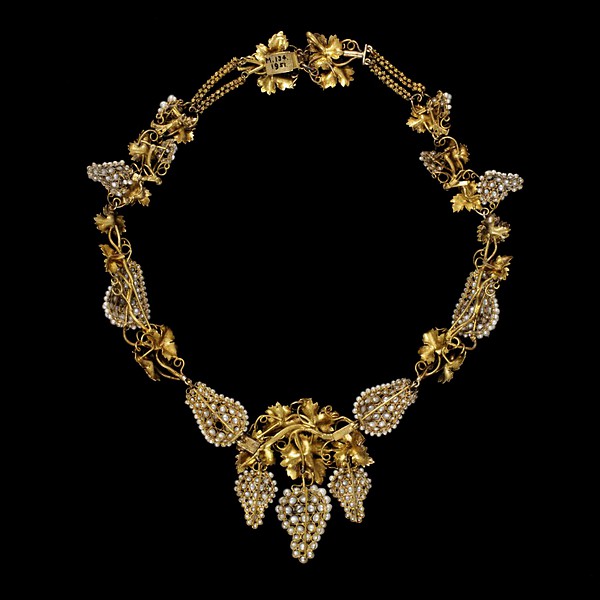
Mastery of Design: The Grapes and Vines Necklace, c. 1850


Necklace
Gold, Seed Pearls
English, c. 1850
The Victoria & Albert Museum


The visual motif of grapes and vines has been utilized in jewelry-making since antiquity. However, the idea saw a revival during the Victorian era when the fashion for sets of seed pearl jewelry gave jewelers the perfect “canvas” for grape-like forms. 

This English example, made around 1850, is the necklace from one of the most complex, elaborate and intricately-made grape parures that I’ve ever seen. The construction of the piece is exceptional. The pearls are attached with horsehair and silk to an elaborate framework made of gold wires. The varicolored gold gives an unusual depth and sense of naturalism to the suite. 


Friday, October 18, 2013

Mastery of Design: The Hull-Grundy Coral and Ruby Dove Earrings

The British Museum


Made in England in the 1830s, this pair of earrings is hung with coral drops.  A setting of bloomed-gold leaves is surmounted by doves with ruby-set eyes.  The 1830s saw a rising taste for Naturalistic jewelry, not only designs of flowers, fungus and foliage, but also birds, insects and animals.  While real preserved animals were also employed, most wearers preferred golden representations to taxidermy.

These earrings are part of the Hull-Grundy Gift to the British Museum.


Wednesday, October 16, 2013

Mastery of Design: Anne Hull Grundy's Morning Glory Brooch

Brooch of Diamonds, White Gold, Nephrite, Chalcedony
The British Museum

Click on image for larger size.  


Made in Germany circa 1930, this handsome brooch of white gold, nephrite, diamonds and stained chalcedony still is matched with its original invoice for £400, as purchased by Anne Hull Grundy.  Taking the form of a brilliant morning glory, the brooch is an interesting combination of Art Deco design ideals and the romantic naturalism favored in the late Nineteenth Century.

Obviously, this is part of the important Hull-Grundy Gift of hundreds of unusual jewels which was bequeathed to The British Museum.


Tuesday, August 13, 2013

Object of the Day, Museum Edition: The Trembler Twig Bracelet, 1850


Bracelet
Gold, Enamel, Pearls
English, 1850
The Victoria & Albert Museum

Made just before the Great Exhibition, this lovely bracelet of gold, enamel and pears shows the leaning toward Naturalism in Nineteenth Century jewelry design. We’ve already discussed the addition of movement in such designs by introducing springed pieces called “tremblers” which quivered sparkled when the wearer moved.

Several of the pearl pieces of this bracelet act as tremblers and create a shimmering effect as it slid around on the lady’s wrist. This jewel was made during the societal reliance on

The Language of Flowers,” which assigned meaning to paricular floral groupings and blooms. Here, we see entwined twigs which represented unending love.

This would have been given as a courting gift and would have led up to a proper engagement. 


Wednesday, June 19, 2013

Painting of the Day: Feeding Ducks, c. 1850

Feeding Ducks
Bocion, after 1850
The Victoria and Albert Museum


This handsome genre scene/landscape is a harmony of small figures, naturalism and fancy.  The architecture of the house belies the naturalistic roots of the scene with it's unusual stylistic nod to the medieval.

"Feeding Ducks," is the work of François Bocion (1828-1890) who was born in Lausanne.  Bocion started his career as a history painter, and the architecture of the house may, in fact, be an offshoot of those early stylistic beginnings.  In the 1840s Bocion emerged as a fancier of the rustic subject matter which characterized Realist and Naturalist works, two styles which were quite the mode in France at the time.  By the 1850s, Bocion found his muse, Lake Leman, a them which was repeated frequently in his oeuvre, and is clearly represented here.


Thursday, May 23, 2013

Object of the Day, Museum Edition: The Lester Bobbin Lace Fern Bodice Front, 1865-1875


The Victoria & Albert Museum


A popular adornment to a Nineteenth Century lady’s outfit was the addition of a lace collar or bodice front. This fashion was particularly stylish in the 1860s and early 1870s. Here, we see an example of the type of bodice front which would have been worn by a fashionable lady. Such a piece could have been worn with a variety of bodices. It would have been intended to be worn over a contrasting colored silk, setting its pattern into clear relief.

This example features a bib-shaped front worked with fine cotton thread and bobbin lace worked in a pattern of ferns and blossoms in cloth stitch with openwork decoration. A narrow border of Bucks point lace has been attached to the outer edge.

The detail and delicacy of the bobbin lace indicates that it was made in Bedfordshire, England which was a lace-making center. In fact, this type of work is often referred to as “Bedfordshire Style.” The curators at the V&A believe this piece was designed by Bedfordshire’s Thomas Lester who was known for such intricate patterns which often depicted ferns and other naturalistic themes. The botanical theme suggests that the bodice front was made between 1865 and 1875.


Wednesday, March 6, 2013

Mastery of Design: The Grapevine Necklace, 1840-1850


Necklace
London, 1840-1850
The Victoria & Albert Museum
The mid-Nineteenth Century saw an upsurge in jewels designed in naturalistic shapes. This trend was made all the more fashionable by Queen Victoria who had several pieces, many of them designed by her husband, Prince Albert, in the form of flowers, fruit or animals. This necklace is a perfect example. Here, we see a necklace in the form of vines laden with grapes and leaves. It is constructed of enameled gold mounted with amethysts.  We've looked at other examples of "grapevine" jewelry before, but those have been made with pearls, this is one step further in the fashion of naturalism.


This type of naturalistic jewelry emerged with the Romantic movement in the early 19th century and steadily grew in popularity, remaining popular for many decades. This piece is part of a suite which includes a matching pair of earrings.

Monday, February 4, 2013

Mastery of Design: A Bee Brooch, c. 1890


Bar Brooch
1890-1900
England
The Victoria & Albert Museum


All of the ideals of late Victorian English jewelry had a party and produced this brooch. The gold bar brooch is mounted with a gold bee. The buzzy little fellow is set with rose-cut diamonds and a pearl. Made between 1890 and 1900, the brooch shows the trend of the era toward diamond jewelry in naturalistic forms. Such a bee was handsome on its own, and, in this case, was designed to be worn as a singular, more informal piece. However, similar bees were often part of opulent diamond floral sprays, sometimes set on coiled wires—tremblers--so they might move as the wearer did.


Monday, December 17, 2012

Mastery of Design: The Meller Brooch, c. 1850

Bodice Ornament
France, 1840-1850
Given by Frederick Meller to
The Victoria & Albert Museum


As mid Nineteenth Century jewelers strove for naturalism in their designs, they created pieces defined by densely-set stones in forms based on the beauty of nature. The next natural step in this fashion was to add movement to jewels which would replicate the motion of a breeze through plants and flowers or the motion of insects.

We’ve talked about tremblers before. These flexible, coiled stalks or springs created a sensation of shimmering nature. As the wearer moved, the jewel would sway and quiver. The overall effect was one of immense glamour and opulence.

While most of these pieces were tremendously expensive diamond creations, jewelers made some with less-costly pastes so that this fashion could be available to a wider range of customers.

This floral spay brooch is a great example of the clever use of pastes. In candlelight or gaslight, these brilliant-cut pastes, set in silver, shimmered almost as much as diamonds, and, with the novelty of motion, these costume pieces were quite convincing. It was made in France around 1840 -1850 and features articulated pendants which would have swayed as the wearer walked. The jewel was to give the impression of flowers bathed in a gentle rain.

Wednesday, December 5, 2012

The Home Beautiful: The Marel Vase and Cover, 1839

Vase and Cover
Marrel Freres, 1839
The Victoria & Albert Museum


With cast plaques depicting the four seasons inset into its foot, this silver, Renaissance-style footed-vase and cover is decorated in the Mannerist style which had been popular at the Fontainebleau around 1530. Furthermore, it’s clearly imitating the work of Bernard Palissy. However, having been made in 1839, it invariably is adorned with the hallmarks of that period—naturalistic clusters of grapes, frogs, lizards and other such stuff. It’s a unique blend of Sixteenth-Century Mannerism and Nineteenth-Century Naturalism.

The vase was exhibited at the Expostion des Produits de l'industrie in Paris in 1839, and then, at the Great Exhibition of 1851 where it was purchased for £100 to be added to the collection of the new South Kensington Museum (later named the Victoria and Albert Museum). The vase’s maker, the Parisian firm of Marrel Frères, was awarded a Council Medal, the highest honor.

The awards council described the piece as, “very elegant and playful in the general form, and well executed; the enameled decoration, though rather thin in character, and in parts not well distributed, is beautifully drawn.”

John Charles Robinson (1824-1913), the Curator of the Museum of Manufactures at Marlborough House Museum (part of the collection which would become the South Kensington Museum, and, then, the V&A) in 1853 said of this vase:

“Although not an inelegant object, there is a certain thinness and poverty in the ornamentation, contrasting most forcibly, for instance with the massive richness of the previous example [a sixteenth-century chalice]. As a specimen of careful and dextrous workmanship, however, this leaves nothing to be desired; it is likewise in all its parts consistently treated in the true direction of the material. On the whole a more characteristic specimen of French taste in goldsmiths' work, as displayed in 1851, could not have been selected.” In short, he liked it.

The silver vessel and its cover are decorated with arabesques in translucent blue enamel and set with cabochon garnets mounted inside the applied cartouches.


Tuesday, November 6, 2012

Mastery of Design: The Grundy Tiara, c. 1850

Click on image for a larger size.
Tiara
Gold and Garnets
England, 1850
The British Museum


Dating to about 1850, this beautiful gold tiara is set with round and leaf-shaped cabochon garnets in the form of a half-circlet of flowers and foliage. Made in England, the tiara shows the sort of requisite ornament worn by aristocratic English ladies at important functions. Similarly, it’s wholly demonstrative of the jewelry designs of the 1850s—designs which relied on natural ornament and motifs based on the beauty of the English garden.

Wednesday, September 26, 2012

Mastery of Design: The Grapes and Vines Necklace, c. 1850

Necklace
Gold, Seed Pearls
English, c. 1850
The Victoria & Albert Museum


The visual motif of grapes and vines has been utilized in jewelry-making since antiquity. However, the idea saw a revival during the Victorian era when the fashion for sets of seed pearl jewelry gave jewelers the perfect “canvas” for grape-like forms. 

This English example, made around 1850, is the necklace from one of the most complex, elaborate and intricately-made grape parures that I’ve ever seen. The construction of the piece is exceptional. The pearls are attached with horsehair and silk to an elaborate framework made of gold wires. The varicolored gold gives an unusual depth and sense of naturalism to the suite. 


Monday, June 25, 2012

The Home Beautiful: The William Morris "Fruit" Wallpaper, 1862

Sketch for Fruit Wallpaper
William Morris, 1862
The Victoria & Albert Museum


Designer and famous socialist William Morris (1834-1896) is known for his handsome designs and patterns. His style developed over the decades. Here’s a look at an early wallpaper pattern which is known both as “Fruit” and “Pomegranate” and dates from around 1862.

Morris used visual motifs from his medieval-style tapestry work, relying on the historical look which his earlier work shared with the Pre-Raphaelite Brotherhood. We see, however, the awakenings of Morris’ interest in naturalism and plants.

This sketch varies from the finished wallpaper. The olives were replaced with peaches in the finished product. Morris deemed the olives too delicate and difficult to see. The pattern forms the basis for the original wallpaper which was used for the V&A's Green Dining Room, circa 1866—now long gone.