Showing posts with label bronze. Show all posts

Wednesday, May 28, 2014

Figure of the Day: The Bronze Jester Candlestick, 15th C.


Bronze Candlestick
Germany
Fifteenth Century
The Victoria & Albert Museum


This handsome Fifteenth Century bronze figure heralds from Germany and takes the form of a fool or jester on a triangular molded pedestal adorned with three apes, of course, and resting on three lions.

But, this isn’t just a sculpture.  He’s a useful fool.  You see, with his extended left hand, he would support a candle which would rest upon his shoulder as he looked up at the flickering light. 

I think this is a very attractive and unusual piece, and exceedingly modern for having been made in the 1400s.  


Wednesday, April 30, 2014

Her Majesty’s Furniture: A Magnificent Jewel Casket, 1750


Crown Copyright
The Royal Collection
Image Courtesy of Her Majesty Queen Elizabeth II

Click image for larger size.


Jewel Casket
Florence
1720
The Royal Collection

Made in 1720 in the Grand Ducal Workshops of Florence by Giovanni Battista Foggini, this amazing jewel casket of Ebony, rosewood, hardstones, and gilt bronze came to the Royal Collection through unknown circumstances, possibly as early as the late Eighteenth Century, but probably via Queen Mary. With its intricate mosaic and ornate ormolu, this casket was the epitome of Florentine style.

Though assigned a practical use (holding jewels), the casket is now as valuable as the objects it once held.

Crown Copyright
The Royal Collection
Image Courtesy of Her Majesty Queen Elizabeth II

Click image for larger size.
Crown Copyright
The Royal Collection
Image Courtesy of Her Majesty Queen Elizabeth II

Click image for larger size.

The carved gilt wood stand with cabriole legs terminating in lions' paw feet is joined near the bottom by an X-shaped stretcher with a pine-cone finial  with rocaille motifs.  It is original to the piece.


Crown Copyright
The Royal Collection
Image Courtesy of Her Majesty Queen Elizabeth II

Click image for larger size.


Tuesday, April 15, 2014

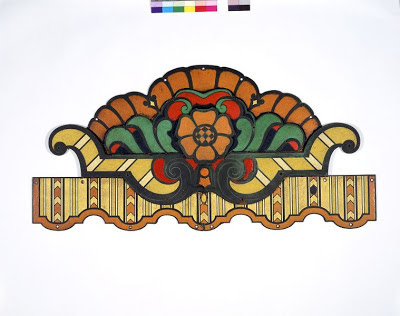
The Home Beautiful: The Raymond Hood Door Surround, 1929


Click Image to Enlarge
Door Surround
Raymond Hood, 1929
The Victoria & Albert Museum


Raymond Hood (1881-1934), an American architect was the son of a well-to-do Rhode Island manufacturer of boxes who forced upon his son a strict, religious and narrow-minded education and upbringing.  Following schooling at Brown University in Providence Rhode Island, Hood began to realize his own creativity, and, in 1899, proceeded to the architecture school at the Massachusetts Institute of Technology, Cambridge. 


1901 saw hood join to firm of Cram, Goodhue & Ferguson, where Hood worked closely with Bertram Grosvenor Goodhue and developed a deep appreciation for Gothic tradition in American architecture, a vital counterpoint to his grounding in Beaux-Arts Classicism. I1904 brought Hood to Paris where he enrolled in the Atelier Duquesne at the Ecole des Beaux-Arts. For the next seven years, Hood traveled throughout Europe and America, and, as the curators at the V&A explain, 

During this period he developed into a sharp, confident, ambitious, worldly and entertaining young architect of much potential, but with a conventional Beaux-Arts approach to style and planning. His early projects are impressive chiefly for their balance of Gothic and classical vocabularies.

By 1914, Hood had settled again in the U.S. and had opened his own firm which brought him recognition for his Bohemian sensibilities, but little paying work.  His gleeful, irreverent and colorful work, however, was praised by critics who recognized Hood's creative gift.  And, soon, he was heralded as a fine interior decorator as well as an architect.

1922 brought a change in Hood's fortunes when he triumphantly entered the Chicago Tribune competition, with a design for a Gothic tower.  This building led to the design of the four grandest skyscrapers of New York City: the American Radiator Building (1923–5), the Daily News Building (1929–30.), the McGraw-Hill Building (1930–31) and the RCA Building at Rockefeller Center (1931–40).  These buildings are Hood's greatest achievements and monuments to his creative genius, giving him a place in history as one of America's greatest architects as well as the architect who did the most to develop American Gothic.

The door surround pictured above, is a rare example of Hood's later domestic design work.  Designed by Hood and crafted by the Birmingham Guild of handicraft, the enamel on bronze pediment was made for Ideal House, Argyll Street, London W1.


Monday, March 17, 2014

Sculpture of the Day: “Irish Peasant Woman” by Edward Onslow Ford, 1881


Irish Peasant Woman
Edward Onslow Ford, 1881
Bronze
Lady Lever Art Gallery
Liverpool

In the 1880’s art was finding a push toward realism. This was especially evident in the style of sculpture known as “New Sculpture.” One had to be careful, however. As an artist, it’s never a good idea to be too realistic when sculpting members of one’s own family.

Such was the case with sculptor Edward Onslow Ford who cast the bronze bust of an aged relative. He was quite proud of himself for showing the natural deterioration of old age. However, according to Ford’s daughter, the sitter “recoiled in horror” when she saw it for the first time.

The realistic trend didn’t last terribly long. Ford gave it up and focused on sculpting ideal busts of perfect young beauties. It’s just a pity that whomever this “Irish Peasant Woman” is, didn’t get the same treatment—at least for her sake.


Saturday, February 22, 2014

Gifts of Grandeur: The Grand Duchess Olga Gold Casket, 1800-1850


Gilt Bronze and Micromosaic Jewel Casket
St. Petersburg, 1800-1850
This and all related images from:
The Victoria & Albert Collection


Tsar Paul I (reigned 1796-1801) built Gatchina Priory, south of St. Petersburg, commissioning the monumental structure in the Gothic style which he favored. This jewel casket exhibits a similar style. It’s believed that the casket (made either in Rome or St. Petersburg) was created for the Grand Duchess Olga (1822-92), the daughter of Tsar Nicholas I.

The casket is constructed of gilt bronze with relief friezes of intricate archways, each interrupted by a central oval. Many of the oval medallions have been inset with micromosaics of putti in the act of play. The jewel case’s top section is adorned with a relief of arcs, arches and fleurs-de-lis set against foliage. At the center of the lid, a rectangular mosaic has been set. This intricate scene depicts the Gatchina Priory nestled into a lush landscape.

Made between 1800 and 1850, the casket is thought to be the work of Georgi Ferdinand Wekler, considered one of the foremost mosaicists of his day. The box is now part of the Gilbert Collection at the V&A.


Thursday, February 20, 2014

Sculpture of the Day: “Victory” by Christian Daniel Rauch, 1851


Christian Daniel Rauch
Victory
1851
Bronze
The Royal Collection
During the Great Exhibition of 1851, Queen Victoria and Prince Albert delighted in the displays of sculpture which lined the main corridor of the exhibit. Queen Victoria was particularly taken with the work of C.D. Rauch and ordered a seven foot tall marble figure of Victory from the sculptor with the intention of presenting as a gift to Prince Albert.

Rauch had sculpted many of the enormous figures which had been displayed at the King of Bavaria’s German showpiece, Valhalla, and his work was well known to many of Euopre’s crowned heads. Curiously, the sculpture that Victoria selected from the Great Exhibition had been intended for her all along. It seems that the King of Prussia had commissioned a grand sculpture of Victory which he planned on presenting to Queen Victoria. Strangely, he never followed through, and the sculpture was never presented to the Queen. Rauch ended up showing the unclaimed work at the Great Exhibition instead, and it coincidentally caught the eye of the Queen.

Prince Albert loved the figure and displayed it at their summer home on the Isle of Wight, Osborne House. A small bronze version of the sculpture (seen above) was cast in Germany and shown at the Great Exhibition, taking the place of the marble which had been moved to Osborne House. After the Exhibition, the bronze was added to the Royal Collection.

Crown Copyright
The Royal Collection
via The Royal Collection Trust
Image Courtesy of Her Majesty Queen Elizabeth II


Tuesday, January 21, 2014

Sculpture of the Day: The Bronze Captive, 1660


The Victoria & Albert Museum


We see here, a captive man with manacled wrists held in front. He kneels on his left knee above a shield, quiver and arrow (symbols of his then-unattainable freedom). Regal in his feathered head-dress and skirt, he looks toward the freedom which has long been denied him.

The work of an unknown sculptor, this powerful figure of patinated bronze dates to 1660-1700 and hails from France. During this period, France colonized islands in the West Indies hoping to transform them into profitable sugar-producing centers fueled by the labor of enslaved Africans.


Wednesday, November 13, 2013

Sculptures of the Day: A Pair of Italian Firedogs


Fire Dogs
Bronze, Circa 1580
Italian
The Royal Collection
Image Courtesy of
Her Majesty Queen Elizabeth II
Firedogs are devices (metal or ceramic) which are designed to hold logs above the level of the hearth so that air can circulate beneath the firewood, thereby allowing for a more even blaze. Firedogs have been used since about 2000 B.C., and were often also employed to hold skewered meats for cooking.


This pair of bronze firedogs dates from about 1580. Crafted in Italy, possibly by the Paduan sculptor Francesco Segala, they are dominated by two figures—one of Mars and one of Hercules. The bases beneath the figures show the coat of arms of the Venetian noble family for whom they were originally designed. Some scholars believe that the original owners were Venice’s Ghisi family. However, due to a similarity to another family’s coat of arms, they have also been attributed to the Riva family.

While the exact date they entered the Royal Collection is unknown, they were first recorded in the British Royal inventory in 1724.

Crown Copyright
The Royal Collection
Via The Royal Collection Trust
Image Courtesy of Her Majesty Queen Elizabeth II

Click on Image for Larger Size.


Tuesday, October 22, 2013

Figure of the Day: Charlie Keith, 19th C.


Bronze Candlestick
Presented to Charlie Keith
London, Nineteenth Century
The Victoria & Albert Museum


You may remember Charlie Keith (1835-1895) from our previous look at one of his costumes. This London clown was billed as “the Favourite Clown, Tumbler, Chair and Original Performer,” following in the footsteps of Joseph Grimaldi and his son. In fact, Keith based his white-faced look on Grimaldi’s, even adapting Grimadli’s wig-style, the “three bobble coiffure.” He was so successful that by 1868, he’d opened his own traveling circus. This figural bronze candlestick was presented to Keith in the late Nineteenth Century. The clown figure is likely based on Keith himself. The modeler is unknown.

The bronze is thought to have been given to Keith before his death in 1896. He died in Bury and was buried in Southport.
 I wonder why he wasn't buried in Bury.  That would have suited him better.


The Home Beautiful: Queen Victoria's Terrier, Spot, 1885


Spot
Paperweight of Bronze and Granite
English, 1885
Crown Copyright
The Royal Collection
Image Courtesy of Her Majesty Queen Elizabeth II


This paperweight dates to 1885 and features a bronze figure of a dog upon a low bronze base. The whole of the piece is supported by a plinth of gray, black and white mottled granite, lined beneath with red velvet. The dog depicted here is another favorite of Queen Victoria—Spot, a white terrier with lemon markings. Queen Victoria adopted spot in 1880 and, five years later, commissioned a
 now unknown sculptor to create this figure of her beloved companion. 


Unusual Artifact: The Two-Headed Chimera Tap, 16th C.


Bronze Tap in the Shape of a Chimera
Italian, Sixteenth Century
The Victoria & Albert Museum


This bronze tap was crafted in the late Sixteenth Century in Italy and takes the form of a two-headed dragon of chimera in full relief. 

Grotesque figures often graced Italian flask or barrel taps like this one which were used to siphon liquids. This example, being of bronze, and sculpted so intricately would have been devoted to a special purpose in a very wealthy household. 


Sculpture of the Day: “Victory” by Christian Daniel Rauch, 1851


Christian Daniel Rauch
Victory
1851
Bronze
The Royal Collection
During the Great Exhibition of 1851, Queen Victoria and Prince Albert delighted in the displays of sculpture which lined the main corridor of the exhibit. Queen Victoria was particularly taken with the work of C.D. Rauch and ordered a seven foot tall marble figure of Victory from the sculptor with the intention of presenting as a gift to Prince Albert.

Rauch had sculpted many of the enormous figures which had been displayed at the King of Bavaria’s German showpiece, Valhalla, and his work was well known to many of Euopre’s crowned heads. Curiously, the sculpture that Victoria selected from the Great Exhibition had been intended for her all along. It seems that the King of Prussia had commissioned a grand sculpture of Victory which he planned on presenting to Queen Victoria. Strangely, he never followed through, and the sculpture was never presented to the Queen. Rauch ended up showing the unclaimed work at the Great Exhibition instead, and it coincidentally caught the eye of the Queen.

Prince Albert loved the figure and displayed it at their summer home on the Isle of Wight, Osborne House. A small bronze version of the sculpture (seen above) was cast in Germany and shown at the Great Exhibition, taking the place of the marble which had been moved to Osborne House. After the Exhibition, the bronze was added to the Royal Collection.

Crown Copyright
The Royal Collection
via The Royal Collection Trust
Image Courtesy of Her Majesty Queen Elizabeth II


Object of the Day, Museum Edition: A Woman Smoking, 1931


"A Woman Smoking"
Medal of French Bronze
Pierre Charles Lenoir, 1931
The Victoria & Albert Museum


By the 1930s, as the Art Deco style had become firmly entrenched in the arts, the style began to depict the many changes that were taking place in the post-war society.  Medals and plaquettes in bas relief were especially popular art forms—stripped of their original traditional and ceremonial meanings and assigned purely decorative properties.   This French plaque of bronze which was struck in 1931 depicts a half-dressed woman smoking a cigarette.  Not only does this show the growing acceptance of women smoking cigarettes, it suggests the increasing modernity and hedonistic approach to life which marked the era.


This uniface metal is the work of the French medalist Pierre Charles Lenoir (1879-1953). 

Tuesday, August 6, 2013

Object of the Day, Museum Edition: Le Terrassier, 1894

Le Terrassier
French, 1894
The Victoria & Albert Museum


The strain of hard labor is evident in the meticulously modeled hands, arms, shoulders and face of this figure of a worker.  He poses, bare-chested, in baggy trousers, leaning slightly on his shovel, fatigued but strengthened by the burden of his work.

This figure, circa 1894, is a brilliant representation of the work of  Aimé-Jules Dalou (1838 -1902), the son of a French glove-maker who was trained in drawing at  the Petit École in Paris.  During his studies, Dalou showed a mastery of anatomy and was encouraged to try his hand at sculpture.  This pursuit led him to the École des Beaux-Arts in 1854.  There, he trained for four years.  Some political kerfuffles (like his part in the founding of the Paris Commune in 1871), led to Dalou being exiled from Paris.  And so, off to London where he stayed until 1879, often exhibiting at the Royal Academy.  He exerted considerable influence on British sculpture while on London.

I suspect he was probably a very unpleasant bloke.  He sculpts in the manner of someone unpleasant.  Nevertheless, his work is attractive and an important step in the evolution of the "New Sculpture Movement."

This particular statuette, "Le Terrassier," shows Dalou's belief in traditional craftsmanship.  He created the figure as a study for a large-scale monument which never came to be.  Dalou was very much against the practice of mass producing sand-cast sculptures.  This figure was cast in bronze by Susse Frères who utilized the lost-wax method. Inscribed ‘DALOU’ and ‘cire perdue’ on the back of the base, it is marked ‘Susse Frs Edn Paris’on the front. The figure is stamped with the foundry mark ‘SUSSE FRERES PARIS LOITEURS’ and, in the middle, a trademark of blacksmiths’ tools.

Monday, July 8, 2013

The Home Beautiful: The Raymond Hood Door Surround, 1929

Click Image to Enlarge
Door Surround
Raymond Hood, 1929
The Victoria & Albert Museum


Raymond Hood (1881-1934), an American architect was the son of a well-to-do Rhode Island manufacturer of boxes who forced upon his son a strict, religious and narrow-minded education and upbringing.  Following schooling at Brown University in Providence Rhode Island, Hood began to realize his own creativity, and, in 1899, proceeded to the architecture school at the Massachusetts Institute of Technology, Cambridge. 

1901 saw hood join to firm of Cram, Goodhue & Ferguson, where Hood worked closely with Bertram Grosvenor Goodhue and developed a deep appreciation for Gothic tradition in American architecture, a vital counterpoint to his grounding in Beaux-Arts Classicism. I1904 brought Hood to Paris where he enrolled in the Atelier Duquesne at the Ecole des Beaux-Arts. For the next seven years, Hood traveled throughout Europe and America, and, as the curators at the V&A explain, 

During this period he developed into a sharp, confident, ambitious, worldly and entertaining young architect of much potential, but with a conventional Beaux-Arts approach to style and planning. His early projects are impressive chiefly for their balance of Gothic and classical vocabularies.

By 1914, Hood had settled again in the U.S. and had opened his own firm which brought him recognition for his Bohemian sensibilities, but little paying work.  His gleeful, irreverent and colorful work, however, was praised by critics who recognized Hood's creative gift.  And, soon, he was heralded as a fine interior decorator as well as an architect.

1922 brought a change in Hood's fortunes when he triumphantly entered the Chicago Tribune competition, with a design for a Gothic tower.  This building led to the design of the four grandest skyscrapers of New York City: the American Radiator Building (1923–5), the Daily News Building (1929–30.), the McGraw-Hill Building (1930–31) and the RCA Building at Rockefeller Center (1931–40).  These buildings are Hood's greatest achievements and monuments to his creative genius, giving him a place in history as one of America's greatest architects as well as the architect who did the most to develop American Gothic.

The door surround pictured above, is a rare example of Hood's later domestic design work.  Designed by Hood and crafted by the Birmingham Guild of handicraft, the enamel on bronze pediment was made for Ideal House, Argyll Street, London W1.


Wednesday, April 24, 2013

Object of the Day, Museum Edition: The Grand Duchess Olga Gold Casket, 1800-1850


Gilt Bronze and Micromosaic Jewel Casket
St. Petersburg, 1800-1850
This and all related images from:
The Victoria & Albert Collection


Tsar Paul I (reigned 1796-1801) built Gatchina Priory, south of St. Petersburg, commissioning the monumental structure in the Gothic style which he favored. This jewel casket exhibits a similar style. It’s believed that the casket (made either in Rome or St. Petersburg) was created for the Grand Duchess Olga (1822-92), the daughter of Tsar Nicholas I.

The casket is constructed of gilt bronze with relief friezes of intricate archways, each interrupted by a central oval. Many of the oval medallions have been inset with micromosaics of putti in the act of play. The jewel case’s top section is adorned with a relief of arcs, arches and fleurs-de-lis set against foliage. At the center of the lid, a rectangular mosaic has been set. This intricate scene depicts the Gatchina Priory nestled into a lush landscape.

Made between 1800 and 1850, the casket is thought to be the work of Georgi Ferdinand Wekler, considered one of the foremost mosaicists of his day. The box is now part of the Gilbert Collection at the V&A.


Tuesday, April 23, 2013

Unusual Artifacts: An Italian Bronze Lamp, 1500-1550


The Victoria & Albert Museum


This bronze lamp made in Italy between 1500 and 1550 depicts the head of a satyr with a foliated beard and eyebrows, mounted on an eagle's claw. His mouth forms the burner and a hinged cover to the oil reservoir is on his crown.

This was made in the workshop of Severo da Ravenna in Padua or Ravenna. Known also as Severo di Domenico Calzetta da Ravenna, he was an Italian sculptor, active between 1496 and approximately 1543.