Showing posts with label Princess of Wales. Show all posts

Sunday, June 22, 2014

History's Runway: The "Elvis" Dress, 1989


"The Elvis Dress"
Catherine Walker, 1989
This and all related images from:
The Victoria & Albert Museum


When I picture Diana, Prince of Wales, it is this gown which she’s wearing. Just one of the many iconic gowns worn by the late Princess, for some reason, this one always sticks in my memory. Known as “The Elvis Dress” (a nickname given to the ensemble by the princess herself because of the similarity of the high white collar of the jacket to those on the jumpsuits worn by Mr. Presley at his most rotund), this dress and matching bolero speak volumes of the stream-lined style favored by the Princess of Wales in the late 1980s.

Well aware of her status as a fashion icon and style-setter, the Princess of Wales was always careful to don only the most flattering and fashionable garments when out for an elegant and formal evening. By the late 1980s, Princess Diana had pushed aside the fuller-cuts, crinolines and flowing chiffons of her earlier days in favor of bolder textures and sleek, tailored gowns. I think this gown is the epitome of that trend. 


The strapless gown of white silk is encrusted with pearls and sequins. It’s given a sense of drama by the tall collar of the matching bolero. It’s the work of Catherine Walker, a favorite
couturière of the Princess of Wales. Diana’s association with Walker began during her pregnancy with Prince William of Wales in 1981. Walker continued to design for the Princess until Diana’s death in 1997.

The princess wore the ensemble to the British Fashion Awards in October 1989, on an official visit to Hong Kong, and, later for an official portrait. The gown had actually been commissioned for the official visit to Hong Kong. Walker envisioned a sheath of pearls for the occasion. Tens of thousands of pearls—long a symbol of the “orient”--were embroidered onto the dress and jacket.

Walker would recall in 2012: “Whenever I saw the Princess in this dress, I could not help but feel that it would not be possible for anyone else ever to wear this dress and bolero. She shone in the dress and the dress shone around her in a shimmering column of glistening pearls.”

It was one of the 79 dresses which the Princess of Wales sold in a charity auction in 1997. The auction, held by Christie’s, raised over three million pounds for AIDS and cancer research. A commemorative doll of the princess shows her in this dress.


Sunday, April 27, 2014

Royal Fashion: Princess Alexandra’s Evening Dress, 1900


Evening Dress
Made for Princess Alexandra of Denmark, 1900
The Victoria & Albert Museum
As both Princess of Wales and Queen Consort, Alexandra of Denmark was known for her impeccable fashion sense and her enduring beauty. Her style was the benchmark for upper class fashion and ladies of the court looked to Queen Alexandra to see what was in vogue.

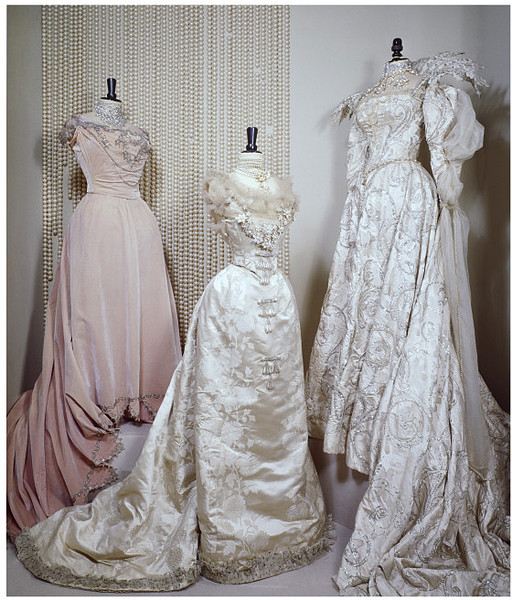
Here’s one of her gowns. This elegant evening dress of figured satin, decorated with imitation pearls, diamantes and spangles was designed by the famous Paris fashion house Maison Laferrière which was was frequented by only the wealthiest in London society. Maison Laferrière was celebrated for their exquisite designs and fine workmanship. The chief mind behind the fabulous fashion house was Madame Laferrière's whose designs were among those shown by the Collectivité de la Couture at the Universal Exhibition of 1900 held in Paris.

This gown was made for Princess Alexandra of Denmark (later Queen Alexandra). It was given to theVictoria & Albert Museum by one Lady Lloyd as part of the Cecil Beaton Collection—an exhibition of style collected by the society photographer Sir Cecil Beaton (1904-1980). 


Tuesday, November 19, 2013

Sculpture of the Day: The Tower Bridge Medal, 1894


Tower Bridge Medal
June, 1894
The Victoria & Albert Museum


This medal of bronze is one of a series which was issued by the Corporation of the City of London to commemorate the June, 1894 opening of the famous Tower Bridge by His Majesty Prince Albert, The Prince of Wales (this is Prince Albert Edward who would become King Edward VII following the death of his mother, Queen Victoria, in 1901).

The face of the medal shows busts of the Prince and Princess of Wales (later Queen Alexandra) superimposed with a crowned head of Queen Victoria.

On the reverse, it reads:

TOWER BRIDGE OPENED 30th JUNE 1894 ON BEHALF OF HER MAJESTY QUEEN VICTORIA BY H.R.H THE PRINCE OF WALES The bridge is pictured in perspective, and, above is the mark of the Bridge House Estates of the Corportion. The arms of the City of London are shown below. The medal is signed, “F. BOWCHER. FECIT.” Medalist Frank Bowcher (1864-1938) designed the piece. 


Monday, April 15, 2013

History's Runway: Princess Alexandra’s Evening Dress, 1900


Evening Dress
Made for Princess Alexandra of Denmark, 1900
The Victoria & Albert Museum

As both Princess of Wales and Queen Consort, Alexandra of Denmark was known for her impeccable fashion sense and her enduring beauty. Her style was the benchmark for upper class fashion and ladies of the court looked to Queen Alexandra to see what was in vogue.

Here’s one of her gowns. This elegant evening dress of figured satin, decorated with imitation pearls, diamantes and spangles was designed by the famous Paris fashion house Maison Laferrière which was was frequented by only the wealthiest in London society. Maison Laferrière was celebrated for their exquisite designs and fine workmanship. The chief mind behind the fabulous fashion house was Madame Laferrière's whose designs were among those shown by the Collectivité de la Couture at the Universal Exhibition of 1900 held in Paris.

This gown was made for Princess Alexandra of Denmark (later Queen Alexandra). It was given to theVictoria & Albert Museum by one Lady Lloyd as part of the Cecil Beaton Collection—an exhibition of style collected by the society photographer Sir Cecil Beaton (1904-1980). 


Monday, April 8, 2013

Antique Image of the Day: Princess Maud of Wales, 1905


Frame with Photograph of Princess Maud of Wales
1905
Unknown Photographer
Frame by Viktor Aarne
Crown Copyright
The Royal Collection
Image Courtesy of Her Majesty Queen Elizabeth II
Later Queen of Norway, Princess Maud was the daughter of King Edward VII and Queen Alexandra. A keen patron of the arts, Princess Maud was also a champion for the rights of children and animals. Though she fulfilled her duties as Queen Consort of Norway, after her marriage to Haakon VII of Norway, she always loved England first and most.


This photograph was taken in 1905 just before becoming Queen Consort. Queen Alexandra placed the cherished photo in a frame by Viktor Aarne of Fabergé. The frame of gold, silver-gilt, guilloché enamel, pearls, diamonds, mother-of-pearl is a masterpiece unto itself.

Crown Copyright
The Royal Collection
Image Courtesy of Her Majesty Queen Elizabeth II

Unusual Artifacts: The Princess Alexandra Pocket Knife, 1863


Click on image for larger size.

The Princess Alexandra Pocket Knife
Denmark, 1863
The Victoria & Albert Museum


We know at once by the monogram that this belonged to Queen Alexandra. She was known as Princess of Alexandra of Denmark until she married Queen Victoria’s eldest son—the Prince of Wales. As the Princess of Wales, Alexandra captured the affection of Britain with her beauty and her devotion to a variety of causes. When the Princes of Wales ascended the throne as King Edward VII, Alexandra became the Queen Consort and—despite her increasing deafness, frequent inability to walk and her husband’s very public infidelities—served the Empire to the best of her abilities.

This penknife of etched, blued and gilded steel was made to commemorate the marriage of the Prince of Wales to Princess Alexandra. On one side of the knife is adorned with the letter A, set between the arms of England and Sweden and Norway. The other side’s decoration is a little more peculiar. It shows to images of interlacing monsters between which is a seated figure of a Norseman playing a harp—as one does when seated between two monsters.

The penknife was made in Denmark for the Princess of Wales in 1863. 


Tuesday, March 19, 2013

Painting of the Day: A Portrait of Lady Anne Hamilton By James Lonsdale, 1815


Lady Anne Hamilton
James Lonsdale, 1815
The Victoria & Albert Museum

Since the early Seventeenth Century, portraiture has been one of the most important historical genres of painting in Britain, allowing us a look at people who were lost centuries ago. Even if those looks are idealized, we are able to study the development of human appearance, priorities and fashion throughout history because of the existence of portraits such as this one. 

Painted by James Lonsdale in 1815, here we see Lady Anne Hamilton (1766-1846). Lady Hamilton was the eldest daughter of Archibald, 9th Duke of Hamilton. Anne Hamilton famoulsy became lady-in-waiting to the Princess of Wales (1768-1821), the future Queen Caroline, and remained at the Queen’s side until 1813, staying loyal to Caroline through her many troubles with her husband, the Prince Regent (later King George IV). 

Lady Hamilton continued to be a dedicated friend after the future Queen Caroline left England in 1814 after becoming separated from her husband, the Prince Regent. Just before the coronation of King George IV, Queen Caroline returned to England to claim what she thought was her rightful place as Queen Consort. Of course, the new King was not eager to see his wife—barring her from the coronation in July of 1821. Queen Caroline took up residence with Lady Hamilton in Portman Street, Portman Square.

Eleven days after enduring the humiliation of not only being banned from the coronation, but also taunted and hissed by the assembled crowd, Queen Caroline began to suffer from abdominal cramps while at the Drury Lane Theater. By August, she was dead. Lady Hamilton accompanied the Queen's body to Brunswick for burial after her death in 1821. The only legacy that Lady Hamilton received after her tireless service to the Queen was she received was a portrait of Caroline.

The painter, James Lonsdale (1777-1839) exhibited two portraits of Lady Anne Hamilton at the Royal Academy. One in 1805 and a second in 1815. Based on her dress, this one is thought to be the one exhibited in 1815.

Lonsdale shows Lady Hamilton seated on a plush settee, wearing a dress of black velvet with a high empire waist and a gold belt, possibly of silk, which matches the gold edging on the square neck and puffed sleeves. She also wears a large plumed black hat, adorned under the brim with a band of jewels.


Tuesday, October 16, 2012

History's Runway: The "Elvis" Dress, 1989

"The Elvis Dress"
Catherine Walker, 1989
This and all related images from:
The Victoria & Albert Museum


When I picture Diana, Prince of Wales, it is this gown which she’s wearing. Just one of the many iconic gowns worn by the late Princess, for some reason, this one always sticks in my memory. Known as “The Elvis Dress” (a nickname given to the ensemble by the princess herself because of the similarity of the high white collar of the jacket to those on the jumpsuits worn by Mr. Presley at his most rotund), this dress and matching bolero speak volumes of the stream-lined style favored by the Princess of Wales in the late 1980s.

Well aware of her status as a fashion icon and style-setter, the Princess of Wales was always careful to don only the most flattering and fashionable garments when out for an elegant and formal evening. By the late 1980s, Princess Diana had pushed aside the fuller-cuts, crinolines and flowing chiffons of her earlier days in favor of bolder textures and sleek, tailored gowns. I think this gown is the epitome of that trend. 


The strapless gown of white silk is encrusted with pearls and sequins. It’s given a sense of drama by the tall collar of the matching bolero. It’s the work of Catherine Walker, a favorite
couturière of the Princess of Wales. Diana’s association with Walker began during her pregnancy with Prince William of Wales in 1981. Walker continued to design for the Princess until Diana’s death in 1997.

The princess wore the ensemble to the British Fashion Awards in October 1989, on an official visit to Hong Kong, and, later for an official portrait. The gown had actually been commissioned for the official visit to Hong Kong. Walker envisioned a sheath of pearls for the occasion. Tens of thousands of pearls—long a symbol of the “orient”--were embroidered onto the dress and jacket.

Walker would recall in 2012: “Whenever I saw the Princess in this dress, I could not help but feel that it would not be possible for anyone else ever to wear this dress and bolero. She shone in the dress and the dress shone around her in a shimmering column of glistening pearls.”

It was one of the 79 dresses which the Princess of Wales sold in a charity auction in 1997. The auction, held by Christie’s, raised over three million pounds for AIDS and cancer research. A commemorative doll of the princess shows her in this dress.


Saturday, September 29, 2012

Sculpture of the Day: The Tower Bridge Medal, 1894

Tower Bridge Medal
June, 1894
The Victoria & Albert Museum


This medal of bronze is one of a series which was issued by the Corporation of the City of London to commemorate the June, 1894 opening of the famous Tower Bridge by His Majesty Prince Albert, The Prince of Wales (this is Prince Albert Edward who would become King Edward VII following the death of his mother, Queen Victoria, in 1901).

The face of the medal shows busts of the Prince and Princess of Wales (later Queen Alexandra) superimposed with a crowned head of Queen Victoria.

On the reverse, it reads:

TOWER BRIDGE OPENED 30th JUNE 1894 ON BEHALF OF HER MAJESTY QUEEN VICTORIA BY H.R.H THE PRINCE OF WALES The bridge is pictured in perspective, and, above is the mark of the Bridge House Estates of the Corportion. The arms of the City of London are shown below. The medal is signed, “F. BOWCHER. FECIT.” Medalist Frank Bowcher (1864-1938) designed the piece. 


Monday, August 13, 2012

Antique Image of the Day: Princess Alexandra and a Kitten, 1880

Princess Alexandra Holding a Kitten
Photograph
W & D Downey of London, 1880
Crown Copyright
The Royal Collection
Image Courtesy of Her Majesty Queen Elizabeth II


This photo was taken in 1880 by W & D Downey of 57 & 61 Ebury Street, London. The albumen photograph was intended to be used for a carte di visite which would have been collected by the public.

Here, we see Alexandra, the Princess of Wales (later Queen Alexandra, Consort of King Edward VII). She is shown in three-quarter length holding a white kitten. Alexandra shared a passion for photography that had developed in the Royal Family with Prince Albert. In fact, the future Queen Consort, was known to take many candid photos, with her own personal camera, of the Royals at home.


Wednesday, September 21, 2011

Painting of the Day: A Portrait of Lady Anne Hamilton By James Lonsdale, 1815

Lady Anne Hamilton
James Lonsdale, 1815
The Victoria & Albert Museum
Since the early Seventeenth Century, portraiture has been one of the most important historical genres of painting in Britain, allowing us a look at people who were lost centuries ago. Even if those looks are idealized, we are able to study the development of human appearance, priorities and fashion throughout history because of the existence of portraits such as this one.
Painted by James Lonsdale in 1815, here we see Lady Anne Hamilton (1766-1846). Lady Hamilton was the eldest daughter of Archibald, 9th Duke of Hamilton. Anne Hamilton famoulsy became lady-in-waiting to the Princess of Wales (1768-1821), the future Queen Caroline, and remained at the Queen’s side until 1813, staying loyal to Caroline through her many troubles with her husband, the Prince Regent (later King George IV).

Lady Hamilton continued to be a dedicated friend after the future Queen Caroline left England in 1814 after becoming separated from her husband, the Prince Regent. Just before the coronation of King George IV, Queen Caroline returned to England to claim what she thought was her rightful place as Queen Consort. Of course, the new King was not eager to see his wife—barring her from the coronation in July of 1821. Queen Caroline took up residence with Lady Hamilton in Portman Street, Portman Square.

Eleven days after enduring the humiliation of not only being banned from the coronation, but also taunted and hissed by the assembled crowd, Queen Caroline began to suffer from abdominal cramps while at the Drury Lane Theater. By August, she was dead. Lady Hamilton accompanied the Queen's body to Brunswick for burial after her death in 1821. The only legacy that Lady Hamilton received after her tireless service to the Queen was she received was a portrait of Caroline.

The painter, James Lonsdale (1777-1839) exhibited two portraits of Lady Anne Hamilton at the Royal Academy. One in 1805 and a second in 1815. Based on her dress, this one is thought to be the one exhibited in 1815.

Lonsdale shows Lady Hamilton seated on a plush settee, wearing a dress of black velvet with a high empire waist and a gold belt, possibly of silk, which matches the gold edging on the square neck and puffed sleeves. She also wears a large plumed black hat, adorned under the brim with a band of jewels.

Thursday, August 18, 2011

Royal Fashion: Princess Alexandra’s Evening Dress, 1900


Evening Dress
Made for Princess Alexandra of Denmark, 1900
The Victoria & Albert Museum
As both Princess of Wales and Queen Consort, Alexandra of Denmark was known for her impeccable fashion sense and her enduring beauty. Her style was the benchmark for upper class fashion and ladies of the court looked to Queen Alexandra to see what was in vogue.

Here’s one of her gowns. This elegant evening dress of figured satin, decorated with imitation pearls, diamantes and spangles was designed by the famous Paris fashion house Maison Laferrière which was was frequented by only the wealthiest in London society. Maison Laferrière was celebrated for their exquisite designs and fine workmanship. The chief mind behind the fabulous fashion house was Madame Laferrière's whose designs were among those shown by the Collectivité de la Couture at the Universal Exhibition of 1900 held in Paris.

This gown was made for Princess Alexandra of Denmark (later Queen Alexandra). It was given to theVictoria & Albert Museum by one Lady Lloyd as part of the Cecil Beaton Collection—an exhibition of style collected by the society photographer Sir Cecil Beaton (1904-1980).


Object of the Day, Museum Edition: The Princess Alexandra Pocket Knife, 1863

Pen Knife
Denmark, 1863
The Victoria & Albert Museum
Today, we’ll be looking at objects related to members of the Royal Family named “Alexandra,” and there were a good many of them! Alexandra is one of the names that one sees repeatedly throughout English history.

Here’s an object related to one of the more famous Alexandra’s. She was known as Princess of Alexandra of Denmark until she married Queen Victoria’s eldest son—the Prince of Wales. As the Princess of Wales, Alexandra captured the affection of Britain with her beauty and her devotion to a variety of causes. When the Princes of Wales ascended the throne as King Edward VII, Alexandra became the Queen Consort and—despite her increasing deafness, frequent inability to walk and her husband’s very public infidelities—served the Empire to the best of her abilities.

This penknife of etched, blued and gilded steel was made to commemorate the marriage of the Prince of Wales to Princess Alexandra. On one side of the knife is adorned with the letter A, set between the arms of England and Sweden and Norway. The other side’s decoration is a little more peculiar. It shows to images of interlacing monsters between which is a seated figure of a Norseman playing a harp—as one does when seated between two monsters.

The penknife was made in Denmark for the Princess of Wales in 1863.

Friday, May 27, 2011

Antique Image of the Day: Princess Maud of Wales, 1905

Frame with Photograph of Princess Maud of Wales
1905
Unknown Photographer
Frambe by Viktor Aarne
The Royal Collection
Later Queen of Norway, Princess Maud was the daughter of King Edward VII and Queen Alexandra. A keen patron of the arts, Princess Maud was also a champion for the rights of children and animals. Though she fulfilled her duties as Queen Consort of Norway, after her marriage to Haakon VII of Norway, she always loved England first and most.


This photograph was taken in 1905 just before becoming Queen Consort. Queen Alexandra placed the cherished photo in a frame by Viktor Aarne of Fabergé. The frame of gold, silver-gilt, guilloché enamel, pearls, diamonds, mother-of-pearl is a masterpiece unto itself.

Object of the Day: A Souvenir of the Wedding of Prince Charles and Princess Diana, 1981

On the morning of July 29, 1981, the world watched the “fairytale” wedding of Charles, Prince of Wales to Lady Diana Spencer. Resplendent in diamonds and silk, she entered St. Paul’s Cathedral to greet her Prince and future husband, and people around the globe were immediately captivated with her.


What started as a fairytale proved to be a nightmare, constantly chronicled by the press and under endless amounts of scrutiny. Still, the event was a day of celebration—not just in Britain, but across the entire world. Dozens of souvenir items were manufactured to commemorate the event. This is one of them.

This small china plate, rimmed in gold, bears the likenesses of the Prince and future Princess in a heart-shaped frame surrounded by symbols of Britain and surmounted by the Imperial crown. While their marriage didn’t last, these souvenirs remain as a reminder of the innocence and joy of the day and the expectations held by the world for this couple.


Saturday, April 30, 2011

The Art of Play: The Royal Wedding Charger, 1981

The Royal Wedding Charger
1981
The Victoria & Albert Museum
Museum of Childhood
This oddly cute toy was produced in 1981 as a memento of the wedding of Prince Charles and Lady Diana Spencer and is the work of Maggie Wareham. Constructed of rope, wood, beads, shells and lace, this hand-carved and hand-painted toy depicts the Prince and Princess of Wales astride a colorful charger.


Though Mr. Heal had created this unusual piece for Mr. Oliver Heal of the department store Heal's of Tottenham Court Road, London. Instead of displaying this nifty object in the store as planned, Mr. Heal was so amused by the toy that he donated it to the Victoria & Albert Museum of Childhood.

Monday, August 23, 2010

Person of the Week: Diana, Princess of Wales

Portrait by Richard Foster, RP
What would have been a “fairy tale” was a life shadowed by pain and doubt. Though some will debate the nature of her true character, no one can deny that Diana, Princess of Wales, was one of the most beautiful and fascinating women of the last century.


August 31 marks the anniversary of her tragic death in 1997. If you’re reading this blog, chances are you remember her wedding to the Prince of Wales. I recall sitting downstairs in our family room as a child, watching her in her magnificent dress on that day. Since then, I’ve always had a soft spot for Diana, and I was terribly saddened to learn of her death.

We all know all of the tabloid junk. Let’s look past that now. Here was a woman who came from the wealthy, aristocratic Spencer family—rooted in centuries of power and prestige. She married the Prince of Wales. Here’s someone who could have been vain and vapid—intolerant and shallow. Yet, she wasn’t. No matter what life threw at Diana, she soldiered on. She was human—subject to the same highs and lows that all of us are, and, so she reacted as any human would. However, she was undeterred in her missions. She put two priorities above all else—protecting her children and helping humanity.

Her visits to patients with AIDS and Leprosy were not the stuff of photo-opportunities. She touched, she talked, she genuinely cared. She made it her goal to try to make people feel better, to make them feel wanted, loved and important and to try to give them some of the things that she seemed to feel she lacked in her own life. Diana worked with the homeless, the elderly and the lost. Through her efforts, she looked after soldiers, people battling addiction and people who felt they had nowhere else to turn.

She was effortlessly beautiful whether in couture or khakis. Draped in diamonds or wearing a helmet, her beauty came from within. Hers was a light that could have been extinguished by circumstance, yet she kept it burning as brightly as she could. For that, we can still learn from her today. And, so, one week before the anniversary of her death, Diana, Princess of Wales, is our person of the week.