Showing posts with label figurine. Show all posts

Friday, February 20, 2015

Figure of the Day: John Liston as “Paul Pry,” 1820-29

John Liston as Paul Pry
1820-1829
The Victoria & Albert Museum

This Staffordshire figure, made in the 1820s, depicts John Liston (1776-1846), considered one of the leading comic actors of his day. The figurine shows Liston in character as “Paul Pry” in the play of the same name. This was one of the actor’s most famous roles and, therefore, this is one of several different figurines of Liston as Pry, the nosy and interfering star of the comic play by John Poole, which were produced in the 1820s—each modeled after contemporary engravings. 


Liston made the annoying character seem quite charming, somehow. The play enjoyed considerable success and, even, introduced several of the character’s catch-phrases into the popular vernacular. By 1825, people were quoting “Pry,’ with: “I hope I don't intrude,” “Just dropped in,” and “It's nothing to me,” with considerable gusto, and, soon, the name Paul Pry became a colloquial term for a busybody.


Wednesday, February 4, 2015

Figure of the Day: The Orange Girl, 1770-1784

The Orange Girl
Niderviller Pottery Factory
France, 1770-1884
The Victoria & Albert Museum


Here’s another attractive French porcelain figure which, once, would have graced an elegant dining table in a wealthy household. She would have once been joined by similarly attired figures, but now, she stands alone.

With her pyramid of oranges supported on a tray, she’s clearly an orange seller. Given her station, however, she’s dressed quite well--in that fantastical way in which peasants were portrayed in these figure.

This is the work of the Niderviller Pottery and Porcelain Factory, dating somewhere between 1770 and 1784.

Thursday, July 17, 2014

Figure of the Day: The Banyan Man, 1760-1780


The Banyan Man
France, 1760-1780
The Victoria & Albert Museum


The work of The Lunéville Pottery Factory in France, this wholly Rococo figure of a standing man was made to appeal to the Eighteenth Century fascination with the exotic and the asian. The figure is dressed in a turban and a banyan, and is likely a lost member of a set of dessert figurines.

The figure was made of tin-glazed earthenware adorned with enamel colors and dates between 1760 and 1780.


Sunday, June 22, 2014

Figure of the Day: Charity, A Staffordshire Figure, 19th C.


Charity
From a Series of the Virtues
Staffordshire, England
C. 1838
The Victoria & Albert Museum


This early Staffordshire figure is part of group meant to depict the virtues of Faith, Hope, Love and Charity. Here, we see Charity in porcelain painted in enamel colors. She is portrayed as a woman in a white robe which is edges in red and covered with a pattern of floral sprigs. 

Charity carries a baby on her left arm as a small child stands by her right side. The rocky, polychrome plinth/mound upon which she stands has been inscribed with her name and is accentuated by a thin, red stripe.


Saturday, March 8, 2014

Object of the Day, Museum Edition: A Figure by Samson et Cie, c. 1845


Il Capitano
Hard-paste Porcelain Figure by Samson et Cie, Paris, 1845
The Victoria & Albert Museum


This figurine of glazed hard-paste porcelain was produced by the Samson factory in Paris which was founded in 1845 by Edmé Samson. The figure depicts “the Captain,” a character from the Commedia dell'Arte. 
 The Captain, or “Il Capitano,” was among the stock characters of Commedia dell'Arte.  The swaggering character was a satire on the military profession.  The bragging Captain, if he ever really was a Captain, held the post a long time in the past. This obnoxious figure was portrayed as a boastful figure with a rakish moustache and dark beard. The Captain was originally conceived as Italian, however, he was depicted as Spanish during the period of Spanish domination of Italy.

This ceramic figurine of the bearded boaster shows him leaning slightly forward, his left arm in the air at shoulder height with his hand to his chest.
 His right hand is held out to the side at waist height. He wears a large, tan, wide-brimmed hat , a close-fitting white jacket and trousers and has a taupe cape over his shoulders. He wears black shoes with foppish gold buckles and stands on a circular rococo-style swirly-edged base with gilt decoration.


Wednesday, February 12, 2014

Figure of the Day: The Hurdy Gurdy Girl , 1785


The Hurdy Gurdy Player
Derby Porcelain, 1785
The Victoria & Albert Museum


The work of the Derby Porcelain Factory, circa 1785, this figure in soft-paste porcelain is painted with enamels and gilded .  The figurine depicts a young musician, the standing figure of a girl, playing a hurdy-gurdy on a rococo scrolled base.

This is number ten of a set of ten which was designed to be displayed on the dining table during the dessert course.


Friday, February 7, 2014

Object of the Day, Museum Edition: Scaramouche and Columbine, 1740


Scaramouche and Columbine
Meissen Porcelain Factory
Germany, 1740
The Victoria & Albert Museum


I’ve always enjoyed Meissen porcelain figures and I’m especially fond of the work of one of their chief modelers, Johann Joachim Kändler (1706-1775) who was responsible for a monumental and diverse range of figures.

In my opinion, some of the most attractive of Kändler’s figures were those which he based on the Commedia dell’Arte. These porcelain figurines and groups were made, in many cases, for export to France where, in the Seventeenth Century, the fashion for adoring the dining table with porcelain figures during the dessert course was especially en vogue. This figure group depicts the Commedia dell’Arte characters of Scaramouche and Columbine. Made in 1740, the figures of hard-paste porcelain shows the famed couple embracing. Columbine holds a bird cage, showing how Scaramouche has captured her heart. The pair of lovers is brilliant with enamel colors in blue, red, gray, yellow, turquoise and white.


Sunday, January 19, 2014

Figure of the Day: The Staffordshire Harpy, 1780-90


Harpy
Burslem Factory, Staffordshire
1780-1790
The Victoria & Albert Museum


Here’s a nifty Staffordshire figure. Not the usual happy scene or elegant portrait, this lead-glazed earthenware figurine depicts a harpy seated on a four-lobed oval base.

With the head of a lady and a bird’s wings and tail, she’s got the body of a lion. And just to make sure that she’s fancy enough for you, her tail is also a whistle! Well, well…that’s handy. She was made between 1780 and 1790 at the Burslem Factory in Staffordshire.


Monday, January 13, 2014

Figure of the Day: A Girl with a Basket of Eggs, 1765


Girl with a Basket of Eggs
William Duesbury & Co.
1765
The Victoria & Albert Museum


Made in Derby, England, around 1765, by William Duesbury & Co., this figure in soft-paste porcelain is painted with enamels and gilded. The figure, in typical Duesbury style, depicts a girl with a basket of eggs. She stands beside a tree trunk on a rococo scrolled base.

Such a figure would have joined similarly pastoral figurines or groups on a grand dining table during the dessert course.


Saturday, November 9, 2013

Object of the Day, Museum Edition: The Duesbury Canary, 1780-1785


Canary
Soft-Paste Porcelain
William Duesbury & Co., 1780-1785
The Victoria & Albert Museum


Made in soft-paste porcelain and painted with enamels, this figure of a canary perched on the stump of a tree is the work of William Duesbury & Co. and dates between 1780 and 1785. The work of the Duesbury Company is always quite fine. Take, for instance, the details here of the foliage and flowers. Surviving figures by the Duesbury factory are quite collectible and considered some of the most attractive porcelain works of the Eighteenth Century. 


Friday, October 4, 2013

Object of the Day, Museum Edition: The Callot Pulcinella Dwarf, 19th C.


Figurine of a Dwarf
French, Nineteenth Century
Based on an engraving by Jacques Callot
The Victoria & Albert Museum


On Tuesday, we looked at one of a series of figurines which were produced in France in the Nineteenth Century and were modeled after images created by Jacques Callot (1592-1635) who was artistically inspired by a troupe of “grotesque” dwarf entertainers known as “Les Gobbi.”

Callot’s other great interest was the Italian tradition of the Commedia dell’Arte. Since Les Gobbi incorporated many facets of the Commedia into their act, the troupe was of great appeal to Callot who was fascinated by their costumes and their melodramatic antics.

This figure of multi-colored, glazed porcelain depicts one of Callot’s drawings of a member of “Les Gobbi.” This little fellow, a masked dwarf musician plucking a violin, is clearly based on the Commedia dell’Arte stock character, Puclinella, who, as we know, is Mr. Punch’s Italian ancestor. The dwarf wears a wee black Pulcinella mask and affects some of the grotesque features which we’ve come to associate with our Old Red Nose. That’s the way to do it.

And, don’t worry. It’s not another day devoted to dwarf-related are. It’s Friday, so it’s a Mr. Punch day! Let’s carry on. Shall we?


Sunday, September 15, 2013

Figure of the Day: Le Papillion, 1861


Emma Livry as "Le Papillion"
Jean August Barre, 1861
The Victoria & Albert Museum


This delicate figurine is the work of Jean Auguste Barre (1811-1896) and depicts the young French ballerina Emma Livry (1842-1863) as “Le Papillon” (The Butterfly).

Livry, is considered “one of the last Romantic ballerinas.” She trained at the Paris Opéra (let’s drop some chandeliers), and later studied with one of the greatest Romantic dancers Marie Taglioni, who noted in Livry, “an ethereal lightness.”

In 1860 Taglioni choreographed “Le Papillon” especially for Livry. The ballet concerns a girl who is turned into a butterfly by an evil fairy. The spell broken when the girl is attracted to a flame which burns her wings.

Ironically and tragically, the plot of the ballet sadly foreshadowed Emma Livry's death at the age of twenty from burns sustained after her dress caught fire when the light fabric of her costume caught the gas jet footlights on the stage. While fabric could be fireproofed, Livry, like many dancers, refused the chemicals on her costumes since they made the fabric stiff and thus less ethereal on stage.

Barre depicts Livry on a multicolored floral base. She is supported on the tip of her left foot, her right leg raised behind with a slightly bent knee. Her arms are curved above her head. She wears the costume of the “Butterfly.” The figure was created in 1861, two years before her death.


Thursday, September 5, 2013

Object of the Day, Museum Edition: A Meissen Commedia dell’Arte Figure, c. 1740


Enamel and Hard-paste Porcelain Figure
1740
The Victoria & Albert Museum

Here, we see a hard-paste porcelain figure of Harlequin propped against a tree stump, looking both mischievous and wicked as he pulls the tail of a complaining pug dog as if cranking the handle of a hurdy-gurdy. The figure is painted in enamel and gilded.

This beautiful weirdness is the work of modeler Johann Joachim Kändler for the Meissen Porcelain Factory. In the 1740s. Kaendler, created a whole array of porcelain figures. The most popular of his designs were those which depicted characters from the Italian Opera and Commedia. These were especially popular in England where Commedia’s Pulcinella had given birth to Mr. Punch in the Seventeenth Century.


The figure with others from the group.

Thursday, August 15, 2013

Object of the Day, Museum Edition: The Bow Porcelain Sheep, 1765


Sheep
Bow Porcelain Factory
England, 1765
The Victoria & Albert Museum


Made at England’s Bow Porcelain Factory, this figure of soft-paste porcelain sates to about 1765. This little sheep is painted with enamel colors. He’s shown standing beside a stump which is adorned with large leaves and flowers with yellow centers and white petals. As sheep tend to do, he is eating the grass and plants around him. This is a great example of the sort of figure which was popular during the Rococo movement. Even the base is Rococo with its six, low feet which have been picked out in green and purple. 


Tuesday, May 14, 2013

Figure of the Day: The Bow Porcelain Sheep, 1765


Sheep
Bow Porcelain Factory
England, 1765
The Victoria & Albert Museum


Made at England’s Bow Porcelain Factory, this figure of soft-paste porcelain sates to about 1765. This little sheep is painted with enamel colors. He’s shown standing beside a stump which is adorned with large leaves and flowers with yellow centers and white petals. As sheep tend to do, he is eating the grass and plants around him. This is a great example of the sort of figure which was popular during the Rococo movement. Even the base is Rococo with its six, low feet which have been picked out in green and purple. 


Saturday, March 2, 2013

The Home Beautiful: The Meissen “Chinese Man” Sweetmeat Stand, 1735


This and all related images:
The Victoria & Albert Museum


Made for the Meissen Porcelain Factory by modeler Johann Joachim Kändler in 1735, this large sweetmeat stand features a figure of a Chinese man in hard-paste porcelain mounted on gilt bronze. The figure—which is removable—is surrounded by ten dishes of porcelain mounted on gilt bronze. The dishes were meant to hold sweetmeats. 


Friday, March 1, 2013

Figure of the Day: The Callot Dwarf, 19th C.


Porcelain Figurine
French, 19th C.
The Victoria & Albert Museum


The work of an unknown modeler at an unknown factory, this figurine is one of a series which was produced in Nineteenth-Century France , modeled after engravings by the artist Jacques Callot (1592-1635). The engravings were printed in 1622 and depicted a troupe of grotesque dwarf entertainers who were known as “Les Gobbi.”

“Les Gobbi” famously performed in Italy for the Medici Court during the period in which Callot was working as a court artist for the powerful family. His task was, essentially, recording court entertainment. Such novelty acts were quite popular throughout Europe at the time and few were as sought-after as “Les Gobbi.” French-born Callot studied art and printmaking in Florence, Italy where he was discovered by the Medicis who instantly recognized his talent and offered their patronage. During his stay with the Medicis, Callot developed a reputation as a master of capturing expressions and for his distinct ability to create scenes of both great joy and grotesquerie. Upon the death of Cosimo Medici, Callot returned to his native France where he embarked on an ambitious series of engravings depicting the tradition of the Commedia dell’Arte.

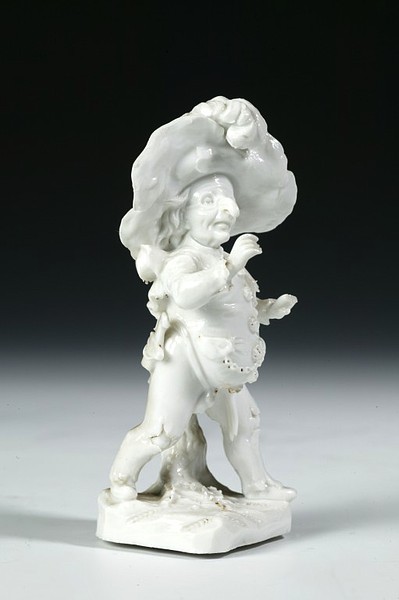
In the Nineteenth Century, Callot’s work was rediscovered and became the inspiration for many figurines ranging from his representations of Commedia dell’Arte figures to these comic dwarves.   This white porcelain figure shows the Italian influence on the costumes of "Les Gobbi" who modeled their masks and garments after the Commedia characters.  This particular, little fellow has a distinct resemblance to Pulcinella.  


Thursday, November 1, 2012

Figures of the Day: A Set of Four Chinese Figures, 17th C.

Set of Four Figures
China, c. Seventeenth C.
Crown Copyright
The Royal Collection
Image Courtesy of Her Majesty Queen Elizabeth II


Made in South China, during or before the Seventeenth Century, this set of four figures is crafted of white porcelain, partly glazed in blue.

The set was purchased by John Crace for the Prince Regent in 1803. The figures were among a group purchased for the future King George IV which included “Six Blue China Figures-- £1.10.0.”

Similar groups of Chinese figures from the same period have surfaced in other museums. Overall, it is believed that these types of figurines were given to powerful men as a wish token meant to encourage the birth of a male heir.

Sunday, October 21, 2012

Figure of the Day: The Banyan Man, 1760-1780

The Banyan Man
France, 1760-1780
The Victoria & Albert Museum


The work of The Lunéville Pottery Factory in France, this wholly Rococo figure of a standing man was made to appeal to the Eighteenth Century fascination with the exotic and the asian. The figure is dressed in a turban and a banyan, and is likely a lost member of a set of dessert figurines.

The figure was made of tin-glazed earthenware adorned with enamel colors and dates between 1760 and 1780.
 

Thursday, September 13, 2012

Figure of the Day: The Orange Girl, 1770-1784

The Orange Girl
Niderviller Pottery Factory
France, 1770-1884
The Victoria & Albert Museum


Here’s another attractive French porcelain figure which, once, would have graced an elegant dining table in a wealthy household. She would have once been joined by similarly attired figures, but now, she stands alone.

With her pyramid of oranges supported on a tray, she’s clearly an orange seller. Given her station, however, she’s dressed quite well--in that fantastical way in which peasants were portrayed in these figure.

This is the work of the Niderviller Pottery and Porcelain Factory, dating somewhere between 1770 and 1784.