Showing posts with label theatre. Show all posts

Wednesday, February 25, 2015

Unusual Artifacts: Harry Randall's Dressing Case, 1840-60


Dressing Case of Harry Randall
1840-60
This and all related images from the
Victoria & Albert Museum


This dressing case was used by the leading music hall comic and “pantomime dame” Harry Randall (1860-1932) as a make-up box. The fine quality of the box and its handsome fittings mark of the status that Randall reached as a performer. Curiously, this was the only personal possession of Harry Randall's that was preserved by his family.

Randall's first professional appearance was in 1884 at Deacon's Music Hall in Islington. He was very close friends with champion dancer Dan Leno and, like Leno, Randall became known for his comedy character songs and his pantomime dames, several of which he performed in pantomimes with Leno. He became so well known that his name was used in the rhyming slang for 'candles' which became known as “Harry Randalls,” or simply “Harrys.”

The wooden dressing case boats inlaid brass edging to the lid and sides. The lid of the box is lined with ruched and padded blue velvet, around which there is a dark blue leather border stamped with a gilt foliate pattern.


The box contains a removable wooden tray divided into six compartments, three of the compartments are lined with blue leather; two with pads of blue velvet and one without lining but with a wooden lid with a silver knob.


The tray contains a wooden lidded compartment, two small round glass jars with silver lids, a long glass tray with a pierced and chased silver lid and a compartment with indentations for tweezers, a corkscrew, a button hook, an awl, manicure scissors and a nail file with a mother-of-pearl handle. The main body of the dressing case has four deep compartments, three containing silver-lidded jars, and one empty with a wooden lid with a silver knob, similar to the wooden lid in the tray but not the same size.


The case was made in London between 1840-1860 by J.J. Mechi. It is marked:

'No.4 LEADENHALL ST. LONDON. J.J.MECHI. To prevent fraudulent imitations signs all his articles thus without which NONE ARE GENIUNE.'
'J.J.Mechi'


When the case was donated to the V&A, the donor, a relative by marriage to Harry Randall, wrote: "I am the current custodian of his travelling box in which he kept his make-up. It has been passed down through the family originating from his sister in law Mrs Annie (Nancy) Randall who was married to Alf Randall, Harry's brother. She had everything belonging to Harry Randall, his make-up box, his scrap book, his chair and his sheet music. After my Great Aunt Nancy died everything of Harry's was thrown out, except his make-up box which my father's sister kept. At this time it still had his original make in on the jars but when my father's sister died and I became the new owner of the box, all the make-up had been washed out by my aunt, unfortunately."


Monday, February 23, 2015

Mastery of Design: "The Queen of Transylvania" Tiara, 1958


Costume Tiara
Cecil Beaton, 1958
The Victoria & Albert Museum


This costume tiara was made for the character of the  “Queen of Transylvania” (as played by Margaret Halstan) in the London production of the musical “My Fair Lady,” at the Theatre Royal, Drury Lane.  The show opened on April 30, 1958.

Based on George Bernard Shaw's play “Pygmalion,” the music for the famous musical was composed by Frederick Lowe, and the book and lyrics were by Alan Jay Lerner. The production was directed by Moss Hart (husband of my dear Kitty Carlisle Hart), the sets were designed by Oliver Smith, and the costumes were designed by the celebrated photographer Cecil Beaton.

The production starred Julie Andrews as Eliza Dolittle and Rex Harrison as Henry Higgins.

This bears a label for Margaret Halstan, who played the Queen throughout most of the London run for My Fair Lady. This is one of several tiaras designed for Halstan for the production.  Photographs from the show indicate different sixed crowns of different weights, allowing the actress flexibility in what she wore each night.  A silversmith made the tiaras, set with fine pastes, based on Beaton’s detailed designs.  

Friday, February 20, 2015

Figure of the Day: John Liston as “Paul Pry,” 1820-29

John Liston as Paul Pry
1820-1829
The Victoria & Albert Museum

This Staffordshire figure, made in the 1820s, depicts John Liston (1776-1846), considered one of the leading comic actors of his day. The figurine shows Liston in character as “Paul Pry” in the play of the same name. This was one of the actor’s most famous roles and, therefore, this is one of several different figurines of Liston as Pry, the nosy and interfering star of the comic play by John Poole, which were produced in the 1820s—each modeled after contemporary engravings. 


Liston made the annoying character seem quite charming, somehow. The play enjoyed considerable success and, even, introduced several of the character’s catch-phrases into the popular vernacular. By 1825, people were quoting “Pry,’ with: “I hope I don't intrude,” “Just dropped in,” and “It's nothing to me,” with considerable gusto, and, soon, the name Paul Pry became a colloquial term for a busybody.


Gifts of Grandeur: The Balmoral Brooch, 1895


Commemorative Brooch
Collingwood & Co., 1895
The Victoria & Albert Museum


Still in its original presentation box, this commemorative brooch was given to the actress Winifred Dolan (1867-1958) by Queen Victoria following Dolan’s special command performance of R. C. Carton's play “Liberty Hall.” The play was performed at Balmoral Castle on September 16, 1895. In the play, Miss Dolan played the role of “Miss Hickson.” The brooch was made by Collingwood & Co. especially for the Queen. Collingwood created several such commemorative pieces which Queen Victoria gifted to visitors or special guests.

As was the style of the time, the jewel is designed as bar brooch featuring the arms of the Royal Victorian Order, enameled in red on a gold base with six imitation pearls. The presentation box of green leather is trimmed with gold and lined in beige satin and velvet. 


Print of the Day: Harlequin and Mother Goose, 1811


Click image to see original size.
"Harlequin and Mother Goose"
William West, 1811
The Victoria & Albert Museum


This print from 1811 was produced by William West (?-1854) and was meant to honor the popular play “Harlequin and Mother Goose” or “The Golden Egg” which debuted at Covent Garden Theatre on Christmas of 1806. The play marked the first major appearance of Joseph Grimaldi (Joey the Clown) who premiered his famed “Bang-Up” song.

William West became known as a publisher of prints and sheets depicting theatrical characters. He worked from the “Circulating Library” which was located on Exeter Street near the Strand. By the end of his career, West published over 140 play sheets at an unheard of rate of one every month. His works served to record the most successful plays and theatrical productions of the London stage for a period of 20 years. 


This print from “Mother Goose” was his first offering. Aside from Grimaldi, we also see “Mr Simmons” as “Mother Goose,” a Harlequin representing John Bologna,, and a figure of Mr. Punch with a saltbox and rolling pin. Mr. Punch and his wife, Judy, are also show on the lower left.


Monday, February 9, 2015

After A Fashion: A Costume Design for Wendy Hiller, 1935


Dress Design for Wendy Hiller, c. 1935
The Victoria & Albert Museum


Wendy Hiller (1912-2003) was trained at the Manchester Repertory Theatre in 1930 and made her West End debut, to exceptional acclaim. In 1935, at the apex of her illustrious carrer, Miss Hiller appeared as Sally Hardcastle in “Love on the Dole.”  Later, she went on to star in countless roles on the stage and, then, in film and television.  Her grand career led to being awarded a DBE (Dame of the British Empire) in 1975.

Here, we see a pencil and watercolor costume design for Dame Wendy Hiller. The drawing shows a side view of an elegant lady with her auburn hair swept back into a low bun. She is depicted wearing a pink dress with cap sleeves trimmed with pearls, a row of pearls, and elbow-length white opera gloves.

The costume sketch is unsigned, but it is inscribed “Miss Wendy Hiller. Heavy Silk Dress Flamingo Pink. Organza Pleated Insets. Large Chiffon Scarves in Three (underlined) Pinks.”

The drawing dates to about 1935.  It’s not certain which of her shows the costume was for.  Perhaps it was a drawing for a gown for her to wear personally.


Saturday, February 7, 2015

Print of the Day: Theatrical Leap Frog, 1804


Theatrical Leap Frog
Print, hand-colored, 1804
The Victoria  & Albert Museum


This hand-colored engraving entitled "Theatrical Leap Frog" is a caricature of the child actor Master Betty leaping over John Philip Kemble--a famed English actor of the late Eighteenth and early Nineteenth Centuries.  It was published in London by Rudolph Ackerman (1765-1834).

It represents the growing popularity of novelty acts as they surpassed legitimate drama in fashion.  The original was drawn by Thomas Rowlandson.


Tuesday, February 3, 2015

Unusual Artifacts: A Silk Program Commemorating the New Empire Theatre, 1896


Birmingham, England (printed)
1896 (printed)
James Upton (printer)
The Victoria and Albert Museum

Click image to enlarge.


In previous years, we've looked at other printed silk programs which were made for important events.  Silk and satin programs were made from the eighteenth century well into the twentieth century to commemorate special theatrical productions such as first nights, gala, commemorative and benefit performances.  By the 1920s, this attractive custom had mostly ceased, and by the 1970s, printed fabric programs were mostly produced for gala opera or ballet performances.  These were typically not printed on silk or satin, but, instead on nylon.

Here, we see, a silk program designed to commemorate the "Grand Opening Night" of the New Empire Theatre on Lime Street, Liverpool, on the 19th December 1896, starring Florrie Harmon as Cinderella; Victor Stevens and Fred Emney as Thisbe and Clorinda, Kate Chard as Prince Felix, and Marie Campbell as Dandini.

The rectangular landscape format program, is printed on both sides and folded into three.  It boasts images from Cinderella in blue ink with the title of production and images of Oscar Barrett and H E Moss printed in sepia ink in roundels.  On the reverse, the cast list and performance details are featured. As was often the case, a decorative fringe graces the top and bottom.

The Victoria & Albert Museum


Thursday, July 24, 2014

Painting of the Day: A Masquerade at the King's Theatre, Haymarket, 1724


Click image to enlarge.
Masquerade at the King's Theatre, Haymarket
Giuseppe Grisoni, 1724
The Victoria & Albert Museum


Flanders-born
* Giuseppe Grisoni (1699-1769) studied in Florence under the artist Tommaso Redi (1665-1726). After a brief sojourn to London with the painter John Talmann (1677-1726), Grisoni returned to Florence where he remained until 1740, working as a teacher at the Academy and turning out portraits and historical paintings. After 1740, Grisoni lived in Rome until the end of his life.

Though this painting is not as finely painted as most of Grisoni's work, it has been attributed to him nonetheless on the basis of a recorded remark, dated May of 1724, by George Vertue which suggests, "Mr Grisoni painter of Florence… has made a fine picture representing the masquerade with various habits."

The canvas depicts a masquerade on the stage of the King's Theatre in Haymarket. This was an opera house which was built by Sir John Vanbrught in 1704-05. The masquerades at the King's Theatre, often emulating the Venetian Carnival, became a tradition after a popular debut in 1711. This work achieves its primary goal of preserving the opulence of the event--showing the luxurious cakes and foods, the gleaming chandeliers and the sumptuous fancy dress.


*

Wednesday, July 23, 2014

Figure of the Day: Fanny Kemble, 1840


Fanny Kemble
Staffordshire, 1840
The Victoria & Albert Museum


As I’ve mentioned before, the earliest Staffordshire earthenware flatbacks depicted Queen Victoria. The popularity of these Royal portraits gave rise to portraits of notable public figures, often celebrated entertainers and actors.

This Staffordshire flatback depicts the actress Fanny Kemble and is based on an 1829 engraving by Richard J. Lane, after a drawing by Sir Thomas Lawrence. Frances “Fanny” Anne Kemble (1809-1893) was the daughter of the famed actors Maria and Charles Kemble and one of the long acting dynasty which had dominated the British stage since the late Eighteenth Century. 

Fanny made her debut on stage at the age of nineteen as “Juliet” at the Covent Garden Theatre. She found fame both in England and in the U.S. where she was married to a Philadelphia businessman.

Wednesday, June 25, 2014

Figure of the Day: An Actor, 2nd C. BC


An Actor
Etruscan, Second Century B.C.
The British Museum


Made in Italy in the Second Century B.C., this terracotta figure depicts a comic actor. As was the theatrical style of the time, the actor has donned a mask. This mask is a broad representation of a bald slave. He carries something in his hand, but what? Is it a purse? We’re unsure. The figure was found in Carino, Italy and is an excellent representation of the figural work of our Etruscan forebears.


Object of the Day, Museum Edition: Blowing up the Pic Nic's, or, Harlequin Quixote attacking the Puppets, 1802


Blowing up the Pic Nic's, or, Harlequin Quixote attacking the Puppets
April, 1802
James Gillray
This version is in the Victoria & Albert Museum.


James Gillray (1757-1815), a popular British printmaker and satirist, was, perhaps, one of the most prolific in his field during the late Eighteenth and early Nineteenth Centuries. Here, we see one of his cartoons from 1802. The image depicts English theater manager Richard Brinsley as Harlequin. He is shown leading a group of professional actors including the famed performer David Garrick (who was, at the time dead), rising from the grave. Also pictured are the actors Mrs. Billington, P. Kemble and, of course the renowned Sarah Siddons. The troupe is protesting members of the Pic Nic Society—an amateur acting group which had been performing at London’s Tottenham Street Concert Rooms. Apparently, they were in the midst of performing the then-popular show, “Tom Thumb.”

Professional actors and theatre managers at the time considered this amateur gang to be a nuisance—taking away revenue from the professionals with their extravagant and decadent displays. Sheridan was among those who launched an aggressive campaign against them. Here, his mask and pen indicate that he has been writing anonymous complaints about the group.

Gillray has cleverly composed this scene to resemble a page from Migel de Cervantes’ “Don Quixote” wherein the famed title character attacks “Master Peter’s” puppet show because he is convinced that the performance is real. In doing so, he has cast his judgment on the futile actions of Sheridan and his band of protestors. The print was published in April of 1802. The version above is in the collection at the Victoria and Albert Museum. Another is in the British Museum
.


Version in the British Museum.

Friday, June 20, 2014

Object of the Day, Museum Edition: Monsieur Mazurier as Mr. Punch, c. 1820


Monsieur Mazurier
Cooke, 1820
The Victoria & Albert Museum


Quite some time ago, we looked at an image of the celebrated Monsieur Mazurier as Mr. Punch.  Here’s another.  This engraving is entitled simply, “Monsieur Mazurier.”

It was published in Paris possibly in the 1820's.  The illustration portrays Mazurier  in a theatrical stance wearing a Punchinello costume. A puppet figure of Mr. Punch can be seen in the background in the same stance.

Engraved by one “C. Motte,” further inscriptions include:
Mr. Mazurier./ Dans le Rôle de Polichinel Vampire/ Theatre de la porte St. Martin' Mr Mazurier/ in the title role in Polichinelle Vampire/ St. Martin Theatre.

So who is this fellow?  Monsieur Charles-François Mazurier performed in “Punchinelle Vampire” as well as in “Jacko, The Brazilian Monkey.”  Both plays were  written by Jean-Baptiste Blache, in Paris and London in the 1820s. In November 1825 Mazurier performed at the Theatre Royal, Covent Garden, in “Punchinelle Vampire” which was translated as “The Shipwreck of Policinello.”  Playbills for the Covent Garden performances are also housed in the V&A.  


Monday, June 16, 2014

Drawing of the Day: Homage to the Queen, 1953


Homage to the Queen
Design for the Coronation Ballet
Oliver Messel, 1953
The Victoria & Albert Museum


“Homage to the Queen” was choreographed by Frederick Ashton as the Sadler's Wells Ballet tribute for the coronation of Queen Elizabeth II on 2 June, 1953. The production was performed at the Royal Opera House. We can tell from production notes which were made at the time that it appears that the production designer, Oliver Hilary Sambourne Messel, (1904 - 1978 ) conceived the ballet opening with an extravagant procession, incorporating both English folk and mythological figures which would close with an Apotheosis showing Elizabeth I as Queen of the Past, handing the Imperial orb to Elizabeth II as Queen of the Present. At the end of the opening, the image of the Queen would be left, as Messel put it, “surrounded with all the virtues and gifts.”

Messel, one of Britain’s leading theatrical designers of the 1930s through 1950s, envisioned this spectacle to be something like a 17th century Jacobean court masque in the manner of Inigo Jones and produced “lavish, fantastical designs” which managers of the ballet noted, “would have cost more than his sets and costumes for the main ballet.” Because of the potential expense, the stage procession of the homage was reduced to a simple entry for the queens of the four elements - Earth, Water, Fire and Air - and their attendant. Messel still got his way—partially. After the ballet, an apotheosis is performed wherein the spirit of the first Elizabeth passes the orb to the second. Here we see one of the storyboard images which Messel produced for his original concept of the homage ballet. This image shows the lion and the unicorn of the Royal arms. The sketch shows the two figures, dancing, facing each other, and carrying flowers which were to be presented to the Queen.

Lord Snowdon, onetime husband of Princess Margaret, and Oliver Messel's nephew, inherited Messel's theatrical designs and other artifacts. According to the V&A, “The designs were briefly stored in a disused chapel in Kensington Palace before being housed at the V&A from 1981 on indefinite loan. The V&A Theatre Museum purchased the Oliver Messel collection from Lord Snowdon in 2005.”


Thursday, June 5, 2014

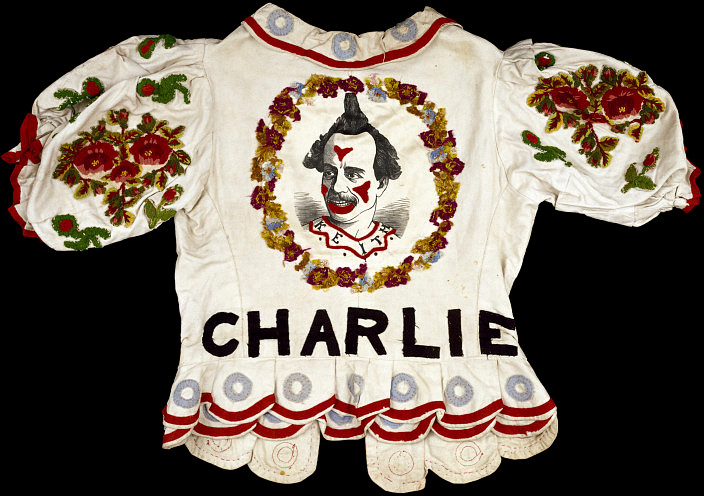
Unusual Artifacts: A Victorian Clown Costume, c.1878


Click image to enlarge.
Charlie Keith's Costume
c. 1870
This and all related images from:
The Victoria & Albert Museum


By the very nature of the job, a clown’s costumes are quickly consumed. So, finding an example of a Nineteenth Century clown’s costume, especially one in good condition, is quite a rare event indeed. The one pictured above is a remarkable example, and, one of only a few such costumes which survive.

Both printed and embroidered, this fine costume belonged to Charlie Keith (1836-1895)—a popular and celebrated clown who was also responsible for managing his own touring circus. The curators of the V&A found an advertisement for Charlie Keith's Circus in The Southport Critic. Dated June 15, 1878, the ad features an engraving of Keith wearing a costume very much like this one. And, here’s a photo from around the same time of Charlie wearing this very costume. 


The costume consists of a back-fastening, waist-length jerkin of heavy white cotton. A scalloped frill adorns the neck. The jerkin features short, puffed sleeves which are also edged with a similar frill. Upon the front is appliquéd a large satin circle printed with an image of Charlie Keith in his clown makeup and costume with his surname “Keith” printed on his neck frill. On his cheeks, red wool hearts have been appliquéd with similar patterns on his cheeks and forehead. The back is similarly adorned with the wearer’s first name. 


Saturday, May 31, 2014

Sculpture of the Day: "Filch" from "The Beggar's Opera," 1920


Arnold Pilbeam as Filch from "The Beggar's Opera," 1920
The Victoria & Albert Museum


This Staffordshire figure by an unknown artist depicts early Twentieth Century actor Arnold Pilbeam as the character of “Filch” from Nigel Playfair's celebrated revival of John Gay's “The Beggar's Opera” which opened at the Lyric Theatre Hammersmith in June of 1920.  The production was designed by Claud Lovat Fraser with music re-written and supplemented by Frederic Austin.  This ballad opera featuring traditional tunes and took London by storm.

The revival ran for over three years to much acclaim and its popularity spawned a surprising number of figurines in porcelain and wax representing moments from the show.  This figure is an excellent example of the type of souvenirs produced during the run of the show.  Here, the character stands in a lime green full-length coat much like the actual costume worn in the show.


Friday, May 30, 2014

Antique Image of the Day: Punch's Puppet Show, or, The Humours of Bartholomew Fair, 1792


Punch's Puppet Show, or, The Humours of Bartholomew Fair
Robert Sayer, 1792
This and all related images from:
The George Speaight Punch & Judy Archive.
The Victoria & Albert Museum


“Punch's Puppet Show, or, The Humours of Bartholomew Fair” is a fold-out flip book depicting sixteen scenes from a Punch & Judy show as well as other entertainments.
  This unusual book was published by Robert Sayer in London, 1792.

The book is sandwiched with two sheets of paper and a book plate is stuck to one of these sheets which features a crest on it and reads: "Be Just and Fear Not, Ex Libris, Edward Arnold, Andrew W. Arnold, The Grove, Dorking, Surrey".

Eight scenes are clearly visible when the book is flat and each of these individually folds down to show another image beneath.


Wednesday, May 28, 2014

Drawing of the Day: Costume Design for 'Babes in the Wood,' 1907


Costume Design
Attilio Comelli
1907
The Victoria & Albert Museum


Here we see a costume design by Attilio Comelli for the character of the Jester in the 1907-1908 play 
Babes in the Wood which ran at the Theatre Royal, Drury Lane.  This production featured characters from the legend of Robin Hood.

In this production, the Jester was played by a woman, so, the drawing for the costume design depicts a female figure wearing a red, orange and purple jester's outfit.

The drawing was finished in 1907 prior to the debut of the production.


Friday, May 23, 2014

Print of the Day: A Ticket to Wynnstay, 1786


Click on image for admission.

Ticket to the Private Theatre at Wynnstay
Wales, 1786
The British Museum


Printed in 1786, this work of rusty red ink on very thick card was produced as a novelty admission ticket for the theatre at Wynnstay. Wynnstay was a grand Seventeenth Century estate in Wales which became the home of Eighteenth Century politician and statesman, Sir Watkin Williams-Wynn, 4th Baronet. Wynnstay boasted an elegant private theatre for which Williams-Wynn would have attractive tickets printed to issue to his guests as mementos of their evening’s entertainment.

This ticket features Mr. Punch, Judy, the Baby and the Devil standing around a barrel which has been adorned with theatrical masks. “Wynnstay” is printed prominently in the center.

In the Nineteenth Century, Wynnstay was a favorite visitation spot for Queen Victoria and her mother, the Duchess of Kent. A hundred years later, the estate had fallen into disrepair and the house was sold off and converted into a school. Later, it was cut up into flats and several private homes. The gardens are now in a continued state of revival.