Monday, October 15, 2012

Mastery of Design: The Wild Jewel, c. 1590


"The Wild Jewel"
Turquoise Cameo of Elizabeth I set in gold with diamonds, rubies and pearls.
1590
The Victoria & Albert Museum


Known as “The Wild Jewel,” this pendant jewel in gold and enamel is set with diamonds and rubies and encloses a turquoise cameo of Queen Elizabeth I.  It is hung with pearls.

The jewel was made circa 1590 in England.  It was lent to the Victoria and Albert Museum for the Special Loan Exhibition of 1862 by James.W. Wild.  Mr. Wild was closely connected to the Museum and was also the architect of the Bethnal Green Museum and of the V&A's Architectural Courts.

According to the tradition in the Wild family, the jewel, along with a lace christening robe, was given by Elizabeth I to a god-daughter of the family.  


Sculpture of the Day: Hush-a-bye, Baby, 1874

Study for "The Rocking Chair"
Dalou, 1874
The Victoria & Albert Museum


Hush a bye baby on the tree top,
When the bough bends the cradle will rock. 


The above nursery rhyme is inscribed into the base of this terracotta sculpture. The piece was exhibited at the Royal Academy of Arts, London, in 1874. The work of Aimé-Jules Dalou (1838-1902), the figure group is a study for a large marble group which was commissioned by the Duke of Westminster.

The marble group, called “The Rocking Chair,” was finished based on this terracotta study. The final piece was shown in 1875 at the Royal Academy and remains in the collection of the Dukes of Westminster.

The Home Beautiful: Pochoir Furnishing Fabric, 1925

Click on image to see a pink spaniel.
Furnishing Fabric, c. 1925
The Victoria & Albert Museum


Made in Manchester, England, around 1925 by Tootal, Broadhurst, Lee & Co, this furnishing fabric was designed by George Sheringham. The repeat of the material depicts a couple attired in Eighteenth Century court costume. Their companion is a pink spaniel. 

Such fairytale-inspired scenes were popular in the 1920s. This one borrows its theme from a series of Italian fashion plates which were made by with pochoir stencils.


Treat of the Week: Banana Bread Trifle Surprise


I’ve seen my mother create the most elegant of meals in the worst conditions. Many of you may recall a little over a year ago when my mother and father were redoing there house. Essentially, the whole place was torn apart. For awhile, even, there was no functioning kitchen. And, yet, my mother still managed to whip up brilliant meals and “Treats of the Week.”

However, every so often, even a genius has a mistake. This past weekend, as workmen were once again traipsing through my mother’s house, she was making banana bread. The thought was, “banana bread is easy, and, with this chaos, it’ll be no problem.” But, sometimes, something that’s supposed to be easy, just isn’t.

When the breads were taken from their pans, the sides crumbled off. It happens to even the best. 


However, as my mother says, “When life ruins your banana bread, you make trifle.” And, little sandwiches, too (and, you all know how much I love little sandwiches). 


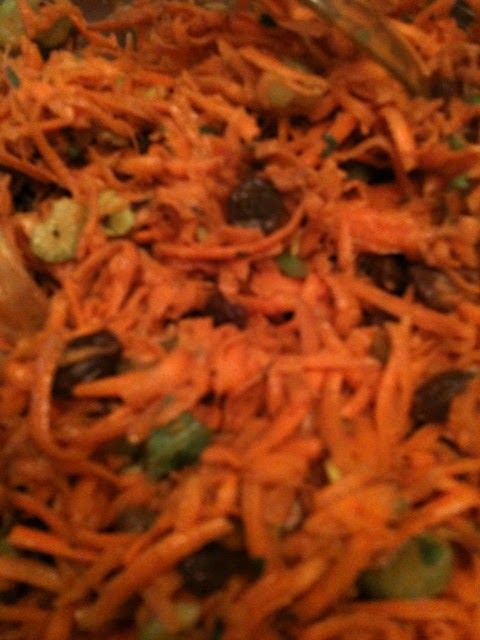
So, after a lovely meal of whole wheat pasta with white beans and leeks in a creamy sauce, a carrot salad (with raisins and celery) and some nice, crusty bread, we were presented with this monumental trifle. 


My mother took the “ruined” bread and, after making some sandwiches filled with plain and strawberry cream cheese from a portion of it, cut up the remainder to assemble this gorgeous trifle. 


Whipped cream, banana pudding, bananas, raspberries, HUGE blackberries and a coulis of currants and strawberries meld together to create a veritable ballet of flavor. The whole of it is adorned with piped whipped cream, berries and pecans.

It’s it grand? If only my mistakes turned out to have such beautiful results!


Mr. Punch of Belgrave Square, Chapter 164


Chapter 164:
Wake 


Johnny Donnan gnawed his rough, dirty fingertips—grabbing with his teeth at the hardened, sharp points of skin which fanned out from the edges of his fingernails and tearing them off. Thin trails of blood cut through the grime on the man’s large hands.

“Ach.” He growled, trudging through the hay and dung of the stables to the spot where he’d taken “Ellen’s” body. At the rear of the cold, stone stables, in a vacant stall, Johnny had arranged the straw into a bed of sorts. In the center of it, he lowered the body of the woman he thought was his daughter.

He knelt beside her.

“Ya look like yer ma.” Johnny murmured.

He recalled the Duchess of Fallbridge. He knew he’d caught her eye. He was young and lean then. He looked, in fact, a bit like Finlay—the same cleft chin, the same sharp nose. He had been fit and strong. Of course the duchess fancied him. He rather fancied her. Sure, she seemed so high and mighty in her fine gowns and jewels. Yes, she had that stiffness that her kind always had, and, yes, she had that stony face. But, Johnny knew, she was a woman and wanted the same thing as any other woman.

They had delighted in one another—the stableman and the duchess. She liked to be struck and he liked doing the striking. They’d enjoyed their times together and, Johnny remembered, he even liked the imperious manner in which she’d order him out of the cottage once she’d finished with him.

Too bad about the baby. Johnny’d thought that the issue of the little girl had been handled. And, then, she returned. Or so he thought. He’d only seen her the once. Then, too, she’d lay in the straw in that very spot.

As Johnny gazed down at “Ellen’s” bloodied face, he had no idea that the woman who he’d so carefully arranged in the straw was not really his daughter. She did, after all, resemble the duchess, and, she even favored his side of the family a bit.

Staring at the woman’s body, he thought for a moment that he’d liked to have known her better. His other children were a disappointment. Finlay was…well, Johnny couldn’t stand to think of Finlay. The other boy had been weak, too. That’s why he died as an infant. But, this one—she seemed like a real woman—strong and determined. Perhaps she was like him.

“Lass…” Johnny whispered. “It’s yer da’. Open yer pretty eyes, then. I’ll not be havin’ no wake here—not tonight. Let’s have time, then. You’ll have a drink for yer da’ at me own wake. But, not this way. Not now.”

The woman didn’t move.

Johnny put his hand on the girl’s stomach. Was there breath in her? It had seemed that she was breathing when he had carried her from the nursery.

“No.” Johnny shook his head. “The lass is dead. Dead and gone.”

He gnashed his teeth.

“I’ll make him pay, that mad…” Johnny muttered. “Duke or no, ain’t no one take a hand to one of Johnny’s children, ‘cept him.”

There it was again—a faint movement of the girl’s stomach. Was she drawing breath?

“Open yer eyes, lass.” Johnny repeated.

Still, she did not.

Johnny frowned.

“Yer called ‘Ellen,’ then.” Johnny Donnan continued. “You came here to get what’s rightfully yers. Open yer eyes, and I’ll help ya get it, lass. If you’re dead, then all I got is Finlay. A man wants more than that. Come on then.”

Johnny leaned back on the stall’s partition and began biting at his hands again. He coughed.

“If you weren’t dead, lass, I’d go up to that house with ya and help ya tear that Duke to shreds with our own fingers.”

Johnny rubbed his eyes. Had he just seen… Then, yes…yes, it was true. The woman’s stomach rose.

“Ach.” Johnny grunted, leaning forward. “Come back, Ellen.”

The woman’s eyes fluttered, and, then, opened.

“There’s me girl.” Johnny grinned.

The slightest of smiles passed across “Ellen’s” lips.


Did you miss Chapters 1-163? If so, you can read them here. Come back tomorrow for Mr. Punch of Belgrave Square, Chapter 165.

Drawing of the Day: You'd Best Go Down to the Gardener, 1916

Scene from "The Widow's Son"
Kay Nielsen, 1916
The Victoria & Albert Museum


The Danish-born illustrator Kay Nielsen had long been inspired by native Scandinavian tales. Even as a child, Nielsen would draw the epic Viking stories which were read aloud to him by his family. This influence naturally led to a career illustrating fairytales and nursery rhymes.

Nielsen’s work hints at the Art Nouveau. He’d studied in Paris during the height of the movement. There, he developed a trademark style which shows elements of the Art Nouveau as well as lines and patterns influenced by Japanese Art.

This 1916 image from the traditional Norse tale, “The Widow’s Son” shows Nielsen’s typical style. A work of pen and ink on paper, the illustration depicts a stylized garden occupied by a bearded man who holds a spade and flowers. He looks over his shoulder to a vision of a female face. I’m not familiar with this story, but, if you are, the inscription must make sense. It reads’ You’d best go down to the gardener.”

Object of the Day: Life and Coffee in a Shoe

Click image to be whipped soundly.


There was an old woman
     who lived in a shoe,
She had so many children
     she didn’t know what to do;
She gave them some broth
     without any bread, 

She whipped them all soundly
     and put them to bed. 


Excellent parenting advice. It makes me think of the strength and purity of coffee, it does.

At first, I wasn’t sure if this card was die-cut or if it was cut by hand by a former owner who intended to use it for other purposes, likely decoupage. The latter was often the fate of these trade cards. In one way this preserved them forever under a nice layer of varnish, but, in another, it distances the item from its original form.

Either way, here we have an old lady who lived in her shoe. Living in a shoe, it seems, hasn’t kept her from procreating. Clearly, this card was once one of a collectible series produced by Lion Coffee. This was No. 8.

Now, you see, this is where the whole thing gets foggy. On the reverse, printed above the verse describing this elderly woman’s living conditions, we have a line drawing of the scene to the left of the image from the next scene in the series.  Or is it? And, then, at the very bottom are the mysterious words, “Bend Back Standards.”

What does that mean?

Was this part of a larger sheet which was designed to be cut and displayed in a child’s room? Were the publishers anticipating that these would be collected in order?

I couldn’t leave it alone. So, a little research tells me that this was, in fact, a die-cut card, one of a nursery rhyme series which also corresponds with a paper-doll series produced by Lion Coffee in the late Nineteenth Century.

But, there’s something missing. First of all, the lower portion of this card is now gone. This would have been bent and taped so that the “shoe” would stand up as a background. You’ll notice that the “old woman” is conspicuously absent from the shoe. That’s because she came later as a paper doll—also a standee. She was shown holding a large stick in one hand and a naughty child in the other and was drawn in mid-spank. Charming.  The second piece of this scene was a standee of the other, already-beaten, children in bed.

All-in-all, it’s a nifty advertising gimmick. Collectors of such things are quite keen to amass the complete sets which, it seems, are very difficult to come by. So, apparently, even a century later, the gimmick is still working. Well done, Lion Coffee.