Tuesday, September 6, 2011

Gifts of Grandeur: The Convolvulus Trembler Ornament, 1840-1850

Brooch
The Victoria & Albert Museum
This shimmering composition of foiled rock crystals, pearls and garnets set in enameled gold started out its life as a head ornament in the mid Nineteenth Century. In the Twentieth Century, it was converted into a brooch, and, in doing so, was considerably cut down with the excess being incorporated into other pieces of jewelry. This is what remains, and though it’s not complete, we can see what it once was and how much it relies on the trend toward Naturalism which prevailed at the time of its creation.

This piece is a trembler—featuring jewels on springs and coils which allowed the stones to move and capture the light as the wearer walked. Such Naturalistic gems almost always boasted compositions of fruit and flowers such as this ornament’s depiction of convolvulus and lilies of the valley. The flowers are created from foil-backed (to offer additional shine) clear and purple quartz with green garnets (tsavorite) and pearls.

Such jewels had a romantic significance and were given as gifts in order to convey symbolic messages. In The Language of Flowers, first published by one Mrs. Burke in 1856, the lily of the valley signified a return of happiness, and the convolvulus could represent the bonds among other things.

Treat of the Week: Stupendous Strawberry Cupcakes

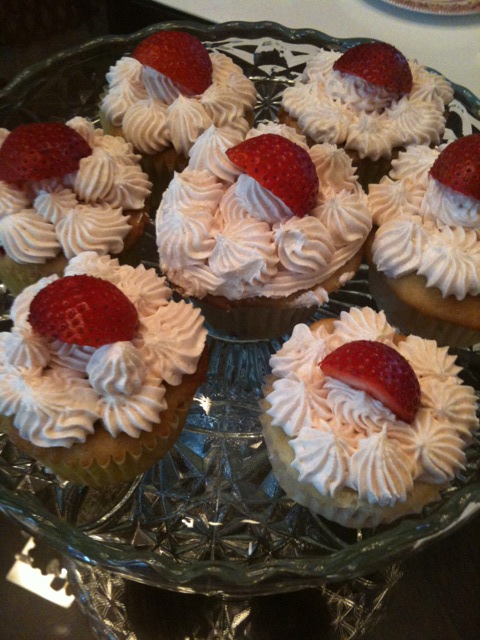
While it’s true that I have a distinct appreciation for most cupcakes, I really have a fondness for strawberry cupcakes. So, I was particularly thrilled to learn that my mother was baking some for Labor Day.

This is a new gem in my mother’s collection of confections. Here we have yellow cake infused with chopped fresh strawberry, giving it a mild strawberry taste and a subtle, attractive pink color.

They are frosted with a Swiss meringue buttercream flavored with strawberry jam which has been expertly piped in an attractive patter atop each moist, delicate cake. Each is then adorned with a strawberry.

Joining these cupcakes was a miniature cake of the same family which we enjoyed first.

There are a variety of strawberry cake recipes available. When you pick the one that best suits you, make sure that if you add fresh strawberries to the buttercream, the icing doesn’t get too runny from the strawberry juice. That’s why my mother uses jam. You get the same bellow strawberry taste for the frosting, but it holds its shape better.


Sculpture of the Day: A Figural Group with Birds and Strawberry Leaves, 1755

Figural Group
1755
Unknown French Maker
The Victoria & Albert Museum
Finding an Eighteenth Century French figural group such as this work of glazed porcelain and gilt metal in its original condition is quite rare. Most of them seem to have been made into lamps. And, most of those lamps have been surmounted by ugly shades for the last forty years or more. I blame Joan Crawford.

This delicate sculptural group features a pair of birds—facing each other--upon a tree stump next to a peculiarly small dog. The group is mounted in gilt metal and fitted with white hard-paste porcelain flowers. As was the fashion of the time, the stump is encircled with leaves and flowers applied in relief. The metal mounting consists of supporting structure of curved and pointed stems to which are attached flat strawberry leaves of gilt metal, five roses and a tulip which serves as a candle holder.

Painting of the Day: A Wreath of Fruit with Birds Suspended by a Cord, Eighteenth Century

Wreath of Fruit with Birds Suspended by A Cord
Unknown Artist after Frans Snyders
Eighteenth Century
One of a Pair
The Victoria & Albert Museum
When a collector spotted a painting that he liked in a museum or the home of an associate, in the Eighteenth Century, he couldn’t very well take a photo of it. If he wanted to have a copy of th painting, he had to commission it and the work would be carried out by another painter. For this reason, every so often, we’ll come across a copy of a painting which dates to around the same period of the creation of the original work. Similarly, paintings were copied by students—either of the original artist or another—as a means of perfecting their own techniques.

Here, we have such a copy. This subtle still life is a partial late Eighteenth Century copy after a large composition by Frans Snyders-- The Infant Jesus with St John the Baptist and Putti with Flowers and Fruit Garlands. In this scene of a wreath of fruits with birds flitting around, the painting depicts a variety of fruits including cherries, strawberries, apples, grapes and pomegranates. In the original painting, this wreath constitutes the upper part of the composition—essentially adornment above the figures of Jesus and John. For some reason the artist duplicated the upper part of the canvas as its own work and then reproduced the original’s festoons of vegetables as another canvas

The original artist, Frans Snyders (1579-1657) was born in Antwerp, where he studied under Pieter Brueghel the Younger (1565-1637) and Hendrick van Balen (1575-1632). Snyders soon became a member of the Antwerp Guild of St Luke in 1602, and, later travelled in Italy from 1608 to 1609. His specialty, clearly, was still-lifes, but he also enjoyed painting animals. He is credited for creating a new form of still life: the animal still life.  Lots and lots of dead rabbits and birds with rotting fruit...

Snyders notably collaborated with a number of celebrated artists: Peter Paul Rubens (1577-1640) Cornelis de Vos (ca.1584-1651), Abraham Janssen (ca.1575-1632), Jacob Jordaens (1593-1678), Jan Boeckhorst (1605-1668) and Willeboirts Bosschaert (1614-1654) to name a few.

Punch’s Cousin, Chapter 335

“Where’s this place?” Punch asked.

“Just follow me,” Marjani whispered. “It’s at the back of town.”

“Is it a bad place?” Punch panted as they hurried toward the Place Congo.

“It didn’t have to be.” Marjani sighed. “I guess it isn’t always. You see, Mr. Punch, it’s really meant to be a place for folk like me to meet and learn from one another. The city set it aside for us to dance and sing and sell our crafts to one another. Most of us done use it like that. Most of us like for to see each other and talk ‘bout them things that we share as a people. But, some folk—folk like Marie—they take it over at night and use it as a gathering space for their own…” Marjani shook her head. “They just done made it into their own place.”

“Coo!” Punch snorted.

“I hear ya, Mr. Punch.”

“It ain’t fair.” Punch grumbed. “It just ain’t fair when humans take somethin’ what’s meant to be good and turn it into somethin’ ugly.”

“That’s what folk do.” Marjani shrugged. “It ain’t all bad, Sir. I don’t begrudge folk their freedom. I think folk should believe whatever it is that they want.”

“Only they should just go on ‘bout doin’ it and leave the rest of us out of it.” Punch growled. “Here, I am the first what knows how important it ‘tis to learn ‘bout new things. Just think of all the things I learned since I been usin’ me master’s body. But, once I learn somethin’ what I don’t believe, I don’t want to have to continue to fight with it.”

“I know.” Marjani nodded.

“Here, what’s that?” Punch pointed to the flickering firelight which could be seen through the thicket of trees in front of the Place Congo.

“That’s where we’re goin’,” Marjani smiled. “Are you ready, Mr. Punch?”

“I reckon.” Punch nodded.

“You’re startin’ to talk like me, Sir.” Marjani chuckled softly.

“Can’t think of no one better,” Punch patted Marjani’s arm.

“Here we go, then,” Marjani sighed. “Whatever you do, keep your thoughts clear. Marie can hear all that you’re thinkin’.”

“I will.” Punch nodded. “Only, what if I think things without wantin’ to?”

“Try to think only of what’s right in front of us.” Marjani grinned.

“Or, maybe what I want her to think I’m thinkin’.” Punch giggled quietly.

“Wait.” Marjani narrowed her eyes.

“What is it?”

“That ain’t a bad idea,” Marjani grinned.


Did you miss Chapters 1-334? If so, you can read them here.

Unusual Artifacts: A Linen Nightcap, 1600-1624

Nightcap
The Victoria & Albert Museum
A beautiful work of linen, embroidered with silver-gilt, silver and silk thread and trimmed with silver-gilt bobbin lace seems quite foreign to modern eyes. It is, in fact, a cap. And, odd as it may seem to us now, it was designed to be worn by a man.

Headwear was a significant part of Seventeenth Century fashion. Not only did caps and hats offer another opportunity for personal adornment, they served to keep the head warm and clean. Both men and women had a variety of caps for different occasions and times of the day. A cap such as this was meant to be worn informally and only at home—in private. Even though it’s a nightcap, it was still made to be quite luxurious—adorned with silver and metal spangles (the Seventeenth Century word for sequins) which would have reflected the light of candles and the fire in the hearth.

The embroidery is neatly finished in a pattern of flowers, strawberries, and leaves inspired by the botanical picture books which were popular at the time.

Object of the Day, Museum Edition: A Porcelain Sugar Bowl and Cover, 1750-1760

Sugar Bowl
The Victoria & Albert Museum
Before the days of paper plates and fast food, a family could communicate a lot about their collective personalities, ideals and position through their choice of china. The best china was saved for guests, of course, and to have a matching set of exceptional china was considered a status symbol.
Very often, a tea service would be purchased that differed from the dinner china, but blended with it. China for tea could be more fanciful than the formal china of the dining room. Take this sugar bowl from a set by Charles Gouyn, for example.

This sugar bowl and cover of soft-paste porcelain is painted with enamels in a pattern of with sprays of roses, other flowers and insects around the ogee-shaped bowl. The cover is adorned with a wavy edge and surmounted with leaves and strawberries.

Such botanical decorations in bright colors were quite fashionable in the mid Eighteenth Century. This sugar bowl is one of the remaining pieces of an extraordinary tea set which was made in London between 1750 and 1760. It was donated to the Victoria & Albert Museum in 1969.