Showing posts with label satin. Show all posts

Friday, February 20, 2015

Gifts of Grandeur: The Balmoral Brooch, 1895


Commemorative Brooch
Collingwood & Co., 1895
The Victoria & Albert Museum


Still in its original presentation box, this commemorative brooch was given to the actress Winifred Dolan (1867-1958) by Queen Victoria following Dolan’s special command performance of R. C. Carton's play “Liberty Hall.” The play was performed at Balmoral Castle on September 16, 1895. In the play, Miss Dolan played the role of “Miss Hickson.” The brooch was made by Collingwood & Co. especially for the Queen. Collingwood created several such commemorative pieces which Queen Victoria gifted to visitors or special guests.

As was the style of the time, the jewel is designed as bar brooch featuring the arms of the Royal Victorian Order, enameled in red on a gold base with six imitation pearls. The presentation box of green leather is trimmed with gold and lined in beige satin and velvet. 


Thursday, February 5, 2015

Unusual Artifacts: Pyramus and Thisbe Valance, 1560


Pyramus and Thisbe
Panel from a Bed Valance, 1560
French, possibly made for Queen Catherine De Medici
The Victoria & Albert Museum


This piece of satin textile is one of a set of panels that once formed part of the decoration of a bed valance—a kind of pelmet round the top of bed curtains. The image is embroidered in colored silk on a red satin ground and depicts the story of Pyramus and Thisbe. Pyramus, thinking that Thisbe was dead, committed suicide by falling on his own sword. This scene is shown within a frame held by men in stylized Roman military dress.

Other decorative motifs pictured include a laughing mask, birds, dolphins, ox skulls, an altar, a vase and draperies and figures of nudes and monsters in the Grotesque style which had been introduced to France between 1550 and 1575, based on Italian artifacts. Given the style, it is possible that this panel may have been part of a set made for Queen Catherine de Medici (1519–89, daughter of the Italian Lorenzo de Medici, later Queen Consort of France), or for another high-ranking member of the French court. Further evidence comes from the fact that in the Nineteenth Century, this fragment was bound in an album inscribed “RICAMI DEI MEDICI.” (‘embroideries of the Medici’). A gold braid was added in the Nineteenth Century.

Wednesday, February 4, 2015

Unusual Artifacts: Wedding Favors, 1854


Click image to enlarge.
Wedding Favors
England, c. 1854
The Victoria & Albert Museum


The tradition of handing out wedding favors, especially to those who participated in the wedding party, goes back centuries. The origin of this custom is difficult to trace as it is not unique to any one culture.

Some of the most famous wedding favors are those which were presented at the 1840 marriage of Queen Victoria and Prince Albert. “The Times” reported that white favors were given out at the lavish nuptials:

Every lady exhibited a white favour, some of which were admirable specimens of refined taste. They were of all sizes, many of white satin riband, tied up into bows and mixed with layers of rich silver lace. Others merely of riband intermixed with sprigs of orange flower blossom.

While the custom of orange blossoms at a wedding pre-dates Victoria’s wedding considerably and actually arose in Asia, the interest in the blooms was rejuvenated after that Royal wedding. After witnessing the gorgeous orange blossoms at Queen Victoria’s wedding, many brides wished to have similar favors and turned to more permanent imitation blossoms.

Take, for example, this pair of wedding favor froms an 1854 union. The orange blossoms on these favors are made of cloth and feature silvered paper leaves and trimmings of cream silk satin ribbon. These items are associated with the wedding of Elizabeth Wroughton Richards to the Reverend Andrew Nugee on August 8, 1854.


Monday, July 14, 2014

History's Runway: A Late Nineteenth Century Corset


Corset
1890-1895
The Victoria & Albert Museum


A lady’s corset didn’t just offer a supportive foundation, it molded her body into unnatural shapes in order to fit whatever peculiar silhouette was in fashion at the time. By the 1890s, women’s bodies were being forced into angular shapes which went against any natural human form. The one we see above, at least, claimed to relieve pressure on internal organs while supporting the stomach. I seriously doubt that it did.

This…thing…is made of whalebone which has been constructed, essentially to be a second ribcage…a restrictive, uncomfortable ribcage in a different shape than the woman’s body. But, just so it didn’t look like a torture device, it had some very attractive embroidery on its pink satin surface. It’s also trimmed with dark pink satin ribbon.

It was made in England between 1890 and 1895. 


Thursday, June 5, 2014

Unusual Artifacts: A Victorian Clown Costume, c.1878


Click image to enlarge.
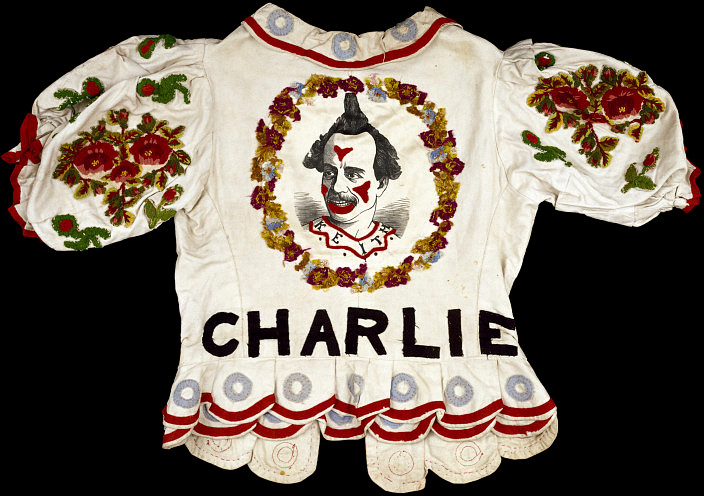
Charlie Keith's Costume
c. 1870
This and all related images from:
The Victoria & Albert Museum


By the very nature of the job, a clown’s costumes are quickly consumed. So, finding an example of a Nineteenth Century clown’s costume, especially one in good condition, is quite a rare event indeed. The one pictured above is a remarkable example, and, one of only a few such costumes which survive.

Both printed and embroidered, this fine costume belonged to Charlie Keith (1836-1895)—a popular and celebrated clown who was also responsible for managing his own touring circus. The curators of the V&A found an advertisement for Charlie Keith's Circus in The Southport Critic. Dated June 15, 1878, the ad features an engraving of Keith wearing a costume very much like this one. And, here’s a photo from around the same time of Charlie wearing this very costume. 


The costume consists of a back-fastening, waist-length jerkin of heavy white cotton. A scalloped frill adorns the neck. The jerkin features short, puffed sleeves which are also edged with a similar frill. Upon the front is appliquéd a large satin circle printed with an image of Charlie Keith in his clown makeup and costume with his surname “Keith” printed on his neck frill. On his cheeks, red wool hearts have been appliquéd with similar patterns on his cheeks and forehead. The back is similarly adorned with the wearer’s first name. 


Wednesday, April 30, 2014

Unusual Artifacts: Pyramus and Thisbe Valance, 1560


Pyramus and Thisbe
Panel from a Bed Valance, 1560
French, possibly made for Queen Catherine De Medici
The Victoria & Albert Museum


This piece of satin textile is one of a set of panels that once formed part of the decoration of a bed valance—a kind of pelmet round the top of bed curtains. The image is embroidered in colored silk on a red satin ground and depicts the story of Pyramus and Thisbe. Pyramus, thinking that Thisbe was dead, committed suicide by falling on his own sword. This scene is shown within a frame held by men in stylized Roman military dress.

Other decorative motifs pictured include a laughing mask, birds, dolphins, ox skulls, an altar, a vase and draperies and figures of nudes and monsters in the Grotesque style which had been introduced to France between 1550 and 1575, based on Italian artifacts. Given the style, it is possible that this panel may have been part of a set made for Queen Catherine de Medici (1519–89, daughter of the Italian Lorenzo de Medici, later Queen Consort of France), or for another high-ranking member of the French court. Further evidence comes from the fact that in the Nineteenth Century, this fragment was bound in an album inscribed “RICAMI DEI MEDICI.” (‘embroideries of the Medici’). A gold braid was added in the Nineteenth Century.


Sunday, April 13, 2014

History's Runway: A Waistcoat from 1770


This and all related images from the V&A.


Famed author Beatrix Potter found some of the inspiration for her book "The Tailor of Gloucester" at what was once the South Kensington Museum (now the V&A). Potter told her editor, Norman Warne, "I have been delighted to find I may draw some most beautiful 18th century clothes at S. Kensington museum." This waistcoat, still on display at the V&A, is one of the pieces that Potter copied for her illustrations. In fact, it appears several times in the book.

This waistcoat from 1770 of cream satin, embroidered with colored silks in stem, would have been part of a dress suit worn by a man on formal occasions. The embroidery was worked in a professional workshop and the front edges were laid with cotton net and edged with couched chenille thread.


Sunday, December 8, 2013

History's Runway: A Dior Cocktail Dress, 1957


Cocktail Dress
Christian Dior
London, 1957
This and all related images from:
The Victoria & Albert Museum


Well, isn’t this yummy? Here, we see a Christian Dior (1905-1957) cocktail dress made of raspberry-hue satin organza. A deep collar flares out from a fitted bodice from which gathered material cascades, seemingly held in place by two softly dramatic bows.

Dior believed that the design of a gown would come to him by studying the fabric. He wrote, “many a dress of mine is born of the fabric alone.” This philosophy is evident with this elegant cocktail dress. Dior let the crisp satin organza speak to him and guide him to create this bouffant masterpiece. The dress is given body by four layers of new petticoat affixed below the tightly fitted waist. The innermost layer of netting is further stiffened with horsehair so that the shape will be retained even after the wearer sits. 


Made in Dior’s London branch (established in 1954), the dress dates to 1957. Dior collaborated with Marc Bohan (b, 1926) on this piece. This was Dior’s “red dress” for 1957. Each of his collections included at least one red dress. Dior famously stated that “red is the colour of life. I love red and I think it suits every complexion. Bright reds - scarlet, pillar-box red, crimson, cherry are very gay and youthful.”


Sunday, November 10, 2013

History’s Runway: The Baba Beaton Wedding Dress, 1934


Wedding Dress
Charles James, 1934
This and all related images from:
The Victoria & Albert Museum


This wedding gown was worn by Miss Baba Beaton in November of 1934 when she married Mr. Alec Hambro. The gown, designed by Charles James, shows the development of the designer’s famous complex cut and simple lines.

James said of his work, “all my seams have meaning - they emphasise something about the body.”

The gown is constructed of cream, ivory, and satin. It’s cut with a high neckline and long, tight sleeves. James’ famous seaming and darting serves to sculpt the satin to fit the body. The finishing touch is a spray of wax orange blossoms at the neck. 


Tuesday, October 29, 2013

Gifts of Grandeur: The Balmoral Brooch, 1895


Commemorative Brooch
Collingwood & Co., 1895
The Victoria & Albert Museum


Still in its original presentation box, this commemorative brooch was given to the actress Winifred Dolan (1867-1958) by Queen Victoria following Dolan’s special command performance of R. C. Carton's play “Liberty Hall.” The play was performed at Balmoral Castle on September 16, 1895. In the play, Miss Dolan played the role of “Miss Hickson.” The brooch was made by Collingwood & Co. especially for the Queen. Collingwood created several such commemorative pieces which Queen Victoria gifted to visitors or special guests.

As was the style of the time, the jewel is designed as bar brooch featuring the arms of the Royal Victorian Order, enameled in red on a gold base with six imitation pearls. The presentation box of green leather is trimmed with gold and lined in beige satin and velvet. 


Sunday, September 15, 2013

History's Runway: Dior-Vivier Evening Slippers, 1952-4


Evening Shoes
Designed for Dior by Roger Vivier
1952-53
The Victoria & Albert Museum


Christian Dior often commissioned the famed Roger Vivier to design shoes to go with his fantastic romantic evening gowns. These slingback, low-heeled evening shoes of hot pink satin are adorned with gold braid, and encrusted with paste stones, and sequins. They surely are the epitome of luxury footwear as well as a perfect example of the brilliant union of two genius designers.

These shoes, like Dior’s gowns, could have only been afforded by the most wealthy ladies. These shoes once belonged to Mrs. Loel Guinness. Mrs. Guinness married into one of Europe's richest families and was a constant patron of designers such as Dior, Balenciaga and Givenchy. Mrs. Guinness was voted “Best Dressed Woman” in the world by Time magazine in 1962 behind Jackie Kennedy in first place. This charming socialite owned seven homes and kept a full wardrobe in each so that she would never have to pack for a trip. 


Sunday, May 5, 2013

Gifts of Grandeur: The Balmoral Brooch, 1895


Commemorative Brooch
Collingwood & Co., 1895
The Victoria & Albert Museum


Still in its original presentation box, this commemorative brooch was given to the actress Winifred Dolan (1867-1958) by Queen Victoria following Dolan’s special command performance of R. C. Carton's play “Liberty Hall.” The play was performed at Balmoral Castle on September 16, 1895. In the play, Miss Dolan played the role of “Miss Hickson.” The brooch was made by Collingwood & Co. especially for the Queen. Collingwood created several such commemorative pieces which Queen Victoria gifted to visitors or special guests.

As was the style of the time, the jewel is designed as bar brooch featuring the arms of the Royal Victorian Order, enameled in red on a gold base with six imitation pearls. The presentation box of green leather is trimmed with gold and lined in beige satin and velvet. 


Monday, April 29, 2013

Unusual Artifacts: Wedding Favors, 1854


Click image to enlarge.
Wedding Favors
England, c. 1854
The Victoria & Albert Museum


The tradition of handing out wedding favors, especially to those who participated in the wedding party, goes back centuries. The origin of this custom is difficult to trace as it is not unique to any one culture.

Some of the most famous wedding favors are those which were presented at the 1840 marriage of Queen Victoria and Prince Albert. “The Times” reported that white favors were given out at the lavish nuptials:

Every lady exhibited a white favour, some of which were admirable specimens of refined taste. They were of all sizes, many of white satin riband, tied up into bows and mixed with layers of rich silver lace. Others merely of riband intermixed with sprigs of orange flower blossom.

While the custom of orange blossoms at a wedding pre-dates Victoria’s wedding considerably and actually arose in Asia, the interest in the blooms was rejuvenated after that Royal wedding. After witnessing the gorgeous orange blossoms at Queen Victoria’s wedding, many brides wished to have similar favors and turned to more permanent imitation blossoms.

Take, for example, this pair of wedding favor froms an 1854 union. The orange blossoms on these favors are made of cloth and feature silvered paper leaves and trimmings of cream silk satin ribbon. These items are associated with the wedding of Elizabeth Wroughton Richards to the Reverend Andrew Nugee on August 8, 1854.


Tuesday, November 13, 2012

Unusual Artifacts: A Late Nineteenth Century Corset

Corset
1890-1895
The Victoria & Albert Museum


A lady’s corset didn’t just offer a supportive foundation, it molded her body into unnatural shapes in order to fit whatever peculiar silhouette was in fashion at the time. By the 1890s, women’s bodies were being forced into angular shapes which went against any natural human form. The one we see above, at least, claimed to relieve pressure on internal organs while supporting the stomach. I seriously doubt that it did.

This…thing…is made of whalebone which has been constructed, essentially to be a second ribcage…a restrictive, uncomfortable ribcage in a different shape than the woman’s body. But, just so it didn’t look like a torture device, it had some very attractive embroidery on its pink satin surface. It’s also trimmed with dark pink satin ribbon.

It was made in England between 1890 and 1895. 


Monday, November 12, 2012

History’s Runway: The Baba Beaton Wedding Dress, 1934

Wedding Dress
Charles James, 1934
This and all related images from:
The Victoria & Albert Museum


This wedding gown was worn by Miss Baba Beaton in November of 1934 when she married Mr. Alec Hambro. The gown, designed by Charles James, shows the development of the designer’s famous complex cut and simple lines.

James said of his work, “all my seams have meaning - they emphasise something about the body.”

The gown is constructed of cream, ivory, and satin. It’s cut with a high neckline and long, tight sleeves. James’ famous seaming and darting serves to sculpt the satin to fit the body. The finishing touch is a spray of wax orange blossoms at the neck. 


Unusual Artifacts: Wedding Favors, 1854

Click image to enlarge.
Wedding Favors
England, c. 1854
The Victoria & Albert Museum


The tradition of handing out wedding favors, especially to those who participated in the wedding party, goes back centuries. The origin of this custom is difficult to trace as it is not unique to any one culture.

Some of the most famous wedding favors are those which were presented at the 1840 marriage of Queen Victoria and Prince Albert. “The Times” reported that white favors were given out at the lavish nuptials:

Every lady exhibited a white favour, some of which were admirable specimens of refined taste. They were of all sizes, many of white satin riband, tied up into bows and mixed with layers of rich silver lace. Others merely of riband intermixed with sprigs of orange flower blossom.

While the custom of orange blossoms at a wedding pre-dates Victoria’s wedding considerably and actually arose in Asia, the interest in the blooms was rejuvenated after that Royal wedding. After witnessing the gorgeous orange blossoms at Queen Victoria’s wedding, many brides wished to have similar favors and turned to more permanent imitation blossoms.

Take, for example, this pair of wedding favor froms an 1854 union. The orange blossoms on these favors are made of cloth and feature silvered paper leaves and trimmings of cream silk satin ribbon. These items are associated with the wedding of Elizabeth Wroughton Richards to the Reverend Andrew Nugee on August 8, 1854.


Tuesday, September 18, 2012

Unusual Artifacts: A Victorian Clown Costume, c.1878

Click image to enlarge.
Charlie Keith's Costume
c. 1870
This and all related images from:
The Victoria & Albert Museum


By the very nature of the job, a clown’s costumes are quickly consumed. So, finding an example of a Nineteenth Century clown’s costume, especially one in good condition, is quite a rare event indeed. The one pictured above is a remarkable example, and, one of only a few such costumes which survive.

Both printed and embroidered, this fine costume belonged to Charlie Keith (1836-1895)—a popular and celebrated clown who was also responsible for managing his own touring circus. The curators of the V&A found an advertisement for Charlie Keith's Circus in The Southport Critic. Dated June 15, 1878, the ad features an engraving of Keith wearing a costume very much like this one. And, here’s a photo from around the same time of Charlie wearing this very costume. 


The costume consists of a back-fastening, waist-length jerkin of heavy white cotton. A scalloped frill adorns the neck. The jerkin features short, puffed sleeves which are also edged with a similar frill. Upon the front is appliquéd a large satin circle printed with an image of Charlie Keith in his clown makeup and costume with his surname “Keith” printed on his neck frill. On his cheeks, red wool hearts have been appliquéd with similar patterns on his cheeks and forehead. The back is similarly adorned with the wearer’s first name. 


Thursday, September 6, 2012

History's Runway: A Dior Cocktail Dress, 1957

Cocktail Dress
Christian Dior
London, 1957
This and all related images from:
The Victoria & Albert Museum


Well, isn’t this yummy? Here, we see a Christian Dior (1905-1957) cocktail dress made of raspberry-hue satin organza. A deep collar flares out from a fitted bodice from which gathered material cascades, seemingly held in place by two softly dramatic bows.

Dior believed that the design of a gown would come to him by studying the fabric. He wrote, “many a dress of mine is born of the fabric alone.” This philosophy is evident with this elegant cocktail dress. Dior let the crisp satin organza speak to him and guide him to create this bouffant masterpiece. The dress is given body by four layers of new petticoat affixed below the tightly fitted waist. The innermost layer of netting is further stiffened with horsehair so that the shape will be retained even after the wearer sits. 


Made in Dior’s London branch (established in 1954), the dress dates to 1957. Dior collaborated with Marc Bohan (b, 1926) on this piece. This was Dior’s “red dress” for 1957. Each of his collections included at least one red dress. Dior famously stated that “red is the colour of life. I love red and I think it suits every complexion. Bright reds - scarlet, pillar-box red, crimson, cherry are very gay and youthful.”


Wednesday, July 25, 2012

Gifts of Grandeur: The Balmoral Brooch, 1895

Commemorative Brooch
Collingwood & Co., 1895
The Victoria & Albert Museum


Still in its original presentation box, this commemorative brooch was given to the actress Winifred Dolan (1867-1958) by Queen Victoria following Dolan’s special command performance of R. C. Carton's play “Liberty Hall.” The play was performed at Balmoral Castle on September 16, 1895. In the play, Miss Dolan played the role of “Miss Hickson.” The brooch was made by Collingwood & Co. especially for the Queen. Collingwood created several such commemorative pieces which Queen Victoria gifted to visitors or special guests.

As was the style of the time, the jewel is designed as bar brooch featuring the arms of the Royal Victorian Order, enameled in red on a gold base with six imitation pearls. The presentation box of green leather is trimmed with gold and lined in beige satin and velvet. 


Sunday, June 24, 2012

History's Runway: Dior-Vivier Evening Slippers, 1952-4

Evening Shoes
Designed for Dior by Roger Vivier
1952-53
The Victoria & Albert Museum


Christian Dior often commissioned the famed Roger Vivier to design shoes to go with his fantastic romantic evening gowns. These slingback, low-heeled evening shoes of hot pink satin are adorned with gold braid, and encrusted with paste stones, and sequins. They surely are the epitome of luxury footwear as well as a perfect example of the brilliant union of two genius designers.

These shoes, like Dior’s gowns, could have only been afforded by the most wealthy ladies. These shoes once belonged to Mrs. Loel Guinness. Mrs. Guinness married into one of Europe's richest families and was a constant patron of designers such as Dior, Balenciaga and Givenchy. Mrs. Guinness was voted “Best Dressed Woman” in the world by Time magazine in 1962 behind Jackie Kennedy in first place. This charming socialite owned seven homes and kept a full wardrobe in each so that she would never have to pack for a trip.