Showing posts with label Grotesque. Show all posts

Thursday, February 5, 2015

Unusual Artifacts: Pyramus and Thisbe Valance, 1560


Pyramus and Thisbe
Panel from a Bed Valance, 1560
French, possibly made for Queen Catherine De Medici
The Victoria & Albert Museum


This piece of satin textile is one of a set of panels that once formed part of the decoration of a bed valance—a kind of pelmet round the top of bed curtains. The image is embroidered in colored silk on a red satin ground and depicts the story of Pyramus and Thisbe. Pyramus, thinking that Thisbe was dead, committed suicide by falling on his own sword. This scene is shown within a frame held by men in stylized Roman military dress.

Other decorative motifs pictured include a laughing mask, birds, dolphins, ox skulls, an altar, a vase and draperies and figures of nudes and monsters in the Grotesque style which had been introduced to France between 1550 and 1575, based on Italian artifacts. Given the style, it is possible that this panel may have been part of a set made for Queen Catherine de Medici (1519–89, daughter of the Italian Lorenzo de Medici, later Queen Consort of France), or for another high-ranking member of the French court. Further evidence comes from the fact that in the Nineteenth Century, this fragment was bound in an album inscribed “RICAMI DEI MEDICI.” (‘embroideries of the Medici’). A gold braid was added in the Nineteenth Century.

Wednesday, April 30, 2014

Unusual Artifacts: Pyramus and Thisbe Valance, 1560


Pyramus and Thisbe
Panel from a Bed Valance, 1560
French, possibly made for Queen Catherine De Medici
The Victoria & Albert Museum


This piece of satin textile is one of a set of panels that once formed part of the decoration of a bed valance—a kind of pelmet round the top of bed curtains. The image is embroidered in colored silk on a red satin ground and depicts the story of Pyramus and Thisbe. Pyramus, thinking that Thisbe was dead, committed suicide by falling on his own sword. This scene is shown within a frame held by men in stylized Roman military dress.

Other decorative motifs pictured include a laughing mask, birds, dolphins, ox skulls, an altar, a vase and draperies and figures of nudes and monsters in the Grotesque style which had been introduced to France between 1550 and 1575, based on Italian artifacts. Given the style, it is possible that this panel may have been part of a set made for Queen Catherine de Medici (1519–89, daughter of the Italian Lorenzo de Medici, later Queen Consort of France), or for another high-ranking member of the French court. Further evidence comes from the fact that in the Nineteenth Century, this fragment was bound in an album inscribed “RICAMI DEI MEDICI.” (‘embroideries of the Medici’). A gold braid was added in the Nineteenth Century.


Friday, March 1, 2013

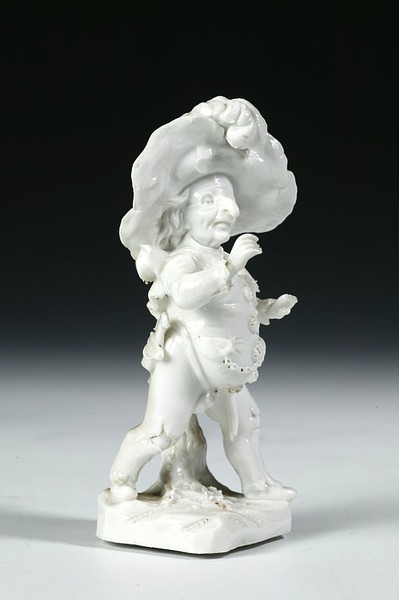
Figure of the Day: The Callot Dwarf, 19th C.


Porcelain Figurine
French, 19th C.
The Victoria & Albert Museum


The work of an unknown modeler at an unknown factory, this figurine is one of a series which was produced in Nineteenth-Century France , modeled after engravings by the artist Jacques Callot (1592-1635). The engravings were printed in 1622 and depicted a troupe of grotesque dwarf entertainers who were known as “Les Gobbi.”

“Les Gobbi” famously performed in Italy for the Medici Court during the period in which Callot was working as a court artist for the powerful family. His task was, essentially, recording court entertainment. Such novelty acts were quite popular throughout Europe at the time and few were as sought-after as “Les Gobbi.” French-born Callot studied art and printmaking in Florence, Italy where he was discovered by the Medicis who instantly recognized his talent and offered their patronage. During his stay with the Medicis, Callot developed a reputation as a master of capturing expressions and for his distinct ability to create scenes of both great joy and grotesquerie. Upon the death of Cosimo Medici, Callot returned to his native France where he embarked on an ambitious series of engravings depicting the tradition of the Commedia dell’Arte.

In the Nineteenth Century, Callot’s work was rediscovered and became the inspiration for many figurines ranging from his representations of Commedia dell’Arte figures to these comic dwarves.   This white porcelain figure shows the Italian influence on the costumes of "Les Gobbi" who modeled their masks and garments after the Commedia characters.  This particular, little fellow has a distinct resemblance to Pulcinella.  


Tuesday, September 18, 2012

Object of the Day, Caption Contest: Albert Odermatt, Costumer

Click image to make his head even bigger.


In the 1880s, giant heads were good advertising. Men and women with enormous craniums and little bodies found their way onto many a trade card of the era. This little fellow is, apparently, an ancestor of Charles Laughton. He’s quite happy about it. He’s also very proud of his little outfit. He’s a gypsy, I think. Or something which would have allowed him to wear an earring. So, when this tiny bloke with his monumental noggin wasn’t busy stealing hats from Smurfs or shopping for bulbous shoes, he was posing for artists who were drawing images for trade cards.

In this instance, he’s been hired to pose for a card for a costumer. To be exact:

ALBERT ODERMATT, 

COSTUMER 
Theatrical and Masquerade Suits 
142 SOUTH CANAL ST., ALLEGHENY. 

I don’t think I could possibly let this opportunity for a caption contest pass by. You know what to do. Answers in the comments section, please.


Tuesday, July 31, 2012

Figure of the Day: The Callot Dwarf, 19th C.

Porcelain Figurine
French, 19th C.
The Victoria & Albert Museum


The work of an unknown modeler at an unknown factory, this figurine is one of a series which was produced in Nineteenth-Century France , modeled after engravings by the artist Jacques Callot (1592-1635). The engravings were printed in 1622 and depicted a troupe of grotesque dwarf entertainers who were known as “Les Gobbi.”

“Les Gobbi” famously performed in Italy for the Medici Court during the period in which Callot was working as a court artist for the powerful family. His task was, essentially, recording court entertainment. Such novelty acts were quite popular throughout Europe at the time and few were as sought-after as “Les Gobbi.” French-born Callot studied art and printmaking in Florence, Italy where he was discovered by the Medicis who instantly recognized his talent and offered their patronage. During his stay with the Medicis, Callot developed a reputation as a master of capturing expressions and for his distinct ability to create scenes of both great joy and grotesquerie. Upon the death of Cosimo Medici, Callot returned to his native France where he embarked on an ambitious series of engravings depicting the tradition of the Commedia dell’Arte.

In the Nineteenth Century, Callot’s work was rediscovered and became the inspiration for many figurines ranging from his representations of Commedia dell’Arte figures to these comic dwarves.   This white porcelain figure shows the Italian influence on the costumes of "Les Gobbi" who modeled their masks and garments after the Commedia characters.  This particular, little fellow has a distinct resemblance to Pulcinella.  


Tuesday, February 7, 2012

Unusual Artifacts: Pyramus and Thisbe Valance, 1560

Pyramus and Thisbe
Panel from a Bed Valance, 1560
French, possibly made for Queen Catherine De Medici
The Victoria & Albert Museum


This piece of satin textile is one of a set of panels that once formed part of the decoration of a bed valance—a kind of pelmet round the top of bed curtains. The image is embroidered in colored silk on a red satin ground and depicts the story of Pyramus and Thisbe. Pyramus, thinking that Thisbe was dead, committed suicide by falling on his own sword. This scene is shown within a frame held by men in stylized Roman military dress.

Other decorative motifs pictured include a laughing mask, birds, dolphins, ox skulls, an altar, a vase and draperies and figures of nudes and monsters in the Grotesque style which had been introduced to France between 1550 and 1575, based on Italian artifacts. Given the style, it is possible that this panel may have been part of a set made for Queen Catherine de Medici (1519–89, daughter of the Italian Lorenzo de Medici, later Queen Consort of France), or for another high-ranking member of the French court. Further evidence comes from the fact that in the Nineteenth Century, this fragment was bound in an album inscribed “RICAMI DEI MEDICI.” (‘embroideries of the Medici’). A gold braid was added in the Nineteenth Century.