Showing posts with label Edward VIII. Show all posts

Thursday, February 5, 2015

Card of the Day: HRH The Prince of Wales

When you're bored with yourself, marry and be bored with someone else

King Edward VIII 

I’ve often written of my dislike for the briefly-reigning King Edward VIII, the one-time Prince of Wales, and later Duke of Windsor. I tend to side with Queen Mary in matters regarding the Royal Family (not that my opinion really matters at all) and tend to keenly feel her disappointment in her eldest son.

But, to be fair, just for a moment, let’s examine the Prince of Wales who is seen here in this 1935 Silver Jubilee card by the Godfrey Phillips Company.

“David,” as he was known within the family was always restless. This was a state of mind which never made sense to his parents—King George V and Queen Mary. The King and Queen were anything but restless. They had their duties, they had each other, they had the empire and they had their family and that was quite enough. Sure, the King and Queen each had their hobbies, shooting and shopping respectively, but at the end of the day, it was a quiet supper en famille which most appealed to them. Prince Edward, on the other hand, yearned for adventure. He was considered quite good looking. Though Mary wasn’t eager to share this with her son, she often wrote to King George just how handsome she thought her fair-haired eldest boy was and that she was pleased that he physically favored, “The old Royal Family.” 


Young Prince Edward
The Royal Collection
David didn’t need his mother to tell him that he was attractive. Everyone else told him. He liked to be told. He liked praise and attention and enjoyed going places where he’d be get both. Sitting at home while his mother sat cataloging her jewels (and truly, this was how Queen Mary spent her evenings) and his father sat smoking and growling to himself about the Empire (which, indeed, is how George spent his evenings), was not appealing. The King was often very vocal (quite violently at times) about his displeasure with his hard-living eldest boy. And, the more the King ranted, the more Prince Edward wanted to be out of the house—typical teenager stuff, but heartily magnified when you’re the Prince of Wales and your dad is the King. What Edward didn’t know was that his mother—though she never said it aloud—often wrote long letters to her husband pleasing with him to be gentler with their son. It didn’t work, but she tried.

Mary, for her part, had no ability to communicate on a personal level with anyone. She was quite shy and inhibited. While she was able to make small talk at parties and while she had no trouble running her myriad charities and talking with her subjects, when it came to talking with her family, she was crippled. This owed a lot to her tumultuous childhood with her egotistical mother and her father, the Duke of Teck, who was, at best, something of a nut. The Queen was very sensitive and loving, but had no means of communicating that. And, so, he children were often left wondering what she was thinking and, when alone with her, would despair that they only talked about vague subjects. Mary’s few attempts to have real conversations with her children were such failures that they would leave her rooms wondering just what had happened.
After the close of the Great War, Mary hoped that “David” would settle down. She had planned to find a way to start to mold him into a proper heir presumptive, but then, her youngest son—Prince John—died during an epileptic seizure. The Queen sank into a private depression. She never spoke of her son’s death. In fact, she rarely ever mentioned him again, but she privately wrote of her secret, deep despair and how it prevented further closeness to her other children.

Meanwhile, the King and Queen couldn’t understand why Britain was so uneasy when they finally had achieved peace. The Prince of Wales began to represent the new sensibilities of the 1920’s—glamour, adventure and excitement. George V and Mary never could understand their son’s sense of boredom. The Queen was the first to point out that she was “never bored.” Yet, “David” was always bored. Always. And, much of the Empire was bored, too.
And so, disappointment built on disappointment. The more the King ranted, the more “David” became bored. He kept questionable company—company which ultimately led to his abdication, and he was, notably, Queen Mary’s deepest disappointment of all.

Tuesday, July 8, 2014

Painting of the Day: A Miniature of King Edward VII and Queen Alexandra, 1902


Miniature
Watercolor on Ivory Set in Gold with
Pearls and Diamonds
Meant to be worn as a Garter Badge
1902
The Royal Collection
Crown Copyright
Image Courtesy of Her Majesty
Queen Elizabeth II
Created in watercolor on ivory in 1902 to commemorate for the Coronation of King Edward VII and Queen Alexandra, this miniature by Johannes Zehngraf (1857-1908) is set in a pendant brooch with an intricate pearl and diamond Maltese cross border. The miniature was set this way so that it could be used as Queen Alexandra’s Family Order. It hangs from a red and white ribbon.

The miniature was first recorded in the Royal Collection during the brief reign of King Edward VIII who had a lot in common with his grandfather (Edward VII) as far as outlook and lifestyle were concerned (not as far as having a desire to serve his country is concerned). You can actually see the resmblence of the one-time Edward VIII to his grandmother, Prince Alexandra as she is depicted in profile on this miniature. 

Tuesday, May 27, 2014

Happy Birthday to Queen Mary!


Happy belated birthday to my favorite deceased Royal, Her Majesty Queen Mary, the one-time Princess Mary of Teck, Duchess of York, Princess of Wales.  The consort of King George V, she was the mother of two kings--one brief and selfish (the Great Kerfuffler™, King Edward VIII) and one who led the empire through the Second World War (King George VI).  Queen Mary died just before her beloved granddaughter ascended the throne as Queen Elizabeth II in 1953.

Yesterday, May 26th, was actually the anniversary of the late Queen's birth.  She was born in 1867.


Show your love for Queen Mary with one of our exclusive "Teck Support" designs, available only in ouronline store.  

Sunday, April 27, 2014

History's Runway: The Duke of Windsor’s Suit, 1940


Lounge Suit
1940
The Victoria & Albert Museum

I will say that the Duke of Windsor (once the Prince of Wales, and once, for a few months, King Edward VIII) was good for one thing—he did influence men’s fashions for the positive and reintroduced color and pattern to a gentleman’s style. Now, that’s not quite as important as what he should have been doing as King, but I’m glad he didn’t stay on the throne, because he had, or so I believe, some questionable allegiances which might have proven rather disastrous during the Second World War.

And, so, let’s ignore all of that for a moment and examine this nifty suit which is displayed on an appropriately creepy mannequin. This is an example of the sort of “lounge suit” which dominated men's fashion from the 1920s onwards.

The “lounge suit” was worn in lieu of the more formal attire which dominated events for decades. By the 1940s, men were wearing lounge suits with a v-neck pullover sweater in place of a waistcoat. This was a trend that was popularized by the pesky Duke of Windsor. And, actually, it’s a look of which I remain a proponent. Until that point, pullovers were mostly the stuff og informal events and sporting occasions.

This rather loud suit was worn by HRH The Duke of Windsor who chose Wallis Simpson over England (despite his protestations to the contrary) and who traded matters of state for matters of fashion—becoming known internationally as the leader of men's fashion. He had a lot of his grandfather, King Edward VII, in him. He liked a good time and preferred informal fashion over the stiff formality of dress that was considered proper during the reign of his great-grandmother, Queen Victoria. The Duke was a patron of the most celebrated London and New York tailors and showed his love of whimsy and adventure by wearing bright colors, strong textures and bold patterns.

This particular suit was only worn a few times by the Duke who eventually gave it to famed photographer and bon vivant Sir Cecil Beaton, who was amassing a collection of fashionable dress for his 1971 exhibition--Fashion: An Anthology. From there, the suit (and many others) came to the Victoria & Albert Museum. I don’t suspect the the Duke’s great-grandmother would have been amused.

Saturday, January 11, 2014

History's Runway: The Lady Glendoven Gown, 1938


Gown of Silk Tulle, 1938
Mainbocher
The Victoria & Albert Museum


The American couturier Mainbocher created this gown of a fine silk tulle of pale green, pink and emerald green stripes.  The dress is decorated with circled and scattered sequins in coordinating colors. The metal zipper at the side of the dress has been colored green and pink to match the stripes.

As was the style of the late 1930s, the bodice is close fitting with cap sleeves and broad shoulders. The shoulders, however are not padded.  The designer was unable to use shoulder padding, as this would be visible through the tulle, so instead three pieces of boning have been employed, arranged in a fan shape to support each of the shoulders. The dress falls from a fitted waist into a very full, floor length skirt which was to be worn over an emerald green satin petticoat because of the transparent nature of the tulle.

Mainbocher established his couture house in Paris in 1929. He was Born Main Rousseau Bocher, running his two names into one to create his label.

The designer is, perhaps, best known for his 1937 design for the wedding dress of the Duchess of Windsor on her marriage to the former King Edward VIII, the Great Kerfuffler ™.  He was a favorite of Wallis Simpson and I could see her wearing this gown as she mercilessly teased anyone who crossed her and drank away the reality that she would never be Queen.

Speaking of Edward VIII/The Duke of Windsor and his wacky abdication, we’ve commemorated the scandal with our exclusive line of Abdication Kerfuffle ™ designs.  Check them out in our online store.  


Tuesday, September 3, 2013

History's Runway: The Lady Glendoven Gown, 1938


Gown of Silk Tulle, 1938
Mainbocher
The Victoria & Albert Museum


The American couturier Mainbocher created this gown of a fine silk tulle of pale green, pink and emerald green stripes.  The dress is decorated with circled and scattered sequins in coordinating colors. The metal zipper at the side of the dress has been colored green and pink to match the stripes.

As was the style of the late 1930s, the bodice is close fitting with cap sleeves and broad shoulders. The shoulders, however are not padded.  The designer was unable to use shoulder padding, as this would be visible through the tulle, so instead three pieces of boning have been employed, arranged in a fan shape to support each of the shoulders. The dress falls from a fitted waist into a very full, floor length skirt which was to be worn over an emerald green satin petticoat because of the transparent nature of the tulle.

Mainbocher established his couture house in Paris in 1929. He was Born Main Rousseau Bocher, running his two names into one to create his label.

The designer is, perhaps, best known for his 1937 design for the wedding dress of the Duchess of Windsor on her marriage to the former King Edward VIII, the Great Kerfuffler ™.  He was a favorite of Wallis Simpson and I could see her wearing this gown as she mercilessly teased anyone who crossed her and drank away the reality that she would never be Queen.

Speaking of Edward VIII/The Duke of Windsor and his wacky abdication, we’ve commemorated the scandal with our exclusive line of Abdication Kerfuffle ™ designs.  Check them out in our online store.  


Tuesday, May 28, 2013

Happy Belated Birthday Mary of Teck


Happy belated birthday to my favorite deceased Royal, Her Majesty Queen Mary, the one-time Princess Mary of Teck, Duchess of York, Princess of Wales.  The consort of King George V, she was the mother of two kings--one brief and selfish (the Great Kerfuffler™, King Edward VIII) and one who led the empire through the Second World War (King George VI).  Queen Mary died just before her beloved granddaughter ascended the throne as Queen Elizabeth II in 1953.


Tuesday, February 5, 2013

Painting of the Day: A Miniature of King Edward VII and Queen Alexandra, 1902


Miniature
Watercolor on Ivory Set in Gold with
Pearls and Diamonds
Meant to be worn as a Garter Badge
1902
The Royal Collection
Crown Copyright
Image Courtesy of Her Majesty
Queen Elizabeth II
Created in watercolor on ivory in 1902 to commemorate for the Coronation of King Edward VII and Queen Alexandra, this miniature by Johannes Zehngraf (1857-1908) is set in a pendant brooch with an intricate pearl and diamond Maltese cross border. The miniature was set this way so that it could be used as Queen Alexandra’s Family Order. It hangs from a red and white ribbon.

The miniature was first recorded in the Royal Collection during the brief reign of King Edward VIII who had a lot in common with his grandfather (Edward VII) as far as outlook and lifestyle were concerned (not as far as having a desire to serve his country is concerned). You can actually see the resmblence of the one-time Edward VIII to his grandmother, Prince Alexandra as she is depicted in profile on this miniature. 

Saturday, May 26, 2012

Happy Birthday to Queen Mary!


Happy birthday to my favorite deceased Royal, Her Majesty Queen Mary, the one-time Princess Mary of Teck, Duchess of York, Princess of Wales.  The consort of King George V, she was the mother of two kings--one brief and selfish (the Great Kerfuffler™, King Edward VIII) and one who led the empire through the Second World War (King George VI).  Queen Mary died just before her beloved granddaughter ascended the throne as Queen Elizabeth II in 1953.


Show your love for Queen Mary with one of our exclusive "Teck Support" designs, available only in our online store.  

Thursday, April 12, 2012

Object of the Day: Portrait of King Edward VII


“Bertie, I can’t hear you.”
--Alexandra of Denmark to her husband the Prince of Wales (King Edward VII) from their marriage in 1863 until his death in 1910.


Since Thursday is always “Gratuitous Bertie Dog Picture” day, I thought we’d begin with another famous Bertie—King Edward VII (1841-1910, r. 1901-1910).  As we know, Bertie was the first born son (not first born child) of Queen Victoria and Prince Albert, and, as such, was the heir apparent.  He waited a long time to be King since his regal mother showed no signs of slowing down during her over sixty-year reign.  Bertie passed the time not studying and, basically, chasing women.  He did pause to marry Princess Alexandra of Denmark, but that didn’t keep him from dating.  With Princess Alexandra, he had six children.  His eldest, Prince Albert Victor, Duke of Clarence, died young while engaged to Princess Mary of Teck—leaving Bertie’s second son, Prince George (King George V) to be the heir presumptive as well as the husband of Princess Mary.

Bertie wasn’t an entirely bad bloke.  He was just passionate and bored.  He loved his wife and was fairly kind to her despite his infidelities.  He spent as much time with her as he could stand and was, I believe, patient with her increasing deafness. 

But, still…he was a bloated hound dog.  Nevertheless, he did have a deep affection for his grandchildren.  He famously held “butter races” with them.  The future Kings Edward VIII and George VI often watched pats of butter melt and run down the King’s legs.  They would wager which oily blob would reach King Edward VII’s shoes first. 

I find King Edward VII to be a curious figure.  In many ways, he was a pig.  I can’t condone his behavior.  Neither could Queen Victoria, it seems, who always blamed Bertie for the death of her beloved Prince Albert  (Albert became weakened when he went to talk his eldest son out of a scandalous relationship with a…gasp…music hall girl).  Yet, he wasn’t an entirely bad King.  He was—despite many scandals—rather popular with the people, and, if anything, knew how to garner good press.  Additionally, he was the father of King George V whom I admire greatly and was reported very kind to Queen Mary, who, as you know, I have an enduring tremendous respect.

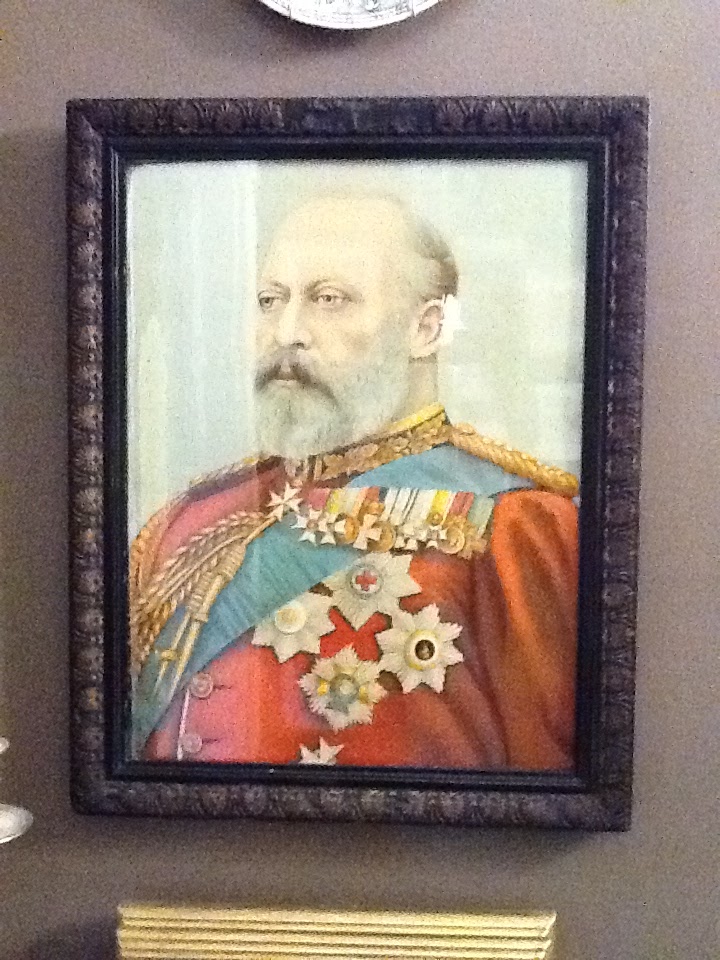
Over Easter, my parents gave me this beautiful chromolithograph of King Edward VII which dates to his 1902 coronation.  This was the official coronation portrait and depicts Bertie—slit-eyed and bloated, but still oddly handsome, in his red uniform adorned with garter stars.

Now, he hangs proudly and contentedly at the entrance of my study.  And, yes, when I pass him I do mimic Queen Alexandra and say, “Bertie, I can’t hear you.”


Wednesday, April 11, 2012

History's Runway: The Lady Glendoven Gown, 1938


Gown of Silk Tulle, 1938
Mainbocher
The Victoria & Albert Museum


The American couturier Mainbocher created this gown of a fine silk tulle of pale green, pink and emerald green stripes.  The dress is decorated with circled and scattered sequins in coordinating colors. The metal zipper at the side of the dress has been coloured green and pink to match the stripes.

As was the style of the late 1930s, the bodice is close fitting with cap sleeves and broad shoulders. The shoulders, however are not padded.  The designer was unable to use shoulder padding, as this would be visible through the tulle, so instead three pieces of boning have been employed, arranged in a fan shape to support each of the shoulders. The dress falls from a fitted waist into a very full, floor length skirt which was to be worn over an emerald green satin petticoat because of the transparent nature of the tulle.

Mainbocher established his couture house in Paris in 1929. He was Born Main Rousseau Bocher, running his two names into one to create his label.

The designer is, perhaps, best known for his 1937 design for the wedding dress of the Duchess of Windsor on her marriage to the former King Edward VIII, the Great Kerfuffler ™.  He was a favorite of Wallis Simpson and I could see her wearing this gown as she mercilessly teased anyone who crossed her and drank away the reality that she would never be Queen.

Speaking of Edward VIII/The Duke of Windsor and his wacky abdication, we’ve commemorated the scandal with our exclusive line of Abdication Kerfuffle ™ designs.  Check them out in our online store.  


Wednesday, November 30, 2011

Obscure Book of the Day: Royal Romances—“David and that Simpson Woman”


As an American who was born almost forty years after the whole “Abdication Kerfuffle” ™ of 1936, I have no rational reason for being so bitter about it nor so critical of the one-time Prince of Wales/King Edward VIII, later, the Duke of Windsor nor of his rather equestrian-looking love, the American lady-boy Wallis Simpson. See? What’s my problem?

(It was never proven that she was a lady-boy)

(Nor was it ever proven that she was a prostitute)

I know what my problem is, actually. In all things, I tend to side with tradition and family. “David” (Edward) didn’t follow through and not only let down Britain, but his mama. And, I really don’t like when people’s mamas get upset. Particularly when the mama in question is Queen Mary, of whom I have developed a certain attachment (Quelle surprise.)

And, so, let’s examine the another obscure book. This one is called, “David and that Simpson ‘Woman.’” Okay. No, it’s not.

The fifth in the series of 1990’s, “Royal Romances: The Love Affairs that Shaped History,” the volume is titled “Edward VIII and Wallis Simpson.” Notice that these are not “The Pleasant and Appropriate Love Affairs,” they’re just the ones “that shaped history.”

And, this one really did. I suppose, if you think about it, it’s a good thing that Wallis sunk her crimson claws into Edward VIII. Had she not, the Second World War would might have had a very different outcome. Stinkin’ Nazis.

So, the book talks about their “love affair.” We already know all about that. Blah, blah. And, there are some nifty photos of her jewels. She had many. And her clothes. She had many. And his clothes. He had many. And their fancy homes. Sigh.

But, the part I like the best is that this volume doesn’t shy away from the truth of the scandal and tells it quite honestly.

Let’s take a look inside.

"I want to be Queen."

Worlds...and used car lots.

"Look at me, I'm a lady."


Hard to tell which is David and which is Wallis.


God Bless the Great Keruffler.


"We like things."


I concur.

At long last I am able to say a few words of my own. I have never wanted to withhold anything, but until now it has not been constitutionally possible for me to speak.


A few hours ago I discharged my last duty as King and Emperor, and now that I have been succeeded by my brother, the Duke of York, my first words must be to declare my allegiance to him. This I do with all my heart.


You all know the reasons which have impelled me to renounce the throne. But I want you to understand that in making up my mind I did not forget the country or the empire, which, as Prince of Wales and lately as King, I have for twenty-five years tried to serve.


But you must believe me when I tell you that I have found it impossible to carry the heavy burden of responsibility and to discharge my duties as King as I would wish to do without the help and support of the woman I love.


"Honey, now that I'm not King, let's buy things." 

Some of Wallis' jewels. 

Can you imagine how fun this last meeting of mother and son was?

And, he died.

Friday, November 18, 2011

Friday Fun: The Children of King George V

The Royal Collection
Crown Copyright
Courtesy of Her Majesty Queen Elizabeth II
 This beautiful video pays tribute to the five children of King George V and Queen Mary: “David” (King Edward VIII/The Duke of Windsor); “Bertie” (King George VI); Mary, the Princess Royal and Countess of Harewood; Prince Henry, the Duke of Gloucester; Prince George, the Duke of Kent; and poor little Prince John.

Thursday, November 17, 2011

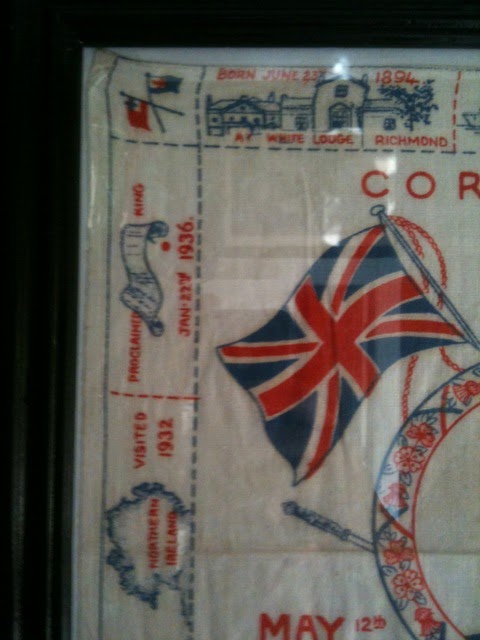
Object of the Day: A Handkerchief Commemorating the Coronation that Never Happened


Oh, Edward VIII---even though he broke his mama’s heart with the abdication kerfuffle, can you imagine what the world would have been like if he’d actually remained King? I’m thinking that the Second World War would have been a lot different…and not in a good way. So, it’s best that he stepped down and let his brother become King George VI, allowing his niece to eventually become Queen Elizabeth II.


Still, as I’ve said before, the Coronation was already planned. It was easy enough to swap out George’s name for Edwards on the programs. So, why not keep the same date?

Here’s one of the rare souvenirs from the coronation that never happened. Most of the Edward VIII items were scrapped when he abdicated and the Coronation was changed for George VI. The ones which remain, most likely, had already been purchased. This handkerchief is emblazoned with a portrait of the temporary King in a circle flanked by Union Jacks and punctuated with his name and the planned dates for the coronation. The border of the textile spells out milestones in Edward’s life. Obviously, the abdication isn’t listed.


Monday, September 19, 2011

Object of the Day: A Souvenir Handkerchief from the Reign of King George V and Queen Mary

A recent addition to my collection of Royal memorabilia is another souvenir handkerchief. Of course, it depicts King George V and Mary of Teck since I tend to favor them. What’s particularly nice about this one is that it also shows their entire family.

Now, this souvenir is not from the coronation nor is it from the Silver Jubilee in 1935. IT was made at some point before 1919 since the family portraits include Prince John who died following a traumatic epileptic seizure in January of 1919. Following John’s death, Queen Mary was so heartbroken that the young prince was barely spoken of again, let alone depicted on any souvenirs.

The handkerchief is printed with “God Save Our King and Queen/ King George V and Queen Mary/ and their Family.” Portrait ovals of George and Mary hover above smaller depictions of their five children: “David” (later King Edward VIII and, then, the Duke of Windsor), Albert (known as “Bertie” to the family, later King George VI), Princess Mary, Prince Henry, Prince George and Prince John. Below the family portraits, are the words and music for “God Save the King” which is labeled as “The National Anthem.”

The handkerchief, though delicate is in excellent condition for its age and is now neatly preserved in a frame made by my father.


Thursday, September 15, 2011

Object of the Day, Museum Edition: An Odd Souvenir from the 1937 Coronation that Didn’t Happen

I ask you.  Would you disturb this sleeping baby?
As I write this, it’s 3:30 in the morning and I’ve been awake all night with a fever and general malaise from a stupid cold that I shouldn’t have gotten because I very, very rarely ever leave my house. Nonetheless, I’m up and have been for many, many hours. Bertie, on the other hand—literally, as you’ll see in a moment—has been asleep for at least ten hours, only waking up for a moment to bark at the thunderstorm that blew through my hometown and to glance at me with contempt when I got up to get my laptop. I should also note that I’m typing this with one hand since Bertie is sleeping on the other one. This is a habit he’s gotten into since his surgery. He likes to have his healing leg resting on some part of me while he sleeps. And, being a sucker for a cute dog, I haven’t the heart to move him.

So, what’s a boy to do? I could lie here awake and wish for someone to bring me ice cream. Of course, I know that that won’t happen since the only other occupants of this house are: A. Bertie who has no thumbs and B. Mr. Punch who is a puppet and doesn’t function independently (thank God). I can’t imagine either of them will bring me ice cream. So, I might as well show my readers—many of whom are in the U.K. and are presently awake—some new old stuff. And, since I’ll no doubt be useless for the rest of the day, let’s dive right in.

Mug
1937
The Victoria & Albert Museum
Let’s begin the day—since I’m feverish—with something that both attracts and confuses me.

This mug attracts me for reasons that are obvious to those of you who come here every day. It’s a coronation mug, so it’s no surprise that I like it. That’s evidenced by the fact that there are about fifty of them in my office on the other side of the house. This one’s not here. It’s in England, in the V&A. I like it despite the fact that it was made for Edward VIII who, in my opinion—feverish or otherwise—just messed up a lot and broke his mama’s heart.

It’s a fun design, brightly colored in the way that things were in 1937. I always think it’s quite funny when people say to me how surprised they were that things of previous eras were in color. The world was in color! Color didn’t just start with the advent of color film, and even if it did, color film was being used in 1937. But, I digress.

What confuses me is that the V&A states that this mug was made in Etruria. Come again? Yes, that’s right—Etruria. Now, just to shed some light on why that’s odd, let’s examine where and what Etruria is or was or might have been. In my understanding, Etruria was the name given to the land that once was in Southern Italy (now Tuscany) from whence the Etruscans came. Wacky Napoleon I of France fancifully revived the name “Etruria” for this region from 1801 to 1807, but, as far as I know, that didn’t stick and by the time Edward VIII was making Queen Mary bellow Cockney phrases of disgust when she learned that her son would not give up that pesky Simpson woman, it was not a term that was in use.

But, yet, the V&A says this comes from Etruria, and so it must have. It was painted with a design incorporating “E.R.,” the Royal Arms, the date of 1937, and a representation of fireworks, designed by Eric Ravilious, and made by Josiah Wedgwood and Sons Ltd.

Two Words...
Abdication.  Kerfuffle.
It’s a pretty thing, but kind of a moot point, too.

And, so, let’s conclude this with a quote from Edward VIII, later the Duke of Windsor:


Perhaps one of the only positive pieces of advice that I was ever given was that supplied by an old courtier who observed: Only two rules really count. Never miss an opportunity to relieve yourself; never miss a chance to sit down and rest your feet.

And, yes, I suspect that was the only somewhat useful thing Edward had to offer. Sad, really. Bertie (my terrier friend, not, Eddie's nephew, King George VI, who was also quite intelligent) is capable of more complex thought.


UPDATE:

I have since been told that Etruria was also the name of a large Staffordshire estate that was acquired in 1765 by Josiah Wedgewood as his home and a factory site.  This became the family home known as Etruria Hall.  I was not in a mindset--at 3:30 in the morning--to come up with that conclusion initially.  So, clearly Bertie is also capable of more complex thought than even I am.