Showing posts with label Embroidery. Show all posts

Monday, February 23, 2015

Ephemeral Beauty: A Die-Cut Trade Card for Kensington Work


Click image to enlarge.


Of my collection of ephemera, I have a special fondness for the die-cut cards.  Here's one in the shape of a painter’s palette. I’ve got another one in the same shape which has a ship on the front. This one depicts a rather manipulative looking kitten who looks a bit like Bertie's cat, Miss Oscar.  

Sure, he seems sweet at first glance, but there’s something underneath his expression that makes me think he’s got a switch-blade. Or…not. He also looks a bit like Princess Diana, too. So, I’m torn.

These die-cut cards were available through catalogs and could be customized. This one has been printed on the front with the words:

Compliments of 
     
MRS. A.W. BELCHER.                                                                         (over) 

Well, if you insist.

The reverse has been custom-printed for an individual operating her own business, which I think is pretty nifty. Let’s see what she has to say.

LADIES…
                I have a fine assortment of new and
artistic designs for Kensington Work, which
you are invited to call and examine. Stitch
taught; work done, or begun: Outlining,
&c., also material for the same. Stamping
to order.
        425 ESSEX STREET, LAWRENCE, MASS.


For those who don’t know, Kensington work is a type of embroidery which was revived and became quite fashionable in Victorian England. The stitch resembles the plumage of a bird with a series of overlapping stitches which create a gradation of color. The technique was used to create patterns of flowers, foliage, birds and animals.


Click image to enlarge.
I wonder if Mrs. Belcher is an ancestor of Bob.

Fox Broadcasting

Tuesday, February 17, 2015

Object of the Day, Museum Edition: The Martha Edlin Beaded Jewelry Case, 1673


Martha Edlin's Jewelry Case, 1673
The Victoria and Albert Museum

Decorated with beadwork--a fashionable embroidery technique in the Seventeenth Century--in which tiny glass beads were threaded and sewn into a pattern, this jewelry case features a padded central panel which lifts open to reveal a compartment for organizing jewels. It is lined with pink taffeta. On the lid, surrounded by an oval wreath formed by silk-wrapped leaves of parchment, is a cockatrice in a tree, with flowers around, worked in glass beads. Outside the wreath, flowers and a leopard are worked in silks in tent and rococo stitches. On the frame surrounding the lid are birds and flowering plants worked in beads. The corners of the frame rest on four round, hand-turned wooden feet. The underside is wholly lined with marbled paper and the edges and seams are covered with silver braid.

Such a fancy case, especially one with such high-quality glass beads and other materials, could only have been made for a very wealthy household. Furthermore, a cabinet-maker would have been employed to make the structure of the case itself if the estate did not already have a man who was proficient in woodworking.

This case once belonged to one Martha Edlin. Her name and the year (1673) have been embroidered on the case. Clearly, Miss Edlin worked the case herself. Given the value of the case itself, we can see that Martha and her successors handled it with extreme care. For this reason, it remains in near pristine condition over three hundred years later.

Martha Edlin (1660-1725) is a name which has become very familiar to me over the past two years as I’ve studied, in detail collection of the V&A. Several items from Martha’s home are now housed in the museum. Martha worked a series of embroideries during her childhood, including this jewelry case, which were cherished by her descendants and passed through the female line of her family for over three hundred years.

Beyond her obvious skill with embroidery, sadly, we know very little about her life, except for the fact that she was married to a man called Richard Richmond. After Richmond’s death, Martha appears to have been a prosperous widow with a handsome home in Pinner in Greater London. She left the bulk of her estate to her daughters and grandchildren.

Among the other treasures created by Martha Edlin, the V&A owns an embroidered sampler in colored silks which Martha created at the age of eight, and a more complicated piece in white-work and cutwork which she crafted at nine. We have looked at those previously. By 1671, Martha’s eleventh year, she had embroidered the panels of an elaborate casket, and two years later. At thirteen, this beadwork jewelry case.

Curiously, for many years, this case became separated from the other Martha Edlin embroideries (which stayed in her family's possession until their acquisition by the Museum). In the Nineteenth Century, the case was purchased at an auction by an unknown buyer. Then, in 1927, the case was again sent to auction where it was purchased by by Sir Frederick Richmond—an ancestor of Martha’s who donated it to the V&A so that it might, once again, join the other beautiful work created by Miss Edlin. 


Monday, February 9, 2015

The Home Beautiful: "A Catte," by Mary, Queen of Scots c. 1569

A Catte
Mary Queen of Scots
Crown Copyright
The Royal Collection 
Image Courtesy of Her Majesty Queen Elizabeth II


This embroidered canvas panel, dating to about 1569, was made by Mary Queen of Scots (1542-1587) who was known as a skilled needleworker.

Mary has pictured a ginger cat with a mouse—set against a checkered floor. Her cipher is prominent. This piece, like much of the Queen’s needlework, was created between 1569 and 1584, during the period when Mary had fled from Scotland and was held captive in England by the Earl of Shrewsbury. Together with Shrewsbury’s wife, Mary Queen of Scots embroidered many such canvas panels which had been drawn out for her in black silk by an embroideress.

Mary based the figure of the cat on an image from a woodcut in” Icones Animalium” by Conrad Gesner--an illustrated tome of natural history which was published in Zurich in 1555. Some suggest that she picked the theme of “A Catte” to indicate that she saw herself as the mouse and Queen Elizabeth as her captor.


Thursday, February 5, 2015

Unusual Artifacts: Pyramus and Thisbe Valance, 1560


Pyramus and Thisbe
Panel from a Bed Valance, 1560
French, possibly made for Queen Catherine De Medici
The Victoria & Albert Museum


This piece of satin textile is one of a set of panels that once formed part of the decoration of a bed valance—a kind of pelmet round the top of bed curtains. The image is embroidered in colored silk on a red satin ground and depicts the story of Pyramus and Thisbe. Pyramus, thinking that Thisbe was dead, committed suicide by falling on his own sword. This scene is shown within a frame held by men in stylized Roman military dress.

Other decorative motifs pictured include a laughing mask, birds, dolphins, ox skulls, an altar, a vase and draperies and figures of nudes and monsters in the Grotesque style which had been introduced to France between 1550 and 1575, based on Italian artifacts. Given the style, it is possible that this panel may have been part of a set made for Queen Catherine de Medici (1519–89, daughter of the Italian Lorenzo de Medici, later Queen Consort of France), or for another high-ranking member of the French court. Further evidence comes from the fact that in the Nineteenth Century, this fragment was bound in an album inscribed “RICAMI DEI MEDICI.” (‘embroideries of the Medici’). A gold braid was added in the Nineteenth Century.

Thursday, January 29, 2015

History's Runway with Miss Oscar: Her Majesty's Hardy Amies Poppy Gown, 1983


Crown Copyright
The Royal Collection
Image Courtesy of Her Majesty Queen Elizabeth II

Not wanting to be left out, Oscar thought she'd offer the first of her fashion posts a bit early.

We begin with an attractive evening gown from The Royal Collection.

Hardy Amies designed this stunning gown for Her Majesty Queen Elizabeth II.  Featuring a cream chiffon skirt with an intricately embroidered bodice, the Queen wore the gown for  a reception in California during an Official Visit to Mexico and the United States of America, from February to March 1983. 

The bodice of the gown is embroidered with Californian poppies in shades of crimson, salmon and purple with stems of black and white.


Crown Copyright
The Royal Collection
Image Courtesy of Her Majesty Queen Elizabeth II

Crown Copyright
The Royal Collection
Image Courtesy of Her Majesty Queen Elizabeth II


Monday, July 14, 2014

History's Runway: A Late Nineteenth Century Corset


Corset
1890-1895
The Victoria & Albert Museum


A lady’s corset didn’t just offer a supportive foundation, it molded her body into unnatural shapes in order to fit whatever peculiar silhouette was in fashion at the time. By the 1890s, women’s bodies were being forced into angular shapes which went against any natural human form. The one we see above, at least, claimed to relieve pressure on internal organs while supporting the stomach. I seriously doubt that it did.

This…thing…is made of whalebone which has been constructed, essentially to be a second ribcage…a restrictive, uncomfortable ribcage in a different shape than the woman’s body. But, just so it didn’t look like a torture device, it had some very attractive embroidery on its pink satin surface. It’s also trimmed with dark pink satin ribbon.

It was made in England between 1890 and 1895. 


Saturday, June 14, 2014

Unusual Artifacts: An Embroidered Pin Cushion, 1670-80


The Victoria & Albert Museum


I love little objects like this that tell a story and speak of the individuals who made them.  This embroidered pin cushion has an obverse of white satin embroidered in colored silks in a pretty design of flowers, a double-headed bird (of course) and the initials “ME.” The back is covered in a rich, deep midnight-blue satin while the edges are bound with a plaited cord of blue silk and twinkling silver thread.

This adorable and beautiful little object was among the contents of an embroidered casket used by a young girl called Martha Edlin, to store her small personal treasures. Needless to say, as young ladies of the Seventeenth Century did, she would have embroidered this herself.
  Curiously, neither the casket nor the pin cushion appears to have been used.

Through other objects in the Victoria and Albert Museum, we know that the girl in question, Martha Edlin (1660-1725). worked a number of fine embroideries during her childhood.
  Thankfully, these were cherished by her descendants and passed down through the female line in her family for over three hundred years. We owe these ladies a debt of gratitude as without their care, we’d not have them to enjoy today.  Other than this, little is known about Martha’s life, with the exception that she married a man called Richard Richmond and appears to have been a prosperous widow, with daughters and many grandchildren.  Later, she is known to have lived in Pinner in Greater London at the time she drew up her will.

Among the other objects which Martha embroidered are a multi-colored sampler which she created at the age of eight, and a more complicated piece in “whitework” and cutwork at nine. By her eleventh birthday in 1671,, she had embroidered the panels of this elaborate casket, and by 1673, she worked an impressive 
 beadwork jewelry case. 


Thursday, June 5, 2014

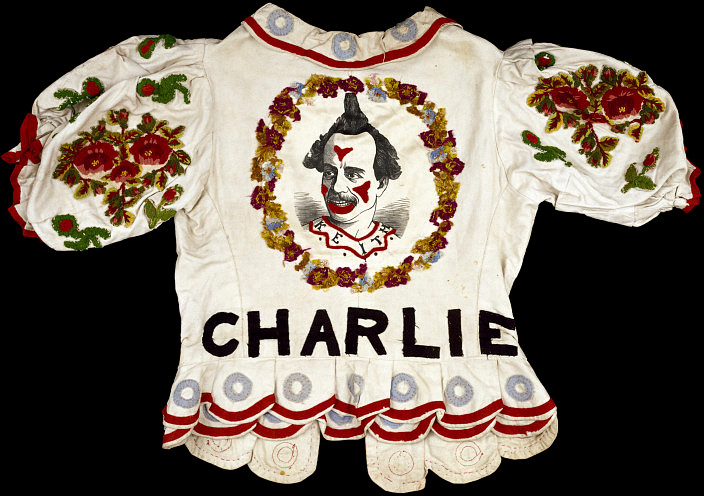
Unusual Artifacts: A Victorian Clown Costume, c.1878


Click image to enlarge.
Charlie Keith's Costume
c. 1870
This and all related images from:
The Victoria & Albert Museum


By the very nature of the job, a clown’s costumes are quickly consumed. So, finding an example of a Nineteenth Century clown’s costume, especially one in good condition, is quite a rare event indeed. The one pictured above is a remarkable example, and, one of only a few such costumes which survive.

Both printed and embroidered, this fine costume belonged to Charlie Keith (1836-1895)—a popular and celebrated clown who was also responsible for managing his own touring circus. The curators of the V&A found an advertisement for Charlie Keith's Circus in The Southport Critic. Dated June 15, 1878, the ad features an engraving of Keith wearing a costume very much like this one. And, here’s a photo from around the same time of Charlie wearing this very costume. 


The costume consists of a back-fastening, waist-length jerkin of heavy white cotton. A scalloped frill adorns the neck. The jerkin features short, puffed sleeves which are also edged with a similar frill. Upon the front is appliquéd a large satin circle printed with an image of Charlie Keith in his clown makeup and costume with his surname “Keith” printed on his neck frill. On his cheeks, red wool hearts have been appliquéd with similar patterns on his cheeks and forehead. The back is similarly adorned with the wearer’s first name. 


Sunday, May 25, 2014

The Home Beautiful: The Cockatoo Fire Screen, c. 1850


Fire Screen of Berlin Woolwork
English, 1847
The Victoria & Albert Museum


This beauty is a masterful example of the popular embroidery technique of “Berlin Woolwork,” so-called because the first printed patterns and dyed wools came from Berlin. Berlin Woolwork was fashionable in Britain between 1830 and the 1870s. Patterns for these pieces were sold individually, or, they could be purchased as kits with the required wools. By 1847, fourteen thousand different Berlin Woolwork patterns were available to consumers in Britain.

This fire screen panel is created of Berlin Woolwork on a taupe linen canvas. The embroidered scene depicts a sulphur-crested cockatoo (a bird from Australia) perched atop a tipped basket overflowing with flowers. A garden background sets the scene with elegant statuary and trees. The background, however, is remains un-worked.

The person responsible for working the scene has shown incredible skill, and has created a sense of realism with the use of plush stitch for the plumage of the cockatoo and cross-stitch in other places for additional texture. The Woolwork was used for a fire screen. The whole piece was assembled in the early 1850s.


Wednesday, May 14, 2014

The Home Beautiful: Trimming from Houldsworth & Co., 1853


Silk Embroidered Trimming
Made by Houldsworth & Co. for the 1853 Dublin Exhibition
The Victoria & Albert Museum


The section of trimming that we see pictured above would have been used as upholstery edging.  However, the real reason that this band was made was to demonstrate the capabilities of Henry Houldsworth’s embroidery machine.

Henry Houldsworth--a Manchester silk spinner, purchased his first industrial embroidery machine in 1829.  Along with the machine, he purchased the British patent rights from Mulhouse in France, where it had been invented in 1828.

Houldsworth and a fellow manufacturer, Louis Schwabe, worked together to improve the machine.  By 1834, the duo had perfected the machine to their satisfaction.  Schwabe's first successful use of the machine concentrated on embroidery for theatrical costumes, especially men's waistcoats.

After Schwabe's death in 1845, Houldsworth took over the business. From this time it was known as  Houldsworth & Co.  The company would become the leading manufacturer of machine embroidery in Britain, exhibiting their wares at the Great Exhibition of 1851.

This piece of embroidery, made in 1853 for the Dublin International Exhibition, is akin to the example exhibited at the Great Exhibition.  This was created by the famed machine which was operated by up to five girls at a time, working up to forty-two needles to create the complicated patterns and ombré (a shaded gradation of color) which were remarkable identical on both sides.


Monday, May 12, 2014

History's Runway: A Little Girl's Dress, 1930


The Victoria & Albert Museum


Made in 1930, this little girl's dress of unlined cotton is printed with a design of stylized flowers and foliage in pale green and blue on a white ground. This sort of dress would have been suitable for everyday wear and play.


Designed in a simple style, the dress has a round neck with a delicate turn-down collar of white lawn.  It’s puffed sleeves are gathered into a frill beneath fabric band above the hem. The dress s given fullness by the pleating of the neck and a shoulder panel at each side.  It fastens at the back of the bodice with five pairs of bound buttons and stitched loops. 


Embellishment and style come from the hand embroidery in powder blue and olive green which adorns the bodice.  Each of the four points of the collar is worked with a design of scrolling lines and geometric shapes which is repeated on the two shoulder panels .

Crafted in the U.K. by Liberty & Co. Ltd., the gown still bears a label stating, “LIBERTY & CO/ REGENT ST, LONDON.”


Monday, May 5, 2014

History's Runway: The Parrot Bag, 1790-1800


Hand Bag
England, 1790-1800
The Victoria & Albert Museum


Fashions of the late Eighteenth to early Nineteenth Centuries saw a transition between hidden interior pockets and external reticules and handbags as a means of storing personal items which were needed on a daily basis. While interior pockets remained in garments, reticules allowed for more portability and versatility as well as a means to show off a bit.

Early reticules like this one still resembled pockets. Still, they were often embroidered and adorned with beads and spangles. They usually closed with drawstrings. This bad is embroidered with a Grecian urn billowing over with flowers. A large parrot adorns the center of the bag. Pink tassels give the bag even more character.

This is the work of a English needlework and was probably made in the home between 1790 and 1800.


Thursday, May 1, 2014

Unusual Artifacts: A Needlework Portrait by Mary Knowles, 1779


Crown Copyright
The Royal Collection
Courtesy of Her Majesty Queen Elizabeth II

We’ve looked at the famed needlework portraits of Miss Mary Linwood. However, Linwood wasn’t the only person recreating painted portraits in embroidery. This needlework picture, commissioned by Queen Charlotte (Consort of George V), in wool dates to 1779 and is the work of Mary Morris Knowles.

Mary Morris Knowles was born of a Quaker family in Rugely, Staffordshire, and was celebrated as much for her intellect as for her skill with the needle. Knowles is now considered to be an important early protagonist of the feminist viewpoint in English cultural life. Ahead of her time, Knowles was an early supporter for the abolition of slavery.

In 1771 Knowles was introduced Queen Charlotte at Buckingham House (now Buckingham Palace), forming a friendship which would last over the next thirty years. Following that first visit in 1771, the Queen commissioned Mrs. Knowles to make a copy of Zoffany’s portrait of George III in needlework or ‘needle painting’ as it was also known.

So pleased with the result, Queen Charlotte showed off the portrait to all of her friends. Eight years later, Mrs. Knowles embroidered this companion picture for Queen Charlotte. It is a self portrait of the artist as she created the needle-painting of George III.

Crown Copyright
The Royal Collection
Image Courtesy of Her Majesty Queen Elizabeth II


Wednesday, April 30, 2014

Unusual Artifacts: Pyramus and Thisbe Valance, 1560


Pyramus and Thisbe
Panel from a Bed Valance, 1560
French, possibly made for Queen Catherine De Medici
The Victoria & Albert Museum


This piece of satin textile is one of a set of panels that once formed part of the decoration of a bed valance—a kind of pelmet round the top of bed curtains. The image is embroidered in colored silk on a red satin ground and depicts the story of Pyramus and Thisbe. Pyramus, thinking that Thisbe was dead, committed suicide by falling on his own sword. This scene is shown within a frame held by men in stylized Roman military dress.

Other decorative motifs pictured include a laughing mask, birds, dolphins, ox skulls, an altar, a vase and draperies and figures of nudes and monsters in the Grotesque style which had been introduced to France between 1550 and 1575, based on Italian artifacts. Given the style, it is possible that this panel may have been part of a set made for Queen Catherine de Medici (1519–89, daughter of the Italian Lorenzo de Medici, later Queen Consort of France), or for another high-ranking member of the French court. Further evidence comes from the fact that in the Nineteenth Century, this fragment was bound in an album inscribed “RICAMI DEI MEDICI.” (‘embroideries of the Medici’). A gold braid was added in the Nineteenth Century.


Wednesday, April 23, 2014

History's Runway: A Boy's Waistcoat, 1820


Embroidered Waistcoat
1820-30
This and all related images from:
The Victoria & Albert Museum


Clothing for little boys over the age of seven, often emulated the outfits worn by grown men. By the end of the Eighteenth Century, trousers had replaced breeches as the main manner of dress for boys. While breeches were fitted to the knee, trousers were wider in the leg and were, therefore, looser, more practical and assuredly more comfortable for a little boy who was prone to be active and moving around. By the 1860’s, the fashion for prepubescent lads was to wear short pants. This was a style which came to the U.K. from the U.S. These short pants were worn with a variety of different shirts, collars, waistcoats and styles of jacket—depending on the occasion.

A waistcoat such as this one would have been a suitable choice for daily wear in the schoolroom of at home. Made between 1820 and 1830 in England, this waistcoat is lined with ivory-colored twill against a front of ivory satin. It boasts pockets and a shawl collar.

The collar and front of this handsome garment are hand embroidered in colored silks with a floral pattern of sprays of rosebuds, forget-me-nots and pansies. The back of the waistcoat is constructed of white cotton and features tapes and brass-bound eyelet holes to adjust the fit.

Now, we should note that this waistcoat was not made for a child—at first. It was made in an adult size. You may find the floral motif a little irregular in pattern, but remember that flowers were assigned particular meanings which were well-known and understood. Let’s take a look at this, then. The roses mean love, and rosebuds, therefore, signify love in its early stages, or a confession of love. The pansies stand for thoughts; and the forget-me-nots symbolized true love or remembrance. In this combination, the flowers would have been suited for a betrothal gift to a gentleman. So, it’s a good possibility, that when this waistcoat was originally made, it was to be worn for a wedding. Years later, the garment was cut down to be given to a child. This was not unusual. Children were often given altered adult clothes since the cost of clothing was comparatively astronomical for most families.


Sunday, April 13, 2014

History's Runway: A Waistcoat from 1770


This and all related images from the V&A.


Famed author Beatrix Potter found some of the inspiration for her book "The Tailor of Gloucester" at what was once the South Kensington Museum (now the V&A). Potter told her editor, Norman Warne, "I have been delighted to find I may draw some most beautiful 18th century clothes at S. Kensington museum." This waistcoat, still on display at the V&A, is one of the pieces that Potter copied for her illustrations. In fact, it appears several times in the book.

This waistcoat from 1770 of cream satin, embroidered with colored silks in stem, would have been part of a dress suit worn by a man on formal occasions. The embroidery was worked in a professional workshop and the front edges were laid with cotton net and edged with couched chenille thread.


Object of the Day: A Die-Cut Trade Card for Kensington Work


Click image to enlarge.


Of my collection of ephemera, I have a special fondness for the die-cut cards.  Here's one in the shape of a painter’s palette. I’ve got another one in the same shape which has a ship on the front. This one depicts a rather manipulative looking kitten who looks a bit like Bertie's cat, Miss Oscar.  

Sure, he seems sweet at first glance, but there’s something underneath his expression that makes me think he’s got a switch-blade. Or…not. He also looks a bit like Princess Diana, too. So, I’m torn.

These die-cut cards were available through catalogs and could be customized. This one has been printed on the front with the words:


Compliments of 
     
MRS. A.W. BELCHER.                                                                         (over) 

Well, if you insist.

The reverse has been custom-printed for an individual operating her own business, which I think is pretty nifty. Let’s see what she has to say.


LADIES…
                I have a fine assortment of new and
artistic designs for Kensington Work, which
you are invited to call and examine. Stitch
taught; work done, or begun: Outlining,
&c., also material for the same. Stamping
to order.
        425 ESSEX STREET, LAWRENCE, MASS.


For those who don’t know, Kensington work is a type of embroidery which was revived and became quite fashionable in Victorian England. The stitch resembles the plumage of a bird with a series of overlapping stitches which create a gradation of color. The technique was used to create patterns of flowers, foliage, birds and animals.

Click image to enlarge.
I wonder if Mrs. Belcher is an ancestor of Bob.

Fox Broadcasting


Thursday, March 27, 2014

History's Runway: The Harrods' Tassel Bag, 1790


This beautiful item had been collected by the Messrs Harrods Ltd. Who donated it to the Victoria & Albert Museum. This Bag or pocket features drawstrings and is embroidered with flowers coming out of a Grecian or Roman urn with a parrot motif in the center. It takes its name from the pink tassel and pink tassel string straps.

The bag is important historically in that it shows the transition between hidden pockets and the external reticule. Though it is embroidered for show and is closed with drawstrings, the bag still resembles a pocket.


Sunday, March 16, 2014

History's Runway: A Pierre Balmain Gown, 1950-1955


Debutante Gown
1950-1955
Pierre Balmain
This and all related images from:
The Victoria & Albert Museum


Made between 1950 and 1955, this evening gown is the work of Parisian designer Pierre Balmain (1914-82). Chances are, it was made as a debutante's presentation dress. Adorned with ostrich feathers, sequins and rhinestones, the gown must have made a grand impression as its wearer made her debut. Constructed of white organza, the gown is beautifully embroidered—a difficult task on such a fine, light fabric. The exquisite embroidery work required immense skill, and was, therefore, sent to a special workshop in Lesage which Balmain had commissioned to create the detailed work. Each bead, each feather and sequin and each rhinestone was applied one-by-one by hand.