Who told you about my dreams? Who told you about my nightmares?
--Joan Crawford as Lucy Harbin
 |
| Columbia Pictures |


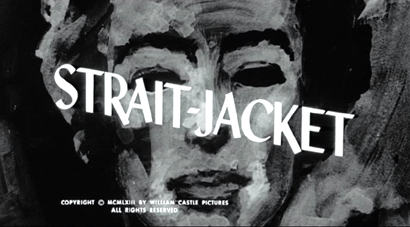
If you’re looking for a wonderfully bizarre film for Halloween, Strait-Jacket is a good choice.

|
| Columbia Pictures |
 |
| William Castle |

 Hot on the heels of Hitchcock’s Psycho, Castle directed what some might consider a rip-off and others might consider an homage. Homicidal was William Castle’s answer to Psycho. While there are some shallow similarities, Homicidal holds up quite well as a genuinely thrilling picture all its own.
 The story concerns a peculiar family. Miriam Webster’s (no relation to the dictionary) brother, Warren, has returned from abroad. He’s brought with him a young woman named Emily. Emily takes care of the sibling’s former nanny, now elderly and disabled. Some strange things begin to happen with Emily around—not the least of which is the seemingly unmotivated, gruesome murder of a Justice of the Peace.
 Emily was played by the lovely Joan Marshall (Herman Munster’s original wife in the pilot of The Munsters”. Marshall is credited as “Jean Arless” in the film. The reasons for the use of the androgynous pseudonym become apparent as the film progresses. I won’t give anything away because William Castle made us all promise not to reveal the ending of the film. However, if you’d like to learn more, I suggest you want this short documentary about the picture. Of course, if you’d prefer to see the film spoiler-free, it’s available on DVD.
 Homicidal is a bizarre and frightening picture. When you watch it, put Psycho out of your mind and enjoy it as its own story. You won’t regret it. You even get a “fright break” so you can leave the room before the end of the film if you just find it too, too scary. If you’d seen the picture in 1961 in a theater, you could have left and received a full-refund. However, everyone who left during the “fright break” was forced to stay in a yellow booth called “The Coward’s Corner.” Ah, William Castle—he giveth and he taketh away.
