Showing posts with label malachite. Show all posts

Wednesday, January 29, 2014

Mastery of Design: The Putti Snuffbox, 1750


Click images to enlarge.
German Snuffbox
Circa 1750
This and all related images from:
The Victoria & Albert Museum


I always like the snuffboxes that are constructed of different media. Typically, we see examples made of precious metals or porcelain, but every so often, we get one of shell or bone which is just lovely. This one is made of tortoiseshell—a medium which found its way into a variety of the decorative arts.

The cartouche-shaped box depicts a scene of putti playing in a fountain—as they do. It’s quite a clever use of carious precious materials. The pilasters with their scrolling decoration are made of inlaid gold while the putti themselves are rendered in ivory. Mother-of-pearl inlay forms the fountain while lapis lazuli and malachite add notes of blue and green respectively to the piece.

There’s no doubt as to the Rococo influence here. Made around 1750, this box is a nifty example of a German take on the Rococo. There’s some debate about just where in Germany the box was made. Some say Southern Germany, particularly Bavaria, while others insist that the piece was constructed in Berlin.

The sides are adorned with more putti and gold shells while the base is engraved with a gold rocaille. The reeded mount comes alive with shell and the scrolled thumb-piece adds interest to the front. Today, the box forms part of the magnificent Gilbert Collection at the V&A.


Tuesday, October 15, 2013

Mastery of Design: The Night Cameo, 1820-1830

"Night"
Italy, 1820-1830
The British Museum


Carved in pale malachite, this gold-framed cameo is carved with the image of a winged woman, "Night," cradling two sleeping children.

This 1820 to 1830 composition is inspired by the marble relief by Bertel Thorwaldsen which was finished in 1815 during the famed sculptors stay in Rome.  The original relief is now in the Thorwaldsen Museum, Copenhagen. 

A cast of the circular gem was cut by Italian jeweler Luigi Pichler after Thorwaldsen's relief and remained a popular motif throughout the Nineteenth Century.

This brooch is one of the many fabulous jewels which were bequeathed to The British Museum as part of the Hull-Grundy Gift.


Sunday, March 3, 2013

Gifts of Grandeur: The Putti Snuffbox, 1750


Click images to enlarge.
German Snuffbox
Circa 1750
This and all related images from:
The Victoria & Albert Museum


I always like the snuffboxes that are constructed of different media. Typically, we see examples made of precious metals or porcelain, but every so often, we get one of shell or bone which is just lovely. This one is made of tortoiseshell—a medium which found its way into a variety of the decorative arts.

The cartouche-shaped box depicts a scene of putti playing in a fountain—as they do. It’s quite a clever use of carious precious materials. The pilasters with their scrolling decoration are made of inlaid gold while the putti themselves are rendered in ivory. Mother-of-pearl inlay forms the fountain while lapis lazuli and malachite add notes of blue and green respectively to the piece.

There’s no doubt as to the Rococo influence here. Made around 1750, this box is a nifty example of a German take on the Rococo. There’s some debate about just where in Germany the box was made. Some say Southern Germany, particularly Bavaria, while others insist that the piece was constructed in Berlin.

The sides are adorned with more putti and gold shells while the base is engraved with a gold rocaille. The reeded mount comes alive with shell and the scrolled thumb-piece adds interest to the front. Today, the box forms part of the magnificent Gilbert Collection at the V&A.


Wednesday, January 16, 2013

Unusual Artifacts: A Roman Micromosaic Specimen Block, 1800

Click Images for Larger Size

Specimen Block
Raffaeli, 1800
This and all related images from
The Victoria & Albert Museum


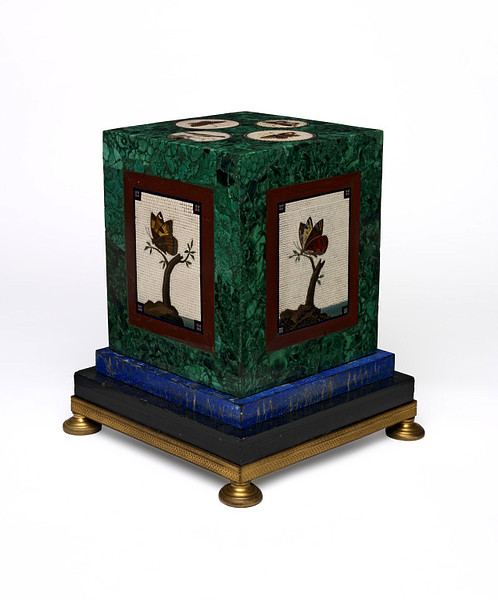
Created as a means of displaying a handsome group of early Italian micromosaics, this specimen block was assembled around 1800. And, it shows them off beautifully, but the block itself must not be dismissed as a mere display item. It’s quite impressive in its own right. The block is a rare Nineteenth Century example of an Italian use of malachite, a stone then found only rarely, and then, typically just outside of Russia. The malachite block stands on a plinth of lapis lazuli, and, this, on a base of black marble within a frame of gilt bronze.

The use of the butterfly form in the micromosaics is wholly Roman, owing to the ancient belief that the butterfly represented the soul leaving the body at the moment of death. The top of the malachite block is set with four lovely micromosaic roundels, each with a white background and three of them featuring the butterfly theme. The fourth depicts a bird resting on a branch.

The other four sides (not counting the side attached to the base), are each set with rectangular micromosaics featuring a depiction of a butterfly perched on a branch within a border of red marble.

While it’s difficult to date the micromosaics, it’s safe to assume that they’re Roman in origin. The valuable collection of panels was assembled by Giacomo Raffaelli (1753-1836). A similarly-set block of lapis lazuli is housed in a private Roman collection. This one was acquired by Sir Arthur and Rosalinde Gilbert and now is part of the V&A’s Gilbert Collection.


Tuesday, November 27, 2012

Precious Time: Napoleon Bonaparte’s Pietre Dura Clock, 1804


Triumphal Arch Clock
Raffaelli and Breguet, 1804
The Victoria & Albert Museum
This magnificent clock wants to be studied. An impressive combination of various stones and gilt bronze, the clock takes the form of a Triumphal Arch of red and white antique marble with shimmering columns of amethyst topped by gilt bronze Corinthian capitals.


The two panels which flank the arch show micromosaic, pietre dure panels depicting military trophies. These pietre dure ornaments as well as other decorative inlays consist of amethyst, lapis lazuli, malachite, labradorite, jasper, agate, marble, and glass.

The whole of the clock case—designed by Giacomo Raffaelli—is surmounted by gilt bronze figures of Victory and Fame while the niche in the archway protects a statuette of Mars. Raffaelli and clockmaker Abraham-Louis Breguet worked together to create this gorgeous timepiece, hoping it would find its way into a prominent home. And, it certainly did.

Pope Pius VII had entrusted Venetian Sculptor Antonio Canova with the task of finding suitable gifts to present to Napoleon Bonaparte on the event of his coronation. The “Triumphal Arch Clock” (as it is known) was among the items selected by Canova for the occasion.

The Empress Josephine was said to have favored the clock and kept it as the centerpiece of her collection. Later, the clock was sold to pay off mounting debts. Purchased by Sir Arthur Gilbert and his wife Rosalinde in 1976, the clock was added to their impressive collection of decorative arts—considered one of the world’s greatest such collections. Gilbert loaned the clock to the Victoria & Albert Museum in 1996 where it remains on loan to this day.


Thursday, August 23, 2012

Gifts of Grandeur: The Putti Snuffbox, 1750

Click images to enlarge.
German Snuffbox
Circa 1750
This and all related images from:
The Victoria & Albert Museum


I always like the snuffboxes that are constructed of different media. Typically, we see examples made of precious metals or porcelain, but every so often, we get one of shell or bone which is just lovely. This one is made of tortoiseshell—a medium which found its way into a variety of the decorative arts.

The cartouche-shaped box depicts a scene of putti playing in a fountain—as they do. It’s quite a clever use of carious precious materials. The pilasters with their scrolling decoration are made of inlaid gold while the putti themselves are rendered in ivory. Mother-of-pearl inlay forms the fountain while lapis lazuli and malachite add notes of blue and green respectively to the piece.

There’s no doubt as to the Rococo influence here. Made around 1750, this box is a nifty example of a German take on the Rococo. There’s some debate about just where in Germany the box was made. Some say Southern Germany, particularly Bavaria, while others insist that the piece was constructed in Berlin.

The sides are adorned with more putti and gold shells while the base is engraved with a gold rocaille. The reeded mount comes alive with shell and the scrolled thumb-piece adds interest to the front. Today, the box forms part of the magnificent Gilbert Collection at the V&A.


Monday, December 19, 2011

Mastery of Design: The Lang Quartz and Jewels Box, 1770

The Victoria & Albert Museum


This magnificent quartz box for holding sweetmeats is mounted in engraved and chased gold and encrusted with stones carved in the form of a woman, birds, flowers and insects. Made in Augsburg, c. 1770, this is the work of the jeweler Heinrich Gottlob Lang who managed to incorporate a host of gorgeous colored stones into his design. The stones, carved and faceted, include: sapphire, pink tourmaline, white opals, garnets, marcasite, lapis lazuli, bowenite, malachite, turquoise, jasper, agate, and chalcedony.

Thursday, September 23, 2010

Gem of the Week: Malachite

This bright green mineral gets its name from its resemblance to the color of the leaves of the mallow plant. For centuries until the Nineteenth Century, malachite was ground for use as a green pigment in paint suspensions. However, the mineral’s properties reacted badly with acids which caused the color to fade or change over time.


Early Victorian Scottish Malachite Buckle Bracelet
Lang Antique and Estate Jewelry, San Francisco
Malachite has long been used in jewelry as well as in the decorative arts. The unusual vibrancy of the color, often banded with darker and lighter greens, immediately puts one in mind of nature. The Victorians frequently employed malachite in their jewelry—often in pieces designed to be worn during the day or in the country, when diamonds or other faceted gems were not considered appropriate. Jewelry makers in Scotland used Malachite with stunning creativity—crafting beautiful brooches, bracelets and rings which showcased the stone’s natural color and smoothness. Scottish artists often combined malachite with silver, colored agates and onyx to create complicated and amazing designs.

This luxurious mineral continues to be popular in jewelry and in furnishings. Legend has it that wearing malachite will ward of disease, witchcraft, and even lightning. That would be a nice side effect, but the best reason to wear malachite is simply that it’s beautiful.

Her Majesty’s Furniture: A Set of Malachite Candelabra

The famed Parisian design firm of Thomire & Cie created these magnificent candelabra of gilt bronze and blazingly green malachite in 1828. The candelabra presently have eight arms, but originally had sixteen. Why or when they were altered is something of a mystery. The candelabra are part of a garniture set which flank a matching clock.

As the story goes, the set was purchased for £500 by King George IV’s Confectioner, Francois Benois. Later, a gift of the set was made to the sovereign. Today, the set is one of the treasure of The Royal Collection.