Showing posts with label butterfly. Show all posts

Thursday, April 24, 2014

Mastery of Design: The Grundy Butterfly Pin, c. 1800


Click on image to enlarge.
Hair Pin
England, 1800
The British Museum


I really like this pin which dates to around 1800. It was likely made in England, but we’ll examine that more closely in a second. Originally, the piece was made as a hairpin. It’s crafted of silver with a closed-back and set with diamonds with ruby eyes and antennae of gold wire.

Two hinged arms with loops at the end were added to the back at a later date. This addition allowed the jewel to be worn as a pendant hung from a ribbon or chain. Butterfly hairpins such as this one were fashionable between1800-30. The pins were usually worn with fresh flower wreaths.

The piece was once part of the collection of Hull Grundy. The curators of the British Museum believe that this pin might be one which was described in the records of the Royal Goldsmiths at Rundells. The piece therein described was supplied to Princess Amelia. The records state: 


“’An elegant Butterfly for the hair' for £142.15s for Princess Amelia.”


Wednesday, January 16, 2013

Mastery of Design: A Diamond Hairpin, 1830-1840


Butterfly Hairpin
Diamonds, Silver, Gold
1830-1840
The Victoria & Albert Museum
Set in silver on a gold frame, rose-cut and brilliant diamonds sparkle in the form of a butterfly. This magnificent diamond hairpin was part of the early Nineteenth Century’s Romantic movement and its reliance on natural forms and designs.

Very often, until the rise of platinum and white gold, diamonds were set in silver prongs so that yellow or rose gold setting would not distract from the diamond or alter its color.


Unusual Artifacts: A Roman Micromosaic Specimen Block, 1800

Click Images for Larger Size

Specimen Block
Raffaeli, 1800
This and all related images from
The Victoria & Albert Museum


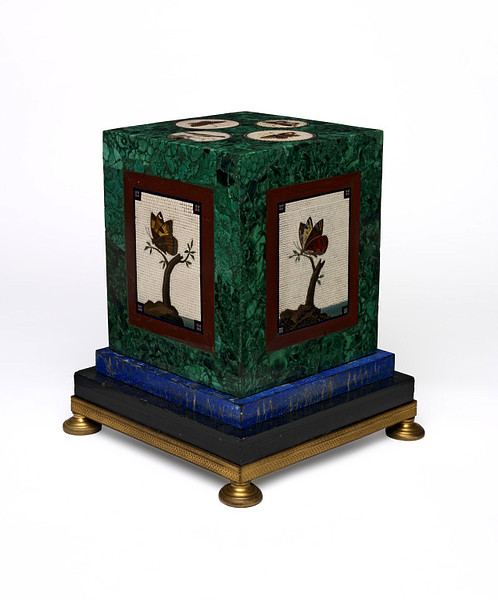
Created as a means of displaying a handsome group of early Italian micromosaics, this specimen block was assembled around 1800. And, it shows them off beautifully, but the block itself must not be dismissed as a mere display item. It’s quite impressive in its own right. The block is a rare Nineteenth Century example of an Italian use of malachite, a stone then found only rarely, and then, typically just outside of Russia. The malachite block stands on a plinth of lapis lazuli, and, this, on a base of black marble within a frame of gilt bronze.

The use of the butterfly form in the micromosaics is wholly Roman, owing to the ancient belief that the butterfly represented the soul leaving the body at the moment of death. The top of the malachite block is set with four lovely micromosaic roundels, each with a white background and three of them featuring the butterfly theme. The fourth depicts a bird resting on a branch.

The other four sides (not counting the side attached to the base), are each set with rectangular micromosaics featuring a depiction of a butterfly perched on a branch within a border of red marble.

While it’s difficult to date the micromosaics, it’s safe to assume that they’re Roman in origin. The valuable collection of panels was assembled by Giacomo Raffaelli (1753-1836). A similarly-set block of lapis lazuli is housed in a private Roman collection. This one was acquired by Sir Arthur and Rosalinde Gilbert and now is part of the V&A’s Gilbert Collection.


Gifts of Grandeur: The Butterfly Ring, 18th C.

The Butterfly Ring
Eighteenth Century?
Crown Copyright
The Royal Collection
 
Image Courtesy of Her Majesty Queen Elizabeth II


This unusual ring, part of the Royal Collection, is one of the rare, unrecorded pieces of jewelry in the lot. The history of the piece is next to unknown, even down to the exact way it entered the collection. 

The ring, meant to take the form of a butterfly is fashioned of silver gilt and set with two diamonds and two garnets to depict the insect’s wings. Given the workmanship and the leather case in which it’s housed, I’d place the ring to the mid-to-late Eighteenth Century. However, that doesn’t mean that the ring came into the Royal Collection at that time.


Object of the Day: A Vintage Silver Pin Set with Butterfly Wings


This past Christmas I received an unusual bit of vintage jewelry which I’ve since researched to discover a whole world of such items which, naturally, now I want to collect.

The brooch of sterling silver is faced with glass. Beneath the glass bezel is a luminescent portrait of a Victorian woman. The portrait has been over-painted with details, but, the woman’s gown is so radiant. That’s because it’s assembled from real butterfly wings.

The picture you see above is not the same piece that I received. It’s a similar work by the same maker. The image below is the brooch that I have. Now, I took dozens of photos of it, but, it just didn’t photograph well. Too much shine, too much detail. However, this blurry picture gives you a sense of the impressive color that the piece exhibits. Much better than the above example. These types of brooches were made in England in the late 1910s and 1920s. 

It seems there’s a bunch of other types of jewels made with butterfly wings from this era. I find it very charming, and, can only assume that the butterflies lived out their natural lives before being made into baubles.

Wednesday, November 7, 2012

Mastery of Design: The Grundy Butterfly Pin, c. 1800

Click on image to enlarge.
Hair Pin
England, 1800
The British Museum


I really like this pin which dates to around 1800. It was likely made in England, but we’ll examine that more closely in a second. Originally, the piece was made as a hairpin. It’s crafted of silver with a closed-back and set with diamonds with ruby eyes and antennae of gold wire.

Two hinged arms with loops at the end were added to the back at a later date. This addition allowed the jewel to be worn as a pendant hung from a ribbon or chain. Butterfly hairpins such as this one were fashionable between1800-30. The pins were usually worn with fresh flower wreaths.

The piece was once part of the collection of Hull Grundy. The curators of the British Museum believe that this pin might be one which was described in the records of the Royal Goldsmiths at Rundells. The piece therein described was supplied to Princess Amelia. The records state: 

“’An elegant Butterfly for the hair' for £142.15s for Princess Amelia.”