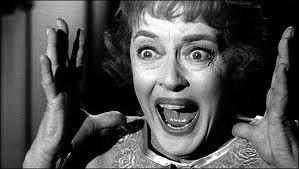
Now let me see... what is it you call your job? Oh, yes. Public relations. Sounds like something pretty dirty to me.
--Charlotte Hollis
In 1964, following the wildly successful pairing of stars Bette Davis and Joan Crawford inWhatever Happened to Baby Jane, Producer/Director Robert Aldrich planned to team the duo in another film based on a another book by Henry Farrell, Whatever Happened to Cousin Charlotte. Davis insisted that the title of the film be changed. She didn’t want audiences to think that the film was a sequel to Whatever Happened to Baby Jane. She suggested, “Hush… Hush, Sweet Charlotte” which was the name of the song which had been composed as the main musical theme of the picture. Aldrich agreed.
A rare publicity shot of Crawford and Davis
Davis would play Charlotte Hollis—an eccentric Southern recluse who hides in her family’s crumbling Louisiana mansion after being accused of murdering her lover many years earlier. Crawford would play Miriam Deering, Charlotte’s strong-willed cousin who’s come to help Charlotte vacate her home when it is ordered to be torn down.
Joseph Cotten was cast as Dr. Drew Bayliss—a long-time friend of the family. The cast was further completed with Cecil Kellaway as an insurance investigator, Anges Moorehead as Charlotte’s cranky but loyal maid, a young Bruce Dern as Charlotte’s girl-hood lover, Victor Buono as Charlotte’s father, and Mary Astor as Charlotte’s former rival. Davis had specifically asked for Astor to play the role of Jewel Mayhew. Astor was one of the few female stars that Bette Davis actually liked. They had been friends and had worked well together on The Great Lie. When Bette Davis liked you, she really liked you. When she didn’t, she really didn’t.
Shooting began with both Davis and Crawford on location at Houmas House in Darrow Louisiana which would serve as the exteriors for Charlotte’s family home. However, soon, Miss Crawford developed one of her famous “Joan Crawford Colds” and was consistently absent—only appearing for four days of filming. Rumor had it that she couldn’t face working with Bette Davis again. While relations between them had been frosty on “Baby Jane,” they did manage to maintain a somewhat professional attitude. This time, however, Crawford wasn’t cooperating and she withdrew from the picture.
Olivia de Havilland as "Miriam"
Aldrich scrambled to find a suitable star for the second leading part in the film. At one point Vivien Leigh was approached to replace Crawford. Leigh responded, “"No, thank you. I can just about stand looking at Joan Crawford's face at six o'clock in the morning, but not Bette Davis'." Katherine Hepburn didn’t return Aldrich’s calls. Barbara Stanwyck and Loretta Young were also considered for the part of Miriam, but either declined or were deemed unsuitable for the role. The only other actress of that caliber that Bette Davis wanted was her old friend and co-star Olivia de Havilland.
Davis and Moorhead
Aldrich flew to Switzerland and, after much cajoling, convinced de Havilland to accept the part. Later, de Havilland would confess that she really did it as a favor to Bette Davis. She said, “I always thought it would be fun if [Bette and I] could work together. Then, I was offered the chance to work with her on the film that became Hush...Hush, Sweet Charlotte when Joan Crawford withdrew. I knew Bette wanted badly to work, and Jane had been such a success that Bette was quite anxious. They had to find the replacement, and Bette wanted me. The problem was I wasn't as anxious to work as she was. I didn't need to. I wasn't thrilled with the script, and I definitely didn't like my part. I was reverse-typecast, being asked to be an unsympathetic villain. It wasn't what people expected of me. It wasn't really what I wanted to do. Bette wanted it so much, so I did it. I can't say I regretted it, because working with her was special, but I can't say it was a picture I am proud to put on my résumé. Given the choice, I wouldn't have deprived Joan Crawford of the honor."
Mary Astor in her final film role.
On the first day of shooting together, Bette Davis and Olivia de Havilland toasted one another with bottles of Coca Cola—a sly slap-in-the-face to Joan Crawford’s memory. Crawford’s husband, Al Steele was an executive at Pepsi Cola.
The result of their collaboration was an excellent Southern Gothic thriller with plenty of chilling moments despite the obviously fake severed body parts. The three leads deliver excellent performances which are relatively restrained given the material. And, it’s interesting to see Olivia de Havilland in a “bad girl” part. With Halloween around the corner, Hush…Hush, Sweet Charlotte should certainly be on your play-list.
Everything clicked on Autumn Leaves. The cast was perfect, the script was good, and I think Bob [Aldrich] handled everything well. I really think Cliff did a stupendous job; another actor might have been spitting out his lines and chewing the scenery, but he avoided that trap. I think the movie on a whole was a lot better than some of the romantic movies I did in the past...but somehow it just never became better known. It was eclipsed by the picture I did with Bette Davis.
--Joan Crawford
This little-known, infrequently-screened Joan Crawford film actually features one of her most subdued and sympathetic performances. InAutumn Leaves, Crawford plays a spinster named Millie who falls in love with a much younger man, Burt (played by Cliff Robertson). When Millie and Burt marry, she realizes that her new husband suffers from a debilitating mental illness. As Millie struggles to get Burt the help he needs, she worries that his love for her will be erased along with his troubles.
Originally, the film was to be called, “The Way We Are,” but director Robert Aldrich and executives at Columbia Pictures wanted to capitalize on the popular song by Nat King Cole, “Autumn Leaves” which they had licensed for the picture. The change in title proved to be a good move. Due to the song’s wide-spread adoration, people flocked to the picture. Though it was panned by many critics, others noted Crawford’s fine performance in what she called, “the best older woman/younger man picture” in history.
The script was actually written by Jean Rouverol and Hugo Butler, but the two had been black-listed as suspected communists and so, the film’s screenplay is credited to Jack Jevne. For some reason, despite its solid acting, the film never really caught on. Crawford was quite proud of the picture. In the quote above, we can see her rightful pride and some slight bitterness that her later picture,Whatever Happened to Baby Jane?, was more of a blockbuster sensation.
Now let me see... what is it you call your job? Oh, yes. Public relations. Sounds like something pretty dirty to me.
--Charlotte Hollis
In 1964, following the wildly successful pairing of stars Bette Davis and Joan Crawford inWhatever Happened to Baby Jane, Producer/Director Robert Aldrich planned to team the duo in another film based on a another book by Henry Farrell, Whatever Happened to Cousin Charlotte. Davis insisted that the title of the film be changed. She didn’t want audiences to think that the film was a sequel to Whatever Happened to Baby Jane. She suggested, “Hush… Hush, Sweet Charlotte” which was the name of the song which had been composed as the main musical theme of the picture. Aldrich agreed.
A rare publicity shot of
Crawford and Davis
Davis would play Charlotte Hollis—an eccentric Southern recluse who hides in her family’s crumbling Louisiana mansion after being accused of murdering her lover many years earlier. Crawford would play Miriam Deering, Charlotte’s strong-willed cousin who’s come to help Charlotte vacate her home when it is ordered to be torn down.
Joseph Cotten was cast as Dr. Drew Bayliss—a long-time friend of the family. The cast was further completed with Cecil Kellaway as an insurance investigator, Anges Moorehead as Charlotte’s cranky but loyal maid, a young Bruce Dern as Charlotte’s girl-hood lover, Victor Buono as Charlotte’s father, and Mary Astor as Charlotte’s former rival. Davis had specifically asked for Astor to play the role of Jewel Mayhew. Astor was one of the few female stars that Bette Davis actually liked. They had been friends and had worked well together on The Great Lie. When Bette Davis liked you, she really liked you. When she didn’t, she really didn’t.
Shooting began with both Davis and Crawford on location at Houmas House in Darrow Louisiana which would serve as the exteriors for Charlotte’s family home. However, soon, Miss Crawford developed one of her famous “Joan Crawford Colds” and was consistently absent—only appearing for four days of filming. Rumor had it that she couldn’t face working with Bette Davis again. While relations between them had been frosty on “Baby Jane,” they did manage to maintain a somewhat professional attitude. This time, however, Crawford wasn’t cooperating and she withdrew from the picture.
Olivia de Havilland as "Miriam"
Aldrich scrambled to find a suitable star for the second leading part in the film. At one point Vivien Leigh was approached to replace Crawford. Leigh responded, “"No, thank you. I can just about stand looking at Joan Crawford's face at six o'clock in the morning, but not Bette Davis'." Katherine Hepburn didn’t return Aldrich’s calls. Barbara Stanwyck and Loretta Young were also considered for the part of Miriam, but either declined or were deemed unsuitable for the role. The only other actress of that caliber that Bette Davis wanted was her old friend and co-star Olivia de Havilland.
Davis and Moorhead
Aldrich flew to Switzerland and, after much cajoling, convinced de Havilland to accept the part. Later, de Havilland would confess that she really did it as a favor to Bette Davis. She said, “I always thought it would be fun if [Bette and I] could work together. Then, I was offered the chance to work with her on the film that became Hush...Hush, Sweet Charlotte when Joan Crawford withdrew. I knew Bette wanted badly to work, and Jane had been such a success that Bette was quite anxious. They had to find the replacement, and Bette wanted me. The problem was I wasn't as anxious to work as she was. I didn't need to. I wasn't thrilled with the script, and I definitely didn't like my part. I was reverse-typecast, being asked to be an unsympathetic villain. It wasn't what people expected of me. It wasn't really what I wanted to do. Bette wanted it so much, so I did it. I can't say I regretted it, because working with her was special, but I can't say it was a picture I am proud to put on my résumé. Given the choice, I wouldn't have deprived Joan Crawford of the honor."
Mary Astor in her final film role.
On the first day of shooting together, Bette Davis and Olivia de Havilland toasted one another with bottles of Coca Cola—a sly slap-in-the-face to Joan Crawford’s memory. Crawford’s husband, Al Steele was an executive at Pepsi Cola.
The result of their collaboration was an excellent Southern Gothic thriller with plenty of chilling moments despite the obviously fake severed body parts. The three leads deliver excellent performances which are relatively restrained given the material. And, it’s interesting to see Olivia de Havilland in a “bad girl” part. With Halloween around the corner, Hush…Hush, Sweet Charlotte should certainly be on your play-list.
Joan Crawford was one of the top stars in the U.S. while Lucille Ball was struggling to maintain her status as “Queen of the B-pictures.” But, by the late 1960’s, Lucy was the bigger star, and Joan needed money—desperately.
So, you’d think that given all of that, and given their shared past, that Lucy and Joan could have gotten along for a week, if only just to shoot Joan’s appearance on “The Lucy Show.”
But, by all accounts, this was not possible.
“The Lucy Show” was essentially a color “I Love Lucy” without Ricky and Fred. I know, I know, Lucy purists will say that the shows were very different, but they really weren’t. Aside from different back-stories and circumstances, the program centered around Lucy doing foolish things and getting Vivian (Vivian Vance who played Lucy’s best friend and neighbor “Ethel Mertz” on “I Love Lucy”) into trouble by her involvement.
So, we’re not looking at Ibsen or Tennessee Williams here. Lucy often had big-name guest stars on her shows, and, she asked Joan to guest in an episode in which the story dictated that Lucy and Vivian inadvertently stumble upon Crawford's new country home—a fixer-upper which the star has vowed to finish on her own. Seeing the dilapidated mansion and the star in her work clothes, they naturally come to the conclusion that the legendary actress had fallen on bad times (she kind of had in real life). Naturally, they arrange for a benefit to raise money for the celeb and, of course, ask her to star in it, too.
Now, it’s no secret that our Joanie liked a nip or two or three during the day. She used her ever-resent silver flask of vodka to full her Pepsi up with a little extra “kick.” Lucy, no stranger to the sauce herself, was, however, very anti-drinking on set. When she saw Crawford and her flask, Lucy was livid. Then, when Crawford was late to the set, Lucy was as red as her hair.
Reportedly, Lucy called Joan and the two had a vicious phone fight wherein Lucy told the Oscar winner to get her act together or she’d be fired and replaced with Gloria Swanson for whom the script had originally been written in the first place.
Lucy, whether justly or not, decided Crawford was drunk during the filming of the episode. You can see what you think. Is Joan’s speech a little slurred? Nevertheless, Lucy was not pleased and had Joan repeat a dance number over and over and over again in front of a live audience—finally and humiliatingly cutting the number at the last minute. This was a great blow to Crawford who had begun her career as a dancer. She felt the insult very deeply, and, when the final shot had been completed, Joan declared, "My God, they tell me I'm a bitch - Lucy can out-bitch me any day of the week!"
And, so, for your Sunday Morning Special this week—here’s the whole bloody mess. Enjoy!
Faux Silk Scarf French, 1940 The Victoria & Albert Museum I'm not sure why that hand bag is there. I think it's trying to eat the scarf.
Made in France in 1940, this scarf of white artificial silk is printed with the signatures of famous film actors of the era. The autographs are printed in green, purple, orange and black and include the signatures of Joan Crawford, Douglas Fairbanks, Merle Oberon and Stan Laurel.
The work of an unknown designer, a scarf such as this would have been a popular item with those who were fans of the cinema, a nifty way to show an affinity for a particular group of stars.
Billie Cassin, Lucille Le Seur, Joan Crawford, Mrs. Fairbanks, Mrs. Franchot Tone, Mrs. Alfred Steele or Queen Bitch—no matter what you called her, she was a star, and she knew it. Joan Crawford remains a star to this day despite the scandalous and scurrilous (and questionable) tome written by her eldest adopted child. She will always be remembered for the dozens of fine, brilliant, stunning and, in some cases, bizarre performances she gave us over the years.
Miss Crawford knew what being a star truly meant. Even as a young player in silent films, she knew how to make sure that the spotlight shined favorably down upon her. She was also one of the first stars to know the power of her own face. Crawford’s image changed over the years, adapting to the times and to what she thought her public wanted from her. This English cigarette card from my collection was from a series of 72 cards depicting both American and English film stars, produced by Carrera’s Fine Quality Cigarettes. I like that her biography states that it is “unnecessary to give details, as she has achieved worldwide fame.”
It’s Joan Crawford. It’s Joan Crawford in Technicolor. It’s a ginger Joan in Technicolor in blackface. It’s wrong. It’s campy. It’s a little scary, too. It’s Torch Song!
By 1953, the self-proclaimed “Queen of the Movies,” the “shop girl who made good” had already been dubbed as “Box Office Poison” and released from her contract at Metro. In 1943, she was recruited by Warner Brothers where she had basically been hired to annoy Bette Davis. She wasn’t really wanted at Warners either. Before her triumph in Mildred Pierce, director Michael Curtiz said, “She comes over here with her high-hat airs and her goddamn shoulder pads... why should I waste my time directing a has-been?" Still, Crawford proved herself with Mildred Pierce, winning the Academy Award for her performance and reestablishing her career. Once again “Hollywood Royalty,” Crawford seemed to be back at the top, but it wasn’t for long. For some reason, she never had the knack for getting the juicy parts that Davis was offered.
In 1952, Crawford asked to be released from her contract at Warner Brothers. For awhile, she acted as an independent performer. This didn’t prove to be too economically good for her. Luckily, by 1955, she had married Alfred Steele of Pepsi and was rolling in all of that soda money—until she bled him dry and he died, but that’s a different story.
One of the first films Crawford made during her freelance period was 1953’s Torch Song which brought her back to Metro Goldwyn Mayer. She must have felt somewhat triumphant coming back to MGM as a star. What a pity that it’s such a strange and jarring picture.
Largely publicized as Crawford’s first appearance in Technicolor, the studio made sure that Joan was as brightly-colored as possible in the film. Dressed in loud, sparkling costumes designed to match her newly hennaed (and peculiarly rigid) hair, Crawford swaggers her way through this odd musical which finds her, later in the picture, in blackface. Why? I’m not sure. By ’53, this was surely not a form of entertainment which was still in vogue or even, really, acceptable. The reasons for this seem to be purely visual. The shocking image of Crawford removing her dark wig to reveal her red hair curling from her painted brown face is bizarre, and, yet, artistically interesting.
The whole picture is, actually, artistically interesting, but simultaneously dreadful. Directed by Charles Walters, the film also stars Michael Wilding (who was married to Elizabeth Taylor at the time) with Harry Morgan (billed as "Henry Morgan"), Gig Young (who would soon marry Elizabeth Montgomery), Marjorie Rambeau, Dorothy Patrick, Eugene Loring, Maidie Norman and James Todd. It’s the story of an embittered, tough Broadway diva (Crawford at her masculine best) as she struggled with the fact that she’s aging as well as the fact that she’s never found true love. She has a complicated relationship with her blind pianist (Wilding) who is the only person who tells her the truth. Throughout all of this confusion, she sings quite a bit. To be sure, all of Crawford’s vocals were dubbed. The singing was supplied by India Adams.
It’s just odd. But, sometimes you want to see an odd Joan Crawford movie. It’s worth watching as a glimpse into the sort of campy pictures that were given to “Hollywood Royalty” in the mid-1950’s. Just don’t watch it if you have a fever. I don’t think that would be healthy.
There are other people besides Joan Crawford in this 1950 Columbia Pictures film based on the play of the same name by George Kelly. Really, there are. But, Crawford dominates the entire picture and holds it in her tiny, polished claw. And, she should. Director Vincent Sherman was correct in letting Miss Crawford swagger and growl her way through the picture. It is, after all about a domineering woman with control issues and a lot of resentment. If you believe everything you read, then, you might think the picture was about Crawford herself.
Harriet Craig is a clinging, cold, manipulative, jealous, petty, neat-freak with a penchant for lying and keeping everything looking perfect. Hmmm… Regardless of any resemblance to the present-day image of Miss Crawford, Harriet Craig is a retelling of a story that had been around for quite some time. Kelly’s play was first produced in 1925 and spawned two film versions—one silent, in 1928, the other, in 1936 starring Rosalind Russell.
This was the period where Crawford had finally abandoned her shop-girl-makes-good persona for the broad-shouldered, hard woman roles which allowed her to continue her career well into her Pepsi Cola days. This wasn’t her first time at the rodeo.
Miss Crawford is perfectly steely and alternately vulnerable in the part as Harriet trounces through the lives of those around her and generally makes existence unbearable for her man’s man husband (played by Wendell Corey). They are joined by Lucile Watson, K.T. Stevens, Allyn Joslyn (a decade before he was driven to wild fits by The Addams Family) and the always-old Ellen Corby who doesn’t look as old as she did as “Grandma Walton,” but has the eternal, “frail, old lady vibe.”
Yes, it’s more than a little melodramatic. Yes, there’s scenery chewing. In fact, there’s some scenery-breaking. But, what do you expect from a Joan Crawford movie from 1950? That’s part of the appeal. You’ll get wasp-waisted, broad-shouldered, overly-lipsticked, severe-hairdo Joan at her very best as she weaves her way around some decent actors and some exceptionally ugly lampshades.
A good time will be had by all—except possibly for Harriet. But, she’s used to it.
Never let it be said that Joan Crawford didn’t have opinions—about everything.In this continuation of a post-“Baby Jane” English interview with the lovely Miss Crawford, we get a look at her thoughts on acting, and on Elizabeth Taylor.
“Scrub, Christina, Scrub.”
--Faye Dunaway as “Joan Crawford”
To say that this is a true biographical film of the life of Joan Crawford would be to give it far too much credit. Based (loosely) on Christina Crawford’s famously scathing account of life with a movie star mother, Mommie Dearest manipulates details, personalities, events and circumstances which were already rather vague and dubious in the source text.
Distributed by Paramount Pictures in 1981, the film was directed by Frank Perry about whom Faye Dunaway would later opine that she wished he knew when to rein in his actors. Dunaway, whom Joan Crawford herself once heralded for her potential, plays a hyper-intense version of Metro’s one-time Queen. She is joined by Diana Scarwid and Mara Hobel as adult and child Christina Crawford, respectively. With them are Rutanya Alda as a fictionalized amalgam of many Crawford household staffers, Steve Forrest as an equally fictionalized combination of Joan’s husbands and lovers, Howard da Silva as a surprisingly convincing Louis B. Mayer, and Jocelyn Brando as “Barbara, please!” a magazine reporter.
The film omits huge facts from the real life of Joan Crawford. While it chronicles her “adoption” of Christina and another child, Christopher, it leaves out the temporary adoption of another son, and the permanent adoption of two girls whom Crawford called “the twins.” Those two of Crawford’s daughters, Cynthia and Cathy, publicly denounced Christina’s scurrilous book as well as the film—disavowing any association with it and stating plainly that Christina was lying.
We’ll never know if Christina Crawford’s account of her childhood is true or not. We can read her book and read other biographies of Crawford and decide for ourselves. The film shouldn’t be taken seriously, but, then again, that’s not its main appeal.
Shortly into the film’s release, Paramount knew they had a flop. To this day, Faye Dunaway doesn’t care to speak of the film and credits it for ruining her career. Paramount had a major task on its hands if they were to make a profit. Realizing that viewers were unintentionally laughing at the violent melodrama, they remarketed the picture trying to capitalize on its camp appeal and dark humor. The film was still a box office disaster, but soon achieved cult status, and now, curiously, is a favorite film of many people.
It’s not meant to be funny. It’s meant to be terrifying. But, the caricature of Crawford is amusing, and Scarwid’s inexplicable Southern accent adds a humor to the most serious of dialogue. In short, it’s a knock-down brawl from start to finish with some of the most quotable lines of any film ever produced.
I’m saddened by the fact that when people think of Joan Crawford, they think “No wire hangers, ever” and imagine, not Crawford’s face, but Faye Dunaway’s. Some people even think that Crawford herself starred in the movie. No, she was dead. And, she would not have approved at all.
Still, I confess, I enjoy the film. “I am not one of your fannnnnns!” And, further confess that I can repeat the dialogue with it. If it had any basis in reality, it would be a true tragedy. But, it’s pure fantasy. It’s accidental farce. And it should be treated as such. That said, watch it—cringe, laugh and be merry. Just be thankful you’re not Christina Crawford, Joan Crawford or even Faye Dunaway.
If you’re given a DVD copy of the picture for Christmas this year, just remember, of all your gifts, “That’s the one you may keep.” Just watch the film, it’s worth it.
Everything clicked on Autumn Leaves. The cast was perfect, the script was good, and I think Bob [Aldrich] handled everything well. I really think Cliff did a stupendous job; another actor might have been spitting out his lines and chewing the scenery, but he avoided that trap. I think the movie on a whole was a lot better than some of the romantic movies I did in the past...but somehow it just never became better known. It was eclipsed by the picture I did with Bette Davis.
--Joan Crawford
This little-known, infrequently-screened Joan Crawford film actually features one of her most subdued and sympathetic performances. In Autumn Leaves, Crawford plays a spinster named Millie who falls in love with a much younger man, Burt (played by Cliff Robertson). When Millie and Burt marry, she realizes that her new husband suffers from a debilitating mental illness. As Millie struggles to get Burt the help he needs, she worries that his love for her will be erased along with his troubles.
Originally, the film was to be called, “The Way We Are,” but director Robert Aldrich and executives at Columbia Pictures wanted to capitalize on the popular song by Nat King Cole, “Autumn Leaves” which they had licensed for the picture. The change in title proved to be a good move. Due to the song’s wide-spread adoration, people flocked to the picture. Though it was panned by many critics, others noted Crawford’s fine performance in what she called, “the best older woman/younger man picture” in history.
The script was actually written by Jean Rouverol and Hugo Butler, but the two had been black-listed as suspected communists and so, the film’s screenplay is credited to Jack Jevne. For some reason, despite its solid acting, the film never really caught on. Crawford was quite proud of the picture. In the quote above, we can see her rightful pride and some slight bitterness that her later picture, Whatever Happened to Baby Jane?, was more of a blockbuster sensation.
In the 1950’s and 1960’s panel shows such as “What’s My Line?” gave people in America a chance to see the sophisticated elite in fine clothes, enjoying a bit of fun together. With panelists such as Arlene Francis, Dorothy Kilgallen, and Bennett Cerf, viewers were treated to a glimpse of East Coast high society. Hosted by the ever-charming, John Charles Daily, the show welcomes people from all walks of life, and also some famous names.
While she was promoting her appearance in William Castle’sI Saw What You Did and I Know Who You Are, Joan Crawford visited “What’s My Line?” As you can see, the audience and the panel were quite appreciative.
Who told you about my dreams? Who told you about my nightmares?
--Joan Crawford as Lucy Harbin
Columbia Pictures
Lucy Harbin married a younger man. Her first husband had been an older fellow with money. When he died, she finally got what she wanted. Or did she? Lucy returns home from a train trip to find her husband—still wearing pants and a belt—in bed with another woman. She did what most rational people would do. She chopped their heads off with an axe that just happened to be in grabbing distance. Poor Lucy. What a shame that their small daughter, Carol, witnessed the whole thing.
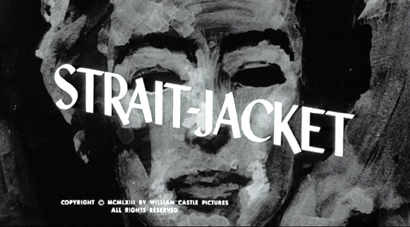
Lucy finds herself carted off to a sanitarium (“Sanitorium,” “It wasn’t a santitarium. It was an ASYLUM. And, it was HELL.” She notes later) in a strait-jacket that does nothing for her figure. Then, we flash forward to the “present” and by “present,” I mean 1964. Lucy is reunited with her daughter on the family farm. Carol wants Lucy to be just as she was and takes her mother for a make-over. They visit a dress shop and a hairdresser who conveniently seems to stock “Joan Crawford Wigs.” That’s when the trouble really begins. The rest of the picture is a wonderful romp which includes a lot of wax heads, some axes, a neatly placed six-pack of Pepsi, Joan Crawford in a slip, some truly ugly statues, a hand-painted car, nervous knitting, some Scotch, and a lot of shouting.
Showman/Producer/Director and all around fun guy, William Castle was rather thrilled with himself when he managed to wrangle a big name star and a big name writer for an upcoming picture. Robert Bloch—who wrote Psycho—agreed to create a similarly grisly tale for Castle and Joan Crawford agreed to star, replacing Joan Blondell who had injured her back. Castle treated Strait-Jacket as an A-Picture and Crawford delivers her performance as if she’s still “Mildred Pierce.” The result is a thoroughly enjoyable film which despite its campier moments is still rather surprising.
I won’t give the plot away, however, it can be shocking if you’ve not seen it before. Crawford really gives it all she’s got, and Diane Baker (Carol) proves she can hold her own with the great Miss Crawford. The cast also includes a sufficiently oily George Kennedy and marks the screen debut of Lee Majors as Lucy’s unfaithful husband.
This clip is one of my favorite scenes from the picture. Here, we see Lucy in her “Joan Crawford Wig” and frighteningly loud dress (can you imagine what color that thing was) meeting Carol’s boyfriend for the first time. She’s a bit overexcited from the one sip of Scotch she’s had and ends up sticking her finger in the boy’s mouth—as one does.
If you’re looking for a wonderfully bizarre film for Halloween, Strait-Jacket is a good choice.
Now let me see... what is it you call your job? Oh, yes. Public relations. Sounds like something pretty dirty to me.
--Charlotte Hollis
In 1964, following the wildly successful pairing of stars Bette Davis and Joan Crawford in Whatever Happened to Baby Jane, Producer/Director Robert Aldrich planned to team the duo in another film based on a another book by Henry Farrell, Whatever Happened to Cousin Charlotte. Davis insisted that the title of the film be changed. She didn’t want audiences to think that the film was a sequel to Whatever Happened to Baby Jane. She suggested, “Hush… Hush, Sweet Charlotte” which was the name of the song which had been composed as the main musical theme of the picture. Aldrich agreed.
A rare publicity shot of
Crawford and Davis
Davis would play Charlotte Hollis—an eccentric Southern recluse who hides in her family’s crumbling Louisiana mansion after being accused of murdering her lover many years earlier. Crawford would play Miriam Deering, Charlotte’s strong-willed cousin who’s come to help Charlotte vacate her home when it is ordered to be torn down.
Joseph Cotten was cast as Dr. Drew Bayliss—a long-time friend of the family. The cast was further completed with Cecil Kellaway as an insurance investigator, Anges Moorehead as Charlotte’s cranky but loyal maid, a young Bruce Dern as Charlotte’s girl-hood lover, Victor Buono as Charlotte’s father, and Mary Astor as Charlotte’s former rival. Davis had specifically asked for Astor to play the role of Jewel Mayhew. Astor was one of the few female stars that Bette Davis actually liked. They had been friends and had worked well together on The Great Lie. When Bette Davis liked you, she really liked you. When she didn’t, she really didn’t.
Shooting began with both Davis and Crawford on location at Houmas House in Darrow Louisiana which would serve as the exteriors for Charlotte’s family home. However, soon, Miss Crawford developed one of her famous “Joan Crawford Colds” and was consistently absent—only appearing for four days of filming. Rumor had it that she couldn’t face working with Bette Davis again. While relations between them had been frosty on “Baby Jane,” they did manage to maintain a somewhat professional attitude. This time, however, Crawford wasn’t cooperating and she withdrew from the picture.
Olivia de Havilland as "Miriam"
Aldrich scrambled to find a suitable star for the second leading part in the film. At one point Vivien Leigh was approached to replace Crawford. Leigh responded, “"No, thank you. I can just about stand looking at Joan Crawford's face at six o'clock in the morning, but not Bette Davis'." Katherine Hepburn didn’t return Aldrich’s calls. Barbara Stanwyck and Loretta Young were also considered for the part of Miriam, but either declined or were deemed unsuitable for the role. The only other actress of that caliber that Bette Davis wanted was her old friend and co-star Olivia de Havilland.
Davis and Moorhead
Aldrich flew to Switzerland and, after much cajoling, convinced de Havilland to accept the part. Later, de Havilland would confess that she really did it as a favor to Bette Davis. She said, “I always thought it would be fun if [Bette and I] could work together. Then, I was offered the chance to work with her on the film that became Hush...Hush, Sweet Charlotte when Joan Crawford withdrew. I knew Bette wanted badly to work, and Jane had been such a success that Bette was quite anxious. They had to find the replacement, and Bette wanted me. The problem was I wasn't as anxious to work as she was. I didn't need to. I wasn't thrilled with the script, and I definitely didn't like my part. I was reverse-typecast, being asked to be an unsympathetic villain. It wasn't what people expected of me. It wasn't really what I wanted to do. Bette wanted it so much, so I did it. I can't say I regretted it, because working with her was special, but I can't say it was a picture I am proud to put on my résumé. Given the choice, I wouldn't have deprived Joan Crawford of the honor."
Mary Astor in her final film role.
On the first day of shooting together, Bette Davis and Olivia de Havilland toasted one another with bottles of Coca Cola—a sly slap-in-the-face to Joan Crawford’s memory. Crawford’s husband, Al Steele was an executive at Pepsi Cola.
The result of their collaboration was an excellent Southern Gothic thriller with plenty of chilling moments despite the obviously fake severed body parts. The three leads deliver excellent performances which are relatively restrained given the material. And, it’s interesting to see Olivia de Havilland in a “bad girl” part. With Halloween around the corner, Hush…Hush, Sweet Charlotte should certainly be on your play-list.
If you enjoy watching Joan Crawford smoke, drink and act amidst the ugliest lamps in film history, then Warner Brother’s stunning 1946 picture, Humoresque is for you.
With a screenplay by Clifford Odets based upon the novel by Fannie Hurst, Humoresque tells the story of a young man (John Garfield) named Paul Boray who dreams of rising above his life above his parents’ grocery store to become a celebrated violinist. Boray gets his chance when his friend, Sid Jeffers (played by the charmingly disturbed Oscar Levant) invites him to go along to a high society party at the home of a wealthy family.
Warner Brothers Pictures
There, Paul meets his hostess, Helen Wright for the first time. Helen is the beautiful and dissatisfied wife of an older wealthy man. She takes an immediate interest in Boray despite taunting him. Soon, Helen begins encouraging Paul’s career and acting as his patron—and more. Paul’s doting mother does not take kindly to his relationship with this married, seemingly-treacherous woman, and makes her opinions known, however Paul is undaunted. Their coupling, of course, has disastrous results. As Paul’s career rises, Helen descends further into her neuroses. In a scene cleverly directed by Jean Negulesco, Helen makes a final decision about her fate.
Warner Brothers Pictures
A character unto itself in this picture, the music speaks for the characters in many instances. Franz Waxman’s original score incorporates some of the most beautiful classical pieces ever written. From Boray’s editorial selection of music which he feels represents Helen to the motif of Dvorak’s Humoresque, the film’s score is as prominent as any of the characters.
This is a film that feeds your senses. In classic Warner Brother’s style, it’s grand, but gritty. Crawford is at her very best and is an excellent match for the powerful John Garfield. If you haven’t seen Humoresque, I’d wholeheartedly recommend it. It will keep you endlessly entertained.