Showing posts with label The British Museum. Show all posts

Monday, June 9, 2014

Mastery of Design: A Seventeenth-Century Diamond and Sapphire Necklace


This and all related images from The British Musuem


There's some debate about where this necklace was made.  It could have come from anywhere, but France, the Netherlands, and England have been speculated.  Nonetheless, it's a safe bet that it dates to the early Seventeenth Century.


The gold necklace is comprised of thirty-five square mounts of gold containing diamonds cut in the form of a truncated pyramid and central pendant of three diamonds and an octagonal sapphire.  The reverses of these links are enameled in black and white while the back of pendant is enameled with a tulip-pattern in red, white and black.


Friday, May 23, 2014

Mastery of Design: The Hull-Grundy Garnet and Pearl Necklace


Garnet and Seed-Pearl Necklace
Circa 1830
The Hull-Grundy Bequest
This and all related images from:
The British Museum


A delicate necklace, designed in the form of leafy entwined flowers, this work of seed-pearls and gold-set diamonds was made in England in the 1830s in the Naturalistic style which was rising in fashion at the time.


Given to The British Museum as part of the Hull-Grundy bequest, the necklace is displayed in its original presentation case though the satin lining of the lid was replaced in the 1970s. 


Tuesday, February 11, 2014

Object of the Day, Museum Edition: The Hull-Grundy Hair Ornament


Hair Ornament
c. 1760
This and all relayed images from The British Musuem


Another jewel from The British Museum's Hull-Grundy Gift, this hair ornament is made in the form of a floral spray with leaves of chased silver and gold settings for the foiled rose-cut diamonds.  Four pear-shaped pendant drop diamonds and two baroque pearls join the four diamond drops.

The ornament was made in Russia, circa 1760 and shows the Eighteenth Century taste for asymmetrical aigrettes in the Rococo fashion.  The style was especially popular in Russia and Italy, adapted from a Spanish style which relied heavily on shimmering pendant drops.  

A brooch set with emeralds from the same time period and place of creation is frequently associated with this hair ornament.  


Tuesday, January 7, 2014

Mastery of Design: A Chased Gold Poodle, c. 1870

Brooch
France, 1870
The British Museum


Made in France, circa 1870, this chased gold brooch takes the form of a handsome poodle.

It's part of the Hull Grundy Bequest to The British Museum.

And, that's really all there is to say about it.  It has nothing to do with anything else I posted today, I just liked it.  Otherwise, I was going for a whole "rebirth" and "innocence" theme for the day.

I'm still recovering from the vile lasts gasps of the illness which gobbled at me at the end of 2013.  However, tomorrow, we will be looking at FOOD, food and more food as we take a look at the Christmas a New Year versions of the "Treat of the Week."  That will be much fun.


Monday, December 16, 2013

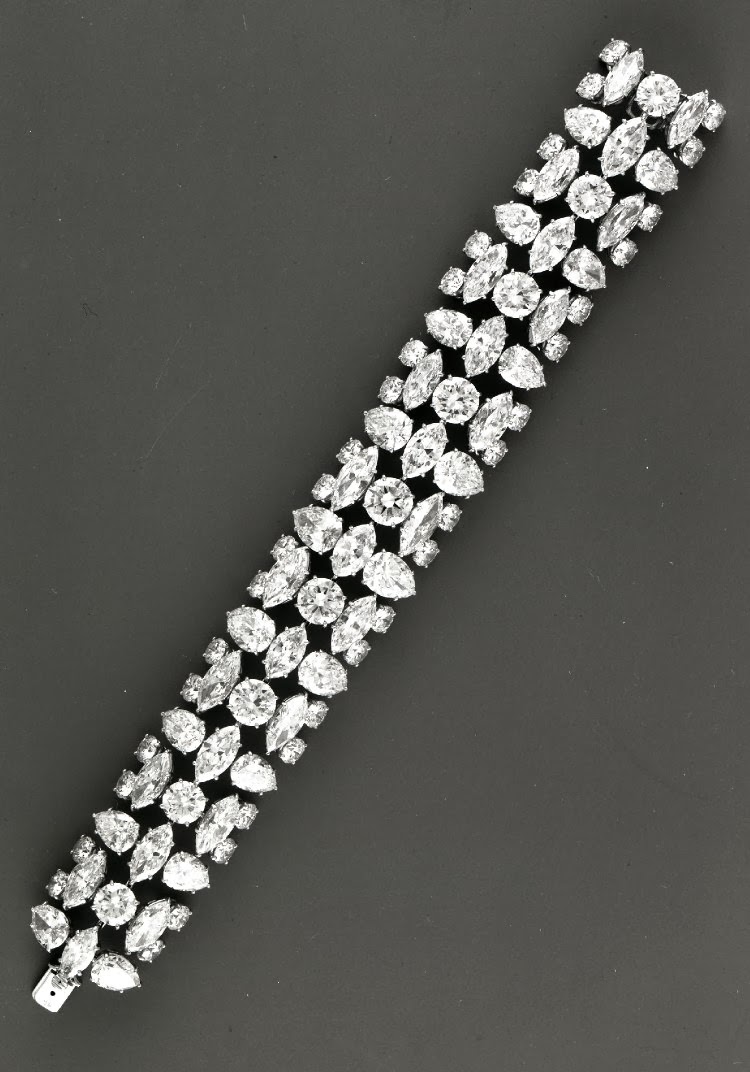
Mastery of Design: A Harry Winston Diamond Bracelet, 1960


All Images from
The British Museum

CLICK IMAGES TO ENLARGE


Designed by the famed Harry Winston for his eponymous house, this extravagant bracelet of diamonds and platinum is set with circular, navette and pear-shaped diamonds, held together by unobtrusive architecture. This preference to let the diamonds take focus instead of the metal mountings was typical of Winston's designs.  The tongue-clasp is constructed of white gold. 


Wednesday, October 30, 2013

Object of the Day, Museum Edition: George Bernard Shaw’s Death Mask


I learned long ago, never to wrestle with a pig. You get dirty, and besides, the pig likes it.
                                            --George Bernard Shaw


You know, George was correct with that.  Nearly fifteen years in education publishing taught me that.  Oinkers!

Speaking of George Bernard Shaw (1856-1950), here's a nice portrait of the Pygmalion from Britain's National Portrait Gallery, a watercolor by Sir John Bernard Partridge ("The five of  us and, mom workin' all day, we knew that we could help her if our music would pay.  Danny got Ruben to sell our song, and it really came together when mom sang along").  

The National Portrait Gallery, Britain

Death mask of George Bernard Shaw, 1950
The British Museum

That's how he looked when he was alive.

And, this is what he looked like when he wasn't!

The practice of making a plaster mask from the face of a corpse is one that is really no longer employed. However, it was considered quite a normal tradition in previous centuries when personal images were rather difficult to come by. In Britain, death masks were often made of both the famous and the infamous as a way of recording their corporeal presence at the very last minute.


Despite being a supporter of Hitler, celebrated writer George Bernard Shaw had a profound effect on both British and world literature. It served to reason that his last countenance should have been preserved. And, so, here he remains today—his jaw loosened by death and his eyes closed in permanent sleep. Happy pre-Hallow-ma-ween.

Let's look at some other fun Shaw quotes which I find to be true.  If it weren't for that whole, Hitler thing, I'd be totally on board.


There is no sincerer love than the love of food.


If you cannot get rid of the family skeleton, you may as well make it dance.


Without art, the crudeness of reality would make the world unbearable.


No man ever believes that the Bible means what it says: He is always convinced that it says what he means.


Friday, October 18, 2013

Mastery of Design: The Hull-Grundy Coral and Ruby Dove Earrings

The British Museum


Made in England in the 1830s, this pair of earrings is hung with coral drops.  A setting of bloomed-gold leaves is surmounted by doves with ruby-set eyes.  The 1830s saw a rising taste for Naturalistic jewelry, not only designs of flowers, fungus and foliage, but also birds, insects and animals.  While real preserved animals were also employed, most wearers preferred golden representations to taxidermy.

These earrings are part of the Hull-Grundy Gift to the British Museum.


Tuesday, October 15, 2013

Mastery of Design: The Night Cameo, 1820-1830

"Night"
Italy, 1820-1830
The British Museum


Carved in pale malachite, this gold-framed cameo is carved with the image of a winged woman, "Night," cradling two sleeping children.

This 1820 to 1830 composition is inspired by the marble relief by Bertel Thorwaldsen which was finished in 1815 during the famed sculptors stay in Rome.  The original relief is now in the Thorwaldsen Museum, Copenhagen. 

A cast of the circular gem was cut by Italian jeweler Luigi Pichler after Thorwaldsen's relief and remained a popular motif throughout the Nineteenth Century.

This brooch is one of the many fabulous jewels which were bequeathed to The British Museum as part of the Hull-Grundy Gift.


Friday, October 4, 2013

Mastery of Design: The Hull-Grundy Garnet and Pearl Necklace


Garnet and Seed-Pearl Necklace
Circa 1830
The Hull-Grundy Bequest
This and all related images from:
The British Museum


A delicate necklace, designed in the form of leafy entwined flowers, this work of seed-pearls and gold-set diamonds was made in England in the 1830s in the Naturalistic style which was rising in fashion at the time.


Given to The British Museum as part of the Hull-Grundy bequest, the necklace is displayed in its original presentation case though the satin lining of the lid was replaced in the 1970s.


Wednesday, August 21, 2013

Mastery of Design: A Seventeenth-Century Diamond and Sapphire Necklace

This and all related images from The British Musuem


There's some debate about where this necklace was made.  It could have come from anywhere, but France, the Netherlands, and England have been speculated.  Nonetheless, it's a safe bet that it dates to the early Seventeenth Century.

The gold necklace is comprised of thirty-five square mounts of gold containing diamonds cut in the form of a truncated pyramid and central pendant of three diamonds and an octagonal sapphire.  The reverses of these links are enameled in black and white while the back of pendant is enameled with a tulip-pattern in red, white and black.


Friday, August 16, 2013

Mastery of Design: The Hull-Grundy Hair Ornament

Hair Ornament
c. 1760
This and all relayed images from The British Musuem


Another jewel from The British Museum's Hull-Grundy Gift, this hair ornament is made in the form of a floral spray with leaves of chased silver and gold settings for the foiled rose-cut diamonds.  Four pear-shaped pendant drop diamonds and two baroque pearls join the four diamond drops.

The ornament was made in Russia, circa 1760 and shows the Eighteenth Century taste for asymmetrical aigrettes in the Rococo fashion.  The style was especially popular in Russia and Italy, adapted from a Spanish style which relied heavily on shimmering pendant drops.  

A brooch set with emeralds from the same time period and place of creation is frequently associated with this hair ornament.