Showing posts with label Jacques Callot. Show all posts

Friday, October 4, 2013

Object of the Day, Museum Edition: The Callot Pulcinella Dwarf, 19th C.


Figurine of a Dwarf
French, Nineteenth Century
Based on an engraving by Jacques Callot
The Victoria & Albert Museum


On Tuesday, we looked at one of a series of figurines which were produced in France in the Nineteenth Century and were modeled after images created by Jacques Callot (1592-1635) who was artistically inspired by a troupe of “grotesque” dwarf entertainers known as “Les Gobbi.”

Callot’s other great interest was the Italian tradition of the Commedia dell’Arte. Since Les Gobbi incorporated many facets of the Commedia into their act, the troupe was of great appeal to Callot who was fascinated by their costumes and their melodramatic antics.

This figure of multi-colored, glazed porcelain depicts one of Callot’s drawings of a member of “Les Gobbi.” This little fellow, a masked dwarf musician plucking a violin, is clearly based on the Commedia dell’Arte stock character, Puclinella, who, as we know, is Mr. Punch’s Italian ancestor. The dwarf wears a wee black Pulcinella mask and affects some of the grotesque features which we’ve come to associate with our Old Red Nose. That’s the way to do it.

And, don’t worry. It’s not another day devoted to dwarf-related are. It’s Friday, so it’s a Mr. Punch day! Let’s carry on. Shall we?


Friday, March 1, 2013

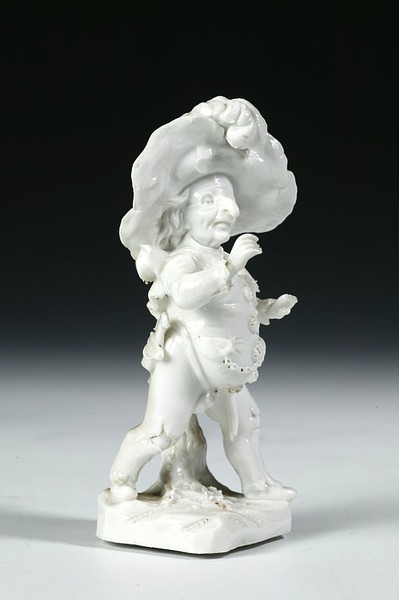
Figure of the Day: The Callot Dwarf, 19th C.


Porcelain Figurine
French, 19th C.
The Victoria & Albert Museum


The work of an unknown modeler at an unknown factory, this figurine is one of a series which was produced in Nineteenth-Century France , modeled after engravings by the artist Jacques Callot (1592-1635). The engravings were printed in 1622 and depicted a troupe of grotesque dwarf entertainers who were known as “Les Gobbi.”

“Les Gobbi” famously performed in Italy for the Medici Court during the period in which Callot was working as a court artist for the powerful family. His task was, essentially, recording court entertainment. Such novelty acts were quite popular throughout Europe at the time and few were as sought-after as “Les Gobbi.” French-born Callot studied art and printmaking in Florence, Italy where he was discovered by the Medicis who instantly recognized his talent and offered their patronage. During his stay with the Medicis, Callot developed a reputation as a master of capturing expressions and for his distinct ability to create scenes of both great joy and grotesquerie. Upon the death of Cosimo Medici, Callot returned to his native France where he embarked on an ambitious series of engravings depicting the tradition of the Commedia dell’Arte.

In the Nineteenth Century, Callot’s work was rediscovered and became the inspiration for many figurines ranging from his representations of Commedia dell’Arte figures to these comic dwarves.   This white porcelain figure shows the Italian influence on the costumes of "Les Gobbi" who modeled their masks and garments after the Commedia characters.  This particular, little fellow has a distinct resemblance to Pulcinella.  


Friday, August 3, 2012

Object of the Day, Museum Edition: The Callot Pulcinella Dwarf, 19th C.

Figurine of a Dwarf
French, Nineteenth Century
Based on an engraving by Jacques Callot
The Victoria & Albert Museum


On Tuesday, we looked at one of a series of figurines which were produced in France in the Nineteenth Century and were modeled after images created by Jacques Callot (1592-1635) who was artistically inspired by a troupe of “grotesque” dwarf entertainers known as “Les Gobbi.”

Callot’s other great interest was the Italian tradition of the Commedia dell’Arte. Since Les Gobbi incorporated many facets of the Commedia into their act, the troupe was of great appeal to Callot who was fascinated by their costumes and their melodramatic antics.

This figure of multi-colored, glazed porcelain depicts one of Callot’s drawings of a member of “Les Gobbi.” This little fellow, a masked dwarf musician plucking a violin, is clearly based on the Commedia dell’Arte stock character, Puclinella, who, as we know, is Mr. Punch’s Italian ancestor. The dwarf wears a wee black Pulcinella mask and affects some of the grotesque features which we’ve come to associate with our Old Red Nose. That’s the way to do it.

And, don’t worry. It’s not another day devoted to dwarf-related are. It’s Friday, so it’s a Mr. Punch day! Let’s carry on. Shall we?


Tuesday, July 31, 2012

Figure of the Day: The Callot Dwarf, 19th C.

Porcelain Figurine
French, 19th C.
The Victoria & Albert Museum


The work of an unknown modeler at an unknown factory, this figurine is one of a series which was produced in Nineteenth-Century France , modeled after engravings by the artist Jacques Callot (1592-1635). The engravings were printed in 1622 and depicted a troupe of grotesque dwarf entertainers who were known as “Les Gobbi.”

“Les Gobbi” famously performed in Italy for the Medici Court during the period in which Callot was working as a court artist for the powerful family. His task was, essentially, recording court entertainment. Such novelty acts were quite popular throughout Europe at the time and few were as sought-after as “Les Gobbi.” French-born Callot studied art and printmaking in Florence, Italy where he was discovered by the Medicis who instantly recognized his talent and offered their patronage. During his stay with the Medicis, Callot developed a reputation as a master of capturing expressions and for his distinct ability to create scenes of both great joy and grotesquerie. Upon the death of Cosimo Medici, Callot returned to his native France where he embarked on an ambitious series of engravings depicting the tradition of the Commedia dell’Arte.

In the Nineteenth Century, Callot’s work was rediscovered and became the inspiration for many figurines ranging from his representations of Commedia dell’Arte figures to these comic dwarves.   This white porcelain figure shows the Italian influence on the costumes of "Les Gobbi" who modeled their masks and garments after the Commedia characters.  This particular, little fellow has a distinct resemblance to Pulcinella.