Showing posts with label etching. Show all posts

Thursday, May 15, 2014

Drawing of the Day: Five Grotesque Heads, 1646


Five Grotesque Heads
Wenceslaus Hollar
England, 1646
Crown Copyright
The Royal Collection 
Image Courtesy of Her Majesty Queen Elizabeth II


Born in Prague, Bohemian etcher Wenceslaus Hollar (1607-1677) spent much of his life in England. There, he attracted the attention of wealthy patrons and noblemen, including Thomas Howard 21st Earl of Arundel and the Royal Court. During the English Civil War, his income naturally suffered, but he created some of the most gripping records of the war.

This study by Hollar shows his penchant for the theatrical and grotesque. Created in 1646, the original drawing for the published etching depicts of five men. An older man who is clean-shaven is crowned with a wreath of oak leaves. Another man has his head tilted back and opens his mouth in a horrid yawn. A bald man is seen in the lower background. On the right, a laughing man is depicted and the composition is balanced by the profile of a man with a headband.

This sort of grotesquerie was quite in vogue in the early Seventeenth Century. Grotesque figures were the subjects of many a medium from porcelain to architecture. Hollar shows us his masterful hand and ability to show both motion and emotion while also satiating the taste for the horrible which was prevalent in arts of the era.


Tuesday, April 8, 2014

Print of the Day: The Balloon from the Gardens of the Mermaid Theatre, 19th C.


The Victoria & Albert Museum


I just adore this. I’ve always had a deep appreciation for hot air balloons. In fact, I live in an area where they are often overhead and I always, for some reason, believe that catching a glimpse of one is good luck. So, let’s all have some good luck today as we appreciate this image.

This hand-colored etching is entitled “A View of the Balloon of Mr. Sadler's ascending with him and Captain Paget of the Royal Navy from the Gardens of the Mermaid Theatre at Hackney on Monday Aug 12 1811.” Not a title that just rolls off of the tongue, but it is, indeed, very specific.

This print from the V&A’s Harry Beard Collection, was published in Britain in the early Nineteenth Century. It has been expertly brightened with watercolor. The scene depicted here is one of a number of experiments in ballooning performed by James Sadler in 1811. Sadler, in 1784, was the second person in Britain to accomplish an ascent in a balloon. Throughout his life he continued to experiment with flight.


Friday, February 14, 2014

Valentine of the Day: May Our Affections Repose into Joy, c. 1840


May our affections repose into joy

And disappointment ne’er our hopes destroy.

The above motto graces this Valentine card of watercolor over lithography, paper lace, and fabrix appliqué. The card was made between 1840 and 1880 and it was donated to the V&A in 1953 along with other cards collected by Guy Tristram Little.

The work of an unknown artist and publisher, the card depicts a couple embracing in a garden of irises. 


Valentine Card, 1840-80
The Victoria & Albert Museum

Sunday, February 2, 2014

Print of the Day: The Three Graces; or the three Bums !!of the O!P!ra, 1810


Click image to get bummed

"Three Graces; or the Three Bums !!of the O!P!ra."
Unknown, 1810
The Beard Collection at
The Victoria & Albert Museum


To be honest, I’ve looked and looked, and can find little explanation as to the meaning of this print. Obviously, it’s a political or social commentary. It’s long associated with similar works by Isaac Cruikshank (ancestor of George) and is often included in published groupings with other satirical drawings of 1790-1810, most of them addressing spies and the foibles of the upper class and those termed macaroni.

Entitled “Three Graces; or the three Bums !!of the O!P!ra,” the etching is hand colored with watercolor and dates 15th February 1810. The publisher is listed as D.C.M. (1700-1900).


Friday, January 31, 2014

Print of the Day: Pulcinella in Rome, 1815


Click image to enlargePulcinella in Rome
Bartolomeo Pinelli, 1815
The Harry Beard Collection at
The Victoria & Albert Museum


From the Harry Beard Collection at the V&A, here’s an etching of a Pulcinella Show (Mr. Punch’s Italian ancestor) being performed in Rome.

The etching was made in 1815 after a painting by Bartolomeo Pinelli (1781-1835). Pulcinella wears his traditional white robe and cap and his black half-mask. Like Mr. Punch, Pulcinella is often armed with a large stick, truncheon or cudgel which he uses to dispatch those who might prevent him from achieving his random goals.

Also interesting is the depiction of the crowd watching the show. Pulcinella, again, like Punch, is the great communicator—attracting people from all corners of life. Here, we see monks curious children, a maid, a gentleman, a middle-class mother and child, and, even a rake smoking a pipe.


Tuesday, January 7, 2014

Object of the Day, Museum Edition: "A Lump of Innocence," 1809

"A Lump of Innocence"
Crown Copyright
The Royal Collection
via The Royal Collection Trust
Image Courtesy of Her Majesty Queen Elizabeth II


Really, Gentlemen, if you gaze upon me in this manner you will put me quite to the blush!"


Properly entitled, "A Lump of Innocence," this hand-colored etching by the celebrated Thomas Rowlandson (1757-1827) is dated 30 Sep 1809.  Depicting a rather amply-proportioned woman, the print shows the central figure coyly looking down as she asserts her innocence in any flirtations which might have arisen around her.  Her attire and the objects around her bely her proclamation. She wears gaudy, flashy jewellery and a golden headband,  Meanwhile, she holds a glass of brandy in her right hand as a bottle of brandy stands on the table to her right. Clearly, she has meant to attract a bit of attention.

The print is inscribed in the plate:

109 / Woodward Del. / Price One Shilling coloured / Rowlandson fe / London Pubd/ September 30th 1809 by Thos Tegg No.111 Cheapside

Friday, May 10, 2013

Object of the Day, Museum Edition: The "Munched Tobacco" Punch and Judy


Hand-colored Etching, Nineteenth Century.
Ink Inscription, 1956.
The George Speaight Punch & Judy Archive
The Victoria & Albert Museum


Well, it’s Friday, and you know what that means—Punch and Judy stuff, especially since yesterday was Punch's 351st birthday.

I like this particular image from a late Nineteenth Century British Print and wish that I could see the reverse of the piece. You see, the image features two motto-like jokes which will forever be unanswered.

The illustration shows Judy (left) and Punch (right).

Under Judy, the text reads: “If the ruins of the Tower of London could speak, what King and Rebel would they name?”

And, under Mr. Punch: “If a piece of munched tobacco could speak, what old English poet would it name?”

Since we don’t have access to the original answers, I’ll let you decide what they should be.  Feel free to post your guesses in the comments section. 

The print is of black ink on paper, loosely washed with watercolor. Mr. Punch and his lovely bride are depicted in a jubilant dance with a glass of wine and tankard of ale.

Above them, written in ink is a personal message—perhaps to George Speaight who amassed the V&A’s exceptional collection of Punch and Judy ephemera. I can’t quite make it out, but I think it reads, “Amazing times. Happy New Year. Alfred Kirby, 1956” and may be a message to the collector when the print was given as a gift, almost one hundred years after it was made.

The curators of the V&A have felt it necessary to note, “Punch is shown to have extreme, exaggerated form of kyphosis and sternal protrusion.” Meaning that our Mr. Punch has a wicked hunchback and big ol’ belly. Well, duh. That’s what makes him Mr. Punch. Curiously, no mention is made of Old Red Nose’s large proboscis and chin nor his wife’s similar facial characteristics. I guess that’s, “normal.”


Friday, March 1, 2013

Object of the Day, Museum Edition: Pulcinella in Rome, 1815


Click image to enlarge
Pulcinella in Rome
Bartolomeo Pinelli, 1815
The Harry Beard Collection at
The Victoria & Albert Museum


From the Harry Beard Collection at the V&A, here’s an etching of a Pulcinella Show (Mr. Punch’s Italian ancestor) being performed in Rome.

The etching was made in 1815 after a painting by Bartolomeo Pinelli (1781-1835). Pulcinella wears his traditional white robe and cap and his black half-mask. Like Mr. Punch, Pulcinella is often armed with a large stick, truncheon or cudgel which he uses to dispatch those who might prevent him from achieving his random goals.

Also interesting is the depiction of the crowd watching the show. Pulcinella, again, like Punch, is the great communicator—attracting people from all corners of life. Here, we see monks curious children, a maid, a gentleman, a middle-class mother and child, and, even a rake smoking a pipe.


Thursday, February 28, 2013

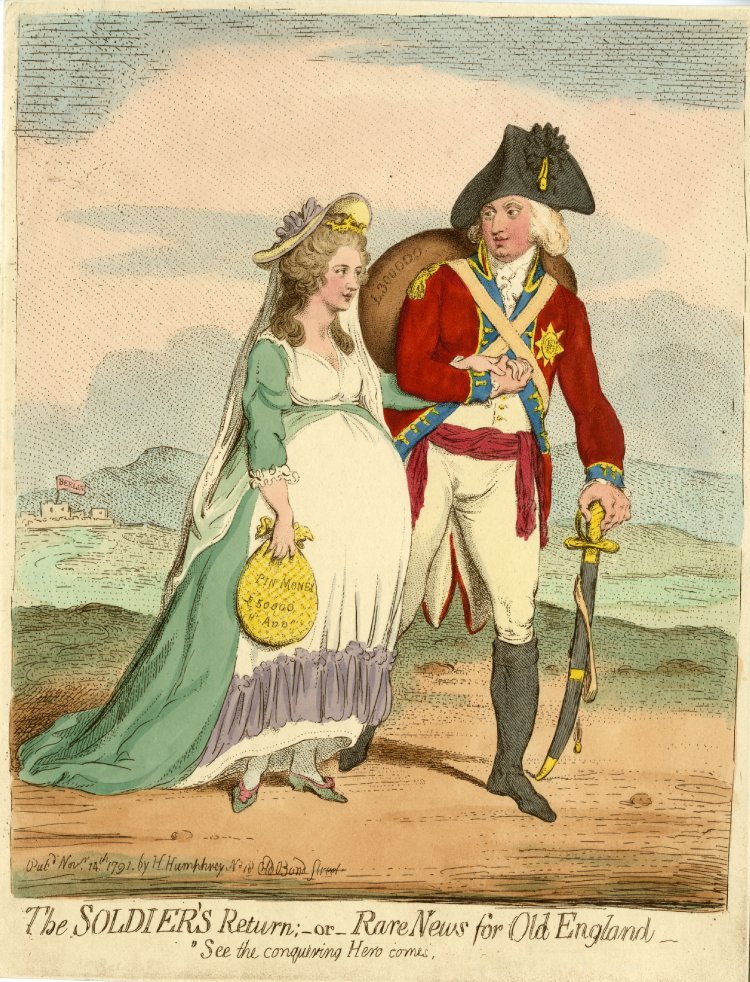
Object of the Day, Museum Edition: The Soldier's Return, 1791


The grand old Duke of York, 

He had ten thousand men. 
He marched them up to the top of the hill 
And he marched them down again. 
And when they were up, they were up. 
And when they were down, they were down. 
And when they were only halfway up, 
They were neither up nor down. 

--Popular Rhyme of 1793, pillorying the Duke of York following the Flanders* Campaign
(*"Stupid Flanders"--H. Simpson)


"The Soldier's Return"
James Gillray and H. Humphrey, 1791
The Victoria & Albert Museum

Entitled “The Soldier's Return;” or “Rare News for Old England,” this hand-colored etching depicts Frederick, Duke of York. Prince Frederick, Duke of York and Albany, Earl of Ulster was the second son of King George III and Queen Charlotte. He was, curiously, at 196 days old named Prince-Bishopric of Osnabrück, making him, to this date, the youngest bishop in history.

Like his brother, the future King George IV, Frederick enjoyed a rather debauched life. And, like his brother (who married the future Queen Caroline with whom he had a strained and bizarre relationship) suffered through a less-than-successful marriage. Prince Frederick remained a relatively popular figure, making a strong impression on the population of Britain with his military work. His reputation, however, suffered two years after his marriage upon the unsuccessful Flanders Campaign. The subtitle reads: “See the Conquering Hero Comes.”

This scene might show Prince Frederick returning from Hanover to meet his cousin/bride Frederica Charlotte of Prussia whom he married in 1791. The print was published in London by H. Humphrey on “14th November 1791.” We should note that the Duke of York married his cousin twice—once on 29 September 1791 at Charlottenburg, Berlin, and again on 23 November 1791 at Buckingham Palace. This scene probably shows the Duke meeting his bride before their second marriage. Something curious about this, however, is that the new princess is clearly pregnant in this picture. The Duke and Duchess had no children together, however, he did sire many illegitimate children (keeping the family tradition of the time alive) with a slew of women all over Britain and Hanover. The depicted pregnancy was more wishful-thinking than anything else since all expected them to procreate. Furthermore, the image is intended to show not only the prince’s virility, but also the longevity of the Royal Family.

This, however, is not as much of a loving tribute as it is a satire. We see here, the Duke of York and his bride walking arm in arm, in the manner of a tramping soldier and his wife. But, there’s more to it than just that. Let’s look more closely. A large bundle on the prince’s back is inscribed “L. 300000.” This refers to the dowry that the Duke received upon his marriage. The dowry from the girl’s father, Crown Prince Frederick William of Prussia, which amounted to only £13,000, was absolutely nothing in comparison with the Duke's debts. Meanwhile, the falsely pregnant princess carries a large money-bag reading: “Pin Money £50000 Pr Annm,” a reference to their controversial yearly allowance. Behind them, at the left, in the distance is a castle with a flag inscribed “Berlin”—a reference to Charlottenburg Palace, the place of their first, German, wedding. The Duke wears regimentals with his star; the Duchess wears a simple straw hat—denoting the idea that she was of humbler, if not still Royal, birth. However, this hat is tilted back to show a tiara, an obvious reference to her past and future great expectations.

Within the pattern of the ground, we can make out: “Pubd Novr 14th 1791. by H Humphrey No 18 Old Bond Street.”

Here’s another image that I know I’ve seen before, but not at the V&A. And, so, I’ve gone on a hunt to figure out where I’ve seen it. The listing for this piece in the V&A tells us nothing except it depicts the Duke of York in 1791—no more. So, I’ve been doing quite a bit of research on this one.

Another version of the same etching by James Gillray lives at the British Museum. I’m fairly certain that’s where I saw it. The British Museum’s example differs slightly since these were hand-colored. See below.

Whew! That’s enough digging into that for now.

The version from the British Museum

Friday, January 4, 2013

Print of the Day: An Etched Frontispiece from Mr. Punch's Pocketbook, 1872

Click image to enlarge

Frontispiece from "Mr. Punch's Pocketbook"
Charles Keene, 1872
The British Museum


Next Friday, you’ll be seeing another of my Christmas gifts—“Mr. Punch’s Pocketbook” from 1860. So, I thought this week, I’d show you a later example of this pocket-sized almanac to give you a sense of the object. “Mr. Punch’s Pocketbook” was the iPad mini of the Nineteenth Century. It contained everything a gentleman traveling by train could ever need from the names of the Royal Family to the cost of postage. It even was filled with beautiful illustrations, stories, jokes and articles which would keep a gent entertained.

So, today, let’s look at this one from 1872. This example lives at the British Museum. All of Mr. Punch’s Pocketbooks included a frontispiece which unfolded into a trifold scene. In this case, we have an illustration by Charles Keene (1823-1872) which depicts “A Matrimonial Hurlingham” This was a pigeon-shooting match wherein eligible bachelors are the pigeons, and the young ladies shoot. Fair enough. Cupid is assisting the ladies, waiting nearby on the right with a string in his hand to deploy a trap.

Even in 1872, each of this lovely frontispieces was hand-colored with watercolor and touched with white gouache.

I look forward to sharing my own 1860 Pocketbook to you next week. I just have to figure out how best to reproduce it without harming it.


Monday, November 26, 2012

Print of the Day: Feasting in the Saloon, 1820s

Feasting in the Saloon
Theodore Lane for Thomas McLean
The Victoria & Albert Museum


Dating to the 1820s, this print from London is entitled “Feasting in the Saloon.” It’s one of a series of prints published by Thomas McLean which was entitled “Theatrical Pleasures.” While we’re not sure of the original artist of the image printed in this hand-colored etching, historians believe it was possible Theodore Lane. 


Tuesday, November 6, 2012

Drawing of the Day: Five Grotesque Heads, 1646

Five Grotesque Heads
Wenceslaus Hollar
England, 1646
Crown Copyright
The Royal Collection
Image Courtesy of Her Majesty Queen Elizabeth II


Born in Prague, Bohemian etcher Wenceslaus Hollar (1607-1677) spent much of his life in England. There, he attracted the attention of wealthy patrons and noblemen, including Thomas Howard 21st Earl of Arundel and the Royal Court. During the English Civil War, his income naturally suffered, but he created some of the most gripping records of the war.

This study by Hollar shows his penchant for the theatrical and grotesque. Created in 1646, the original drawing for the published etching depicts of five men. An older man who is clean-shaven is crowned with a wreath of oak leaves. Another man has his head tilted back and opens his mouth in a horrid yawn. A bald man is seen in the lower background. On the right, a laughing man is depicted and the composition is balanced by the profile of a man with a headband.

This sort of grotesquerie was quite in vogue in the early Seventeenth Century. Grotesque figures were the subjects of many a medium from porcelain to architecture. Hollar shows us his masterful hand and ability to show both motion and emotion while also satiating the taste for the horrible which was prevalent in arts of the era.


Tuesday, October 2, 2012

Print of the Day: The Three Graces; or the three Bums !!of the O!P!ra, 1810

Click image to get bummed

"Three Graces; or the Three Bums !!of the O!P!ra."
Unknown, 1810
The Beard Collection at
The Victoria & Albert Museum


To be honest, I’ve looked and looked, and can find little explanation as to the meaning of this print. Obviously, it’s a political or social commentary. It’s long associated with similar works by Isaac Cruikshank (ancestor of George) and is often included in published groupings with other satirical drawings of 1790-1810, most of them addressing spies and the foibles of the upper class and those termed macaroni.

Entitled “Three Graces; or the three Bums !!of the O!P!ra,” the etching is hand colored with watercolor and dates 15th February 1810. The publisher is listed as D.C.M. (1700-1900).


Friday, August 31, 2012

Antique Image of the Day: Les Etrennes du Bébé, 1865

Click image to enlarge.
Gifts for a Baby
A. Queyror, 1865
The Victoria & Albert Museum


Created in 1865, this illustration is entitled “Les Etrennes du Bébé “or “Gifts for a Baby.” Etchings of the print were published in Paris by Cadart & Luquet. Essentially an inventory of toys, I selected this image by A. Queyroy because of the very obvious figure of Mr. Punch along with a toy theatre, a drum, a rabbit and a horse.


Friday, June 15, 2012

Print of the Day: Pulcinella in Rome, 1815

Click image to enlargePulcinella in Rome
Bartolomeo Pinelli, 1815
The Harry Beard Collection at
The Victoria & Albert Museum


From the Harry Beard Collection at the V&A, here’s an etching of a Pulcinella Show (Mr. Punch’s Italian ancestor) being performed in Rome.

The etching was made in 1815 after a painting by Bartolomeo Pinelli (1781-1835). Pulcinella wears his traditional white robe and cap and his black half-mask. Like Mr. Punch, Pulcinella is often armed with a large stick, truncheon or cudgel which he uses to dispatch those who might prevent him from achieving his random goals.

Also interesting is the depiction of the crowd watching the show. Pulcinella, again, like Punch, is the great communicator—attracting people from all corners of life. Here, we see monks curious children, a maid, a gentleman, a middle-class mother and child, and, even a rake smoking a pipe.


Friday, May 18, 2012

Antique Image of the Day: Pray remember the Puppet Shew Man, 19th C.


Pray Remember the Puppet Shew Man
Nineteenth Century
George Speaight Archive
The Victoria & Albert Museum


This Nineteenth Century, hand-etching is inscribed “Pray remember the Puppet Shew Man (sic.) and depicts, fittingly, a crowd at a puppet show as the bottler (money collector) works his way through the crowd.

The caricature-style image is meant to reinforce the roughness of the characters and the inscription is written in common London-street parlance of the Nineteenth Century. 

And, that, frankly, is all we know.  It’s not signed nor has it been attributed to anyone, and, frankly, the date of creation is difficult to pin down.  However, it’s a fine image which very neatly serves its purpose.  It lives in the George Speaight Archive at the V&A.


Friday, May 11, 2012

Antique Image of the Day: Four Punchinellos, 1751


Four Punchinellos
Giovanni Battista Tiepolo
1751
The Harry Beard Collection
The Victoria & Albert Museum


Earlier today, we looked at a scene of three Punchinellos.  Now, from the same artist, the same engraver and the same year, we look at the next in the series—four Punchinellos.


Perhaps this one precedes, in story, the scene we saw this morning (see the bottom of the page) wherein two Punchs were stealing the lunch of another Punchinello.  Perhaps not, since Punchs like to eat.  Nevertheless, we see here four Punchinellos cooking. Three of them have  gathered around a pot which is boiling on an open fire. The final figure is--facing away from the others—stands next to a metal jug. I wonder what he’s up to.


In the background, we can pick out a ruined building with a shadowy figure inside.   It’s a delightfully odd picture.  


Also from the Harry Beard Collection, this, too, is the work of Giovanni Battista Tiepolo.

Friday, February 10, 2012

Valentine of the Day: May Our Affections Repose into Joy, c. 1840

May our affections repose into joy
And disappointment ne’er our hopes destroy.

The above motto graces this Valentine card of watercolor over lithography, paper lace, and fabrix appliqué. The card was made between 1840 and 1880 and it was donated to the V&A in 1953 along with other cards collected by Guy Tristram Little.

The work of an unknown artist and publisher, the card depicts a couple embracing in a garden of irises.


Valentine Card, 1840-80
The Victoria & Albert Museum

Object of the Day, Museum Edition: The "Munched Tobacco" Punch and Judy

Hand-colored Etching, Nineteenth Century.
Ink Inscription, 1956.
The George Speaight Punch & Judy Archive
The Victoria & Albert Museum


Well, it’s Friday, and you know what that means—Punch and Judy stuff.

I like this particular image from a late Nineteenth Century British Print and wish that I could see the reverse of the piece. You see, the image features two motto-like jokes which will forever be unanswered.

The illustration shows Judy (left) and Punch (right).

Under Judy, the text reads: “If the ruins of the Tower of London could speak, what King and Rebel would they name?”

And, under Mr. Punch: “If a piece of munched tobacco could speak, what old English poet would it name?”

Since we don’t have access to the original answers, I’ll let you decide what they should be.  Feel free to post your guesses in the comments section. 

The print is of black ink on paper, loosely washed with watercolor. Mr. Punch and his lovely bride are depicted in a jubilant dance with a glass of wine and tankard of ale.

Above them, written in ink is a personal message—perhaps to George Speaight who amassed the V&A’s exceptional collection of Punch and Judy ephemera. I can’t quite make it out, but I think it reads, “Amazing times. Happy New Year. Alfred Kirby, 1956” and may be a message to the collector when the print was given as a gift, almost one hundred years after it was made.

The curators of the V&A have felt it necessary to note, “Punch is shown to have extreme, exaggerated form of kyphosis and sternal protrusion.” Meaning that our Mr. Punch has a wicked hunchback and big ol’ belly. Well, duh. That’s what makes him Mr. Punch. Curiously, no mention is made of Old Red Nose’s large proboscis and chin nor his wife’s similar facial characteristics. I guess that’s, “normal.”

Tuesday, February 7, 2012

Object of the Day, Museum Edition: The Soldier's Return, 1791

The grand old Duke of York,
He had ten thousand men.
He marched them up to the top of the hill
And he marched them down again.
And when they were up, they were up.
And when they were down, they were down.
And when they were only halfway up,
They were neither up nor down.


--Popular Rhyme of 1793, pillorying the Duke of York following the Flanders Campaign
("Stupid Flanders"--H. Simpson)


"The Soldier's Return"
James Gillray and H. Humphrey, 1791
The Victoria & Albert Museum

Entitled “The Soldier's Return;” or “Rare News for Old England,” this hand-colored etching depicts Frederick, Duke of York. Prince Frederick, Duke of York and Albany, Earl of Ulster was the second son of King George III and Queen Charlotte. He was, curiously, at 196 days old named Prince-Bishopric of Osnabrück, making him, to this date, the youngest bishop in history.

Like his brother, the future King George IV, Frederick enjoyed a rather debauched life. And, like his brother (who married the future Queen Caroline with whom he had a strained and bizarre relationship) suffered through a less-than-successful marriage. Prince Frederick remained a relatively popular figure, making a strong impression on the population of Britain with his military work. His reputation, however, suffered two years after his marriage upon the unsuccessful Flanders Campaign. The subtitle reads: “See the Conquering Hero Comes.”

This scene might show Prince Frederick returning from Hanover to meet his cousin/bride Frederica Charlotte of Prussia whom he married in 1791. The print was published in London by H. Humphrey on “14th November 1791.” We should note that the Duke of York married his cousin twice—once on 29 September 1791 at Charlottenburg, Berlin, and again on 23 November 1791 at Buckingham Palace. This scene probably shows the Duke meeting his bride before their second marriage. Something curious about this, however, is that the new princess is clearly pregnant in this picture. The Duke and Duchess had no children together, however, he did sire many illegitimate children (keeping the family tradition of the time alive) with a slew of women all over Britain and Hanover. The depicted pregnancy was more wishful-thinking than anything else since all expected them to procreate. Furthermore, the image is intended to show not only the prince’s virility, but also the longevity of the Royal Family.

This, however, is not as much of a loving tribute as it is a satire. We see here, the Duke of York and his bride walking arm in arm, in the manner of a tramping soldier and his wife. But, there’s more to it than just that. Let’s look more closely. A large bundle on the prince’s back is inscribed “L. 300000.” This refers to the dowry that the Duke received upon his marriage. The dowry from the girl’s father, Crown Prince Frederick William of Prussia, which amounted to only £13,000, was absolutely nothing in comparison with the Duke's debts. Meanwhile, the falsely pregnant princess carries a large money-bag reading: “Pin Money £50000 Pr Annm,” a reference to their controversial yearly allowance. Behind them, at the left, in the distance is a castle with a flag inscribed “Berlin”—a reference to Charlottenburg Palace, the place of their first, German, wedding. The Duke wears regimentals with his star; the Duchess wears a simple straw hat—denoting the idea that she was of humbler, if not still Royal, birth. However, this hat is tilted back to show a tiara, an obvious reference to her past and future great expectations.

Within the pattern of the ground, we can make out: “Pubd Novr 14th 1791. by H Humphrey No 18 Old Bond Street.”

Here’s another image that I know I’ve seen before, but not at the V&A. And, so, I’ve gone on a hunt to figure out where I’ve seen it. The listing for this piece in the V&A tells us nothing except it depicts the Duke of York in 1791—no more. So, I’ve been doing quite a bit of research on this one.

Another version of the same etching by James Gillray lives at the British Museum. I’m fairly certain that’s where I saw it. The British Museum’s example differs slightly since these were hand-colored. See below.

Whew! That’s enough digging into that for now.

The version from the British Museum