Showing posts with label hand colored. Show all posts

Tuesday, January 7, 2014

Object of the Day, Museum Edition: "A Lump of Innocence," 1809

"A Lump of Innocence"
Crown Copyright
The Royal Collection
via The Royal Collection Trust
Image Courtesy of Her Majesty Queen Elizabeth II


Really, Gentlemen, if you gaze upon me in this manner you will put me quite to the blush!"


Properly entitled, "A Lump of Innocence," this hand-colored etching by the celebrated Thomas Rowlandson (1757-1827) is dated 30 Sep 1809.  Depicting a rather amply-proportioned woman, the print shows the central figure coyly looking down as she asserts her innocence in any flirtations which might have arisen around her.  Her attire and the objects around her bely her proclamation. She wears gaudy, flashy jewellery and a golden headband,  Meanwhile, she holds a glass of brandy in her right hand as a bottle of brandy stands on the table to her right. Clearly, she has meant to attract a bit of attention.

The print is inscribed in the plate:

109 / Woodward Del. / Price One Shilling coloured / Rowlandson fe / London Pubd/ September 30th 1809 by Thos Tegg No.111 Cheapside

Friday, August 2, 2013

Print of the Day: State-Jugglers, 1788

"State-Jugglers"
James Gillray
The British Museum


There's SO much of late Eighteenth-Century political significance happening in this print by James Gillray, that I couldn't possibly begin to do it justice in a short post.  So, let's take a look at it from the top down.  

Teeter-tottering on a post projecting from the facade of St. James Palace (which has been adorned with the sign from the Crown Inn), we see King George III in the guise of Mr. Punch and Queen Charlotte dressed as Judy.  By this point, George was quite out of his head and the monarchy was being supported by a variety of pandering handlers who are depicted here in a pyramid of various fairgrounds activities, including fire-breathing.  Military officers, hold out there hats for donations while the common people are kept at a distance.

Below the title is inscribed:


"Who wrought such wonders as might make
"Egyptian sorcerers forsake
"Their baffled mockeries, & own
''The palm of magick our's alone.''

Churchll, 16 May 1788 Hand-coloured etching


Thursday, January 10, 2013

Unfolding Pictures: The Great Exhibition Fan, 1851

Click image for larger size.

Souvenir Fan from the Great Exhibition
England, 1851
This and all related images from:
The Victoria and Albert Museum


Created in England in 1851, this fan of hand-colored, printed paper and pierced bone sticks and guards inlaid with silver, commemorates the Great Exhibition of the Works of Industry of All Nations of 1851—a.k.a. Prince Albert big “Look What We Can Do” festival at Joseph Paxton’s ‘Crystal Palace’ in Hyde Park in London.

Fans were not only a major part of the exhibition, but they were also available for sale as souvenirs. This fan was made as a souvenir, but a high-end souvenir. Versions were also made without the silver inlay and with less-expensive wooden sticks and guards.

The reverse of the fan is printed in gilt with vignettes of female silhouettes between various coats-of-arms. The obverse features, in the center, a façade of the Crystal Palace flanked by the flags of participating nations.

Prince Albert, in all of his Coburg cleverness, saw to it that the proceeds of the Great Exhibition were used to purchase a large plot of land which would allow the building of the South Kensington Museum, now the V&A. Furthermore, a large portion of the winning entries in the exhibits were purchased for display in this proposed museum. So, without the Great Exhibition, we’d have no Victoria & Albert Museum. 


Click image for larger size.

Wednesday, January 9, 2013

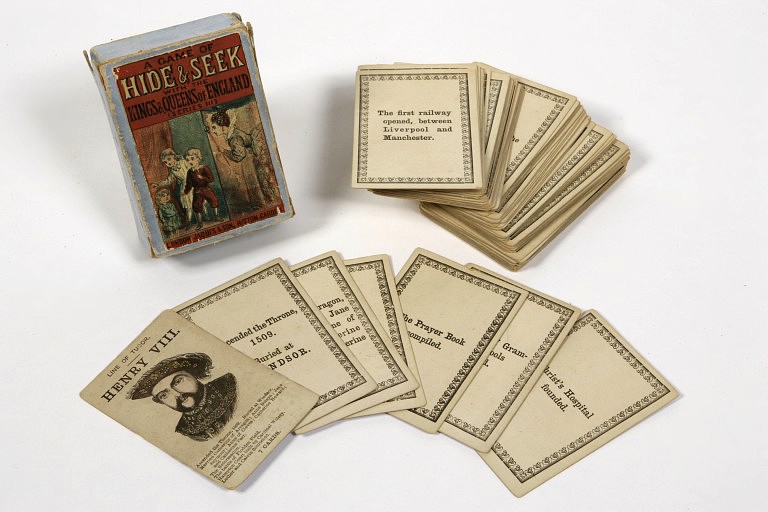
The Art of Play: A Game of Hide and Seek with the Kings and Queens of England; Series II; Series III, 1870s

A Game of Hide and Seek
Britain, 1870
The Victoria & Albert Museum


Published by the games makers John Jaques & Son, Ltd., in the 1870s, this group of three card games spands the reigns of the British monarchs from William I to Queen Victoria. A card for each monarch shows an illustration of the sovereign, and the name of their line (Tudor, etc.). Other cards include titled personages. Each card is hand-colored. The set, played to the rules of “Happy Families,” came boxed with purple slipcases.


Monday, December 10, 2012

Unusual Artifacts: Marvels of the Stereoscope, 1860

Click on image for a larger size.

Marvels of the Stereoscope:  What is Seen and What is Not Seen
Michael Burr, c. 1860
The Victoria & Albert Museum


In the 1860s, photographer Michael Burr produced this hand-colored photograph called “Marvels of the Stereoscope: What is Seen and What is Not Seen.” The image, actually two frames with one slightly off-set, were manufactured as stereographs in their own right. The cards served to show the amazing depth of field which could be achieved by the simple stereoscope.

Stereoscopic images were all the rage in the second half of the Nineteenth Century and were the third most popular format for albumen photographs, behind cartes de visite and cabinet cards. A display of stereoscopic Daguerreotypes by Duboscq at the Great Exhibition caught the eye of Queen Victoria who was so amazed by the illusion of three dimensionality that she became a fan of the art form. Her Majesty’s admiration only caused the production of stereoscopic images to increase.

Burr’s image not only satirizes stereoscopic photography, but also celebrates it and refers to a quote from Hamlet, “Seems madam? Nay, it IS!”