Showing posts with label hand-colored. Show all posts

Tuesday, June 24, 2014

Antique Image of the Day: A Dutch Toy, 1814


Image from The British Museum


A Dutch Toy!!!-Or, a pretty Play-thing for a Young Princess!!! Huzza


Titled as the above line reads, this satirical print depicts Princess Charlotte of Wales (1796-1817), only child of the Prince Regent (later King George IV) and Caroline of Brunswick.  


In this scene, Princess Charlotte is seated enthroned under a canopy.  She wears the "Prince of Wales' Feathers."  In her hands, she's holding a pantin (a jointed puppet), pulling the string so that the figure's legs and arms are extended.  The pantin is holding a flag inscribed surmounted by an orange.  The flag reads, "Orange Boven."  Meanwhile, the puppet looks at the princess pleadingly.

What's behind this hand-painted engraving?

Princess Charlotte, like many a princess before her (especially one who was thought to be Queen one day) was essentially being told who she should marry.  She preferred Prince Leopold of Saxe-Coburg-Gotha (Uncle of Queen Victoria as well as Prince Albert, Victoria's consort).  Meanwhile, George preferred his daughter to marry the Prince of Orange, and, soon, Orange and Charlotte were engaged.

Charlotte wrote:

No arguments, no threats, shall ever bend me to marry this detested Dutchman.

Eventually, George gave in for the sake of his only (legitimate) child and his only hope of having one of his own continue on the throne after he died.  Princess Charlotte broke off her engagement in a letter of June 16th, giving as reasons, that 'from recent circumstances:

I am perfectly convinced my interest is materially concerned with that of my Mother, and that my residence out of this Kingdom would be equally prejudicial to her interest as to my own.

That Charlotte did this only increased her popularity more.  Though this print suggests that Princess Charlotte had a thing for the Marquis of of Lansdowne (not to be confused with the Baron Lensdown), she really only liked Leopold.  

George IV consented to this and Charlotte and Leopold were married May 2, 1816.

But, she died.  

Charlotte passed away after giving birth to a stillborn son.  She complained, "They've made me tipsy," and was found dead after bleeding terribly.

Had she lived, she would have been Queen after the death of her father and Leopold would have been Prince Consort.  After the death of George IV, the throne went to his brother, William IV, and, then, to his niece, Queen Victoria who married Prince Albert as her consort.  Leopold really pushed for the marriage of the two cousins (Victoria didn't mind, she fancied Albert) so that at least ONE Prince of Saxe-Coburg-Gotha at the side of the British Queen--a role which escaped him in his own life.  Still, he did okay, becoming King of the Belgians.  So, don't cry for him.


Sunday, April 27, 2014

Unfolding Pictures: The Georges Barbier Fan, 1912


Hand Fan
Georges Barbier and Madame Paquin
French, 1911
The Victoria & Albert Museum


Georges Barbier (1882-1932), a celebrated Parisian fashion illustrator of the early Twentieth Century, collaborated with the most avant-garde fashion designers in France at the time. Barbier worked with such famous names as Paul Poiret and Madame Paquin (1869-1936) whose elaborate oriental costumes for the Ballets Russes tremendously influenced fashion in the 1910s.

Madame Paquin and Barbier worked together to design a series of fans on that Eastern theme. This decorated fan of printed and hand-colored paper and hand-painted silk is an example of the collaboration. Looking ahead to the designs which would dominate the Art Deco ideals of the 1920s, the fan features sticks and guards of bone which have been adorned with painted grapes and butterflies. Tassels of mulit-colored silks hanf from the gold rivet. A woman is also depicted. She wears a headdress which is identical to one which was designed by Madame Paquin. When folded, this fan, made in 1911, displays a zig-zag pattern betwe
en the guards.  


Sunday, February 2, 2014

History's Runway: A Pair of Painted Spanish Gloves, 1800-1820


Gloves
The Victoria & Albert Museum

This pair of women's gloves of cream kid leather is printed with a neo-classical design printed in black outline which was then and hand-painted. The gloves come from Spain and date to between 1800 and 1820. Probably made for export to the U.K., the gloves epitomize the trend of the era for neoclassical iconography.


Furthermore, gloves of this style were very fashionable in England at the early part of the Nineteenth Century. Many such gloves originated in Spain. The origins of this pair are clear by the caption beneath the image which reads, “'Venus y las tres Gracias.”

As the name would suggest, the image depicts Venus and the three Graces (Thalia, Aglaia and Euphrosine) together with Cupid and reminds the wearer of the idea that beauty and love will disarm and triumph over force.

Gloves were a customary gift and one of the few tokens that etiquette decreed a gentleman could, with propriety, present to a lady who was not his wife.


Saturday, January 18, 2014

The Art of Play: A Chinese Shadow Puppet, late 19th C.


Shadow Puppet
China, Late Nineteenth Century
The Victoria & Albert Museum


Shadow puppets are neat. But, then, I’m a puppet fancier, so I suppose I’d be inclined to think so. This one comes from China and dates to the late Nineteenth Century. It’s a tiger! He’s got very handsome tiger striped and a feline face—all hand painted.

This tiger is made up of eight individual pieces which are joined with twine at the head, neck, body, waist and tail. These moveable joints allow the puppet to be manipulated in realistic-looking way. Rods at the head and tail are used to move the joints. He’s composed of oil parchment and painted with watercolor.


Thursday, October 3, 2013

Print of the Day: Giving Alms, 1840


Click on image to enlarge.

"Giving Alms"
Thomas, 1840
The Victoria & Albert Museum 


This print from 1840 by Napoléon Thomas (born 1810, died at some point after that) depicts guests of a fancy dress ball. They’ve paused to give alms to an impoverished woman. How she got into the ball, I'm not quite sure.  But, there she is nonetheless.


Such paintings and prints were fairly standard issue in mid-Nineteenth Century France—part of an attempt by artists to remind their patrons, both elite and middle class, to remember those less fortunate (many of whom were artists). The handsome lithograph is hand-colored and is inscribed “Napon. Thom.” The piece was given by Mr. James Laver, CBE to the Victoria & Albert Museum in 1964. 


Tuesday, September 3, 2013

Object of the Day, Museum Edition: Mrs. Nisbett as Zarah, c. 1842


Mrs. Nisbett as "Zarah"
T.H. Jones
The Harry Beard Collection at:
The Victoria & Albert Museum


This hand-colored engraving, based on a drawing by T.H. Jones, depicts mid-Nineteenth Century actress Mrs. Nisbett in the title role of Zarah, as performed at the Queens Theatre around 1842. The actress is show in her famous costume of an off-the-shoulder white blouse beneath a three-quarter-length green, spiral-patterned gown in the sack-back style which is worn over a scarlet petticoat with a black-edged hem. Her green bloomers are scandalously visible as are her strapped sandals.

Heavy, gold jewelry defines the costume—dangling earrings, an impressive belt, rings and bracelets. A scarf of crimson and black comprises her headdress.

A caption below the image reads:


“(Zarah) Hark to the cry of their days - already have they opened on the scent of blood."

Friday, August 23, 2013

Print of the Day: A Dutch Toy, 1814


Image from The British Museum


A Dutch Toy!!!-Or, a pretty Play-thing for a Young Princess!!! Huzza


Titled as the above line reads, this satirical print depicts Princess Charlotte of Wales (1796-1817), only child of the Prince Regent (later King George IV) and Caroline of Brunswick.  

In this scene, Princess Charlotte is seated enthroned under a canopy.  She wears the "Prince of Wales' Feathers."  In her hands, she's holding a pantin (a jointed puppet), pulling the string so that the figure's legs and arms are extended.  The pantin is holding a flag inscribed surmounted by an orange.  The flag reads, "Orange Boven."  Meanwhile, the puppet looks at the princess pleadingly.

What's behind this hand-painted engraving?

Princess Charlotte, like many a princess before her (especially one who was thought to be Queen one day) was essentially being told who she should marry.  She preferred Prince Leopold of Saxe-Coburg-Gotha (Uncle of Queen Victoria as well as Prince Albert, Victoria's consort).  Meanwhile, George preferred his daughter to marry the Prince of Orange, and, soon, Orange and Charlotte were engaged.

Charlotte wrote:

No arguments, no threats, shall ever bend me to marry this detested Dutchman.

Eventually, George gave in for the sake of his only (legitimate) child and his only hope of having one of his own continue on the throne after he died.  Princess Charlotte broke off her engagement in a letter of June 16th, giving as reasons, that 'from recent circumstances:

I am perfectly convinced my interest is materially concerned with that of my Mother, and that my residence out of this Kingdom would be equally prejudicial to her interest as to my own.

That Charlotte did this only increased her popularity more.  Though this print suggests that Princess Charlotte had a thing for the Marquis of of Lansdowne (not to be confused with the Baron Lensdown), she really only liked Leopold.  

George IV consented to this and Charlotte and Leopold were married May 2, 1816.

But, she died.  

Charlotte passed away after giving birth to a stillborn son.  She complained, "They've made me tipsy," and was found dead after bleeding terribly.

Had she lived, she would have been Queen after the death of her father and Leopold would have been Prince Consort.  After the death of George IV, the throne went to his brother, William IV, and, then, to his niece, Queen Victoria who married Prince Albert as her consort.  Leopold really pushed for the marriage of the two cousins (Victoria didn't mind, she fancied Albert) so that at least ONE Prince of Saxe-Coburg-Gotha at the side of the British Queen--a role which escaped him in his own life.  Still, he did okay, becoming King of the Belgians.  So, don't cry for him.


Friday, August 16, 2013

Object of the Day, Museum Edition: Votaries of Fashion in the Temple of Folly, 1808


Click Image to Enlarge
Votaries of Fashion in the Temple of Folly
Tegg, 1808
The British Museum


This satirical print dates to 1808 and is entitled, “Votaries of Fashion in the Temple of Folly.” The hand-colored print was made by Thomas Rowlandson after an original by George Moutard Woodward, and published in London by Thomas Tegg.

The print served as the frontispiece to The “Chesterfield Travestie; Or, School for Modern Manners. Embellished with Ten Caricatures, Engraved by Woodward from original Drawings by Rowlandson [sic] . . . 1808.”

In the composition, Folly, a woman of fashion, is enthroned beneath a canopy. She has donned a fool’s motley and holds the bauble of a jester. She’s joined by a Punchinello as a crowd forms to stare at them in the sumptuous room.


Saturday, January 5, 2013

Print of the Day: Giving Alms, 1840

Click on image to enlarge.

"Giving Alms"
Thomas, 1840
The Victoria & Albert Museum


This print from 1840 by Napoléon Thomas (born 1810, died at some point after that) depicts guests of a fancy dress ball. They’ve paused to give alms to an impoverished woman. How she got into the ball, I'm not quite sure.  But, there she is nonetheless.


Such paintings and prints were fairly standard issue in mid-Nineteenth Century France—part of an attempt by artists to remind their patrons, both elite and middle class, to remember those less fortunate (many of whom were artists). The handsome lithograph is hand-colored and is inscribed “Napon. Thom.” The piece was given by Mr. James Laver, CBE to the Victoria & Albert Museum in 1964. 


Friday, January 4, 2013

Print of the Day: An Etched Frontispiece from Mr. Punch's Pocketbook, 1872

Click image to enlarge

Frontispiece from "Mr. Punch's Pocketbook"
Charles Keene, 1872
The British Museum


Next Friday, you’ll be seeing another of my Christmas gifts—“Mr. Punch’s Pocketbook” from 1860. So, I thought this week, I’d show you a later example of this pocket-sized almanac to give you a sense of the object. “Mr. Punch’s Pocketbook” was the iPad mini of the Nineteenth Century. It contained everything a gentleman traveling by train could ever need from the names of the Royal Family to the cost of postage. It even was filled with beautiful illustrations, stories, jokes and articles which would keep a gent entertained.

So, today, let’s look at this one from 1872. This example lives at the British Museum. All of Mr. Punch’s Pocketbooks included a frontispiece which unfolded into a trifold scene. In this case, we have an illustration by Charles Keene (1823-1872) which depicts “A Matrimonial Hurlingham” This was a pigeon-shooting match wherein eligible bachelors are the pigeons, and the young ladies shoot. Fair enough. Cupid is assisting the ladies, waiting nearby on the right with a string in his hand to deploy a trap.

Even in 1872, each of this lovely frontispieces was hand-colored with watercolor and touched with white gouache.

I look forward to sharing my own 1860 Pocketbook to you next week. I just have to figure out how best to reproduce it without harming it.


Friday, December 14, 2012

Print of the Day: Votaries of Fashion in the Temple of Folly, 1808

Click Image to Enlarge
Votaries of Fashion in the Temple of Folly
Tegg, 1808
The British Museum


This satirical print dates to 1808 and is entitled, “Votaries of Fashion in the Temple of Folly.” The hand-colored print was made by Thomas Rowlandson after an original by George Moutard Woodward, and published in London by Thomas Tegg.

The print served as the frontispiece to The “Chesterfield Travestie; Or, School for Modern Manners. Embellished with Ten Caricatures, Engraved by Woodward from original Drawings by Rowlandson [sic] . . . 1808.”

In the composition, Folly, a woman of fashion, is enthroned beneath a canopy. She has donned a fool’s motley and holds the bauble of a jester. She’s joined by a Punchinello as a crowd forms to stare at them in the sumptuous room.


Monday, November 26, 2012

Print of the Day: Feasting in the Saloon, 1820s

Feasting in the Saloon
Theodore Lane for Thomas McLean
The Victoria & Albert Museum


Dating to the 1820s, this print from London is entitled “Feasting in the Saloon.” It’s one of a series of prints published by Thomas McLean which was entitled “Theatrical Pleasures.” While we’re not sure of the original artist of the image printed in this hand-colored etching, historians believe it was possible Theodore Lane. 


Thursday, November 8, 2012

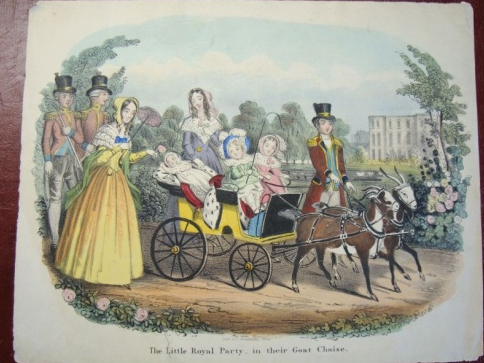
Print of the Day: The Little Royal Party in their Goat Chaise; etc.

Prints of the Royal Family
England, 1850s
Crown Copyright
The Royal Collection
This and all related images courtesy of Her Majesty Queen Elizabeth II


Here we see a series of prints published by Dean & C0 of Threadneedle Street. The four hand-colored (with watercolor) prints depict the Royal Family in Windsor Park, The Royal Family in Scotland, The Royal Party in the Home Park and The Little Royal Family in their Goat Chaise. Such images of Queen Victoria, the Prince Consort and the Royal Children would have been happily purchased by the public. This set dates to the early 1850s.


Sunday, October 28, 2012

The Art of Play: A Chinese Shadow Puppet, late 19th C.

Shadow Puppet
China, Late Nineteenth Century
The Victoria & Albert Museum


Shadow puppets are neat. But, then, I’m a puppet fancier, so I suppose I’d be inclined to think so. This one comes from China and dates to the late Nineteenth Century. It’s a tiger! He’s got very handsome tiger striped and a feline face—all hand painted.

This tiger is made up of eight individual pieces which are joined with twine at the head, neck, body, waist and tail. These moveable joints allow the puppet to be manipulated in realistic-looking way. Rods at the head and tail are used to move the joints. He’s composed of oil parchment and painted with watercolor.


Thursday, July 26, 2012

Unfolding Pictures: The Georges Barbier Fan, 1912


Hand Fan
Georges Barbier and Madame Paquin
French, 1911
The Victoria & Albert Museum


Georges Barbier (1882-1932), a celebrated Parisian fashion illustrator of the early Twentieth Century, collaborated with the most avant-garde fashion designers in France at the time. Barbier worked with such famous names as Paul Poiret and Madame Paquin (1869-1936) whose elaborate oriental costumes for the Ballets Russes tremendously influenced fashion in the 1910s.

Madame Paquin and Barbier worked together to design a series of fans on that Eastern theme. This decorated fan of printed and hand-colored paper and hand-painted silk is an example of the collaboration. Looking ahead to the designs which would dominate the Art Deco ideals of the 1920s, the fan features sticks and guards of bone which have been adorned with painted grapes and butterflies. Tassels of mulit-colored silks hanf from the gold rivet. A woman is also depicted. She wears a headdress which is identical to one which was designed by Madame Paquin. When folded, this fan, made in 1911, displays a zig-zag pattern betwe
en the guards.  


Print of the Day: Mrs. Nisbett as Zarah, c. 1842


Mrs. Nisbett as "Zarah"
T.H. Jones
The Harry Beard Collection at:
The Victoria & Albert Museum


This hand-colored engraving, based on a drawing by T.H. Jones, depicts mid-Nineteenth Century actress Mrs. Nisbett in the title role of Zarah, as performed at the Queens Theatre around 1842. The actress is show in her famous costume of an off-the-shoulder white blouse beneath a three-quarter-length green, spiral-patterned gown in the sack-back style which is worn over a scarlet petticoat with a black-edged hem. Her green bloomers are scandalously visible as are her strapped sandals.

Heavy, gold jewelry defines the costume—dangling earrings, an impressive belt, rings and bracelets. A scarf of crimson and black comprises her headdress.

A caption below the image reads:

“(Zarah) Hark to the cry of their days - already have they opened on the scent of blood."