Showing posts with label Switzerland. Show all posts

Sunday, June 22, 2014

Precious Time: The Roman Charity Watch and Case, 1680-1700


Watch and Case
Switzerland, 1680-1700
This and all related images from:
The Victoria & Albert Museum


This watch is housed in a copper gilt case which, along with the timepiece, has been enameled with a variety of Italian scenes including “Roman Charity” and “Lucretia.” Made in Geneva, Switzerland, the movement is signed “Baccuet.” Created between 1680 and 1700, the enameling was done by the family team of Jean Pierre (1655-1723) and Ami Huaud (1657-1724). Their competent enamel work on the scene of “Roman Charity” was based on an engraving by Claude Mellan which itself was after a painting by Simon Vouet. 


Tuesday, March 11, 2014

Mastery of Design: The Sene and Detalla Snuffbox, 1800


Snuff Box
Sene and Detalla, Geneva
Switzerland
With Original Leather Box
1800
Gold, Diamonds, Enamel
This and all related images:
The Victoria & Albert Museum

We’ve looked at a good many snuffboxes over the last three years, but this one is exceptionally fine. Here, we see an oval gold snuffbox enameled in translucent blue within 
taille d'épargne (a popular decorative technique of the Eighteenth Century also known as “sparing cut” in which engraved lines in a metal base are filled in with opaque enamel, without any variation in the depth of the lines) borders .

The cover of the snuffbox is set with glittering diamonds depicting a Chinoiserie pavilion which is trimmed with foliage and flowers within an additional border of diamonds with 
champlevé (The technique of decoration by enameling in which the design was made by lines or cells cut into the metal base by carving, engraving, etching or stamping and filled with powdered enamel of various colors and then fired to fuse the enamels) foliage between. The base of the box is beautifully engine turned and engraved with a temple beside a lake upon which ships float.

The box comes from Geneva, Switzerland and was probably produced for the Ottoman Empire, where there was a keen market for European-made objects in the Chinoiserie style.


Tuesday, March 4, 2014


Mastery of Design: The Dame Joan Evans Swiss Topaz Necklace, 1835

Necklace
Switzerland, c. 1835
The Victoria & Albert Museum


Beginning in the 1830s, the jewelry trade saw a greater consumer demand as more people were able to afford gems and jewels. Traditional techniques such as casting, chasing and engraving were still employed in the most high-end pieces, however, into the 1850s, newer industrial methods were used to make less expensive products for a growing mass market.

Here, we see a piece made for the mass market using machines.  This necklace was created by pressing the gold into the required shape using a die-stamping machine.  The flatted gold was rolled a machine into a very thin sheet which could be stamped to make multiple standard components. Even the collets were stamped on—allowing the setting of gemstones to be completed quicker.

After being assembled from pre-made pieces, the gold was enameled and set with pink-foiled topazes.
  This necklace was made in Switzerland between 1835 and 1840.  It was once part of the impressive collection of jewels amassed by Dame Joan Evans.


Wednesday, January 15, 2014

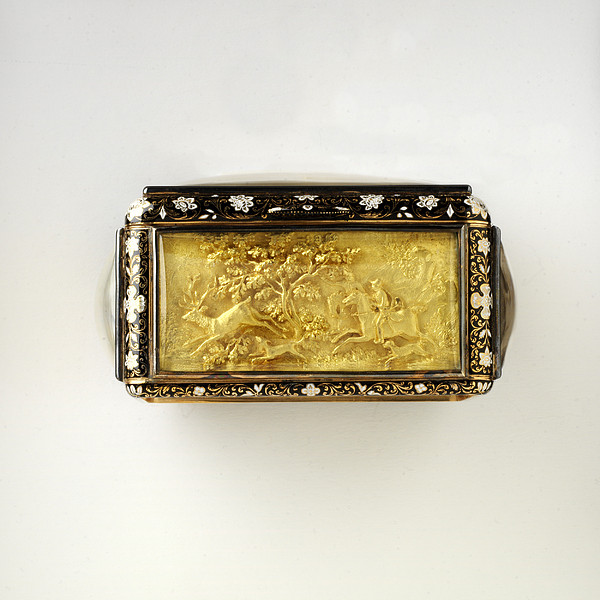
Mastery of Design: The Boar Hunt Snuffbox, 1821-1826


This and all related images from:
The Victoria & Albert Museum


This large, rectangular gold snuffbox is set with five chased gold panels under slightly convex glass. The glass is bordered by silver-gilt filets and cage-work enameled in black and white with flowers and foliage on a champlevé (a process of enameling wherein the surface is carved or cast with troughs into which the enamel is applied in cells) ground.

The panel on the box’s cover depicts the a boar hunt and around the walls, a family of deer are depicted watching a stag hunt. The black enamel on the base is alive with a chevron pattern which accents the scenes.

This monument to porcine murder is multi-national with mounts made in Geneva, Switzerland and the patterns made in Strassburg, France. Created between 1821 and 1826, the panels are the work of French sculptor Jacques Frederic Kirstenstein for Bautte et Moynier.

Jacques Frederic Kirstenstein frequently portrayed hunting scenes on chased gold panels such as these. His work was very popular and highly celebrated. He won gold medals for his work at the Exhibitions of 1810 and 1834. The Swiss firm of Bautte & Moynier commissioned Kirstenstein specifically for this snuffbox. 


Sunday, October 27, 2013

The Home Beautiful: A Cowrie Shell Spoon, c. 1530


Spoon of Gilt Silver and Cowrie Shell, c. 1530-40
The Victoria & Albert Museum


This cowrie-shell spoon may have been made purely for decorative purposes, but it shows signs of wear which indicate that it was used for practical applications.  It’s a safe bet that this spoon was set aside for taking medicine (or, I like to think, for eating caviar) as the lack of silver on the bowl avoided the pesky issue of oxidization.

At the time this spoon was made, in the Sixteenth Century, the cowrie shell was a rare and exotic material which was reserved for royalty and nobility. Certainly this example was used by an aristocratic family as evidenced by the owner’s coat of arms on the silver mount.

The bowl of the spoon is formed from a segment of a large cowrie shell, set into a silver-gilt handle which has been fluted.  The fluting terminates in a flat end in the form of a shield on which is enameled the fore part of a horse.   This is the work of either a German or a Swiss craftsman and dates to about 1530-40.


Thursday, August 22, 2013

Unfolding Pictures: The Birdcage Fan, 1780-1790


Hand Fan
Painted by Johannes Sulzer
Switzerland, 1780-1790
The Victoria & Albert Museum


The leaves of hand fans provided yet another surface to introduce popular artistic themes to the public. Hand-painted fans were treated with as much seriousness as any oil painting, and fan painters enjoyed the opportunity to present contemporary compositions in a different format.

One of the most exuberant fan painters of the Eighteenth Century was Swiss artist Johannes Sulzer (1748-1794) who, unlike most of his contemporaries, took to signing his fans. Above, we see a good example of Sulzer’s work—painted during a time when “Conversation Pieces” were quite the fashion. He’s given us such an intimate scene, depicting a couple engaged in a conversation with a young woman knitting. The reverse of the fan shows another popular late Eighteenth Century subject—an elegant house with a formal garden.

Sulzer has included images of two bird cages—one open and the other closed--flanking the miniature painting of the grand country house. These bird cages were a favorite subject for the artist and, more often than not, appear somewhere on his fans—acting almost as a signature of their own. 

Sulzer painted this fan of gouache on paper in Switzerland between 1780 and 1790. The whole is given shimmer with a silver wash. It is signed, “Peint & monté par J. Sulzer au Rossingnol à Winterthur.”


Sunday, July 14, 2013

Mastery of Design: The Sene and Detalla Snuffbox, 1800


Snuff Box
Sene and Detalla, Geneva
Switzerland
With Original Leather Box
1800
Gold, Diamonds, Enamel
This and all related images:
The Victoria & Albert Museum

We’ve looked at a good many snuffboxes over the last three years, but this one is exceptionally fine. Here, we see an oval gold snuffbox enameled in translucent blue within taille d'épargne (a popular decorative technique of the Eighteenth Century also known as “sparing cut” in which engraved lines in a metal base are filled in with opaque enamel, without any variation in the depth of the lines) borders .

The cover of the snuffbox is set with glittering diamonds depicting a Chinoiserie pavilion which is trimmed with foliage and flowers within an additional border of diamonds with champlevé (The technique of decoration by enameling in which the design was made by lines or cells cut into the metal base by carving, engraving, etching or stamping and filled with powdered enamel of various colors and then fired to fuse the enamels) foliage between. The base of the box is beautifully engine turned and engraved with a temple beside a lake upon which ships float.

The box comes from Geneva, Switzerland and was probably produced for the Ottoman Empire, where there was a keen market for European-made objects in the Chinoiserie style.


Precious Time: The Notebook Watch, 1840


Notebook/Watch
Swiss, 1840
The Victoria & Albert Museum
This masterpiece of gold, enamel, silk , paper, and glazed miniatures under glass is a clever combination of useful items and attractive design. Made in Switzerland in 1840, this notebook boasts glazed miniatures of bucolic scenes on both covers and conceals an enamel and gold pen.

When opened, the notebook reveals, on one side, a scene of the Palais Royale in Paris, and on the other, a jeweled watch with an enamel face.

Curiously, though I have access to a dozen photographs of this work of art courtesy of the Victoria & Albert Museum, I have none of the watch or the scene of the Palace nor can I find any. There’s a picture of the paper lining, but none of the good stuff. So, we’ll have to imagine what they might look like. But, based on the opulence of the outside, I’d guess that the inside is quite grand.


Thursday, June 6, 2013

Unusual Artifacts: A Swiss Music Box Pendant, 1805-1810


"Musical Box" Pendant
Gold, Enamel, Rose-Cut Diamonds, Pearls
Switzerland, 1805-1810
The Victoria & Albert Museum

At first glance, this masterpiece of enameled gold, rose-cut diamonds and pearls with its delicate floral pattern and alluring blue color-scheme appears to be a brilliant and magnificent pendant in the shape of a harp—which it is. However, it’s much more than that. When you study it further, you begin to wonder why it comes with a matching key.

It’s then that you realize that the key is used to wind the piece and that it is, in fact, a small music box meant to be worn as a jewel.

Made in Switzerland between 1805 and 1810, this is the height of ingenuity, combining Swiss sensibilities with stunning French design.


Wednesday, May 22, 2013

Gifts of Grandeur: The Geneva Snuffbox, 1810


Click image to enlarge.

Snuffbox
One of a Pair
Sene and Detalla of Geneva
1810
The Victoria & Albert Museum


This is one of two very similar lavish enamel and diamond snuffboxes made in Geneva (by the firm of Sene and Detalla) which are found in the V&A’s Gilbert collection. Like its mate, this one was likely made for export from Switzerland to the Ottoman market in 1810.

The oval box features a cover enameled in translucent red. The cover boasts a double diamond border and the topmost panel is applied with a diamond spray. The sides of the box’s base are enameled with a blue trellis pattern which is mounted with enameled “pearls.” The inside of the lid has been set with an enameled plaque which depicts doves and a basket.


Wednesday, January 23, 2013

Precious Time: The Louis Reymond Watch, 1860


Watch
Louis Reymond
Switzerland, 1860
The pocket watch was one of the most important parts of any individual’s suite of jewelry. Before the advent of wristwatches and certainly before you could buy a cheap watch at any apothecary or street corner, a person’s watch was treated with the utmost care both in creation and in design.

This enameled gold watch case is set with diamonds and comes from Le Locle, Switzerland. It is the work of Louis Reymond and dates to about 1860. While the case itself is not marked, the lever escapement bears the mark of Louis Reymond.

The case is adorned with a romantic design of cherubs flaking an oval of sky blue enamel into which the diamonds have been set. The reverse shines with a similar design replacing the cherubs with roses and with a blue swan atop the central enamel oval.


Thursday, October 18, 2012

Precious Time: The Roman Charity Watch and Case, 1680-1700

Watch and Case
Switzerland, 1680-1700
This and all related images from:
The Victoria & Albert Museum


This watch is housed in a copper gilt case which, along with the timepiece, has been enameled with a variety of Italian scenes including “Roman Charity” and “Lucretia.” Made in Geneva, Switzerland, the movement is signed “Baccuet.” Created between 1680 and 1700, the enameling was done by the family team of Jean Pierre (1655-1723) and Ami Huaud (1657-1724). Their competent enamel work on the scene of “Roman Charity” was based on an engraving by Claude Mellan which itself was after a painting by Simon Vouet. 


Sunday, September 30, 2012

Painting of The Day: Catching Frogs, c. 1840

Click on the image to catch some froggies.
"Catching Frogs"
Switzerland, c. 1840-1847
The Victoria & ALbert Museum


Created in Switzerland between 1840 and 1847, this genre painting is the work of Barthélemy Menn (1815-1893) who studied with Ingres and followed him on his journey to Rome. Though he started with historical compositions, Menn is best remembered for his lush landscapes and handsome portraits in a manner similar to that of the Barbizon School—quite a departure from the influence of Ingres’ shiny Manneristic approach.

Take this painting, for example. We can clearly see the hand of Corot and the school of Barbizon guiding Menn’s brush. Executed in a broad style, this combination landscape and genre painting, entitled “Catching Frogs” neatly demonstrates Menn’s admiration for the rising Realist movement of the 1840s in France.

Hey! Guess what? Guess who bequeathed this painting to the V&A. Go on… I’ll wait.

Yes! It was our old friend, The Reverend Chauncey Hare Townshend. Shocking. 


Friday, September 21, 2012

Mastery of Design: The Geneva Snuffbox, 1810

Click image to enlarge.

Snuffbox
One of a Pair
Sene and Detalla of Geneva
1810
The Victoria & Albert Museum


This is one of two very similar lavish enamel and diamond snuffboxes made in Geneva (by the firm of Sene and Detalla) which are found in the V&A’s Gilbert collection. Like its mate, this one was likely made for export from Switzerland to the Ottoman market in 1810.

The oval box features a cover enameled in translucent red. The cover boasts a double diamond border and the topmost panel is applied with a diamond spray. The sides of the box’s base are enameled with a blue trellis pattern which is mounted with enameled “pearls.” The inside of the lid has been set with an enameled plaque which depicts doves and a basket.