Showing posts with label Obkect of the Day. Show all posts

Saturday, December 17, 2011

Object of the Day, Museum Edition: The Annibale Rossi Virginal, 1577

The Victoria & Albert Museum


What is the difference between the musical instrument we call a “virginal” and the one we refer to as a “spinet”? Even museum curators find that the terminology for virginals and spinets is often unclear.


The instrument that you see pictured above—from the Victoria & Albert Musem--has been until recently described as a “spinet.” However, further research into the terms shows that this is actually of a type of instrument which is described by musicologists today as a “virginal.” Spinets and virginals, along with harpsichords, are stringed keyboard instruments which are special inasmuch as the strings have a plucking mechanism rather than a striking mechanism as in a piano. They are decidedly similar instruments.

The term “virginal”(thought to be chosen for its association with young female musicians) was commonly used in England to denote all plucked instruments, and some writers still use it to denote smaller instruments in rectangular cases. This practice was in use from the Sixteenth Century onward. Meanwhile, the term “spinet” has long been used to refer to a pentagonal or polygonal instrument.

Recently, the term “virginal” has been more accurately bequeathed to instruments with strings running at right angles to the keys, and with long bass strings at the front while the term 'spinet' denotes instruments with strings at an oblique angle and with the longer bass strings at the back. In other words, the spinet is a smaller version of the harpsichord—an instrument with only one set of keys.

In either case, both types of instruments were originally designed to be portable and were laid on a table top for playing.

The very first virginals were produced in Sixteenth-Century Italy. These early examples were created in a variety of shapes, from rectangular to polygonal. These Italian virginals were generally crafted of thin cypress wood, topped with elegant moldings and trim-pieces, and adorned with exotic inlays. These small instruments were surprisingly loud and could produce the entire range of notes in popular music of the time.

Here, we see such a virginal from Sixteenth-Century Italy with a cypress case and soundboard. It boasts boxwood and ivory ornaments, and is inlaid with pearls, amethysts, lapis lazuli, jasper, agate, turquoise and other precious and semi-precious stones. Since the ability to play an instrument was considered a “princely virtue,” instruments were treated with the utmost respect and were regally adorned. This example shimmers with 1,928 precious and semi-precious stones.

Annibale Rossi (active 1542-1577) of Milan in northern Italy, was the maker of this elaborate virginal. Rossi’s signature is still easily read on the piece. Rossi was praised in Paolo Morigi's work, La Nobilità di Milano (1595): wherein he was said to have produced an instrument “with the keys all of precious stones” for a “learned and refined nobleman.” Such a mention was quite an accolade considering that while the instruments and their owners were often praised, their makers were usually not.

Thursday, August 18, 2011

Object of the Day, Museum Edition: The Princess Alexandra Pocket Knife, 1863

Pen Knife
Denmark, 1863
The Victoria & Albert Museum
Today, we’ll be looking at objects related to members of the Royal Family named “Alexandra,” and there were a good many of them! Alexandra is one of the names that one sees repeatedly throughout English history.

Here’s an object related to one of the more famous Alexandra’s. She was known as Princess of Alexandra of Denmark until she married Queen Victoria’s eldest son—the Prince of Wales. As the Princess of Wales, Alexandra captured the affection of Britain with her beauty and her devotion to a variety of causes. When the Princes of Wales ascended the throne as King Edward VII, Alexandra became the Queen Consort and—despite her increasing deafness, frequent inability to walk and her husband’s very public infidelities—served the Empire to the best of her abilities.

This penknife of etched, blued and gilded steel was made to commemorate the marriage of the Prince of Wales to Princess Alexandra. On one side of the knife is adorned with the letter A, set between the arms of England and Sweden and Norway. The other side’s decoration is a little more peculiar. It shows to images of interlacing monsters between which is a seated figure of a Norseman playing a harp—as one does when seated between two monsters.

The penknife was made in Denmark for the Princess of Wales in 1863.

Tuesday, August 9, 2011

Object of the Day Museum Edition: A Photo of King George V, 1928

Photo of King George V
The Victoria & Albert Museum
This photograph from 1928 was taken by E.O. Hoppe for the., Illustrated London News published on November, 26.

A rare glimpse at the King—post World War I—seated at his writing desk, we see the objects which he most favored. His desk is adorned with photos of his family, especially the full-length photo of his beloved wife Queen Mary adorned in her finest jewels.

The King served his Country until his last terrible illness. During this period, Queen Mary quietly assumed much of the Monarch’s responsibilities. His funeral was a day of great national mourning as the nation realized that it was truly the end of an era.


Sunday, July 17, 2011

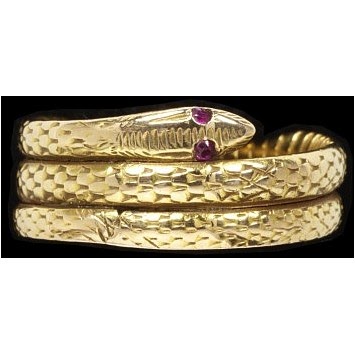
Object of the Day, Museum Edition: King George IV’s Serpent Ring, 1800-1830

Ring
Gold, Rubies
1800-1830
The Victoria & Albert Museum
A few months ago, I shared with you the gold snake ring from my personal collection. Snakes have long been a symbol of eternal love, and were frequently used in the design of jewelry. This trend became all the more popular when Prince Albert presented Queen Victoria with an engagement ring in the form of a serpent.
This particular ring from the V&A belonged to King George IV (1762-1830). In fact, this may be the ring that the King is seen wearing in a portrait by Sir Thomas Lawrence (The Wallace Collection).

Cast in gold and set with ruby eyes, the ring is clearly designed for masculine wear. Such rings were often set with gems for the eyes, and sometimes with enamel. Queen Victoria's engagement ring featured emerald eyes.


Sunday, June 12, 2011

Object of the Day: Museum Edition: A Pressed Glass Plate for Queen Victoria’s Golden Jubilee, 1887

My plate, 1897
Well, would you look at that! Several weeks ago, I shared with you a recent edition to my collection of Royal memorabilia. I’d never seen a plate like this pressed glass beauty created for Queen Victoria’s 1897 Diamond Jubilee.


It seems, there are more of them, and even some produced ten years earlier for the 1887 Golden Jubilee. Look, here’s one in the Victoria & Albert Museum! This one doesn’t have the gold backing that mine does, but perhaps that addition only came with the Diamond Jubilee Version. This particular plate is nearly identical to the one in my collection.

Made by Sowerby Ellison Glassworks in 1887, this plate was one way to meet the tremendous public demand for objects commemorating the Queen’s jubilee. I’m just so tickled to this this item in the V&A!


The Victoria & Albert Museum

The Victoria & Albert Museum

Tuesday, September 28, 2010

Object of the Day: A Curious Victorian Portrait

I was drawn to this painting when I saw it in a Dallas antique shop. Despite her sour expression, she’s really quite charming. Something about her reminded me a tad of Agnes Moorehead. And, so, she came home.


With her elaborately braided coiffure and her sensible wrap, she strikes us as being a very proper lady. The fact that she was painted with this rather grim expression speaks volumes about her sensibilities. Yet, she’s quite pretty in her own way. Her pale skin and auburn hair tell of a beauty hidden by too much emotion.

I have no idea who she was or, even, who painted her. However, judging by the canvas, the frame and the composition, I would place the painting around 1880. It’s either American or British. The French wouldn’t have painted a woman looking so dour. It’s just a curious portrait. I have a fondness of grim portraits. In many ways, I prefer them to highly idealized representations because they tell a tale of a real life. Life is not always rosy cheeks and perfect drapery. Sometimes, even the best of us looks a little pinched.

Wednesday, September 8, 2010

Objects of the Day: A Pair of Art Nouveau Vases

The Art Nouveau period (approximately 1890-1905) was defined by fluid shapes, free-flowing curves and a reliance on stylized natural themes. The style of the “new art” was undulating with life. A popular medium during the art nouveau, art glass reached a stylistic apex often featuring bright colors set against the contrast of clear and frosted glass.


This pair of French art-glass vases defines the Art Nouveau style. Rising to a gentle, tapered trumpet from the bulbous base which was characteristic of the style, these vases speak of the delicacy of natural forms which so inspired artists of the day.

Garnet-colored, hand-painted designs with roots in the Rococo, effortlessly reinforce the shape of the vase. They’re accentuated by gold paint which shimmers against the frosted glass. Clear glass adds an extra layer of dimension along the edges of the vases. Thin and delicate, these vases stand at fifteen inches in height. They seem to be untouched by time and continue to represent their origins with pride.