Showing posts with label snake. Show all posts

Monday, October 14, 2013

Object of the Day, Museum Edition: The Captain Newman-Newman Ring, 1811


Mourning Ring
Made in Honor of Captain Newman-Newman
Britain, 1811
The Victoria & Albert Museum
This handsome piece of jewelry commemorates a tragic naval event.  In 1811, as senior captain in the Baltic fleet, Captain Newman-Newman was ordered to escort home the ships: The St George , The Defence, and The Cressy. In a gale off Jutland, Newman’s ship, The Hero, went aground and was lost with Newman-Newman and all but 12 of her ship's crew.  A similar fate befell the “St George” and the “Cressy.”

This tragedy was the greatest shipwreck disaster ever known on the west-coast of Jutland and was a serious loss for Royal Navy which is remembered to this day. A century and a quarter  years after the event, the Danish press took the initiative to raise a memorial stone to commemorate the disaster.  The stone was unveiled at a ceremony in 1937 and still stands on the Thorsminde Tongue facing the position where the “St George” was lost.

This gold ring is actually a piece of mourning jewelry in honor of the disaster.
 The ring is enameled in black, white, red and blue with an oval bezel with the Union jack surrounded by a serpent. The piece, made in England in 1811—just after the tragedy--is inscribed on the reverse:

 Captn. James Newman Newman lost off the Haak in the Hero 74. Dec. 24, 1811, aged 46.


`

Wednesday, September 12, 2012

Mastery of Design: The Child & Child Serpent Brooch, c. 1900

Brooch
Child & Child, c. 1900
The Victoria & Albert Museum


Since Queen Victoria’s serpentine engagement ring revived the ancient theme of snakes in jewelry, the idea of incorporating the little slithery beasties into works of precious metals and gems remained quite popular well into the dawn of the Twentieth Century. In fact, there’s been a recent snaky resurgence of late.

Made around 1900, we can see from this brooch that the snake was alive and well as Victoria was about to close her reign. The brooch was made by the firm of Child and Child (marked with two Cs with a sunflower). Brothers Walter Child (1840-1930) and Harold Child (1848-1915) founded their jewelry concern in Seville Street, London, in 1880 and quickly impressed London Society with their artistic designs. Child and Child was popular with such celebrated luminaries as Queen Victoria herself, King Edward VII, King George V, my pal Queen Mary, the late Empress Frederick of Prussia, and the Tsarina of Russia.

Just looking at this handsome brooch of gold, silver, amethyst, enamel and a pearl tells us why the brothers’ works were so popular with the elite of London. It’s truly a masterpiece, and, best of all, it doesn’t bite. 


Sunday, May 6, 2012

Gifts of Grandeur: The Captain Newman-Newman Ring, 1811


Mourning Ring
Made in Honor of Captain Newman-Newman
Britain, 1811
The Victoria & Albert Museum


This handsome piece of jewelry commemorates a tragic naval event.  In 1811, as senior captain in the Baltic fleet, Captain Newman-Newman was ordered to escort home the ships: The St George , The Defence, and The Cressy.  In a gale off Jutland, Newman’s ship, The Hero, went aground and was lost with Newman-Newman and all but 12 of her ship's crew.  A similar fate befell the “St George” and the “Cressy.”

This tragedy was the greatest shipwreck disaster ever known on the west-coast of Jutland and was a serious loss for Royal Navy which is remembered to this day. A century and a quarter  years after the event, the Danish press took the initiative to raise a memorial stone to commemorate the disaster.  The stone was unveiled at a ceremony in 1937 and still stands on the Thorsminde Tongue facing the position where the “St George” was lost.

This gold ring is actually a piece of mourning jewelry in honor of the disaster.  The ring is enameled in black, white, red and blue with an oval bezel with the Union jack surrounded by a serpent. The piece, made in England in 1811—just after the tragedy--is inscribed on the reverse:

 Captn. James Newman Newman lost off the Haak in the Hero 74. Dec. 24, 1811, aged 46.


`


Sunday, July 17, 2011

Object of the Day, Museum Edition: King George IV’s Serpent Ring, 1800-1830

Ring
Gold, Rubies
1800-1830
The Victoria & Albert Museum
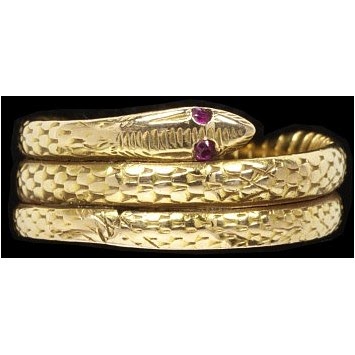
A few months ago, I shared with you the gold snake ring from my personal collection. Snakes have long been a symbol of eternal love, and were frequently used in the design of jewelry. This trend became all the more popular when Prince Albert presented Queen Victoria with an engagement ring in the form of a serpent.
This particular ring from the V&A belonged to King George IV (1762-1830). In fact, this may be the ring that the King is seen wearing in a portrait by Sir Thomas Lawrence (The Wallace Collection).

Cast in gold and set with ruby eyes, the ring is clearly designed for masculine wear. Such rings were often set with gems for the eyes, and sometimes with enamel. Queen Victoria's engagement ring featured emerald eyes.