From the 1850’s onward, a woman’s ensemble was not complete without a bracelet, or specifically, several bracelets worn in rows. This bracelet of pearls and diamonds was strictly meant for full eveningwear. Designed in 1880 of gold, pearls and European-cut diamonds, this is part of a matching suite of jewels.
Such jewelry was only to be worn at nighttime formal occasions. Ladies were encouraged to wear less elaborate jewels during the day with the exception of state events. I am also reminded of a line from the original Upstairs, Downstairs when Rose Buck explains to the new lady of the house, Hazel Bellamy, that Lady Marjorie always said, “No diamonds in the country.”
The great Fred Tickner was acclaimed for his beautifully-made puppets—especially his Mr. Punch figures. Tickner was an inspiration for generations of puppet makers, including Bryan Clarke from whom my Mr. Punch is coming.
This example of Tickner’s brilliant work dates to around 1975 and is houses in the V&A. A traditional glove puppet of Mr Punch, it has been hand-carved for the face and hands, which are hand-painted. Punch’s characteristic hair is made of imitation fur.
His costume is traditional, yet unique. He wears a pine green hat adorned with small yellow felt circles and a handsome black felt hat-band which has been trimmed with yellow braid and green rosettes anchored with metal studs. Instead of bright red, he wears a raspberry pink corduroy jacket with unusual turquoise corduroy front panels. The entire costume is trimmed with yellow braid and yellow buttons, with a yellow ribbed fabric ruff edged with red braid. His breeches match his hat, and his legs are painted yellow with blue-painted shoes decorated with red and black felt shoe roses.
Beautiful puppets. Gorgeous booth! Interesting business. This is a fine, frantic Punch & Judy Show by an unknown professor. I don’t quite know why Mr. Punch keeps dragging himself along the playboard. Shouldn’t he “stand” from time to time? Yet, he keeps scooting across the playboard. This, I find slightly odd. That and Judy’s beehive. But, all-in-all, it’s a very enjoyable show. I love the suitcase bit—very clever! Enjoy!
Mr. Punch had something of a rough week last week in Punch’s Cousin. First of all, he realized that an additional personality—Guignol—resided within their body. Guignol presented himself as their sense of rational thought, but Punch wanted nothing to do with the entity and wished him away. He quickly realized that he didn’t know where Julian was hidden within their shared body.
Punch’s internal search for Julian led him through a mysterious gallery of memories at the end of which Julian appeared and told Punch that he would support his alter in whatever he wanted to do. As Mr. Punch once again took over the body—to the relief of Robert, Adrienne and Marjani—he was unaware of the treachery that unfolded in other parts of the French Quarter.
Barbara Allen—after her failed suicide attempt—was carried off by one Louis Glapion, brother of Marie Laveau’s deceased second husband. Louis carried Barbara to Marie’s house—followed by Charles. As Marie and Iolanthe Evangeline were delighted to see Barbara returned to them (so they could continue to torture her), Charles crept into Marie’s house where hwas surprised to find his wounded brother with Nellie.
Charles threatened to expose Nellie to Iolanthe Evangeline—from whom she was running—unless she helped him rescue Barbara. Despite Giovanni’s weak protests and arguments, Nellie agreed, and went in search of Marie’s daughter so that Marie II could assist in attracting her mother’s attention thereby causing a distraction which would allow Charles to sneak out with Barbara.
The plan worked until Ulrika Rittenhouse refused to let Barbara leave—calling for Marie and Iolanthe who emerged carrying Barbara’s abducted son. As Marie threatened the child, Barbara realized that escape was impossible.
Meanwhile, Cecil arrived to join Punch, Adrienne, Robert and Marjani as Punch suggested that they use the law t their advantage. And, elsewhere, Arthur showed signs of the Yellow Fever.
This week, a life will be lost, and the course of their journey will change forever. Come back on Monday for exciting new Chapters of Punch’s Cousin.
As Britain recovered from the Great War and tried to rally during the Great Depression, King George V and Queen Mary were adamant that all of the Empire was represented in London and were quite proud when a central location for South African officials was erected in London.
The fortieth in the series of 1935 Silver Jubilee cards by Wills’s Cigarette Company shows the opening of the new South Africa House in London.
The reverse of the card reads:
THE OPENING OF THE SOUTH AFRICA HOUSE, LONDON
Another fine Dominion Head-quarters in the heart of London was inaugurated by the King on June 22nd, 1933, when he drove in state from Buckingham Palace to South Africa House in Trafalgar Square. General Smuts accompanied him as Minister in attendance-an honour never hitherto conferred on a Minister in a Dominion Cabinet. After the King had unlocked the great door with a golden key, he congratulated South Africa on this new "monument of concord and amity"; and declared the building open. The ceremonial was slight, but the atmosphere of Imperial friendship highly cordial.
The South Africa House, an attractive bit of architecture, still proudly stands—unaltered—in London.
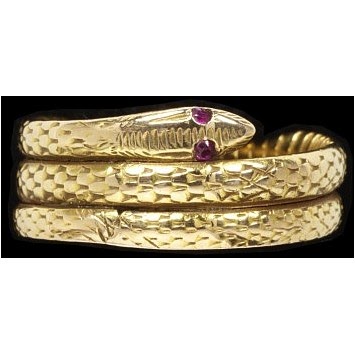
A few months ago, I shared with you the gold snake ring from my personal collection. Snakes have long been a symbol of eternal love, and were frequently used in the design of jewelry. This trend became all the more popular when Prince Albert presented Queen Victoria with an engagement ring in the form of a serpent.
This particular ring from the V&A belonged to King George IV (1762-1830). In fact, this may be the ring that the King is seen wearing in a portrait by Sir Thomas Lawrence (The Wallace Collection).
Cast in gold and set with ruby eyes, the ring is clearly designed for masculine wear. Such rings were often set with gems for the eyes, and sometimes with enamel. Queen Victoria's engagement ring featured emerald eyes.
Every Saturday afternoon, I sit down for a few hours and plan what’s coming to Stalking the Belle Époque in the upcoming week. This is always a lot of fun for me because I have a chance to sort through the archives of museums around the world and look at all of the fantastic items which may not be on public view.
This week, I’ve found a really exciting assortment of items from Italy, Britain and France. Some of the things that I’ve got planned for the coming week are truly extraordinary and I can’t wait to share them all with you.
In addition to the usual art, artifacts, jewels and rare objects, we’ll be looking at an assortment of interesting personalities, films and brilliant ideas.
This promises to be a very thrilling week. Make sure to check back each day!