Sunday, November 3, 2013

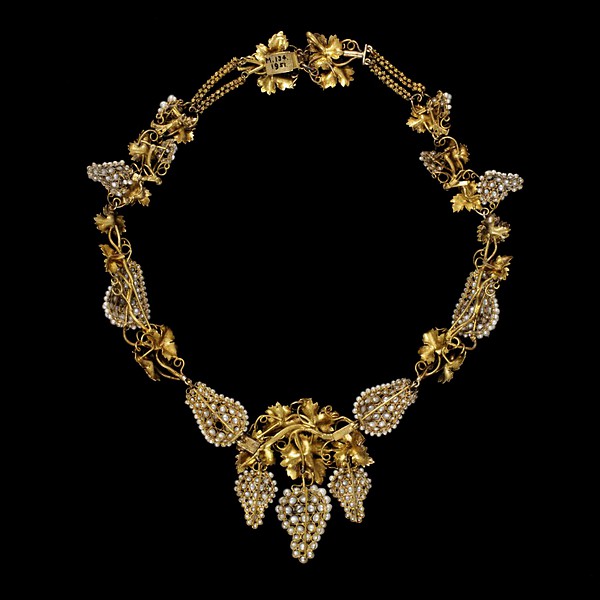
Mastery of Design: The Grapes and Vines Necklace, c. 1850


Necklace
Gold, Seed Pearls
English, c. 1850
The Victoria & Albert Museum


The visual motif of grapes and vines has been utilized in jewelry-making since antiquity. However, the idea saw a revival during the Victorian era when the fashion for sets of seed pearl jewelry gave jewelers the perfect “canvas” for grape-like forms. 

This English example, made around 1850, is the necklace from one of the most complex, elaborate and intricately-made grape parures that I’ve ever seen. The construction of the piece is exceptional. The pearls are attached with horsehair and silk to an elaborate framework made of gold wires. The varicolored gold gives an unusual depth and sense of naturalism to the suite. 


Gifts of Grandeur: A Footed Plateau, 1866-1867


Footed Plateau
France, 1866-1867
The Victoria & Albert Museum


This tazza, or footed plateau, is comprised of moulded earthenware glazed in brilliant blue and painted with enamels with a scene of a female figure holding a daisy. It is inscribed, “A la Belle Marquerite” in the center, and “soi toujours la confidante de nos amours a Marguerite.” Something about always being the confidante of her loves, is Marguerite. Or maybe something about pudding. You decide.

Made in Paris, this sumptuous tazza is the work of Joseph-Théodore Deck (1823-1891). Deck was born in Guebwiller, Alsace, and apprenticed to a traditional stove-making firm in Strasbourg. He would later study in other towns along Germany and Austria, settling in Paris around 1851 when he was appointed as overseer for the Dumas stove and tile firm.

In 1855 Deck launched his own studio and, later, even, his own retail shop, with the aid of his brother, Xavier. The Deck Brothers commissioned a host of well-known painters of the day to provide designs for their wares, and, often to paint them in their own hand. This tazza was painted by Emil Auguste Reiber (1826-1893). Joseph Deck was especially praised for his innovative glazes. He’d spent years researching glazing and color techniques of the handsome ceramics of the Middle and Far East. Just three years before his death, he was appointed as Director of the National Manufactory at Sèvres.

It has something of a "That Girl" vibe, too.  yes?


At the Music Hall: “Hands, Knees and Boomps-a-Daisy,” 1936


Hands, knees, and boomps-a-daisy,
I like a bustle that bends;
Hands, knees, and boomps-a-daisy,
What is a boomp between friends?
Hands, knees, oh don’t be lazy,
Let’s make the party a wow!
Now then, hands, knees, and boomps-a-daisy,
Turn to your partner and bow.

Annette Mills, the sister of actor Sir John Mills and aunt of Hayley and Juliet Mills, was embarking on a successful career as a dancer when a broken leg ruined the chance of realizing her dreams. She turned her attention to song-writing and penned two popular songs, one of which was “Hands, Knees and Boomps-a-Daisy” which quickly became extremely popular in music halls and night clubs of the late 1930’s. The dance associated with the song—which involved the bumping of posteriors—was a successful and enduring novelty.

Here’s a rendition of “Hands, Knees and Boomps-a-Daisy” as performed by Joe Loss and his Band.

History's Runway: The Miss Wethered Gown, 1785


Gown
France, 1785
Worn by one Miss Weathered
The Victoria & Albert Museum


Made in France in 1785, this gown boasts a skirt of printed cotton and an exquisite silk bodice which appears to be two separate garments, although the two are sewn together. The light cotton is printed with a pattern of pine trees, lilacs, dianthus, convolvulus and daisy trails. 
 The bodice, typical of the 1780s, is tight fitting at the back and closes in front.


The Home Beautiful: A Fairyland Lustre Vase, 1920-41


Fairyland Lustre Vase
1920-1941
The Victoria  & Albert Museum


Made in Etruria, England, between 1920 and 1941, this vase belongs to the genre called “Fairyland Lustre.”  

Daisy Makeig-Jones's, the artist responsible for this vase as well as the majority of the fairyland pieces, long had a fascination with fairies, and was a fan of the work of such illustrators as Arthur Rackham, Edmund Dulac and the Danish artist, Kay Nielsen—all of whom were very popular in the 1920s. Makeig-Jones worked for Wedgwood who famously always produced a huge range of styles to capture different market tastes.  She was encouraged to produce a line of fairytale-themed pieces.  This was the result.

These pieces were targeted to the luxury end of the market and they represent one of Wedgwood's most extraordinary technical achievements in the ceramic industry. The Fairyland Lustre line proved extremely popular throughout the 1920s as expensive collector's pieces.

This Fairyland lustre vase is tall and slim and narrows at shoulders, slightly flaring at neck, and is a perfect example of the species. According to the V&A, “The decoration is based on two Japanese myths. Kuan Yin, a Buddhist deity, poured water of creation over the earth - it fell in a series of bubbles and within each was a baby. The other concerning a Goddess who aided villagers terrorized by a dragon fond of eating children's flesh. Bubbles, fairies, city and figure riding on a boat/bird are depicted.”


Sunday Viewing: The Little Foxes, 1941


Take us the foxes, the little foxes, that spoil the vines: for our vines have tender grapes.
--Song of Solomon 2:15


Bette Davis—at the height of her career—had as much power in Hollywood as any man. She was considered, in fact, “the fifth Warner Brother.” The executives at Warner Brothers were probably quite happy to loan Bette—a constant thorn in their collective sides—to RKO in 1941 for the prestigious film production of Lilian Hellman’s 
The Little Foxes.

The Little Foxes was one of Lillian Hellman’s many triumphs on Broadway. Opening to much acclaim in 1939, the stage version of the show starred the great Tallulah Bankhead. Bankhead, however, was not considered “box office” enough for the film version, and, so, RKO recruited Miss Davis who accepted the part with glee.

RKO Pictures
Davis plays “Regina Giddens” in this historical drama set in the South in the early 1900’s. Regina likes to think of herself as the head of her family. She holds great dominion over her sympathetic teenage daughter, Alexandra (played beautifully by the wonderful Teresa Wright), her infirm husband (Herbert Marshall in a brilliant performance), and, to some extent her greedy brothers, Ben and Oscar Hubbard (played by Charles Dingle and Carl Benton Reid respectively). Of particular note is Patricia Collinge as Oscar’s wife Birdie, the last surviving member of an aristocratic Southern family. Collinge reprised the role she had played in the stage version. One of finest actresses of her day, you may remember her from Alfred Hitchcock’s Shadow of a Doubt in which she, again, was teamed with Teresa Wright. Dan Duryea plays Oscar’s smarmy son, Leo, with his usual oily flare. And Richard Carlson plays Alexandra’s beau.

The story centers around the Hubbard families lust for wealth and power. They conspire to form a deal with a wealthy Chicago businessman. However, they don’t have the required funds to enter into the deal. Thus, Regina’s brother’s attempt to steal the money from her husband, Horace. Regina, however, gets the upper hand. Or does she?

This film is a cinematic masterpiece directed by William Wyler (
Jezebel, The Heiress, The Letter, among many other great films) who clashed with his former lover, Bette Davis constantly throughout filming. Their friction, however, produced one of Bette’s finest and most subtle performances.The Little Foxes is a must-see film. The clip below should whet your appetite.


Gifts of Grandeur: The Rudolphi Putti Bracelet, c. 1840-1853


The V&A
Bracelet
Oxidized Silver and Emeralds
Rudolphi, 1840-1853
The Victoria & Albert Museum


Made by Paris’ Rudolphi in 1842, this bracelet of cast and oxidized silver and cabochon emeralds bears a striking resemblance to the description of a bracelet designed by Masson and exhibited by F. J. Rudolphi at the Great Exhibition in London in 1851.

We can’t be sure if this bracelet with its openwork quatrefoil and cast cherubs (putti) is the same exact item displayed at Prince Albert’s 1851 Exhibition. This one, from the V&A, came in a sharkskin Rudolphi case which gives his address as 23 Boulevard des Capucines. The jeweler moved to that address in 1853. If the bracelet was cased when it was new, it cannot therefore have been made earlier than 1853.

It is possible, however, that the bracelet could have been made in the 1840s and cased, or re-cased, after Rudolphi moved to the Boulevard des Capucines. We just can’t be sure. The workmanship of the bracelet, and, especially, its ornament of vines and rococo foam, closely matches Rudolphi’s style of the 1840s.