Monday, July 9, 2012

Mastery of Design: The Prince Albert Tie Pin, 1865

Stickpin with Enamel Portrait of Prince Albert
England, 1865
Crown Copyright
The Royal Collection
The Victoria & Albert Museum


The enamel portrait contained in this handsome tie-pin is based on a photograph by John Edwin Mayall which was taken within weeks of the Prince Consort's death in December of 1861.

The portrait by William Charles Bell (1831-1904) is set in a gold stick-pin with a chased Greek key design.

The pin was presented to one Nestor Tirard by Her Majesty Queen Victoria in 1865. On the pin’s reverse this gift has been inscribed: “Nestor Tirard/fromVR. Coburg Aug 26./1865.” The piece still retains its original blue velvet presentation case. After Prince Albert’s death, the Queen often made commemorative gifts in her beloved husband’s honor.

So, who was this Nestor Tirard. Jean Nestor Tirard (d. 1888) was the hairdresser to Queen Victoria from 1846 until 1867.

What's Bertie Watching? USA’s White Collar


The USA Network’s White Collar remains one of the best shows on television due in large part to the excellent cast, brilliant writing and slick production. I’ve always contended that the pairing of the show’s leads Matt Bomer and Tim DeKay is among the finest moments in casting in television history.

Bomer as the charming con-man “Neal Caffrey” brings both danger and sensitivity to the role. Bomer’s “Neal” is more than the typical gorgeous bad boy. He’s a complicated young man who is conflicted. Is he simply greedy? No. The writers and producers of the show have cleverly revealed bits of Neal’s past, giving us a nod that he acts as he does in response to some deep disappointment. Neal is constantly searching for something, trying to fill his emptiness with each new conquest. Still, such back-story would be moot without the right actor. Bomer—with each sly smile, each fleeting pained look, each shrug of his shoulders conveys more in one glance than most actors do with a whole monologue.

Similarly, Tim DeKay as FBI Agent Peter Burke is not the usual one-note fed. Peter is both on the side of the law and loyal to Neal with whom he has developed a reluctant friendship. Peter’s affection for Neal is palpable. He wants Neal to be reformed, to be successful and happy. He wants to believe in Neal, but Neal—at every turn—makes this a difficult task. Again, in the hands of a lesser actor, the relationship could seem flat and forced. But, DeKay brings a heart to Peter which is believable and natural.

Rounding out the cast are Willie Garson, Tiffani Thiessen and Marsha Thomason. The program is elegant, sharp and sumptusouly shot. In many ways, it’s a love-letter to Manhattan with long, luxurious shots of the city.

White Collar returns to USA tomorrow, Tuesday, July 10 at 9/8 Central.


Treat of the Week: A Feast for the Fourth


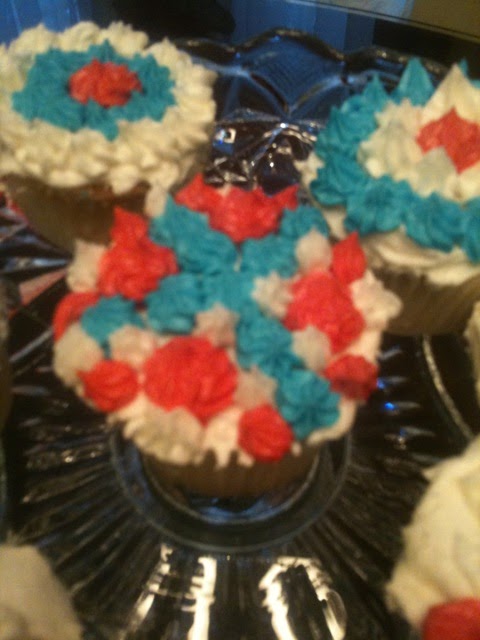
This week’s treat isn’t from this past Sunday, as usual, but rather from last Wednesday—the Fourth of July. Bertie and I went to visit my parents for the holiday and we enjoyed a fitting celebration. After all, I can think of no better way to celebrate American than with beef. Lovely filet mignon bathed in herbed compound butter was the centerpiece of the meal—joined by bountiful platters of grilled zucchini, squash and asparagus. Lovely! Adding a huge bowl of red, white and blue star-shaped ravioli smothered in fresh and sun-dried tomatoes and garden herbs made the meal even better. 


As always, the real star of the show was the dessert. My mother whipped up some patriotic cupcakes. Large white cupcakes and small chocolate companions were iced in white butter-cream and then adorned with piped decorations in muted red, white and blue. Take a moment to enjoy the different patterns. What a huge lot of work! Yet, somehow my mother makes it seem so effortless to create this treats from scratch each week. I’ll never know how she does it, but, I’ll always appreciate each glorious treat.


History's Runway: A Suit by Anthony Corbett, 1961

Wool Suit
Anthony Corbett, 1961
The Victoria & Albert Museum


In Britain, in the early 1960s, fashionable young men adopted the “continental” or “Italian” style of dress which relied on a slim, fitted suit with a short jacket known, ever-so charmingly as a"bum-freezer.”

This charcoal gray wool suit is cut in the "Italian Style.” This fashion had first been introduced into London fashion in the late 1950s by the designer Cecil Gee. Here’s an example of the look from 1961 by Anthony Corbett. The suit has been paired with its original accessories, an Aquascutum cotton shirt and Emilio Pucci printed silk tie.


Mr. Punch of Belgrave Square, Chapter 82,


Chapter 82: 
Grooming 


Mr. Punch smiled as the morning sunlight hit his back and shoulders. The Grange’s cheerful morning room was adorned with the bright, sentimental genre paintings that Sir Colin Molliner had collected throughout his lifetime. Scenes of cherubic maids engaged in domestic tasks, young men wooing their loves, children at play with their canine friends and farm wives preparing luscious meals lined each wall. Sir Colin systematically had replaced the ponderous Flemish still-lives of rotting fruit and rancid game which had long been displayed in that room, and Punch was glad of it.

He sat on the blue, gold and red plaid carpet of the room—cross-legged. Dog Toby lay in front of his master—his fuzzy stomach toward the ceiling and feet extended—as Punch groomed the dog with a stiff brush. This had been their morning routine for quite some time and both master and dog enjoyed the time together. As he brushed the dog, Mr. Punch chattered gaily, describing the paintings in the room for his four-footed chum.

“And, over there is a painting of a lady.” Punch continued. “She’s waitin’ for a letter, she is, and she don’t look so very happy ‘bout havin’ to wait. But, see, in the corner, you can notice her maid. Her maid’s got the letter already and she’s readin’ it her own self. Ain’t very loyal of her.” Mr. Punch smiled. “We’re lucky, we are. We got a loyal staff.”

Punch paused as the door to the room opened. He looked up brightly with wide eyes hoping that it was Robert who was coming in, or, perhaps Gamilla with young Colin. Seeing that it was Finlay who had entered, Punch fixed his face into a more noble expression—the slight smile and wise eyes which he affected whenever trying to imitate Julian. He nodded at the man in the manner which he thought befitted a Duke.

“Good morning, Your Grace.” Finlay nodded as he came into the room.

“Good morning, Finlay.” Punch responded in his finest “Julian” voice.

“If you don’t mind, Sir, I’ve come to start to set the sideboard for breakfast.”

“I don’t mind at all,” Punch smiled.

“I trust Dr. Halifax will be down soon,” Finlay replied, arranging the silver serving pieces.

“Yes. He’s just with Gerard now.” Mr. Punch answered.

Finlay paused. “Sir, I can do that for you.” He pointed to the brush which Punch was using.

“That won’t be necessary, Finlay.” Mr. Punch shook his head.

“Still, Sir. It’s rather beneath your station.”

Mr. Punch squinted. “I don’t think so. Dog Toby and I enjoy the time together.” He wished that it had been Charles or Speaight who had entered—someone who already knew of his “Mr. Punch” side, someone with whom he did not have to pretend.

“As you wish, Sir.” Finlay nodded. “He does seem to be enamored of Your Grace.”

“We’re chums…” Punch chirped. He caught himself and added more seriously. “The dog and I have been very close for quite some time now.”

“How old is he?” Finlay asked.

“I can’t be sure.” Mr. Punch answered. “He’s been with me for a year. He was a gift.”

“From the doctor, Sir?”

“No.” Mr. Punch shook his head. “From a friend that we met in America.”

“Oh?” Finlay smiled.

“A very kind African lady.”

“Gamilla?” Finlay continued.

“Not Gamilla, but someone well known to Gamilla. Her name is Marjani and she’s a very fine lady. She was very good to us. She found Dog Toby and gave him to me.”

“How kind, Sir.” Finlay nodded. “Obviously, the dog is quite content with you.”

“And, I with him.”

“And, if you’ll pardon me sayin’ it, Sir, he’s a most lucky dog.” Finlay grinned.

Mr. Punch blinked rapidly for a moment, narrowing one eye. “Uh…thank you, Finlay.”

“Your Grace?” Finlay began. “Mrs. North told me that you and she had a talk this morning, very early.”

“That’s right.” Punch smiled. “Speaight as well.”

“I’m told that you’ve decided to resurrect the Servants’ Ball.”

“That’s correct. I hope to host the ball next week.” Punch answered.

“How very exciting.” Finlay grinned. “Will it be fancy dress?”

“Yes. That’s what I was thinking.”

“As what will you dress, Sir? No doubt some great handsome figure from history?”

Punch squinted again. “I don’t know that Dr. Halifax and I will don fancy dress. As hosts, I think we’ll come as we are. However, that’s not to say that the rest of you shouldn’t.”

“Oh, Sir. Think of it.” Finlay winked, stepping forward. “You could be anything you wish. Adonis, or Adam, or Bonnie Prince Charlie, or, even Beau Brummell.”

“I think not.” Mr. Punch shook his head. He didn’t wish to look up at Finlay, and, instead focused on brushing the happy dog. “I’ve only worn a costume once. At the end of 1852--at a similar fete while in New Orleans. I don’t care to dress so again.”

“As whom did you dress, Sir?” Finlay asked. “Someone quite dashing, I’m sure.”

“I was Punchinello.” Punch replied plainly. “Dr. Halifax was ‘the Doctor’—you know, from the puppet show.”

“How clever, Sir.” Finlay stepped even closer. “But why would you hide your face behind such grotesquerie?”

“Because, Finlay, grotesquerie is part of life. Every man is inhabited by something grotesque. There’s beauty in it, actually. I am not ashamed to admit that within me is something as magnificently flawed as Punchinello with his hump and great nose and chin. When we allow ourselves to be grotesque, then, and only, then can we be our most attractive.”

“It just seems a shame to me to place perfection in shadow.” Finlay grinned.

“Finlay, no man is perfect—especially not I.” Mr. Punch sighed.

“You are most wise, Your Grace.”

Mr. Punch shrugged. “More so than anything, Finlay, I’m hungry. I trust the doctor will be down momentarily. Perhaps you can see about the progress of breakfast?”

“Certainly, Your Grace.” Finlay nodded.

After Finlay had left the room, Mr. Punch looked at Dog Toby, scratching his belly. “Ain’t that odd? What a strange bloke. What’d you think, Chum?”

The dog rolled over on to his stomach and, lifting his hind quarters in the air, wagged his tail.

“You’re hungry, too, then.” Mr. Punch smiled, forgetting all about Finlay. “Here, let’s go find our chum, then. Maybe we can stop and see Colin on the way. By then, breakfast will be ready.”

Together, Punch and the dog bounded from the room.

From around the corner, Finlay watched as the Duke and Dog Toby sprinted up the monumental staircase.

“Poor, barmy fella.” Finlay muttered. “Thank God you’re as handsome as you are. I don’t think that doctor is takin’ care of you proper. That’s why you need your Finlay.”


Did you miss Chapters 1-81? If so, you can read them here. Come back tomorrow for Chapter 83 of Mr. Punch of Belgrave Square.

Painting of the Day: A Young Man of the Maynard family, Eighteenth Century

A Young Man of the Maynard Family
George Romney, c. 1780
The Victoria & Albert Museum


British portrait painter George Romney was one of the most prolific in his field during the later Eighteenth Century. One glance at his sitter books from 1776-1795 shows the he painted over 1500 individuals. Romney was known for his sensitive renditions of his sitters and his ability to convey the subject’s emotions and personality in simple and elegant ways. 


Take this portrait of a young man for example. The man’s face has been delicately rendered, showing an engaging expression which is dramatically hidden behind the shadow from his tilted hat. This theatrical trickery makes us want to learn more about the sitter, and also imbues the canvas with the mysterious sense of life for which Romney’s work became famous. 


Object of the Day, Museum Edition: The Fontana Inkstand, c. 1550

Inkstand
Fontana Workshop, c. 1550
This and all related images from:
The Victoria & Albert Museum


Made in the mid-Sixteenth Century, this tin-glazed earthenware inkstand comes from the Fontana Workshop in Urbino, Italy. The inkstand is surmounted by a figure of a young man playing an organ. He is joined by his faithful spaniel who is getting his ear scratched by his master. An inkstand such as this would have been made to appeal to a young gentleman for use in his private study. During this era, a class of urban professional men was developing and many workshops created specialized items to appeal to them. Desk accessories and ink stands were the centerpieces of these collections. Very often, these stands were fitted with compartments for pen, pounce, a paper knife, and scissors. This example once had a sliding drawer which is now missing. 


The scene depicted here shows a fashionable young gentleman dressed in the “uniform” of a nobleman. He sits at an architecturally-designed organ which is being operated by a boy at the reverse operating bellows. The entire group rests on a rectangular stand supported by lion's paws at the corners. At one point in the last five hundred years, the stand was broken, and, then, restored. There’s evidence of restoration to the chair, the brim of the hat, one of the capitals of the organ’s pilasters and the boy’s toes and bellows.