Showing posts with label Display a Musical Instrument. Show all posts

Sunday, July 24, 2011

Object of the Day, Museum Edition: An Antique Zither, 1860

Alpine Zither
1860-1867
Franz Lehner, Prague
The Victoria & Albert Museum
When Stalking the Belle Époque began just over a year ago, I shared images of two antique musical instruments in my collection: an autoharp and a psaltery—both in the zither family. The zither has been around for centuries and has been an important part of both musical and art history. A particular strain, the Alpine zither, was developed by one Johan Petzmayer (1803 - 1884) in Munich, Germany, during the 1820s. This type of zither was played on a table by pressing on the five highest strings with a fretted finger board (operated by the left hand) and plucking alternating strings with the thumb and index finger of the right hand.

Here’s an example of an Alpine Zither from the Victoria and Albert Museum. This particular model was made by Franz Lehner (1801 - 1878). Lehner was a violin maker from Prague. He displayed this attractive instrument at the Paris exhibition of 1867.

Wednesday, July 20, 2011

Object of the Day, Museum Edition: An Italian Dulcimer, 1750

Dulcimer
Italian, 1750
The Victoria & Albert Museum
In past months, I’ve shared a couple of the antique musical instruments in my collection, but I have to admit, I have nothing like this. Here’s another object that I call dibs on should the V&A ever have a garage sale.

This is a Dulcimer. A painted masterpiece in magnificent colors, it comes from Italy and dates to around 1750. Italian Dulcimers of this style are referred to as “trapeze-shaped,” and were designed to be played with natural quills which were attached to leather thimble-like rings worn over the tips of the fingers. The curators at the V&A believe that this dulcimer’s case may have come originally from another instrument. The splendidly decorated case is painted with scenes of Apollo and the Muses. This traditional theme was common adornment on harpsichords and other keyboard instruments.

I love everything about this instrument and think it would look quite smashing in my living room.

Saturday, October 23, 2010

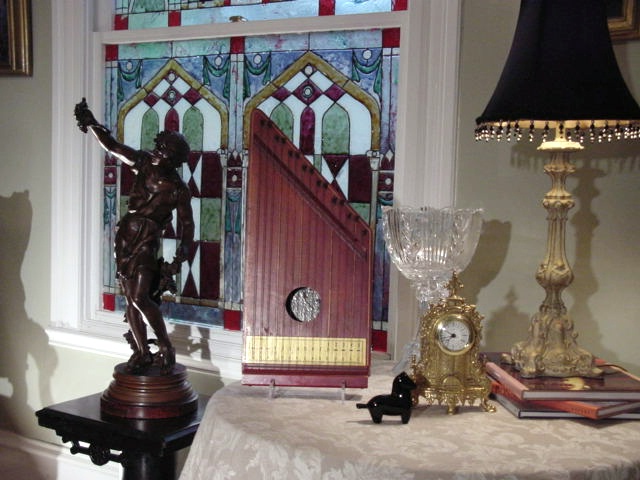
Object of the Day: An Antique Psaltery

A psaltery is a musical instrument in the same family as the autoharp or zither. Psalteries have been created for thousands of years. Along with the autoharp, they reached a level of popularity as a drawing room instrument in the mid-to-late Nineteenth Century.


This particular psaltery is American in origin. Crafted in New York in the late Nineteenth Century, the psaltery still sports its original label which states that it was designed by Satis Coleman. The maple case featured delicately rounded corners and a brilliant polish. In remarkably good condition, it’s still even (mostly) in tune.

I have no idea how to play it, but it does make for an attractive decorative item. Antique musical instruments have a very positive spirit about them. From their creation onward, they’ve brought joy to many people.

Sunday, August 1, 2010

Decorating Tip: Display a Musical Instrument

I used to play the clarinet—twenty years ago. That clarinet is still sitting in its case in a closet somewhere in my parents’ house. The reason I stopped was one of pure vanity. I didn’t want to make my teeth crooked. However, I still appreciate the beauty of the clarinet—both its sound and its visual beauty. Musical instruments—aside from the art they create—are works of art unto themselves.

Do you have an instrument that you used to play just sitting around somewhere? Do you have an antique or vintage instrument that belonged to a family member or that you purchased because you liked the way it looked? If so, you can display it in your home as an art object. Musical instruments have a grace and beauty that’s at once both sculptural and painterly. Any instrument can be displayed. Special hangers are crafted to display stringed instruments on a wall, and a variety of stands are available to support an instrument for viewing. Adding a musical instrument to your décor speaks volumes. It’s three dimensional art which can elicit a wealth of beautiful emotions.