Monday, July 18, 2011

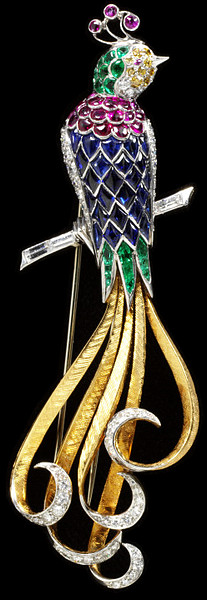
Mastery of Design: A Diamond and Gemstone Bird Brooch, 1940-1950

Brooch
French, 1940-1950
The Victoria & Albert Museum
The 1940’s ushered in a revival of colorful, gem-set jewelry inspired by nature. This return to Victorian ideals was a stark contrast to the colder, geometric designs of the 1930’s and a return tot he ideals of the Victorian era as jewels began to, once again, take the form of flowers. While geometric and abstract designs continued to be popular during this period, these gentler examples offered an alternative to the more classically-minded consumer.

This brooch of platinum and gold is an excellent example of this resurgence of Victorian themes. Set with diamonds, emeralds, rubies and sapphires, this eye catching piece is the work of a unknown French jeweler.


Person of the Week: Marsha Thomason

Marsha Thomason
Fan’s of USA’s White Collar know Marsha Thomason as Agent Diana Barrigan who adds a feminine touch to the ultra masculine team of Peter Burke (Tim DeKay) and Neal Caffrey (Matt Bomer) as well as Neal’s eccentric confidante, “Mozzie” (Willie Garson).

The Manchester, England-born Thomason attended Oldham Sixth Form College to study for her “A Levels” in Media Studies, Theatre Studies and Performing Arts. Later, Thomason attended the Manchester Metropolitan University where she earned a Bachelor of Arts degree in English. But that wasn’t the start of her ambition to become a professional actor. Miss Thomason , from the age of thirteen, knew the path she wanted to take and, at that young age, attended Oldham Theatre Workshop. There, she was able to join in youth theatre productions both on stage and behind the scenes.

Thomason’s career began on British television in the series Playing the Field and Where The Heart Is. She also starred in the first series of the BBC Three drama Burn It. Miss Thomason’s U.S. career took off with her starring role in Disney's The Haunted Mansion. She also appeared in the films My Baby's Daddy, Black Knight and Pure. Her US television work included Las Vegas and Lost.

Miss Thomason with Matt Bomer
Miss Thomason first appeared in the pilot episode of White Collar, returning for the first season finale and joining the cast as a fulltime regular with the second season. Thomas married in 2009 and is an staunch supporter of the Machester City Football Club.

Painting of the Day: Spring Flowers, 1851

Spring Flowers
George Smith, 1851
The Victoria & Albert Museum
In Britain, in the 1850’s, people’s tastes in art leaned toward sentimental scenes of families and children. This was largely influenced by the fact that the Empire was being ruled by a young woman who had recently married and started a large family. Collectors such as John Sheepshanks and the Reverend Chauncy Hare Townshend (whom we’ve mentioned in relation to his impressive gem collection) led this movement which quickly excited upper-crust Victorian society.

Here, we see such a scene painted by George Smith (1829-1901) who studied at the Royal Academy schools and later exhibited many works there and at the British Institution. He was celebrated for his genre paintings, especially those of children in idyllic scenes such as this.

This painting was first exhibited at the Royal Academy in 1851. At its debut, The Art Journal in reviewed the piece quite favorably. “Children decking with flowers their little sister, whom they have drawn forth in her little cart; the picture has much truthful excellence,” the reviewer noted.

During a time when childhood was often cut short by illness and poor conditions, such scenes were especially revered. Artists were careful to not represent the darker realities of Victorian childhood, instead focusing on scenes of perfection and beauty.

Treat of the Week: The Perfect Blueberry Tart

With blueberries being brilliantly in season, we’ve been treated to a good many blueberry creations from my mother’s kitchen. This week’s “Treat of the Week” is a delicious and unique blueberry tart. Upon a thick, tender shortbread crust, a layer of cooked blueberries is generously spread. This sweet, wonderful layer is topped with fresh, uncooked blueberries and garnished with strips of lemon zest. (See the recipe below)

We were able to enjoy this remarkable tart with homemade peach ice cream. Luscious chunks of fresh peach added the ideal texture to this creamy treat and proved the perfect complement to the tart! My mother’s new Cuisinart Ice Cream Maker is proving to be quite handy. I can’t recommend it enough.

Here’s what you’ll need for the tart:


FOR THE CRUST:
o 1 1/4 cups all-purpose flour (spooned and leveled), plus more for dusting


o 1/3 cup sugar


o 1/4 teaspoon salt


o 8 tablespoons (1 stick) cold unsalted butter, cut into small pieces


FOR THE FILLING
o 6 cups (six 1/2-pint containers) fresh blueberries, rinsed and dried


o 2 tablespoons cornstarch


o 2 teaspoons finely grated lemon zest


o 3 tablespoon fresh lemon juice


o 2/3 cup sugar


o Pinch of salt

HOW TO PREPARE
1. Preheat oven to 375 degrees. In a food processor, combine flour, sugar, salt, and butter; process until large moist crumbs form (dough should hold together when squeezed).


2. Transfer dough to a 9-inch round tart pan with a removable bottom; with floured fingers, press evenly into bottom and up sides. Freeze until firm, about 15 minutes; prick bottom of dough all over with a fork. Bake until golden, 20 to 25 minutes; cool completely.


3. Meanwhile, reserve 1 cup of the prettiest berries for topping. In a medium saucepan, bring 1/4 cup water and 1 1/2 cups berries to a boil over high heat. Reduce heat; simmer, stirring occasionally, until berries begin to break down, 3 to 4 minutes.


4. In a small bowl, mix cornstarch with 2 tablespoons water; stir into berries in pan. Add lemon zest and juice, sugar, and salt. Bring to a boil; reduce heat. Simmer, stirring, just until mixture begins to thicken, 30 to 60 seconds. Remove from heat. Stir in remaining 3 1/2 cups fresh berries. Immediately pour hot berry mixture into cooled tart shell, and smooth with a spatula.


5. Scatter reserved berries on top, pressing down lightly to help them adhere. Refrigerate until cool, about 30 minutes and up to overnight.


FOR THE ICE CREAM:

Buy this...


Punch’s Cousin, Chapter 297

Barbara Allen coughed and sputtered as she held her child close to her breast, shielding his face from the smoke that billowed out of the house from which they had just fled.

Charles caught her as she stumbled. “We must go,” he panted.

Barbara turned to look at the house as it flickered, flames licking at the windows as the lace curtains inside evaporated into piles of ash. She could hear the screams of the home’s occupants—loudest of them all Ulrika’s, Iolanthe’s and Marie’s.

Barbara’s mind replayed the events that had led to that moment—in a strange, quick succession of images.

Marie had threatened the boy, Colin, and a rage the likes of which she’d never known before overtook Barbara as she broke away from Charles, overturning oil lamps and candles as she overpowered Marie and took her child from the arms of the Voodoo Priestess.

How did they escape?

As flames from the disturbed lamps and candles quickly gobbled up the brittle wood of Marie’s old, mean house, Charles had grabbed Barbara around the waist—the child dangling from her arms—and pulled her from the building as Marie, Iolanthe and Ulrika scurried to extinguish the fire.

“They’ll be coming for us!” Charles shouted. “Barbara! Hurry!”

Charles looked pleadingly at the woman he’d grown to love. For a moment, his body was gripped in a terrible shiver as he thought that aside from the three wicked women, that house was occupied by his brother, Nellie, Marie’s daughter and brother-in-law and who knew who many others. He feared for them, but knew they must flee.

Barbara took a deep breath and began to run. Charles followed.

“Where are you going?” Charles panted behind her.

“I don’t know.” Barbara coughed.

“We must bring the boy back to His Grace.” Charles sputtered.

“No!” Barbara said loudly, not pausing.

“Barbara?” Charles shouted.

“No.” Barbara said emphatically. “Not this time.”

Within the burning house, Marie cursed loudly and began chanting in a tongue unknown to Ulrika who grinned at the menace with which it trickled. Iolanthe began to chant as well as the two women—assisted by young Marie and Louis Glapion—struggled to extinguish the flames.

“Ulrika!” Marie shouted. “Go to the back of the house and help those there escape.”

Ulrika paused.

“Go, Woman!” Marie screamed.

In a strange moment of cooperation, Ulrika did as instructed, rushing through the back corridor, banging on doors. Nellie—who was still hiding in the larder—heard Ulrika’s calls and knocks, but did not come out.

Next, Ulrika pounded on Giovanni’s door.

“Help me!” Giovanni shouted.

Ulrika thrust the door open to find the injured Giovanni still in his bed, trying to get up.

Their eyes met and they both grinned.

As the flames behind her illuminated her red hair, Ulrika gazed at Giovanni Iantosca, knowing her life was forever changed.

“You look like a demon, my beauty.” Giovanni sighed despite the danger around them. “You look magnificent.”

“As do you,” Ulrika purred.

“Help me,” Giovanni said softly.

“Anything.” Ulrika smiled, walking toward the man’s bed.

Meanwhile, Mr. Punch sighed contentedly as he once again returned to their borrowed house on Royal Street.

After checking on Fuller, Robert and Punch said good night to Adrienne and Cecil and retreated to Punch’s/Julian’s room.

Punch happily sprawled out on the familiar bed—the closest thing to a home he’d had in awhile. He squealed with glee as Toby jumped upon the bed with him and embraced the dog gently, scratching his ears and cooing at the faithful animal.

Robert grinned broadly. “I’ll return in a moment.”

“Here, where you goin’, Chum?” Punch squawked.

“Wait here.” Robert nodded. “I won’t be long.”

And, he wasn’t. Robert returned quickly with Mr. Punch’s puppet and placed the wooden-headed figure next to Punch and the dog.

“Oh! Me friend! Me puppet friend! I missed him, too.”

Robert sat on the edge of the bed and looked affectionately at Mr. Punch—ensconced with his beloved terrier and his puppet. “I know that you did.”

“Coo! I’m sleepy.” Punch sighed.

“I’m sure.” Robert nodded. “I am, too.”

“Here, you think they’ll cooperate—the beadle and the constable?” Punch asked.

“I don’t know.” Robert smiled. “I’m not quite sure they call their authorities beadles here, by the way.”

“Whatever they call ‘em.” Punch shrugged. “They’ll help us, won’t they? They’ll help us get the baby back, yes?”

“I hope so,” Robert nodded. “We’ll have to tell them about our deception in making people think we’d been killed. And, we’ll have to expose Barbara’s part in the crime, but I hope that common sense will prevail.”

“Think we’ll get in trouble?” Punch asked. “We didn’t do nothin’ too bad. I’m very good, you know. Very, very good. Don’t think we should get in trouble.”

“I don’t know.” Robert replied, “but it’s what we need to do. It’s what we should have done in the first place.”

Marjani knocked on the door before opening it and poking her head in. “Pardon me, Sirs.”

“Yes, Marjani?” Robert asked.

“Come to say ‘good night’ to us? How’s Columbia?” Punch asked.

“She’s fine, Sir.” Marjani nodded. “But, we got a visitor.”

“Who?” Robert asked.

“Arthur.” Marjani shook her head.

“Send him ‘way. I don’t want to see ‘im. The lyin’ beast!” Punch growled.

“He’s come to see me,” Marjani explained. “His friend—the dimwit—brought him.”

“Why?” Robert wondered.

“I saw the man, Doctor,” Marjani answered seriously. “Arthur’s got the Yellow Jack.”


Did you miss Chapters 1-296? If so, you can read them here.

Card of the Day: The King at a Test Match, Lords

Who knows what any of this means? It’s something about Cricket. King George V, being a typically British Royal, enjoyed sports and things like this. Queen Mary—not so much. Ever since her childhood as Princess May of Teck, Mary much preferred museums and garden teas to running around and sweating. I’m with Mary on that. However, the Queen was very supportive of her husband’s sporting interests. In fact, when she was pregnant with their children, she encouraged George to go play even though he worried about leaving his beloved wife alone. She knew that his sporting endeavors meant a lot to him. And, so, for this reason, it means something to me, too.

In the series of 1935 Silver Jubilee Cards that Wills’s Cigarette Co.mpany produced in honor of King George V and Queen Mary, a number of the King’s sporting interests were depicted. Here’s one of them.

The reverse of the card reads:
THE KING AT A TEST MATCH, LORDS


The King's visit to Lord's on June 25th, 1934, for the second Test Match of the series was a happy augury for England, the home side winning on that ground for the first time for thirty-eight years by an innings and 38 runs. A crowd which filled every seat saw His Majesty walk down the pavilion steps to say a word to the teams. The English side are being presented, and the King is shaking hands with Bowes, who secured four wickets. The hero of the match, however, was his fellow-Yorkshireman, Verity, who, on a pitch exactly suiting his "slows," took fifteen wicket for 104 runs-an outstanding feat among the bowling performances of Test Cricket.


Object of the Day, Museum Edition: An Antique Rose-Cut Diamond Child’s Ring

Ring
Seventeenth Century, England
Gold and a Rose-Cut Diamond
The Victoria & Albert Museum
In May, I posted an article about an antique diamond child’s ring that I was given. I wear this ring every day, stacked with other small rings on my little finger, and I just adore it (it’s been re-sized since May). Since then, I’ve also posted other examples of antique children’s jewelry.
This ring from the V&A is the oldest that I’ve found thus far. Created in England at some point in the Seventeenth Century (probably between 1650 and 1680), this ring is a little worse for wear, but is still in remarkably good condition for its age. A gold band has been set with a small rose-cut diamond (which appears to be foil-backed as most rose-cut diamonds of the era were).

Designed specifically for a child, this ring is inscribed on the inside with the phrase, “This spark will grow,” which is really quite sweet. It makes me wonder for whom this ring was made and how long he or she wore it. We’ll never really know, but I’m thrilled that this dear piece of jewelry has survived for over three hundred years.