Tuesday, July 5, 2011

Gifts of Grandeur: A Gold, Ruffled Cuff Bracelet, 1860

Cuff Bracelet
Gold, Turquoise, Pearls
1860
The Victoria & Albert Museum
Queen Victoria made no secret of her love of jewelry and she was known to both write and speak at length on the subject of jewels and, especially, those which she had just purchased or been given. This was, later in her life, a common interest that Victoria would share with her cousin/granddaughter-in-law, “Princess May” of Teck (later Queen Mary) who shared a similar passion for sparkly things.
In a letter written in 1861 to her daughter, Princess Frederick William of Prussia, Queen Victoria described the gifts her husband, Prince Albert, (the Princess’ father) had given to her for their wedding anniversary. Among them, she wrote was, “a beautiful bracelet which he got at Coburg- from Gotha- a large elastic gold bracelet like a cuff - and so pretty.” This was to be the last anniversary that the Queen and Prince Consort would share. Albert would die later that same year.

Such bracelets were quite the fashion in the 1860’s. Known as “Manchette,” they had become popular in France in the 1850’s and the English capitalized on the trend. They were to be worn slightly under the sleeve of a gown and mimicked the look of a cloth cuff. Often, they were adorned with gemstones and pearls.

While this is not the exact bracelet given to the Queen (that one was either bequeathed to one of Victoria’s daughter or granddaughters or is tucked away somewhere in a drawer in the Royal Collection), it’s pretty close. We see the gold has been chased to look like a textile and pleated accordingly. Turquoise and pearl—a popular combination in early Victorian jewelry—forms a buttonhole and button.

Treat of the Week: Red, White and Blueberries, A Patriotic Cake

For the Fourth of July, we always take time, as a family, to celebrate together. One tradition is the wonderful “Flag Cake” that my mother bakes each year.

This delicious cake is comprised of two layers of rich pound cake which, this year, was filled with cherry preserves. Then, it is iced and piped with stiff whipped cream and adorned with raspberries and blueberries to create the look of the flag.

Patriotic, yes. Attractive, certainly. Delicious, most assuredly. Who needs fireworks when you’ve got such a wonderful explosion of flavors right in front of you?


Mastery of Design: The Chrysoprase Tiara, 1835

Tiara
Gold, Chrysoprase
England, 1825-1835
Given by Dame Joan Evans
The Victoria & Albert Museum
By the 1830’s, technology in a variety of areas was advancing quickly. The use of machines changed the way items were produced and allowed previously out-of-reach objects to be available to the middle classes. Those in the steadily-growing middle class looked to nobility and royalty as their barometers of style. In order to be truly fashionable, one yearned to duplicate the fashions of aristocrats without trying to ape them. Most important of all fashion was jewelry. Of course, Royalty and nobility had entire wardrobes of priceless jewelry at their disposal, but new technologies meant that the middle class could have similarly-styled (though more cheaply made) pieces at hand. Take this tiara for example.
This tiara would have been the envy of any middleclass lady who had spotted The Duchess of Cambridge or Princess Mary Adelaide at the theatre sporting a similar-looking model. What was the difference between this tiara and the one belonging to Her Serene Highness? Quality and time and materials. This tiara has been quickly manufactured by pressing the gold into shape using a steel die stamping machine, this by-passing the need for thick gold that required chasing and casting from an expert jeweler.

Reverse
Such pieces were made swiftly and with little fuss. First, flattened gold was rolled through machinery to create a very thin sheet which was then stamped to make multiple standard components. Even the prong settings for the gemstones could be stamped on, allowing for the “finish-work” to be completed in short order.

After the stamped sections of gold were polished, they were assembled and the piece was fitted with its gemstones. In this example, we see chrysoprase (a form of chalcedony) which, when viewed from a distance, mimicked the look of more impressive stones.

This desire for jewelry in the style of the nobility added additional business to the gem trade in Britain, and also changed the law forever. Because cheaper pieces were being produced for mass consumption, legislation was passed to ensure that jewelers were being honest about the quality of the gold they were selling. In 1854, three lower standards of gold alloys were legalized with the condition that the items being sold were advertised truthfully.

Her Majesty’s Furniture: The Queen Victoria Drawing Room Chair, 1851

Chair
Henry Eyles, 1851
Walnut, carved and inlaid, inset with a
Worcester porcelain plaque, with an
embroidered satin seat.
This and all images:
The Victoria & Albert Museum


This dear little chair was not made for Queen Victoria’s use, but, rather, as an homage to the Queen upon the opening of the Great Exhibition in 1851. The maker, Henry Eyles, described this piece as “a drawing room chair.” Inspired by the popular styles of Eighteenth Century French furnishings, the chair features a “shaped back” and cabriole legs—a style which was considered quite appropriate and fashionable for drawing rooms in the 1840s and 1850s. With its pale color palette and embroidered seat cover, such a chair would have been intended for the use in a lady’s drawing or reception room.
The maker, Henry Eyles, made his living as an upholsterer in Bath and kept a shop-front at 31 Broad Street, London. Later, after 1851 he opened another location at 7 Margaret's Buildings. Shortly before the 1851 Great Exhibition, Eyles was eager to show off his skill and designed this chair for presentation. It was exhibited by Eyles in Class XXVI (Furniture) and was considered quite unconventional for the porcelain plaque with the image of Queen Victoria, and the delicately embroidered Royal Arms on the seat. Eyles’ reasoning was two-fold. He wished to demonstrate his creative abilities, and also pay tribute to the monarch. Here, he has succeeded on both counts.


Punch’s Cousin, Chapter 286

Though the world continued around his body, and though Robert continued to desperately restore life to Julian’s breathless husk, Mr. Punch was unaware of what went on outside of the interior space that he shared with Julian, Scaramouche, Jack Ketch and one other.

“Use your head, Mr. Punch.” the mysterious voice reprimanded him. The voice was heavily accented—French. Mr. Punch recalled when he first met Adrienne and spoke to her in French, unaware that he even knew the language, but convinced that he must, in fact, know the same things that Julian knew.

“Who are you then?” Punch grunted as he continued to beat Jack Ketch about the head and shoulders with the stick that he had imagined.

“Je ne crois pas que vous devez demander. M. Punch, ne pensez-vous pas là me connaître? Vous devriez le faire. Je suis, bien sûr, votre cousin.”

“Me cousin?” Punch scowled. He continued to slap at Jack Ketch who tried in vain to escape. “Here, I ain’t got no cousin.”

“Perhaps His Grace has no other family, but you, Mr. Punch, you have cousins all over the world. Yours is an, ‘Énorme famill.’ Vous avez cousins dans le monde entier. Nous avons tous chefs de bois. Nous sommes tous liés ensemble dans la fraternité des marionnettes.”

“I ain’t no marionette neither.” Punch spat. “I’m what’s called a glove puppet and I ain’t even that no more. I’m a man with legs and…”

“You’re not a man. You’re only the thoughts of a man—controlled by another. You are still a puppet, cher ami en bois.”

“Shut your gob, then!” Punch growled.

“I will, but, I must caution you. You’re too much at your present task. You’ve failed the Kingdom.”

“Here, what are you talkin’ ‘bout?” Punch shook his head as he continued to beat Jack Ketch.

“Mr. Ketch cannot harm you. None of us, inside here, can harm you. We all function like the gears of a clock, we grind and move, but serve to make the whole. You’re the force that propels us. And, you’ve let the pendulum stop swinging.”

“Ugh!” Punch screamed. “I ain’t got time for poetry, I don’t.”

“Shut your eyes,” the voice commanded.

“No.” Punch replied.

“Do this, cher Punch!” The voice urged. “Do this and will Jack Ketch away. He will comply.”

“Oh!” Punch shouted, shutting his eyes. “Go away, Jack Ketch!”

When Punch opened his eyes again, he found he was swatting at the air where Jack Ketch had been hunched over. The hooded figure was gone.

“There,” the voice oozed. “Now, start the pendulum so that the clock might keep time.”

“What clock?” Punch groaned. “Ain’t no clock!”

“On the mantel.” The voice replied curtly.

Punch looked to his left and saw upon the phantom mantel a wide black slate clock surmounted by a bronze figure which strangely resembled Julian, standing tall with extended hands.

Punch reached behind the clock, opening the round metal door on the reverse of the case and flicked the pendulum with his finger. It began ticking, first weakly, and then with the strength of gravity.

Punch felt warm as Julian’s body began to breathe again. He could hear Robert’s cheers of relief from outside.


Did you miss Chapters 1-285? If so, you can read them here.

Card of the Day: Opening of Parliament House, Canberra

For King George V and Mary of Teck, the late 1920s, following the Great War, were punctuated by a series of events which were intended to build moral and bolster the Empire. Their Majesties spent a large amount of time traveling around Britain and the Commonwealth, attending celebrations, memorials and opening and dedicating buildings. When they were unavailable, the Royal couple’s children often stepped in to represent the Royal Family. While the Prince of Wales (David, the future brief King Edward VIII) was usually the next appropriate stand-in, he often would have other stresses on his schedule—largely personal. Therefore, the Duke and Duchess of York, Bertie and Elizabeth (the future King George VI and “Queen Mother”) were usually tapped to go to these occasions. The Twenty-eighth card in the series of Silver Jubilee cigarette cards by Wills’s Cigarette Co., shows the Duke and Duchess of York opening the Parliament House in Canberra, Australia


The reverse of the card reads:


THE OPENING OF PARLIAMENT HOUSE, CANBERRA


On May 9th, 1927, the Duke of York opened the Parliament House in the new Australian capital of Canberra. At the inauguration, he dwelt on the Dominion’s progress in a quarter of a century, and the hopes which the transfer of Federal Government to a fresh city, marking a new epoch, aroused. So overwhelming were the crowds at Canberra that 2000 visitors had to be content with accommodation under canvas. The day after the Parliament House ceremony, the Duke, by the King’s special authority, invested Mr. Stanley Bruce, the Premier, and other prominent Australians, with New Year Honours.

The Parliament House still stands, but is referred to as “Old Parliament House,” having been replaced by a new facility which was opened by Queen Elizabeth II. IN the King’s Hall, large-scale statue of King George V remains on display.


The event in 1927.

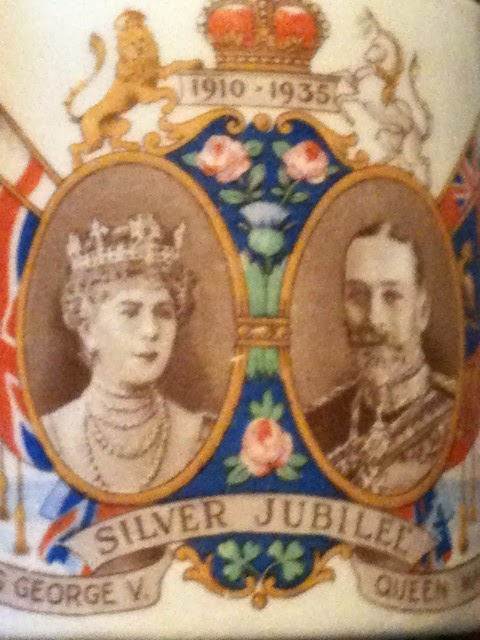
Object of the Day: A Souvenir of the Silver Jubilee of King George V and Queen Mary, 1935

Words cannot express my thoughts and feelings. I can only say to you, my very dear people, that the Queen and I thank you from the depths of our hearts for all the loyalty, and may I say, the love with which this day, and always, you have surrounded us. I dedicate myself anew to your service for the years that still may be given me.
--King George V on the anniversary of his accession, May 6, 1935

In 1935, the British people celebrated the Silver Jubilee of King George V and Queen Mary, marking twenty-five years since the King’s accession to the throne. On May 6, 1935, amidst much cheering and shows of loyalty, the King addressed his people with a message to the Empire which was simultaneously broadcast via wireless.

By this point, King George V was suffering terribly after a series of debilitating physical events. His poor health is evident in his voice when one listens to surviving recordings of his message. The King concluded his message with the very same words that his grandmother, Queen Victoria, used in addressing the people on the event of her Diamond Jubilee. George V was to die shortly after this, leaving Queen Mary to deal with the aftermath of her son’s (The Prince of Wales, briefly King Edward VIII) abdication.

However, the Jubilee was marked by great joy. As remains the custom, a variety of souvenir items were produced for the event. This is one of them. This small china cup bears the images of King George V and Queen Mary surrounded by visual representations of the Empire and marked on the reverse with their cipher.