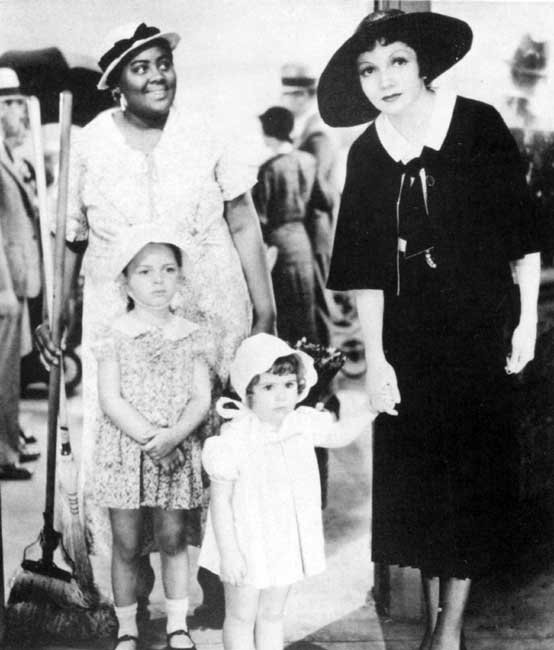
Claudette Colbert, Louise Beavers, 1934
Universal Pictures
In 1933, novelist Fannie Hurst wrote a controversial novel about racism and sexism in 1920’s America. In the novel, a young widow, Bea Pullman, with a small child and an invalid father hires an African American woman, Delilah, to help her with the responsibilities of running a home and business. Quite impoverished, Bea has continued her late husband’s business of selling maple syrup door-to-door. Though Bea can’t afford to pay Delilah, the woman happily agrees to work in the Pullman household so that she’ll have a comfortable home for her daughter, Peola. Peola’s father was a very light skinned African American man, and Peola appears to be Caucasian. Throughout the novel, Peola struggles with her white appearance and her black heritage with tragic results.
A scene from the 1934 film
Universal Pictures
A film version was produced in 1934 by Universal Pictures starring Claudette Colbert as Bea Pullman and Louise Beavers as Delilah. The film also starred Warren William as Bea’s love interest and Ned Sparks as her eventual business partner. Directed by John Stahl, the film stays relatively true to its source material with some exceptions. For some reason, Bea’s business venture changes from waffles to pancakes and the character of her invalid father is removed. The name of her love interest is changed along with some other minor details. The original script for Imitation of Life had a difficult time being approved by the Production Code Office who objected to the more overt depictions of racism and insisted that they be removed. Universal pictures agreed to change the more controversial elements and language in the story.
Lana Turner and Juanita Moore, 1959
Universal Pictures
Curiously, Universal decided to remake Imitation of Life in 1959. This version of the film, while still keeping the same themes—is vastly different than its predecessor and source material. In this version, the protagonist is also an impoverished widow, but she’s an aspiring actress named Lora Meredith. After misplacing her daughter on the beach, she finds Annie, an African American woman who has a light-skinned daughter named Sarah Jane. Lora agrees to give Annie and Sarah Jane a home though she can’t afford it. As Lora’s career takes off, she’s a less attentive mother than she should be, and, in some cases seems unaware of the drama involving Sarah Jane’s personal identity. Lana Turner plays Lora Meredith with Juanita Moore as Annie, Sandra Dee as Lora’s teenage daughter, Suzie, and Susan Kohner as a grown-up Sarah Jane. Other notable cast members include John Gavin, Robert Alda and Troy Donohue.
Very pink and yellow...
Lana Turner, 1959
Universal Pictures
While the outcome of the 1959 Imitation of Life is the same as the novel and first film, the journey toward that end is vastly different and considerably more tawdry. Filmed in almost blinding Technicolor, the picture is visually interesting with gorgeous costumes and jewelry, but lacks some of the power and social consciousness of its predecessors. Still, it’s a fun film to watch.
Both versions of Imitation of Life have been released on a double-sided DVD. I would strongly recommend it. Having both films gives you a chance to compare and contrast, and it’s an excellent way to spend a Sunday afternoon. Here are the first sequences of both films.
Philippe Mercier, painter and librarian to the Prince of Wales from 1728-1738, often sketched and painted scenes of daily life at the royal residences. This scene of a music party from 1733 shows a typical day in the life of the Royal Family of the Eighteenth Century. Here, we see Frederick, The Prince of Wales playing the cello. He is accompanied by his sister, Princess Anne, playing the harpsichord. Anne had been taught by Handel himself and by all accounts was just as skilled a player as he instructor. Also with them are Princess Caroline on the lute and Princess Amelia who reads aloud from a book of Milton’s poetry.
This painting was criticized for a number of reasons. First of all, Frederick’s love of playing the cello was considered unseemly and not appropriate for a man of his station. Similarly, the princesses are attired in costumes which were considered common and not the stuff of royalty. Still, Mercier argued that he depicted the scene as it actually happened.
One of three versions of this same scene, the other two, painted after this one, show the sitters in a more opulent outdoor setting and in costumes which were generally considered to be more fitting to their royal dignity.
It’s hard to imagine anyone other than Vivien Leigh as Scarlett O’Hara, but we’re all aware of the famous search for Gone with the Wind’s leading lady.Almost every available female star of the era was tested for the part.Some, like Paulette Goddard, were true contenders for the role.Others, such as Lana Turner, delivered truly cringe-worthy performances.Enjoy this smattering of screen tests from Selznick Pictures as David O. Selznick searched for his Scarlett.
The days following Christmas haven’t been so very merry for Julian/Punch and his companions. Not only did they quickly depart Marionneaux for New Orleans, but they came to the city just as Iolanthe Evangeline was welcoming a very unwelcome visitor from England—namely Julian’s mother, The Duchess of Fallbridge. Iolanthe wasted no time in blackmailing the Duchess with the information that it was Her Grace who ordered the murder of Julian’s father, Sir Colin Molliner. With the Duchess firmly in her grip, Iolanthe was ready for the next phase of her dastardly plan. The arrival of the Duchess didn’t make for very happy family reunions. Her Grace was shocked to find that her daughter had not only had a child, but was also married to the Duchess’ former footman. To make matters worse, the Duchess learned that Barbara was working as one of Iolanthe’s girls. As she’s prone to do, she took her anger out on her son. However, she wasn’t greeted warmly at Dr. Biamenti’s Royal Street mansion when Mr. Punch told her exactly how he felt and his friends made a great show of their support.
Meanwhile, Marjani suffered a terrible loss. After her long struggle with the Yellow Fever, Nontle died—leaving her small daughter, Columbia, to be raised by Marjani. Marjani received a surprise when Mr. Fontanals freed her. But, she didn’t leave before making her opinion of the man clearly known. On her way to New Orleans, look for Marjani to rejoin the only people who have truly supported her.
Of course, the Duchess isn’t the only trouble that Mr. Punch and his companions must contend with. Ulrika Rittenhouse is also in New Orleans—along with Arthur. As she continues to drug both Arthur and Barbara, we’ll see two forces—Iolanthe and Ulrika—struggle for control.
This coming week promises a lot of excitement in Punch’s Cousin. As Mr. Punch and his friends prepare themselves for Edward Cage’s masquerade ball, they’ll face challenges both new and old. Loyalties will be tested, and we’ll see one force get the upper hand. With three powerful women struggling for dominance, who will be caught in the crossfire?
You still have a chance to read a preview of The Cages of Marionneaux. This upcoming novel—a companion to both Punch’s Cousin and The Garnet Red will be available soon. So, keep coming back to learn how you can order the book.
My mother is a very skilled needlepoint artist.When I was a little boy, she made a lovely needlepoint stocking for me.In 1979, she created a small companion piece for the large stocking.This beautiful stocking hangs on the Christmas tree.Expertly crafted, this little stocking shows a true mastery of the craft with its series of very complicated stitches and knots.After thirty-one years, it retains its original brilliant colors and is a cheerful addition to the tree.
Black and White Whisky—a branded blend of Scotch whisky—was created in London by James Buchanan, a famous merchant. Originally, the brand was called, “House of Commons,” but due to its black and white labels became colloquially known as “Black and White.” Buchanan officially changed the name of his product to Black and White in the 1890’s and devised an advertising campaign which featured a Scottish terrier (Blackie) and A West Highland White Terrier (Whitey) who would be the spokesdogs for the brand for many decades to come.
This ad is dated 1952, and features Blackie and Whitey as movie stars singing the praises of the famous spirits. This is one of a set of three which were purchased on a trip to Louisiana. I’m not a drinking man, but I couldn’t resist these smiling canine faces.
As we approach Christmas, Stalking the Belle Époque will feature a look at some holiday-related items. We’ll continue our tour of the Christmas ornaments that I’ve collected over the last three decades. We’ll also have a look at some famous Christmas presents that have been given to notable historical figures during the last few centuries. Our usual journey into classic films will lead us into an exploration of two holiday favorites—the 1951 British film adaptation of Charles Dickens’ A Christmas Carol and the film version of raucous Broadway play, The Man Who Came to Dinner.
Our trek across the globe will land us in Atlanta, Georgia as we take a look at one of the Southern United States’ most unusual and attractive mansions—Rhodes Hall. Of course, as always, we’ll get glimpses into the world’s finest museums as we study the art and artifacts which have shaped our culture.
Don’t forget, you still have one more week to vote for your choices in both Humanitarian of the Year and Person of the Year. Voting ends on Sunday, December 12. I’m curious to see who you’ll pick.
There’s a lot in store for you this week at Stalking the Belle Époque. I can’t wait to share it all with you.