Thursday, June 21, 2012

Figure of the Day: Polito's Royal Menagerie, 1830

Polito's Royal Menagerie
Staffordshire, 1830
The Victoria & Albert Museum


Made in Staffordshire circa 1830, this celebrated, exceptional mantelpiece ornament is considered the most elaborate of the early Nineteenth Century figural groups by the Staffordshire factory. This was the last hurrah of the figural groups before the concern focused on the less expensive flatbacks for which Staffordshire is now famous. The earthenware piece is made-up of castings from two separate moulds which have been assembled by a “repairer” before firing and adorned with painted and sponged enamels. The cost of producing such a piece prohibited further manufacture on a broad scale.

The group depicts the entrance of one of the famous travelling menageries of Stephen Polito, the self-styled “modern Noah.” The traveling show was called “Polito's Royal Menagerie of the Wonderful Birds and Beasts from Most Parts of the World.”


Object of the Day: A Trade Card for Ayer's Pills

Click above image to enlarge.


Dr. James Cook Ayer (1818-1878) of Lowell, Massachusetts was one of the wealthiest patent medicine makers in Nineteenth Century America. Ayer was famous for both his Sarsaparilla and his Cathartic Pills.

We’ve looked at several examples of American Victorian trade cards advertising for Ayer’s Sarsaparilla, but here’s one for Ayer’s Pills—clearly marketing them to young ladies.

The front of the card has a very attractive illustration of several healthy looking young girls and adolescent young ladies—all of whom look very healthy. They hold a banner which reads:

“THE LITTLE FAVORITES”
AYER’S PILLS – SUGAR COATED 

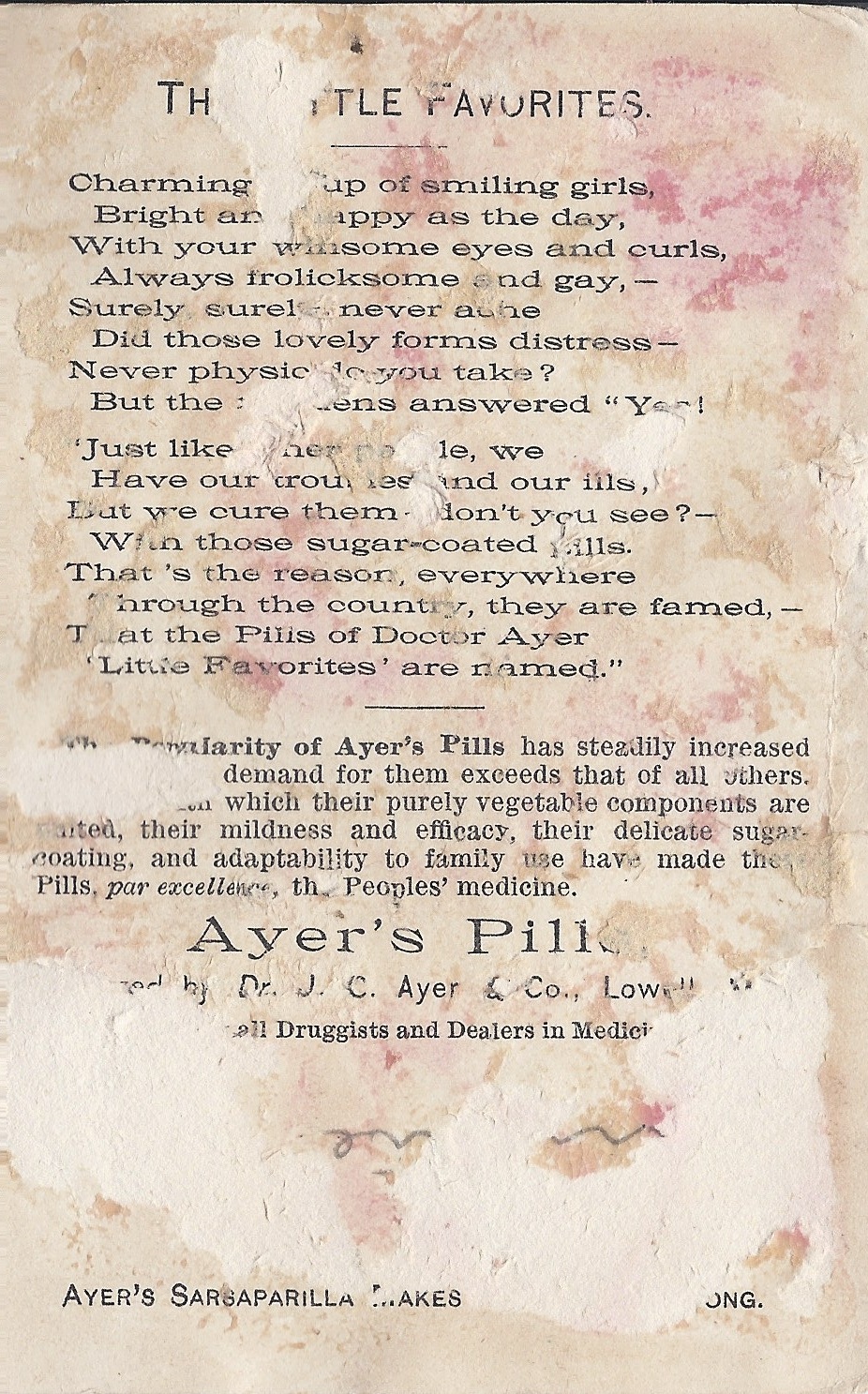
Sadly, the reverse of the card has been damaged. The card was once glued into an album. This is to be expected since these cards were collected for that purpose. Frankly, it’s rare to find one that isn’t ruined on the back. Since it was removed from the album, only part of the original text remains as you can see in the photo below. However, let’s see if we can’t piece some of it together.

It reads:

THE LITTLE FAVORITES 
_______

Charming group of smiling girls 
Bright and happy as the day, 
With your winsome eyes and curls, 
Always frolicksome and gay, -- 
Surely, surely never ache 
Did those lovely forms distress – 
Never physic did you take 
But the _________ens answered, “Yes!” 


Just like __________le, we 
Have our troubles and our ills 
But, we cure them, don’t you see? – 
With those sugar-coated pills. 
That’s the reason everywhere 
Through the country, they are famed, -- 
That the Pills of Doctor Ayer 
“Little Favorites” are named.” 


The popularity of Ayer’s Pulls has steadily increased 
________ demand for them exceeds that of all others 
________ which their purely vegetable components are 
____, their mildness and efficacy, their delicate sugar- 
coating, and adaptability to family use have made them 
Pills, par excellence. The People’s Medicine. 

Ayer’s Pills 

Created by Dr. J.C. Ayer & Co., Lowell, Mass. 

Sold by all Druggists and Dealers in Medicine 

Ayer’s Sarsaparilla Makes _________________ng.


Wednesday, June 20, 2012

Mastery of Design: The Carlo Giuliano Mother-of-Pearl Brooch, 1865

Brooch of Mother-of-Pearl and Gold
Carlo Giuliano, 1865
The Victoria & Albert Museum


Inspired by the shape of an ancient Greek leather shield, this brooch of gold and mother-of-pearl is decorated with twisted gold wires, with grains of gold, and with two cast lion masks and three cast heads of lionesses.

This piece, dating to 1865, is the work of Carlo Giuliano (1826-1895) who trained in the celebrated Castellani workshops in Rome before he accompanied Alessandro Castellani to London, in 1860.

In London, Giuliano established his own manufactory at 13 Frith Street in Soho. His work soon caught the attention of important patrons, and it was, notably, much-admired by the Pre-Raphaelite painters and their circle. Upon his death, Giuliano bequeathed his collection of jewelry to the South Kensington Museum (now the V&A). Sadly, most of the best pieces of the collection were stolen in 1899 and never recovered. Giuliano’s sons Carlo Joseph and Arthur made a further gift in 1900, which included this brooch.


Gifts of Grandeur: The Pearwood Mirror Back, 1901

Carved Mirror Back of Pearwood
Francis George Wood, 1901
The Victoria & Albert Museum


Usually, hand-held mirrors such as this were made as part of a lady’s dressing table set. This one, however, stands alone. It was made as a competition entry for National Competition of Art & Design, held by the Government School of Design in London in 1901. The maker of this decorative back for a mirror won the top honors at the competition. His name was Francis George Wood.

Wood attended the Salford School of Art--one of a network of local art schools that had been established in Britain from the 1850s onwards. Such schools provided training for artists and designers with the intention of finding them employment in manufacturing. The hope was to improve the overall quality and artistry of Britain’s manufactured goods. The idea became quite popular following the Great Exhibition of 1851 when all of Britain’s wares were on display for the world to see. That triumph, spurred by Prince Albert, set the standard for the quality of British manufacture, and it was a standard which trained artists such as Wood hoped to surpass. 


Wood’s work is exquisite. He relies on fashionable themes of the early Twentieth Century, but approaches them with a new energy. Daffodils were a popular decorative motif at this time and Wood plays with the shape of the flowers, creating an ornament of intertwining stems and leaves which shows the influence of the Arts and Crafts designer Walter Crane (1845-1915), as well as continental Art Nouveau. Wood’s triumph with this design brought him to national attention.

History's Runway: An Evening Gown from The House of Worth, 1910

Evening Gown
The House of Worth, 1910
Paris
This and all related images from:
The Victoria & Albert Museum


The famed, eponymous, Parisian fashion house created by Charles Frederick Worth (1825-1895), in 1910, created evening dresses with a straight silhouette, leading other designers to create similar shapes. Since the designs themselves were rather simple, they relied on color and texture to create dramatic impact. Embroidery, beading, sequins and other decoration added an additional theatricality.

This exquisite gown from the House of Worth juxtaposes a vivid velvet pile against a light-reflecting beadwork, and a triple-tiered matt net overskirt which covers the whole of the shimmering, trained satin skirt. The outline of the gown is that of a pillar or sheath—a stark contrast to the voluptuous curves of the early 1900s. Still, old habits are hard to break and the bodice is boned. 


The Home Beautiful: The “Flora's Train” Tiles, 1900-1901

Set of Six Tiles called "Flora's Train"
Walter Crane, 1900-1902
This and all related images from:
The Victoria & Albert Museum


Circa 1900, Victorian artist and illustrator, Walter Crane (1845-1915) designed this set of six tiles which, while similar to the style he used for book illustrations, also shows the influence of the rising Art Nouveau. The tiles have been molded so that the outlines of the patterns are raised in relief. Obviously, the design for the tiles was created before they were fired, allowing this relief to have been made. Each pale blue tile depicts a female figure.

On each tile, the gown worn by the woman depicted has been colored to match the flower with which she has been posed. The flowers depicted are: cornflower, blue-bell, columbine, anemone, poppy and daffodil

Made in Clifton Junction, (near Manchester) England at Pilkington's Tile and Pottery Company, the set of earthenware tiles was called "Flora's Train.”


Mr. Punch of Belgrave Square, Chapter 67


Chapter 67: 
Transportation 


“No one would done believe it,” Gamilla shook her head as she stared out the window of the carriage.

“What’s that?” Ellen asked, smiling at the girl from across the carriage.

“I done rode on a train.” Gamilla giggled. “A train! Me! Who’d think? And…now, I’m in Scotland.” She shook her head again. “When I was just a girl, I never thought I’d see all this.”

“What did you think you’d see?” Ellen asked.

“Our village, I reckon.” Gamilla shrugged. “Never knew there were places like England and Scotland. All I knew was a little bit of land in Africa. I gotta say, when we was taken to America, I was terrible frightened. I was just a girl…a baby, really. Oh, the things, I saw. I’d never want you to know, Miss. When we got to America, I thought that was it. I done thought my life was over. But, I got lucky. I got picked for house work. And, Mr. Fontanals—well, he wasn’t too bad. He left me alone at least. If I’d been older, maybe…well…”

“I understand.” Ellen nodded.

“Well, see…Mr. Fontanals, he sold me.”

“Why did he sell you?” Ellen asked. She paused. “Isn’t it terrible to even say the words? To think of a person being bought and sold…”

“It’s jus’ a fact, Miss.” Gamilla shrugged. “You know? I never knew why he sold me. I reckon that he found a prettier girl to work in the house. Marjani’s daughter…”

“Marjani?” Ellen nodded. “You’ve mentioned her to me before. She’s the woman who is raising her granddaughter—the woman who worked for His Grace and Dr. Halifax.”

“She didn’t really work for the Duke, no. Not actually. She’s a nurse. They’re friends. But, yes, you remember the woman I mean.” Gamilla sighed. “See, bein’ sold, for me, really was the luckiest thing of all. Dr. Halifax’s brother bought me. And, he set me free. Then, I come here. And, now, I done rode on a train. And…look! Right out that window is Scotland! I done seen the world, Miss. Never thought it would happen. I even seen where the Queen of England lives.” Gamilla wiped a tear from her eye. “My master is friends with the Queen of England. She done been in the house where I live. Imagine.”

Ellen smiled. “It is exciting.”

“You must be awful excited, Miss.” Gamilla took a deep breath. “This is where you’re from, ain’t it?”

“Well, yes and no…” Ellen nodded. “I did spend much of my childhood in Scotland.”

“With your brothers?”

“Yes.” Ellen continued. “We moved to London when I was…well…an adolescent. My father had opportunities. Also, we hoped that we could find help for Roger.”

“So, you all up and moved?”

“Not all of us. One of my brothers stayed behind. The eldest. He’d found a girl and they married.”

“So, you and your mama and pa and the other boys…”

“Not my mother.” Ellen sighed.

“Oh?”

Ellen pointed out the window of the carriage. “We’re nearly there.”

Gamilla nodded, realizing that Ellen didn’t wish to discuss her past any longer.

“It’s beautiful country, Miss.” Gamilla smiled. “The Duke tells me that Their Majesties done got a house near his.”

“Balmoral,” Ellen nodded. “It’s lovely—I’m told. I’ve never seen it close up, and certainly not since Their Majesties have owned the land. I read that they launched a campaign of renovation on the house, but that it’s still too small. When we ride by, I’ll point it out. The Duke tells me that we should be able to see where they’ve cleared the land for the new castle.”

“Will there be a new castle?” Gamilla’s eyes widened.

“Oh, yes.” Ellen nodded. “Prince Albert has already commissioned an architect. I read in ‘Punch’ that they’re going to start this summer and that they’ll build the house from granite quarried from the estate.”

“Punch,” Gamilla grinned.

“The London Charivari…” Ellen smiled politely. “It’s a periodical…”

“Oh, I know, Miss.” Gamilla laughed. “The name makes me smile since…well, you know why.” She paused. “It’s an interestin’ periodical, Miss. I done read it. The Duke gives me his copy when he’s finished with it.”

“Oh.” Ellen replied.

“Didn’t think that somethin’ like that would interest me?” Gamilla chuckled.

“I didn’t say that.” Ellen said dramatically.

“It’s all right, Miss. I’m only teasin’ ya.” Gamilla grinned.

Ellen nodded.

“Punch.” Gamilla tittered. “I sure am glad that the last two days have seen His Grace get stronger.” She continued.

“Yes.” Ellen smiled. “It’s miraculous.”

“It’s like God done jus’ wanted him to go to Scotland and see his papa’s family home. He jus’ lifted the illness right off him.”

“I sincerely doubt that God cares if the Duke of Fallbridge returns to his father’s ancestral home.”

“Maybe,” Gamilla shrugged. “Jus’ seemed like a nice thought. Still, I sure am glad he’s better. When we last stopped, I noticed he even had that twinkle in his eye again.”

“I can’t imagine why.” Ellen muttered.

“What’s that?” Gamilla asked.

“It’s just that riding all this way in a carriage is arduous enough, but His Grace has endured it with a baby and a dog.”

“But, he wanted to, Miss. He said he wanted to be able to sit with Colin and Dog Toby and the doctor for their first time riding through Scotland. It’s sweet. His Grace loves his family so much.”

“All of his family?” Ellen mumbled.

“What’s that?”

“Oh, nothing.” Ellen sighed. “I was just remembering that His Grace has a sister.”

“Uh huh.” Gamilla frowned. “Miss Allen.”

“Pardon me?”

“Well, Miss. I don’t know how much you been tol’ ‘bout the Duke’s sister, but when I met her she was called ‘Barbara Allen.’”

“I only know a little about it.” Ellen shook her head. “I’m sorry. I shouldn’t have brought it up. It’s just that…well, I suppose being back in Scotland has made me nostalgic. I was thinking of my own family.” She took a deep breath. “I’m so excited for you, Gamilla. You’re going to have such a good time at Grange Molliner. I visited there as a girl.”

“You said, Miss.” Gamilla answered. “I think that’s wonderful that the Duke lets the house be open to visitors like he does. Ain’t it funny? Bet you never thought you’d work for the man who owns it.”

“No…I never thought that.” Ellen smiled strangely.

Gamilla squinted at the governess.

“I think all this rocking and bumping has made me a little dizzy.” Ellen sighed. “I…ummm…I’ve always found carriage rides to be torture.”

“I like ‘em.” Gamilla giggled. “But, you do look a little poorly. Can I get ya anythin’. We got some water or maybe a little digestive biscuit to settle your stomach.”

“No…I’m fine. Thank you.”

“You don’t look so fine.”

“It’s just the carriage rocking…”

“Hope you ain’t getting’ sick, too.” Gamilla looked at Ellen with genuine concern. “I know Charlie and Gerry say that His Grace was poisoned, but maybe he really was sick. You don’t feel sick, do ya? Are ya warm?”

“Sweet Gamilla,” Ellen reached across the carriage to pat the woman’s knee. “How you worry. I promise, I’m just weary from the ride.”

“You’ll let me know if you feel worse?”

“Certainly.” Ellen smiled. “I’m so thankful for your friendship. I think you’re my only friend.”

“No.” Gamilla shook her head. “Everyone in the house likes you, Miss.”

“Well, not everyone.” Ellen laughed. “Charles is not too fond of me.”

“Oh…you don’t worry none ‘bout Charles. He takes a long time for to warm up to folk. Took him months before he liked any of us. He’s a funny boy, but he’s so nice when you get to know him. Give it time, Miss.”

“Thank you, Gamilla, I will.”

“Oh!” Gamilla pointed out of the window. “Look there…” She pointed. “Look at them men haulin’ away them big trees. Is that…? Is that Balmoral?”

“Yes.” Ellen replied. “Looks to me that they’re just about ready to start construction of the new castle.”

“How excitin’!” Gamilla chirped. “So, we ain’t far from Grange Molliner?”

“No.” Ellen grinned.

“Good.” Gamilla cooed. “We’ll get ya out of this carriage and into a nice bath. You’ll feel better.”

“Don’t worry about me.” Ellen winked. “Everything I need will soon come to me.”


Did you miss Chapters 1-66? If so, you can read them here. Come back tomorrow for Chapter 68 of Mr. Punch of Belgrave Square.