Monday, June 25, 2012

Mastery of Design: An English Citrine and Gold Brooch, 1850-65

Brooch of Citrine and Stamped Gold
1850-1865
The Victoria & Albert Museum


Citrine, a type of quartz can vary in color from the more common yellow to red, brown or orange. Of course, the stone is usually a lemony, sunshiny color—like citrus fruit, hence the name which derives from the French word, “Citron.” The main source of citrine is Brazil.

Here’s a handsome citrine brooch which dates between 1850 and 1865. The brooch is set in stamped gold and was made in England by a now unknown jeweler. 


The Home Beautiful: The William Morris "Fruit" Wallpaper, 1862

Sketch for Fruit Wallpaper
William Morris, 1862
The Victoria & Albert Museum


Designer and famous socialist William Morris (1834-1896) is known for his handsome designs and patterns. His style developed over the decades. Here’s a look at an early wallpaper pattern which is known both as “Fruit” and “Pomegranate” and dates from around 1862.

Morris used visual motifs from his medieval-style tapestry work, relying on the historical look which his earlier work shared with the Pre-Raphaelite Brotherhood. We see, however, the awakenings of Morris’ interest in naturalism and plants.

This sketch varies from the finished wallpaper. The olives were replaced with peaches in the finished product. Morris deemed the olives too delicate and difficult to see. The pattern forms the basis for the original wallpaper which was used for the V&A's Green Dining Room, circa 1866—now long gone.

History's Runway: Lady Gladwyn's 1957 State Visit Gown

Gown by Pierre Balmain
French, 1957
The Cecil Beaton Collection at
The Victoria & Albert Museum


Lady Gladwyn’s name is synonymous with “high fashion.” She was the wife of the British Ambassador to Paris from 1954 to 1960. Lady Gladwyn famously hosted the state visit of Queen Elizabeth and Prince Philip at the French Embassy on Tuesday April 9, 1957, at which this dress was worn.

This floral masterpiece was designed by Parisian couturier Pierre Balmain (1914-82), and showcases, on the bodice, the appliqué technique which was characteristic of his work. The full-length evening dress of cream warp printed silk is emblazoned with an oversized pink rose pattern. The strapless, boned bodice, scalloped at the waist, is trimmed with appliqué roses below the bust line and to the waist.

Lady Gladwyn wrote in her diary that night:

The supper was, I think, just right for the occasion: cold salmon, chaudfroid of chicken, a salad, oranges and lemons filled with sorbet, and a wonderful Bollinger... The difficulty was to get rid of all the guests. They lingered on, and at half past one in the morning Cecil Beaton was still sketching Diana Cooper in the Ionian Room.

Speaking of Cecil Beaton, the celebrated society photographer and bon vivant collected several of the dresses worn during this state visit so that he could donate them to the V&A. Among the gowns which Beaton managed to add to his collection from this 1957 state visit are the Queen's embroidered ivory gown by Norman Hartnell (1901-79), Lady Gladwyn's lilac lace gown by Jacques Fath, and Baroness Alain de Rothschild's spotted tulle gown by Christian Dior (1905-57).


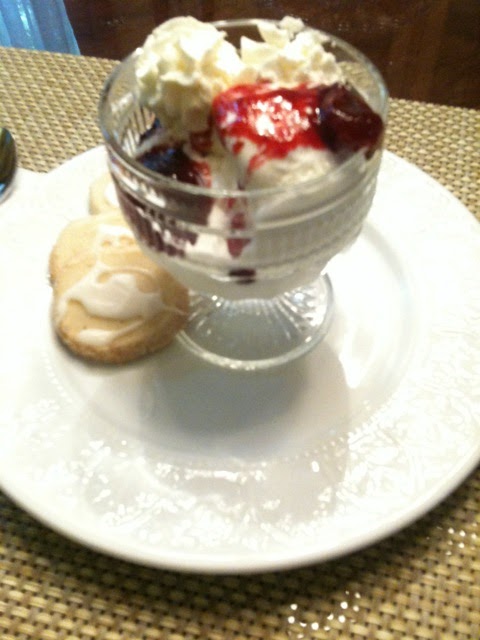
Treat of the Week: Lemon Icebox Cookies with Lemon Chiffon Ice Cream and Cherry Sauce


A wonderful dinner of my mother’s homemade red sauce and meatballs made our Sunday together a very special occasion. Accompanying the dinner was a luscious, cool tomato and mozzarella salad with a fresh lemon-herb dressing which absorbed nicely into the wonderful rosemary bread that my mother served with it. The lemon in the dressing set the stage for the real showstopper which was to follow. 


This week’s treat of the week is a double feature. First, we have homemade lemon icebox cookies. The dough includes lemon juice and lemon zest. It is then chilled in a log, rolled in turbinado sugar, cut and baked. The finished cookies have a glorious, mellow lemon taste. A drizzle of lemon-infused sugar glaze adds extra beauty for the taste buds as well as the ice.

Along with these lovely cookies, we were treated by another of my mother’s brilliant ice cream creations made in her Cuisinart Ice Cream Machine. This lemon chiffon ice cream is flavored with just a little lemon extract and has a refreshing, light lemon taste. My mother created a special sauce to go with it. The sauce included pitted fresh cherries, brandy and cassis and is a truly excellent accompaniment to the smooth lemon ice cream. 


I confess, I ate quite a lot of this yesterday, and I don’t regret one bite. As the temperatures soar, there’s little that’s more simultaneously soothing and invigorating than the flavor of lemon.


Mr. Punch of Belgrave Square, Chapter 71


Chapter 71: 

Otherwise 


“Ach, Girl.” Mrs. North clucked her tongue. “Your silence tells me more than any words.”

“Mrs. North,” Gamilla said quickly. “This boy here, he was adopted in New Orleans—in America. His mama and papa died from the Yellow Fever at the same time the Duchess of Fallbridge died. His Grace—he adopted the boy out of love and kindness.”

“Why do you lie to me, Girl?” Mrs. North smiled.

“It’s not a lie, Mrs. North.” Charles spoke up.

“No, Ma’am.” Gerard shook his head. “That’s the truth.”

“Aye, boys.” Finlay chuckled. “There won’t be any convincin’ of Mrs. North otherwise. Once she makes up her mind, lads, she’s unmovable. I’ll tell ya this—I’ve known this woman since I were born and there wasn’t one time, not one, then, that I can think of when she wasn’t spot on.”

Gamilla, Charles and Gerard exchanged glances.

“Look, lass, I’m only tryin’ to protect the master and the family.” Mrs. North sighed. “How’m I to do that without the whole story?”

“But, Mrs. North.” Charles began…

“You English…” She clucked her tongue again. “You and your denials.”

“I’m not English.” Charles snorted.

“Nor am I.” Gamilla smiled.

Gerard shrugged. “I am. But…”

“You’re all loyal to the master?” Mrs. North asked.

“Certainly.” Charles nodded. “We all came with him from America. You’ll not find a group of people more loyal.”

“’Cept maybe here, lad.” Mrs. North winked. “How’s this for loyalty? I spent me life in this empty house—bein’ visited by the old master maybe five times and even less by His Grace when a man. Day in and day out, we fight to keep the Grange from fallin’ into the ground. No one knows. No one cares. So, why do we do it? Loyalty! All you in your fine townhouse—you see the Duke every day. He sees how keen ya are to help him. He can thank ya for a cup of tea. He can praise ya for paintin’ the balusters. Us? We get a letter at Christmas thankin’ all of us at once. Yet, we do our jobs for we wish to see the Molliner name be one of great pride. Maybe we don’t hear the London rumors as they’re spoken, but they come to me nonetheless. You can shut the gobs of them pages and clerks in the pubs what talk of the Duke, lads. And, you, Girl, you can stop the girls at the market quick enough. Sure, and maybe you know the truth, so it’s easy for ya to stop them talkin’! What do we know? One day, we hear the Duchess is dead and the Duke is the heir. One day we hear he has a new ward. We hear he’s mad! We hear he’s all sorts of things! What do we got to fight with, then? Just our loyalty—that’s what.”

Charles bit his lip.

“Mrs. North,” Gamilla spoke up. “We don’t doubt that you’re loyal to His Grace…”

“Then, why won’t ya confirm what I can see plain ‘nough on me own?” Mrs. North growled. “This tot is a Molliner sure ‘nough.”

Mrs. Pepper stormed into the servants’ hall from the kitchen. “Now, I’ve heard enough. Mr. Speaight always tells us that it’s not our place to discuss our betters.”

“And, where’s your Mr. Speaight now, Pepper? In his room with a wet rag on his head! You English—you’re all so high and mighty.”

“I won’t be spoken to that way in my kitchen!” Mrs. Pepper barked.

“Ain’t your kitchen, woman! It’s my kitchen. You’re a guest here.”

“Any place the Duke brings me is my kitchen.” Mrs. Pepper snapped.

“Sure, it is.” Mrs. North laughed.

“Well, I never…” Mrs. Pepper snorted.

“Sure ya have.” Mrs. North howled. She pointed at Colin. “You mean to tell me, Pepper, that this boy don’t look like His Grace to you?”

“I never thought of it,” Mrs. Pepper replied stiffly.

“So, think of it now!” Mrs. North said.

“It ain’t my place, Mrs. North!” Mrs. Pepper shouted.

“Yes!” Gamilla yelled above the din of the two women arguing.

“Yes?” Mrs. North smiled.

“Yes. Colin is the child of the Duke’s sister.” Gamilla said softly.

“Gamilla!” Mrs. Pepper scolded.

“Mrs. Pepper, she’d have found out one way or another. Besides, she already done knew.”

“But, you can’t say that.” Mrs. Pepper hissed. “You don’t know.”

“I do know.” Gamilla shook her head. “I know all too well.”

“We all do, Mrs. Pepper.” Gerard shook his head. “’Specially Charlie.”

“I…” Charles grumbled. “I…had a friendship with…the lady. The child is hers.”

“Are you the father, then?” Mrs. North asked.

“Is this true?” Mrs. Pepper sniffed.

“I’m not the boy’s father, Mrs. Pepper.” Charles replied. “But, the child was born of Lady Barbara. His Grace adopted the boy in order to protect him.”

“And you three kept this secret all this time?” Mrs. Pepper nodded.

“We did, Mrs. Pepper.” Gerard mumbled.

“And, it’s fine that ya did.” Mrs. North interrupted. “And, what’s just been said in this room is still a secret—not to leave these walls. You hear me, Finlay!”

“Yes, Mrs. North.” Finlay smiled.

“I’ll make leather of ya if I hear you say a word.” Mrs. North continued.

“I understand.” Finlay replied.

“As for you, Pepper,” Mrs. North smiled. “I understand what you was sayin’. But, I gotta know the truth. It’s the only way for me to know how to best look after the master.”

Mrs. Pepper sighed. “You Scots…”

“But, ya understand?”

“I do.” Mrs. Pepper nodded.

“So, who’s the father?” Mrs. North grinned.

“No one knows.” Charles replied.

“Really?” Mrs. North nodded. “So, Lady Barbara turned out to be round-heeled?”

“She was a…” Gerard began. He stopped, thinking better of it.

“Was she paid for it, then?” Mrs. Pepper asked, blushing.

“Now, now, Pepper.” Mrs. North laughed. “I thought you didn’t ask questions about your betters.”

“Clearly, this girl was no better of mine,” Mrs. Pepper replied firmly.

“Yes, Mrs. Pepper.” Gerard said softly.

“Poor lad.” Mrs. Pepper shook her head, looking at Colin. “He must never know.”

“Aye, and he won’t.” Mrs. North announced. “Now, we’ll not speak of this again! Back to work, all of ya! The master and Dr. Halifax will be goin’ for their walk soon ‘nough. I want tea ready for them when they return—that means Finlay, you show Charles and Gerard where…”

“I know me job, Mrs. North.” Finlay grumbled.

“None o’ your cheek, boy.” Mrs. Pepper and Mrs. North said in unison. They paused, both smiling at one another.

“As for you, Pepper…” Mrs. North said after inhaling. “You’re all right. But, I don’t care for your Mr. Speaight.”

“Still, Mrs. North,” Mrs. Pepper began. “He is your equal.”

“Aye.” Mrs. North frowned. “I’ll check on him, then. And, let him know he can plan tomorrow’s outing.”

Mrs. Pepper nodded and the two women walked into the kitchen together.

“Come on, Charles,” Finlay patted Charles on the back. “I’ll show ya the pantry.”

“Sure.” Charles nodded, following the man.

Alone with Gamilla and Colin, Gerard smiled. “My sweet, you handled that really well. I’m proud of you.”

Gamilla shook her head. “Didn’t know what to do. That woman she was…she was peckin’ at me like a hungry hen.”

“Like you said, she’d already figured it out.”

“I reckon.” Gamilla shrugged.

“We can trust her, ‘Milla.” Gerard nodded. “I’m sure of it.”

“I hope so.” Gamilla sighed, hugging Colin. “Don’t know what I’d do otherwise.”


Did you miss Chapters 1-70? If so you can read them here. Come back tomorrow for Chapter 72 of Mr. Punch of Belgrave Square.

Painting of the Day: Still Life with Fruit, a Lobster and Game, Late 17th C.

Still Life with Fruit and Dead Game
Michiel Simons, late Seventeenth C.
The Victoria  & Albert Museum


A stone table has been draped with a sumptuous, dark velvet cloth. Upon it, stands a roemer filled with white wine and a monumental porcelain bowl which has been filled with peaches, apricots, pears and grapes on the vine. A gleaming pewter plate artfully contains almonds and a partially peeled lemon with the voluptuous, curving rind still attached, curling over the table’s edge. A lobster has been placed on the cool surface of the table, along with a loaf of bread, red grapes, a pomegranate, more peaches, plums and pears and five small birds.

This typically Dutch still life is indicative of what I like to call the “Dead Animals/Rotting Fruit” style which was dominant in the Netherlands and in Flanders in the Seventeenth Century. This one is the work of Michiel Simons. Entitled “Still Life with Fruit, a Lobster and Dead Game,” this late Seventeenth Century work is really the ideal Dutch still life. In addition to showing a household’s wealth—noted with the ability to acquire exotic game, wine (usually served with lemon as it is here) and exceptional serving pieces, these still life paintings were the perfect opportunity for an artist to demonstrate his ability to capture different textures and lighting.

Object of the Day: A Trade Card for Coffee and Yeast

Click Above Image to Enlarge


Omaha Nebraska’s Consolidated Coffee Co. and German Yeast Co. must have had some tie to one another other than location. The two late Nineteenth Century concerns are often connected in advertising of the period. Take, for instance, this trade card which came with a large lot of Victorian cards which I recently purchased.

Both companies call their product “German.” The coffee is German and the yeast is, too.

Furthermore, the card has some mild German-esque visual cues as well.

The front of the card shows beautiful (I want to say Magnolia, but I know I’m wrong) white flowers in close-up over a European-inspired landscape of a mountain range over an aqueduct and Schloss. This rather mixed-up image is nicely illustrated and has been embossed, giving it nice depth. Furthermore, at one point, the flowers and the blue space to the right corner of the card was once coated with a fine layer of silver glitter. Only traces of the glitter remain, sadly—the glue having given up the ghost long ago.

Let’s take a look at the reverse. As I said, it’s a double whammy. Why note that the deal was perfectly harmless? That makes me think that it isn’t.


To the Lovers of a Good Cup of Coffee 
     IF you want a good, strong, and at the same
time a pleasant cup of coffee, always use the 

German. It is a perfect belnd of fine flavors, and
has no equal. Try it, and you will use no other.
Put up only in one pound air-tight packages,
The Coffee being hermetically sealed with a
perfectly harmless coating, holds it aroma un-
til ground.


                                                                              Roasted and Packed only by the 
CONSOLIDATED COFFEE CO., Omaha, Neb. 

One of these cards in every package of
German.

____________________________________________


Bread is the Staff of Life. 

     If you want a good, sweet, wholesome Bread,
Always use
German Hop Yeast. It is a
strictly Vegetable yeast, no Chemicals or Brew-
ery Offalls used in its composition. Only Ger-
man Hops used, costing twice as much as com-
mon Hops.
     One of these cards with each five cent pack-
Age of GERMAN HOP YEAST.


                                             Put up only by the 
German Yeast Co., 
                                                     Omaha, Neb. 

Consolidated Coffee Co., Proprietors.