Sunday, January 8, 2012

Mastery of Design: The Clockwork Peacock Brooch, c. 1880

The Victoria & Albert Museum


This would never be considered the finest jewel I’ve ever written about.  But, it’s cute and it does stuff.  An inexpensive  brooch, this is a great example of the cheaper, mass produced jewelry that was within the financial means of the middle and lower classes. This sort of novelty with a clockwork mechanism was meant to be worn for fun more so than fashion.

 
You see, the peacock’s tail feathers , when the mechanism is wound, revolve.  This bauble of  a gilded copper alloy is set with paste and adorned with bright enamel.  Made in Germany in 1880-1890, it’s a miracle that this brooch survives in working condition.  


Sculpture of the Day: The Death of Munrow, 1830

The Victoria & Albert Museum


Though rather naïve in its modeling, this ceramic sculpture depicts a serious subject--the death of Lieutenant Hugh Monro (Munrow), a young British army officer serving in India, who was mauled by a tiger while picnicking on a hunting trip in 1792.


Monro's gruesome death is thought to have been the inspiration for the creation of the automaton and mechanical organ called “Tippoo's Tiger” which is one of the V&A's most popular exhibits.  “Tippoo's Tiger” was created for the Indian ruler Tipu Sultan, who was said to have loathed the British so deeply that he commissioned the piece showing the dominance of India over Britain. 

This ceramic Staffordshire group from 1830 mirrors the design of the famed automaton, causing one to conclude that the modeler must have seen images of Tippoos Tiger which was a popular theme for engravings. 


Here, Monro reclines at the feet of the tiger, wholly unaware of his fate.  Monro was  molded from a model for a standing figure of a military hero.  The piece is brightly enameled and labeled as, “THE DEATH OF MUNROW.” 


Gifts of Grandeur: A (Naughty) Automaton Box of Gold, 1820

The Victoria & Albert Museum


With its delicately decorated case of scrolling foliage and a classically rendered musical trophy, no one could tell that the interior of this precious box holds an erotic scene.  In fact, that’s the only purpose for the box—just to hold this saucy animation. 

The cover of the gold case is chased and set with a band of opaque blue enamel with foliage.  It all looks so innocent and elegant—until you look inside.  The animated scene shows a standing nude couple, um…enjoying each other, before an altar, as a bystander plays a lyre—as one does.


The Art of Play: The Muriel Farr Automaton, 1890

The Victoria & Albert Museum


Though automata had been produced as early as ancient times, they were never more opular than in the Eighteenth and Nineteenth Centuries. By the Nineteenth Century, collectors of automata regarded French makers as the best, notably Roullet et Descamps, and Vichy and Lambert (the maker of the piece above).

Automata in the Nineteenth Century depicted attractive or amusing young women and men or animals for the most part. However, there was a small, but devoted group of collectors with a taste for grotesques ranging from demons, wizards, cigarette-smoking monkeys and racial stereotypes.

These complicated clockwork figures were anything by playthings for children, they were collector’s items prized for their artistic and scientific achievement and mostly collected by wealthy gentleman as status symbols. Most children (and, really, adults) only had a chance to see these novelties in shop displays.

Regardless of the venue, automata fascinated all who saw them—continuing the love affair that humans have with inanimate objects that replicate natural human emotions. It’s the same relationship that we have with robots and other contemporary amusements and technologies.

This figure shows such an automata stripped of her adornment. This piece, made between 1890 and 1900 by Leopold Lambert (with head and arms by Jumeau) is a mechanical and musical figure of a young Caucasian girl standing with her arms bent and raised. Her bisque head is set from inside with blue glass eyes, and her ears are pierced for earrings.

Her head , arms and hands move, but it has not so far been possible to identify exactly what the doll's actions represent, as her props and identifying costume do not survive. It is possible that she may have been smelling a perfume or a flower, or looking closely at something—a mirror or jewel perhaps. We’ll never know.

This figure was owned by one Muriel Farr as a child, but how a child came to own such a costly automaton is unknown. Since Muriel did not attain the automaton until 1918, it is thought that she was bequeathed the figure by a wealthy relative.


New Product in the Stalking the Belle Époque Store


Don’t forget to take a look in our online store.  From hats to bags and all kinds of clothes and other great gift items, there’s something for everyone!  Nine new designs include nods to the Bertie Dog and Mr. Punch and, our new Royal line introduces our first products for Queen Elizabeth’s Diamond Jubilee.  If you’re looking for a fun, unusual Valentine’s Day gift, this is the place for you!


And, for the reader in your life, my first novel, The Garnet Red is available for download via iBooks and Nook and in hardcover via Google Books and Amazon.com.


Unusual Artifacts: A Musical Automaton Snuffbox, 1786

The Victoria & Albert Museum


With the popularity of lavish snuffboxes as collectibles for the elite of the Eighteenth Century, it was only natural that luxurious novelty examples of these jeweled and gold creations would crop up.  Musical boxes and boxes with automata became popular in France and England in the late Eighteenth Century. In London, this phenomenon was described by Horace Walpole writing to Mary Berry in 1791:

"I should tell you that I have been at Sir Joseph Banks's literary saturnalia, where was a Parisian watchmaker who produced the smallest automaton that I suppose was ever created. It was a rich snuffbox, not too large for a woman. On opening the lid, an enamelled bird started up, sat on the rim, turned round, fluttered its wings and piped in a delightful tone the notes of different birds, particularly the jug, jug of the nightingale. It is the prettiest plaything you ever saw- the price tempting- only five hundred pounds'.

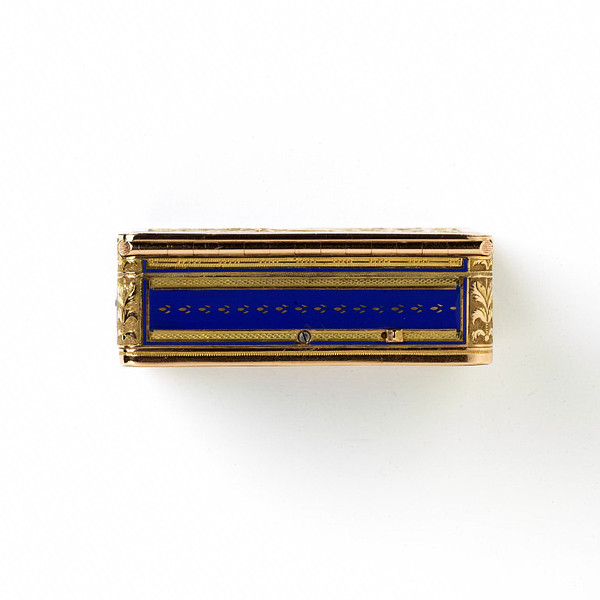
Let’s take a look at one—an example of colored gold showing, on the top, a scene of amorous couples in a landscape between a castle and a cliff.  Here, when the key is wound on the front of this box, a ship in full sail moves across the open sea. A button hidden on the front of the box activates a four-bell musical carillon. The movement was imported from Geneva, and the French case is marked for the maker Joseph-Etienne Blerzy, 1786.  


Object of the Day, Museum Edition: A Mechanical Turtle, 1600-1650

The Victoria & Albert Museum


What better way to start a Sunday than with a mechanical turtle? 


This little German curiosity was probably created to be displayed with other examples of scientific and artistic skill in a Kunstkammer--a room (or series of rooms) in a large private German or Austrian house or palace which was especially reserved for the private exhibition of rare, valuable and intriguing objects and artifacts.


Among the most popular items displayed in a kunstkammer were, generally, beautifully made automata in the late sixteenth and early seventeenth centuries.  The more unusual, the better.  Take this turtle for example.  Here, the animal’s head pokes out from under its shell as the object is rolled. The “merman” (not, “Everything’s Coming Up Roses,” but a male mermaid)  atop the shell is designed to raise its arms and bring its trident down on the head of the moving tortoise—as one does when riding a turtle. 


Even more curiously, this is made from a real tortoise shell which has been fitted with a brass head and feet--the mechanism hidden inside the shell. 


Made between 1600 and 1650, the tortoise was given to the Victoria & Albert Museum by Colonel Sir Charles Wyndham Murray (1844-1928),a renowned British army officer and politician.  Aside from that, nothing is known of the early history of this object.


The triton figure is thought to be the result of a later alteration to the piece, replacing what was probably a simple clock.  This has been deduced based on the rather crude modeling of the figure and the disproportionate size compared to the turtle.